

By Pete Apple
The Hidden Story Behind Die Damage
Modern coin presses operate at remarkable speed. They strike coins with precision measured in fractions of a second. However, even the most advanced systems leave evidence when something goes wrong.
Feeder mechanisms drive that story.
They transport, align, and position planchets into the striking chamber. Then, they eject each finished coin. This process must remain perfectly timed. When timing shifts or parts wear down, the mechanism can strike the die itself.
That contact creates damage.
Collectors often see these marks. Yet few understand their origin. This article connects those marks to the machines that caused them.
Why Feeder Mechanisms Matter
Feeder mechanisms perform a critical role. They ensure that each planchet enters the press correctly.
However, high-speed production introduces stress.
Parts wear down. Alignment shifts. Timing slips. Mechanical failures occur. When these issues develop, feeder components may contact the dies and leave visible damage.
These marks follow patterns. They do not occur randomly.
This article presents three primary die damage patterns observed from approximately 1990 to 2018. It forms part of a broader study of coin presses and feeder systems.
Understanding the Study
This work summarizes findings from a larger exploratory study of feeder mechanisms and die damage patterns [1].
Complete documentation for every press and feeder type does not exist. In addition, the Mint often used multiple systems at the same time. Therefore, each example reflects the most likely mechanism, not absolute certainty.
Even so, consistent patterns allow reliable identification.
Pattern A (1990–2018): Arced Die Scrapes from Dial Feeders
Key Diagnostics:
- Scrapes show a slight arc
- Length measures at least 1/3 of the coin’s diameter
- Orientation falls near 30°, 45°, or 60° (±10°)
- Scrapes show ragged edges and varying widths
- Density appears moderate to high
Historical Context
During this period, the Mint converted 55 Bliss presses to dial feed systems [2] using Colony Dial Feed Assemblies [3]. At the same time, at least 10 Gräbener presses with dial feeders operated at the Philadelphia Mint [4].
Schuler presses did not use dial feeders during these years. In fact, Schuler did not apply for a dial feeder patent until 2015 in Germany and 2018 in the United States [5].

How the Damage Forms
Dial feeders move in a circular path. As a result, any contact with the die produces a slight arc.
This arc remains subtle.
To visualize it, hold a coin against the edge of a dinner plate. Over a distance of one-third of the coin’s diameter, the curve appears faint but real. The same effect appears in die scrapes.
Collector Insight
The arc serves as the strongest diagnostic feature. When present, it strongly indicates a dial feeder mechanism.

Pattern B (1990–2018): Straight Die Scrapes from Pusher Feeders
Key Diagnostics
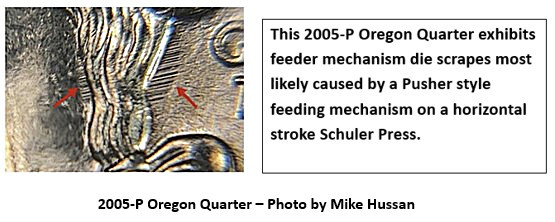
- Scrapes appear straight, not curved
- Length measures at least 1/3 of the coin’s diameter
- Orientation falls near 30°, 45°, or 60° (±10°)
Historical Context
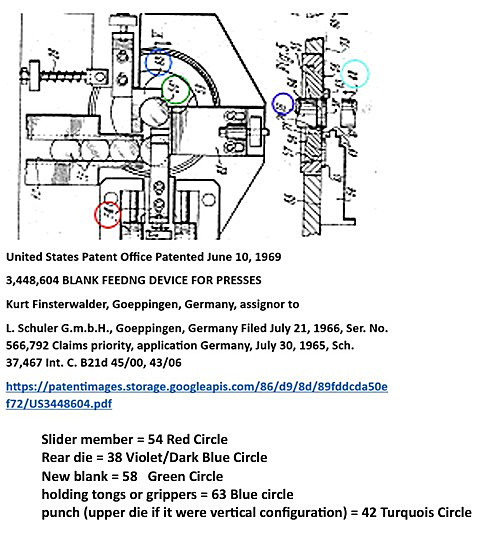
Schuler presses arrived at the Mint before October 1987 . These presses most likely used a pusher feeding mechanism, since Schuler did not apply for a dial feeder patent until 2018 [5].
The pusher mechanism itself dates back earlier. It received a patent on June 10, 1969 [6].
How the Damage Forms
Pusher feeders move in a straight line. Therefore, any contact with the die creates linear scrapes.
No arc appears.
Collector Insight
When long scrapes lack curvature, the evidence strongly supports a pusher feeder mechanism.

Pattern C (1990–2018): Short Scrapes and Transitional Uncertainty
Key Diagnostics
- Scrapes measure less than or equal to 1/3 of the coin’s diameter
- Orientation remains near 30°, 45°, or 60° (±10°)
- A Period of Transition
During the 1990s, the Mint replaced Bliss presses with Schuler presses.
Schuler presses arrived in Denver before October 1, 1987 [7]
At least 34 Schuler high-speed presses were ordered from 1990 through 1998.
Evidence suggests Bliss presses were largely replaced by 2000 and likely fully replaced by 2007 [8]
These Schuler presses most likely used pusher feeding mechanisms.
The Diagnostic Challenge
Short scrapes create ambiguity.
At this length, curvature becomes difficult to detect. Therefore, both dial feeders and pusher feeders remain possible causes.
Probability and Evidence
Despite this uncertainty, available data provides guidance.
Certificates of authenticity for retired dies show that Schuler presses (pusher feeders) appear significantly more often than Bliss and Gräbener presses (dial feeders). The ratio approaches three to one in updated records from 1998 to 2008 [9].
This trend suggests that, especially after 2001, pusher feeder mechanisms more likely caused die damage.
Collector Insight
Short scrapes require careful evaluation. However, historical evidence supports a higher probability of pusher feeder involvement.

Why This Matters to Collectors
Die damage preserves mechanical history.
Each scrape reflects a specific interaction between machine and die. More importantly, each pattern links to a particular feeder mechanism.
By understanding these patterns, collectors can:
- Identify the probable press type
- Distinguish between dial and pusher feeders
- Strengthen attributions with technical evidence
This knowledge transforms surface marks into meaningful data.
The Bigger Picture
Feeder mechanism damage follows engineering rules. It reflects machine design, wear, and operational change.
As Mint technology evolved, these patterns changed as well.
Today, collectors can read those changes directly from the coins.
In many cases, a single scrape reveals the machine behind the strike.
More Articles on Feader Mechanisims from Pete Apple
- Feeder Mechanisms and Die Damage Patterns (1896–1945)
- Feeder Mechanisms and Die Damage Patterns (1945–1990)
- Feeder Mechanism Die Damage Patterns (1990–2018)
- Feeder Mechanism Die Damage Patterns (2018 – Present)
Citations
[2] Annual Report of the Director of the United States Mint, 2000, page 29
[3] Annual Report of the Director of the Mint, 1990, page 25; US Mint email, Sept. 4, 2024
[4] Certificates of Authenticity for Retired U.S. Mint Dies, CoinWeek, Feb. 3, 2026
[5] Schuler Dial Feeder Patent, US Patent No. 11,292,286 B2
[6] Finsterwalder Patent, June 10, 1969, US Patent 3,448,604
[7] Coin World, Dec. 11, 2023 (Mike Diamond)
[8] Study of Feeder Mechanism Die Damage Patterns, page 25
[9] Certificate data comparison for Bliss, Gräbener, and Schuler presses


Fascinating article by Pete.
Thank you! It has been an interesting research project!
Nice informative series.
I appreciate your comment!
Would not have guessed that there are die varieties like this
I started noticing differences in patterns that varied with time periods and was led to explore in more detail. Ken Potter, editor and author of some popular books, like Strike it Rich with Pocket Change, lit the fire for me to follow up!