By Pete Apple
Why This Study Still Matters
Studying feeder mechanism die damage patterns from the early 20th century to the present creates real challenges. Researchers still lack complete, detailed information on press types and feeder mechanisms. In addition, mints often used several types simultaneously. Therefore, readers should treat the following examples as representative of the mechanism most likely responsible for a specific pattern of die damage.
Feeder mechanisms perform a precise job. They transport, align, and position coin planchets into the striking chamber of a coining press. Then they help eject the coin after striking. However, high-speed press operation creates stress. Wear, timing issues, part misalignments, and other mechanical failures can cause the mechanism to malfunction. When that happens, the mechanism can strike the dies, causing die damage.
In this article, I summarize findings from a broader exploratory study [1] of various coin presses, their feeder mechanisms, and the die damage patterns that each mechanism most likely produced.
I provide this summary to create a more streamlined path for identifying the probable feeder mechanism behind a specific die damage pattern. Since the early 1900s, eight primary patterns of feeder-mechanism die damage have emerged. This article covers the final pattern in that series.
Pattern 2018 to Present
PATTERN 2018 to present: DIE SCRAPES, ORIENTED HORIZONTALLY OR AT AN ANGLE of 30°, 45° or 60° (±10°)
From Pusher Feeders to Dial Feeders
In 1966, Schuler filed for a patent that covered a Pusher Feeding device for a horizontal stroke press. The patent was issued in 1969. [2] Most likely, that pusher-style mechanism operated on the Schuler presses first installed at the Mint.
Later, Schuler applied for a Dial Feeder patent in Germany in 2015 and in the United States in 2018. [3] On March 14, 2018, in the United States, a patent was Assigned to SCHULER PRESSEN GMBH and was Applied for in the US on that date by L Schuler GmbH. As often happened in industry, a company likely began production and distribution of a piece of equipment once it filed the patent application.
Evidence from feeder mechanism die damage patterns strongly suggests that Schuler Dial Feeders entered production at the United States Mint in 2018. [4]
What the Schuler Dial Feeder Shows
The photo below shows the Dial Feeder Mechanism on a horizontal stroke Schuler Press. The white ellipse at left identifies the mechanism. The stationary feeder fingers attached to the indexing plate also stand out clearly. Just as importantly, the setup shows how the mechanism rotates a planchet into the striking chamber.

The following description explains the process in direct terms:
“Here is the dial feed plate with the feeding fingers (the grey Y parts). Each feeding finger is housing a blank. When the punch is going backwards the diel feed plate is moving one step and feeds a blank in front of the collar. One die is fix on the bed side. The other die is movable and is connected to the punch (slide side). The punch is moving forward, pushes the blank into the coining collar and the coin is struck.
The fixed (almost fixed) die on the bed side is moving a bit forward and pushes the blank out of the coining collar back to the feeding finger. When the dial feed blade is moving to another step a new blank is getting into strike position and the struck coins are falling down from the feeding finger into a conveyor belt.” [5]
What Changed After 2018
The Schuler press changed the evidence we see on coin dies. Between 2000 and 2018, collectors began to see feeder-applied struck-through features from time to time when the feeder mechanism used a pusher style. Those features resulted from a gritty paste that the feeder or ejector applied to the die face. Then, after 2018, those same features appeared much more often with the Dial Feeder Mechanism.

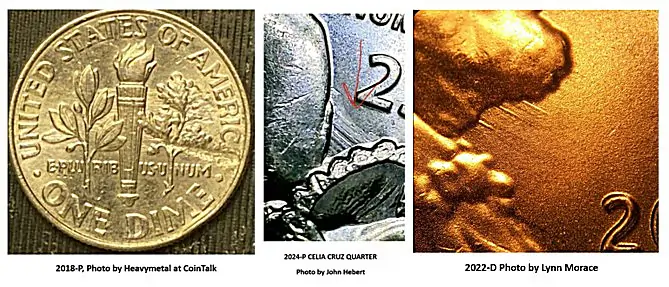
During this period, feeder mechanism die scrapes appear in several forms. However, many examples remain too short to prove with certainty that the dial feeder caused them. Even so, I have found no evidence that any other feeder type saw widespread use, or any use at all, after 2018. [6]
That point matters. It does not completely rule out the possible use of other press types after 2018. Still, the weight of the evidence points to the Schuler Dial Feeder as the dominant source behind this modern damage pattern.
The Key Takeaway
Collectors and error-variety specialists should pay close attention to horizontally oriented die scrapes and to scrapes that run at 30°, 45°, or 60° (±10°). Those marks fit the final major feeder mechanism die damage pattern in the long series that began in the early 1900s.
Moreover, the available evidence points to Schuler Dial Feeders at the U.S. Mint beginning in 2018. [4] As a result, this pattern offers an important diagnostic tool. It can help connect modern die damage to the feeder systems that likely produced it.
More Articles on Feader Mechanisims from Pete Apple
- Feeder Mechanisms and Die Damage Patterns (1896–1945)
- Feeder Mechanisms and Die Damage Patterns (1945–1990)
- Feeder Mechanism Die Damage Patterns (1990–2018)
- Feeder Mechanism Die Damage Patterns (2018 – Present)
CITATIONS
[1] A STUDY OF FEEDER MECHANISM DIE DAMAGE PATTERNS by Pete Apple, https://www.coincommunity.com/pdf/Study%20of%20Feeder%20Mechanism%20Die%20Damage%20Patterns.5.1.pdf
[2] Finsterwalder, Kurt, United States Patent Office Patented June 10, 1969, 3,448,604 BLANK FEEDNG DEVICE FOR PRESSES, Kurt Finsterwalder, Goeppingen, Germany, assignor to L. Schuler G.m.b.H., Goeppingen, Germany Filed July 21, 1966, Ser. No. 566,792 Claims priority, application Germany, July 30, 1965, Sch. 37,467 Int. C. B21d 45/00, 43/06 https://patentimages.storage.googleapis.com/86/d9/8d/89fddcda50ef72/US3448604.pdf
[3] TRANSPORT DEVICE FOR TRANSPORTING COIN BLANKS AND METHOD FOR PRODUCING A COIN, German application No. filed Sep. 16, 2015. No. 102015115647.4 United States Patent, Brechling et. al., Patent No.: 11,292,286 B2, Applicant: SCHULER PRESSEN GMBH, https://patents.google.com/patent/US11292286B2/en
[4] In a Census of Feeder Mechanism Die Damage Examples I maintain, a noticeable increase of examples of feeder-applied struck-through begins in 2018.
[5] Email from Andre Faust @ Schuler Group to John Miller, Marh 6, 2024, Faust, Andrew, Area Sales Manager, Schuler Pressen GmbH | Schuler Platz 1 | 73033 Göppingen | Germany.
[6] At least one Ferracute Press (Press number N012 in Philadelphia) was still in use in 1997, as were some Gräbener Presses and Cincinnati Milacron presses along with some unidentified press types through 2001 [9], so there may be the possibility of the use of other press types some 20 years later after 2018.