


As the United States shifted its industrial might to the war effort, the Federal Government closely evaluated its supply of strategic materials. Copper, which the Mint used for cents and alloyed with silver and gold for other denominations, was diverted to military use in 1943.
Likewise, the government redirected nickel, used to strike the Jefferson five-cent coin, in the spring of 1942, and it remained absent from coinage until the war ended in 1945. Manufacturers relied on nickel to build the P-51 Mustang and the B-29 Superfortress. In addition, its anti-corrosive properties made it ideal for constructing Navy ships and amphibious landing craft.
The Search for a Replacement Metal
As a result of these shortages, the United States Mint began searching for a replacement for nickel. However, this effort raised a familiar issue that had already surfaced during the transition from the Liberty Head Nickel to the Indian Head (Buffalo) Nickel: the new metal had to meet the needs of the vending machine industry.
Importantly, vending machines check not only a coin’s weight but also its electrical resistance. Therefore, any substitute for nickel in the five-cent coin needed to satisfy both requirements. Otherwise, tens of thousands of machines across the country would fail to recognize the new coins.
After several trials, metallurgists identified a suitable solution. They determined that an alloy of copper, silver, and manganese met both the weight and electrical specifications. Consequently, with the passage of the Act of March 27, 1942, Congress authorized the new “War Nickel” alloy.
Soon after, the Mint produced the first coins of this new composition in October of that year. As a result, five-cent coins entered circulation without their namesake metal, there was no nickel in the “nickel.” Notably, these wartime nickels marked the first use of silver in a five-cent denomination since the half dime was last minted in 1873.
How Can I Tell if I Have a War Nickel?
However, not every nickel struck in 1942 qualifies as a War Nickel.
Before Congress authorized the change on March 27, the Philadelphia and Denver Mints struck a combined 63,727,000 coins in the standard composition. After authorization, the Philadelphia Mint produced 57,873,000 wartime nickels for circulation, along with 27,600 Proof examples. Meanwhile, the Denver Mint did not strike additional nickels in 1942. In contrast, the San Francisco Mint produced 32,900,000 War Nickels after striking none earlier in the year.
To distinguish the new alloy coins from regular issues, the Mint introduced a clear visual marker. Specifically, it used oversized mintmarks.
Under normal circumstances, mintmarks for Denver and San Francisco appear as small letters positioned above the steps on the right side of Monticello, home of President and Founding Father Thomas Jefferson, on the reverse. In contrast, wartime nickels display a large mintmark above the dome of Monticello. Furthermore, to meet this requirement, the Mint used the “P” mintmark for Philadelphia coins for the first time.
After the war ended, the Mint resumed using the standard nickel composition. At the same time, it returned the “D” and “S” mintmarks to their original positions. Over time, approximately 870 million Jefferson War Nickels disappeared from circulation. In many cases, the public removed them, as often happens when “bad” money follows “good.” Eventually, collector interest in these unusual coins grew. Today, dealers frequently package and market sets of worn examples to beginning collectors.
Characteristics of the Jefferson War Nickel
Wartime nickels differ noticeably from standard Jefferson Nickels. For example, they typically appear brighter and often show stronger strikes. In addition, they tone similarly to 90% silver coins and sometimes display vivid iridescent colors. Collectors also frequently encounter examples with Full Steps details from this period.
However, not every coin meets high-quality standards. Because the wartime alloy did not always blend evenly, some coins exhibit lamination defects or irregular oxidation. Therefore, collectors building high-end registry sets should avoid coins with these impairments.
Jefferson War Nickel Varieties
Several collectible varieties exist. Notable examples include the 1943-P 3 Over 2, the 1943-P Doubled-Die Obverse, the 1943-P Doubled Eye, and the 1945-P Doubled-Die Reverse, along with other minor die variations.
In addition, the Mint produced several off-metal strikes. For instance, some 1942-P and 1943-P nickels were struck on copper-nickel planchets. Conversely, a few 1946 examples were struck on leftover silver-alloy blanks—a situation similar to the famous 1943 Bronze Cent.
Henning’s Folly

In the early 1950s, 1944 copper-nickel coins without the P mintmark were discovered in circulation, but these were determined to be counterfeits. CoinWeek contributing writer Tyler Rossi wrote an excellent piece on the Henning counterfeit 1944 nickels.
In-Depth Jefferson War Nickel Date Analysis by CoinWeek Notes
Design
Obverse:
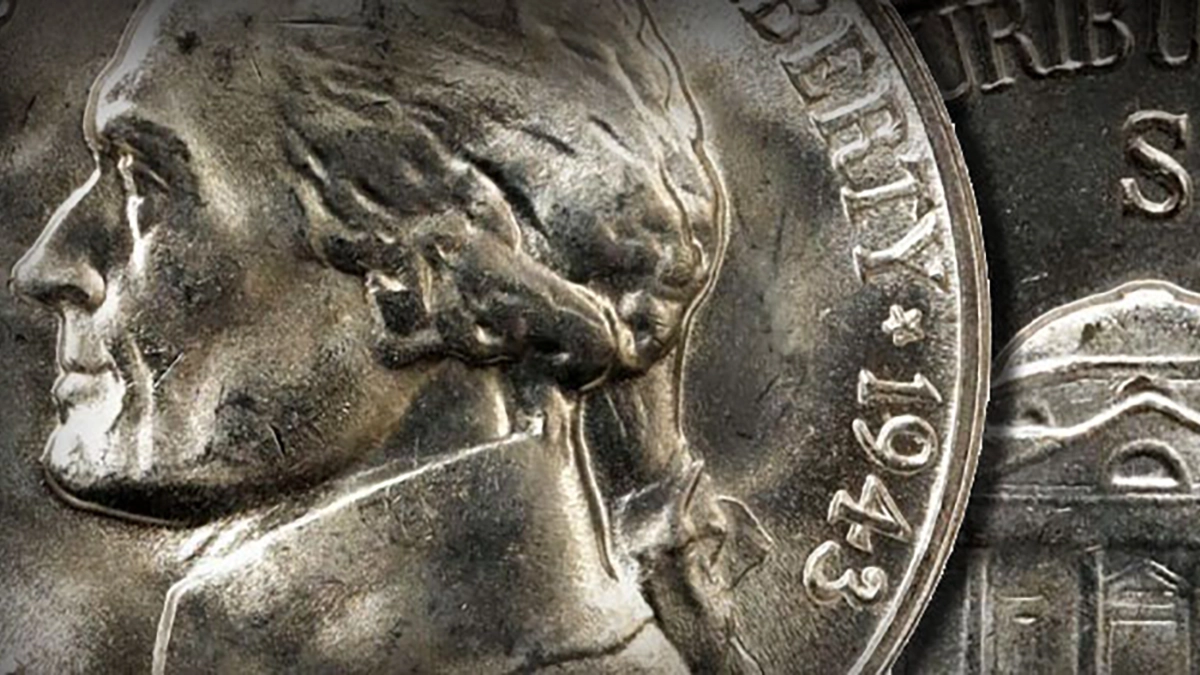
The obverse displays a left-facing portrait of President and Founding Father Thomas Jefferson, who wears a coat and a wig representative of the period. Inside a flat rim is the motto IN GOD WE TRUST to the left of the portrait, and the word LIBERTY and the date to the right, the last two separated by a small centered five-point star.
Reverse:
The reverse shows an elevation view of the front of Jefferson’s Virginia mansion Monticello, with the word MONTICELLO below. Around the smooth rim are the motto E PLURIBUS UNUM at the top and the legend UNITED STATES OF AMERICA at the bottom; The denomination FIVE CENTS in smaller letters forms a concentric arc above STATES OF and below MONTICELLO. Wartime nickels were minted in Philadelphia, San Francisco, and Denver; P, S, and D mintmarks are located above the building, below E PLURIBUS UNUM.
Edge:
The edge of all Jefferson War Nickels is plain or smooth, without reeding or edge lettering.
Designer
Felix Schlag was born in Frankfurt, Germany in 1891. After receiving an education at the Munich University of Fine Arts, he moved to the United States in 1929. Schlag died in 1974. Yet while he did win numerous art contests and commissions throughout much of the remainder of his life, the Jefferson Nickel was his only coin design.
Coin Specifications
- Coin Type: Jefferson War Nickel
- Years of Issue: 1942–1945
- Mintage (Circulation): High: 271,165,000 (1943-P) … Low: 15,294,000 (1943-D)
- Mintage (Proof): 27,600 (1942-P only)
- Alloy Composition: 56% copper, 35% silver, and 9% manganese
- Weight: 5.00 grams
- Diameter: 21.20 millimeters
- Edge: Plain
- Designer: Felix Schlag
Additional References
- Bowers, Q. David. The Experts Guide to Collecting and Investing in Rare Coins. Whitman Publishing.
- A Guide Book of Buffalo and Jefferson Nickels. Whitman Publishing.
- A Guide Book of United States Type Coins. Whitman Publishing.
- Breen, Walter. Walter Breen’s Encyclopedia of U.S. Coins. Doubleday.
- Guth, Ron, and Jeff Garrett. United States Coinage: A Study by Type. Whitman Publishing.
- Taxay, Don. The U.S. Mint and Coinage. Arco Publishing.
- Yeoman, R.S., and Jeff Garrett (editor). The Official Red Book: A Guide Book of United States Coins. Whitman Publishing.
* * *






The Jefferson War(Silver)PL Nickles were really-limited, Bein’certified thru NGC in (Proof-Like)Grade.(Pcgs never Certified these) I do have the 1945-S I’ve had for many years. NGC only has (1) in MS-65 of which I’m fortuate to own. I realize there were less than (10) of these Certified in this Grade,thru out the War Years (1942-1945).Has Anyone/Anybody been able to put a Value on such coins as these? Any help would be greatly appreciated.
PS: This coin is in my NGC Registry 1938 to Date/Category/JGB’s Jeff- Collection. You are welcome to visit,an give any comments.
Respectively’ Jim/jb4gpo/
I have a 1945 S wartime nickel in VF condition that I am very interested in selling. If you know any collectors that would be interested in buying would you please forward my email to them . I ask this because I’m in a very rural area and don’t make it to the bigger cities often enough to look them up .
Thank you for your time
I found a 1942 P nickel and I was wondering what it’s worth it’s got all the descriptions of the described in the World War II description and off the metal amative said was 56 percent copper 35 percent silver and 16 percent manganese I was just wondering if anyone to give me a price on It.
I believe I have a 1954P wartime nickel that’s made of copper. Any experts on here that could help me differentiate between the 2 ?
Thanks James
Do you mean 1945P?
I have a 1943 P nickel and I was wondering what it’s worth
I have whist I believe to be a rare 1943 P non-silver war nickel. The coin weighs 5.00 grams. I did a specific gravity test using my coin scale and a plastic cup filled with water. Placed the cup containing the water on the scale then pressed the tare weight button on the scale which zeroed it out. With the nickel tied to a sewing thread I submerged the nickel in the water which produced a weight of .55 grams. I then divided 5.00 grams by .55 grams which gave me a density reading of 8.92 which is the density of copper/nickel. Silver density is 9.25. Now does anyone out there know how I can find out the metal content to be sure that it is copper/nickel and not silver?
I have what I believe to be a rare 1943 P non-silver war nickel. The coin weighs 5.00 grams. I did a specific gravity test using my coin scale and a plastic cup filled with water. Placed the cup containing the water on the scale then pressed the tare weight button on the scale which zeroed it out. With the nickel tied to a sewing thread I submerged the nickel in the water which produced a weight of .55 grams. I then divided 5.00 grams by .55 grams which gave me a density reading of 8.92 which is the density of copper/nickel. Silver density is 9.25. Now does anyone out there know how I can find out the metal content to be sure that it is copper/nickel and not silver?
I have a 1945 P nickel that weighs 4.6- 4.7 no more. All info i find sayys it should wegh 5g. Any info on this is greatly appreciated!! Is it an error ? And price value?
Does Breen or anyone else list a 1943 P over inverted P mint mark?
I’ve got 1 of them and 18th century Morgan silver dollar one with the mistake and 72 silver dollar 72 half dollar
@Michael James Ingram Because war nickels contain 1.75 grams of silver, in average condition the majority of them are pretty much worth only their melt value.
Without a LOT more information about the Morgan dollar it’s not possible to say anything beyond its melt value. Morgans were struck for almost three decades (in the 19th and 20th centuries rather than the 18th) and at five different mints. You need to specify its date, how worn it is, and what mint mark if any is above the DO in DOLLAR on the reverse side. You also need to be specific about what you suspect to be an error on one of the coins.
Finally, if by “72” you mean 1972, your half dollar is made of cupronickel like quarters and dimes, and is only worth face value. Likewise, unless your $1 coin is a 40% silver issue or a proof version, it’s unlikely to bring more than $1.50 at retail.
I found a 1943 P while searching rolls I plan on searching for more although they’re few and far between.