

By Pete Apple
Something vanished from the United States Mint sometime between 2008 and 2022. No announcement followed. Even more striking, no one seems to have noticed.
CHARGES FILED
The charge is simple but serious. The Master Hub may have quietly disappeared from the die-making process without notice. As a result, numismatists may have attributed Master Die Doubled varieties to a process that may no longer exist.
SETTING THE SCENE
By 2008, the Mint used the freeform 3D modeling system by Sensable Technologies, Inc. to design some of its most recent coins. At the same time, the computer numerical control (CNC) digital engraver cut hub manufacturing time to under 24 hours. [1] Clearly, the die-making process was changing fast, and not everyone was keeping up.
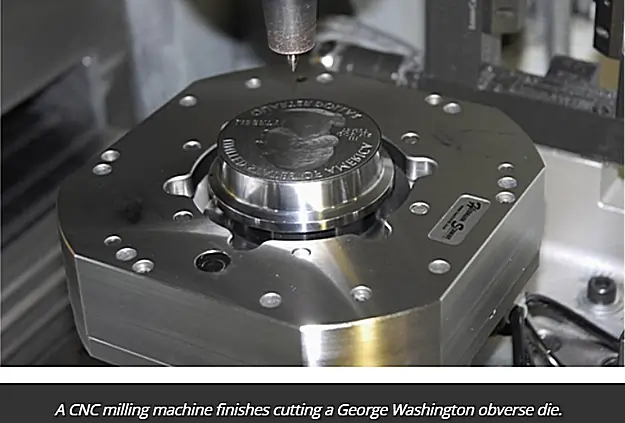
An article from 2016 includes a photo of a CNC milling machine. America the Beautiful 5-ounce silver coins were struck by dies engraved by this machine. No hubs, whether Master or Working, were used in the die-making process for these coins because 3-inch-wide dies were too large to hub. [2]
THE FIRST CLUE
The first clue comes from the Mint’s own 2024 Biennial Report. In its discussion of hubbing technology, the report does not mention Master Hubs. Instead, it focuses on PVD coatings of Working Hubs. [3] Perhaps the report had no reason to mention Master Hubs at that point. In fact, Mint Reports rarely mention them. The last reference before 2008 appears in 1974. Still, the silence of an official document can sometimes say as much as direct testimony.
A detailed series of articles on equipment and procedures at the Philadelphia Mint [4.3] gives exhaustive detail on die making and coin production. The articles describe the specific CNC machine in use: a Mikron HSM 300 MoldMaster. This machine used a BLUM laser system for tool measurement and a water-cooled high-frequency spindle as the cutting instrument. It cut hubs and dies. It also created resin templates for Mint artists who sculpt in clay.
Yet despite that level of detail, one omission stands out. The articles mention a Master Hub, but they provide virtually no detail about its creation or use. In contrast, they describe nearly every other step in die making and coin production in depth.
“These Are Not Masters”
One article even includes a photo of a working hub and die with the notation “These are not masters.” That line feels telling, as if even the author recognized the gap. When a witness volunteers what something is not, the obvious question becomes why the disclaimer was necessary.
The court also notes that sources asserting the continued use of Master Hubs in recent years may rely on little more than “Mint Lore.” In other words, they may repeat the same story year after year out of habit and familiarity, with one source echoing another and no one verifying whether the practice remains current. [4]
In a court of law, uncorroborated hearsay is inadmissible. So the question before us is whether numismatic tradition deserves a higher standard.
MASTER HUB/DIE DOUBLING AS A WITNESS
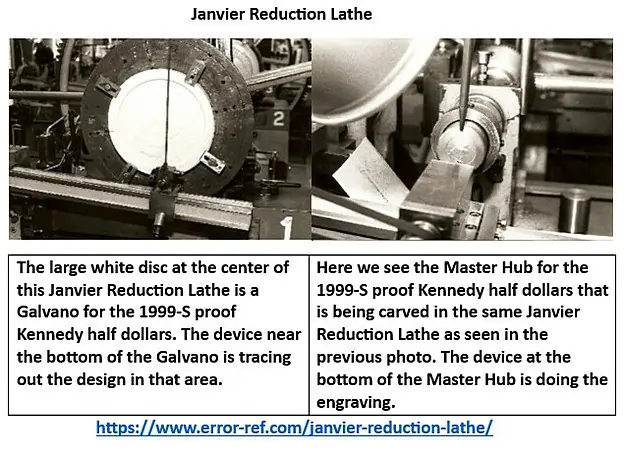
In the past, numerous instances [5] of Master Hub Doubling (MHD) appeared on Wheat Cents. These cases pointed directly to movement of the stylus needle on a Janvier Reduction Lathe. Therefore, they confirmed the involvement of a Master Hub.
Since hub doubling on a Master Die (MDD) should also confirm the involvement of a Master Hub, what do expert witnesses say?
Expert witnesses use different approaches when they attribute whether an example is MHD/MDD or Working Hub Doubling (WHD).
Some focus mainly on the number of different doubling examples identified. In that view, more examples make MHD/MDD more likely.
Others focus mainly on appearance. WHD resembles Strike Doubling because it looks flat and “shelf-like.” MHD, by contrast, resembles Hub Doubling because it looks raised and rounded. Then, secondarily, they consider the number of examples identified.
Some of these attributors recognize the inexact nature of these methods. They especially recognize the limits created by the number of examples available to them.
Even so, the methodology behind this testimony does not conclusively confirm the existence of a Master Hub, especially for the years after CNC technology arrived. So what does the evidence tell us?
EVIDENCE FROM MASTER DIE DOUBLING EXAMPLES
Only a few primary years, 2019, 2022, and 2023, show attributed MDD since the beginning of CNC technology. Even there, questions remain. As discussed in the witness testimony above, the 2022 and 2023 examples may instead reflect Working Hub Doubling (WHD), CNC irregularities, die dents, or something similar. [6]
Since the 2019 Cent MDD attribution stands as the sole unchallenged example since 2008, another possibility arises. Other recent doubling examples attributed as MHD/MDD may actually represent something else. If so, the use of a Master Hub may have gradually faded out since the beginning of CNC use.
EVIDENCE FROM 2022 DOUBLING
Why did hub doubling varieties explode in 2022? [8]
With the arrival of CNC, the Mint pursued coin-design optimization in earnest. It aimed to prolong die life through failure mapping, characterization, design modification techniques, changes to die curvature, and lower design relief. CNC programming handled a large portion of these adjustments. [7]
Observers have noted that the explosion of hub doubling varieties in 2022 may relate to experiments with die curvature that affected how a die slips and creates doubled dies during the hubbing process. [8] However, that type of die slippage would not explain the simultaneous increase in Master Die Doubling because working dies play no role in creating a master die.
We do know that the Mint worked to incorporate effective testing results into circulating coinage production. In the 2018 Biennial Report to Congress, the Mint stated: [9] “Specifically, matching planchet upset and die curvatures will reduce coining pressures around the coin edge…[called] ‘matched system’ … Once completed, these refinements can be incorporated into the standard 5-cent design and testing undertaken to transition the approach to other denominations.”
So another explanation becomes possible. Incremental design optimization, applied through fine adjustments to CNC programming, may have influenced the appearance of transitional features and anomalies. In turn, observers may have mistaken those features for Master Die Hub Doubling, or doubling assumed to originate from a Master Hub.
Was the Master Hub gradually phased out? What does the documentary evidence say?
INTRODUCING EXHIBITS OF DOCUMENTARY EVIDENCE
A study commissioned by the Mint may provide the most important clue of all. The 2012 Alternative Metals Study reports the tooling progression for making a coin with this caption: “Arranged from left to right are the master hub, the master die, a working hub, a working die and a coin.” [10]
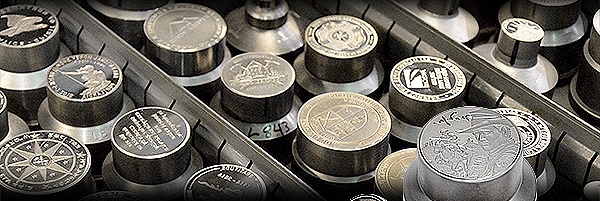
The same study then draws a clear distinction between the old process and the current one. The old process involved “the evolution of artistic design details from digital maps through machining the master hub.”
The current process, as of 2012, is described as follows: “Currently, all coin designs are modeled and digitized, or produced digitally. Master Dies (emphasis mine) are prepared on digitally controlled milling machines at the Philadelphia facility.” [10]
That study appears to draw a quiet but firm line between what was and what is. And in that distinction, the Master Hub seems to stand on the wrong side of the line.
AN ALTERNATE PERPETRATOR IS IMPLICATED
The prosecution has assumed that Master Hubs are still used in the die-making process. However, the evidence pushes us to consider an alternate perpetrator of master die doubling.
Could the explosion of hub doubling varieties in 2022, attributed as MDD from the hubbing process, instead come from an entirely different suspect? The evidence invites a new charge.
Perhaps we are not seeing Hub Doubling of a Master Die at all. Instead, perhaps we are seeing a type of “Master Die Doubling” that arises from the CNC milling process itself. Let the record show this as CNC DOUBLING (CNCD).
The CNC milling process had both means and opportunity. Tool deflection [11] is a well-documented operational issue. In addition, spindle misalignment, chatter vibration, work-holding instability, and tool wear can all cause the cutting tool to deviate from its intended path.
Any of those conditions, if they occurred at a specific moment and location during the cutting of a Master Die, could leave behind exactly the kind of localized outline variation that witnesses have attributed as MDD.
The jury is still out. Even so, the record shows one more motive. If the die-making process no longer uses Master Hubs, then the cost savings would be significant. That result would directly address the cost reduction mandated by The Coin Modernization, Oversight, and Continuity Act of 2010. [12]
THE COURT NOTES ONE FINAL EXHIBIT
The 2008 Mint Director’s Report reveals that CNC milling was already producing single or multiple hubs [13], and that detail may be the most telling clue of all. The traditional Master Hub drew its value from a single, carefully preserved object that maintained design integrity through minimal use. [14]
But if CNC milling could reproduce that same design accurately on demand, and in multiples, then the machine had already assumed the Master Hub’s most essential function. The evidence suggests that 2008 may mark not only the beginning of CNC technology at the Mint, but also the beginning of the end for the Master Hub itself.
A FLAW IN THE PROSECUTION’S CASE
The court identifies a critical gap in the methodology used to attribute Master Hub Doubling and Master Die Doubling. The prosecution has moved forward on the unchallenged assumption that only a single Master Hub and/or Master Die exists for each design. Yet the exhibit just entered into evidence directly contradicts that assumption.
If multiple Master Hubs or Master Dies of a single design were produced, then the entire framework for distinguishing MHD/MDD from Working Hub Doubling by counting examples comes into question. Clearly, the methodology needs reexamination.
SURPRISE WITNESSES COME FORWARD
At this point in the proceedings, two confidential witnesses step forward. The court protects their identities. The first was present during the testing of the Martha Washington Nonsense Dies in 2012. The second is currently involved in Mint operations.
Both testified, with a high degree of certainty though not absolute certainty, that current die making begins with the Master Die produced via CNC 3D technology, that Working Hubs still hub all dies, and that hubbing is now 100% single hubbing.
The court recognizes that confidential testimony, while compelling, cannot be independently verified.
COURT IS ADJOURNED PENDING NEW EVIDENCE
The case remains open. The jury is still deliberating. And somewhere in Philadelphia, the Master Hub may be hiding in plain sight,or it may simply be gone. Additional witnesses are invited to come forward!
CITATIONS
[2] How the U.S. Mint makes its 3-inch-wide dies, By Paul Gilkes, Published: Nov 11, 2016, 5 AM, COIN WORLD, https://www.coinworld.com/news/us-coins/mint-eliminates-step-in-3-inch-die- production.html (Photo shown with permission).
[3] 2024 Biennial Report to Congress as Required by the Coin Modernization, Oversight, and Continuity Act of 2010, (Public Law 111-302), United States Mint, Department of the Treasury 2024, Pages 8 & 28. In fact, a Master Hub reference in any Director’s Report is uncommon. While an argument from silence (argumentum ex silentio) is often considered a logical fallacy, it is nevertheless mentioned as being suggestive. Before 2008, the only apparent reference to a Master Hub (without identifying by that name) was in 1974. Page 43, Mint Directors Report 1974.
[4.1] RE: sources that appear to rely on ‘Mint Lore’ without independent verification: “Before a coin can be struck, the U.S. Mint needs to make dies” by Paul Gilkes, Coin World, August 2021, Pages 18,20. Die Making at the U.S. Mint, by Stephanie Meredith with help from the staff of the Denver and Philadelphia Mints, April 2021. https://www.usmint.gov/learn/production-process/die-making#
[4.2] RE: general overview video — sources that appear to rely on ‘Mint Lore’ without independent verification: How COINS Are Made, by Factora https://www.youtube.com/watch?v=9R-YGPT-OuE
[4.3] RE: …“articles on equipment and procedures at the Philadelphia Mint”: How the Philadelphia Mint Makes Hubs and Dies to Produce Coins, By Darrin Lee Unser – September 13, 2013, COINNEWS https://www.coinnews.net/2013/09/13/how-the-philadelphia-mint-makes-hubs-and-dies-to- produce-coins/ Detailed capabilities of the Mikron HSM 300 MoldMaster are generally available with an internet search and are not mentioned in this article.
More Citations
[5] RE: Master Hub Doubling on Wheat Cents via Janvier Reduction Lathe: https://doubleddie.com/58285.html; https://www.error-ref.com/reduction-lathe-doubling/; https://www.lincolncentforum.com/the-non-hub-doubling-resource-page/
[6] RE: Attributed MDD examples since CNC technology: 2019 1¢ WMDO-001 https://doubleddie.com/2474337.html 2022-P 25¢ MA WMDO-001 & 2022-P 25¢ MA WMDR-001 https://www.doubleddie.com/2680879.html? 2023 5¢ Doubled Master Die https://www2.briansvarietycoins.com/listings/view/1869?
[7] 2022 Biennial Report to the Congress as required by The Coin Modernization, Oversight, and Continuity Act of 2010 (Public Law 111-302) United States Mint, Department of the Treasury, 2022, Pages 12-13
[8] American Women Quarters Doubling Study by Tanner Scott, http://crdievarieties.com/doku.php?id=awqstudy
[9] 2018 Biennial Report to the Congress as required by The Coin Modernization, Oversight, and Continuity Act of 2010 (Public Law 111-302), Page 7.
[10] ALTERNATIVE METALS STUDY, Contract Number: TM-HQ-11-C-0049, FINAL REPORT, August 31, 2012, Submitted to: United States Mint, Pages 300-301.
[11] RE: tool deflection as a well-documented operational issue in CNC milling: https://www.cnccookbook.com/afraid-tool-deflection/ https://www.datron.com/resources/blog/tool-deflection-in-cnc-machining/ See the following resource on curved surface machining which is directly analogous to coin die engraving (note the extensive references for further research): Analysis of the Effect of Machining Parameters on the Cutting Tool Deflection in Curved Surface Machining, by Leleń, Michat & Zawada-Michałowska, Magdalena & Pieśko, Pawet & Biruk-Urban, Katarzyna & Józwik, Jerzy & Korpysa, Jarosław & Anasiewicz, Kamil & Habrat, Witold & Lisowicz, Joanna. (2025), Applied Sciences. 15. 11013. 10.3390/app152011013. https://www.researchgate.net/figure/Effect-of-tool-deflection-in-milling-a-machining-conducted- with-an-end-mill-and-its_fig5_396566520
[12] COIN MODERNIZATION, OVERSIGHT, AND CONTINUITY ACT OF 2010, 124 STAT. 3272, PUBLIC LAW 111–302—DEC. 14, 2010.
[13] 2008 Mint Director’s Report, op., cit., page 21.
[14] “The original hub is carefully stored to insure against loss of the original reduction.” 1974 Mint Director’s Report, op., cit., page 43.



Excellent research, we’ll documented. Thanks!
Thank you!
The Mint is now moving beyond CNC milled Master Dies to Laser Engraved Master Dies. The 2024 American Liberty silver medals and the 2025 American Liberty gold coins (resurrecting the 1794-dollar designs) are the first to incorporate this technology. The 2025 Laser Engraved American Eagle One Ounce Silver Proof Coin is the first American Eagle Silver Proof Coin (with a laser-engraved privy mark) minted using laser-engraved master dies.
Very interesting!
Thank you! I find it interesting that the continued use of a Master Hub is assumed in numerous discussions.