


Dr. Steve Benner for CoinWeek …..
Introduction
Triumphal arches are a uniquely Roman architectural concept. There were no precedents for this type of arch in the Greek world or the Far East. The Romans acquired the idea of the arch (“fornix” for oven) from the Etruscans but perfected it with the use of concrete and formwork. It may have originated from the Etruscan practice of the sub-jugum (“under the yoke”), which was a rectangular arch of spears that defeated soldiers were forced to walk under. Wherever the idea came from, the Romans embraced it. They used it in their aqueducts, buildings, gates, etc. To them, it represented Rome’s might and power.
The triumphal arch came into use in the 3rd century BCE. The earliest examples were probably built in conjunction with triumphal processions by victorious generals (hence the name) and may have been temporary (wooden?). They could also be created by placing statues on top of aqueducts (see Figures 2b and 3d). Around 196 BCE, freestanding arches were erected in the Forum Boarium and on the spina of the Circus Maximus by the proconsul of Spain, L. Stertinius. Three more are known to have been built: one for Scipio Africanus in 190 BCE, one for the conquest of Corinth in 146 BCE, and the Fornix Fabius by Quintus Fabius Maximus Allobrogicus in 121 BCE. It is not recorded what these were made of, and there are no remains to confirm their construction. When Augustus became Emperor in 27 BCE, the building of triumphal arches increased dramatically.
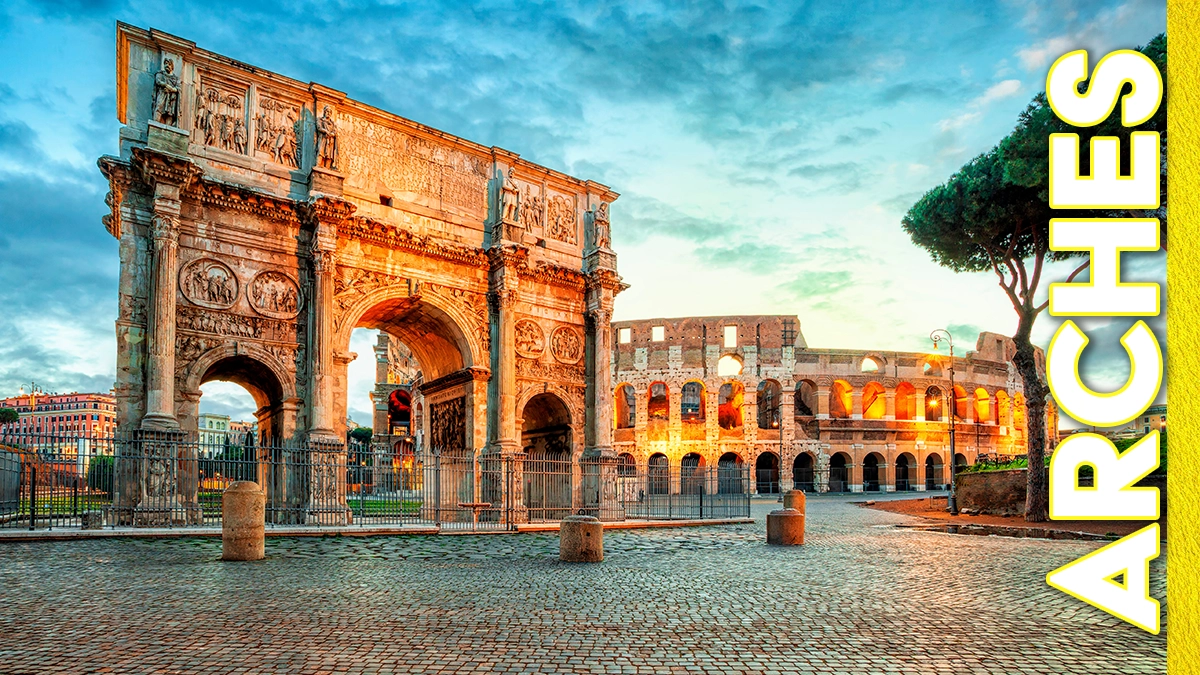
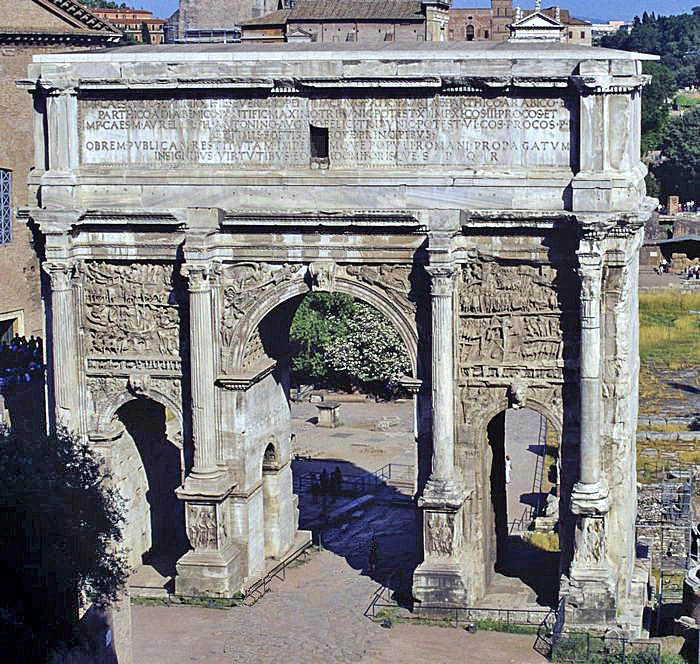
An arch could be one of several types: single, double, triple, or quadruple (quadrifrons). The last type had an arch facing in each direction and was usually placed at road intersections. They were typically 50 to 80 meters high and adorned with columns, statues, reliefs, and a quadriga on top. A description of the honoree or builder was included in the inscription on the entablature at the top (Figure 1). The reliefs consisted of battle scenes, prisoners, winged victories, gods, etc. Niches along the sides held statues of gods or people. Arches could be built not only for military victories but also for civic accomplishments. The Senate authorized the building of numerous arches in Augustus’ honor, both in Rome and in the provinces, and most emperors built them if they managed to stay alive long enough to do so. There were at least 36 arches built in Rome during its long history, but only three main ones are still extant: the Arch of Titus, the Arch of Septimius Severus (Figure 1), and the Arch of Constantine. The latter was built using parts from other emperors’ structures (Marcus Aurelius’, Trajan’s, and Domitian’s). Since most of the triumphal arches in Rome are now gone, coins have been crucial for understanding what these lost structures looked like.
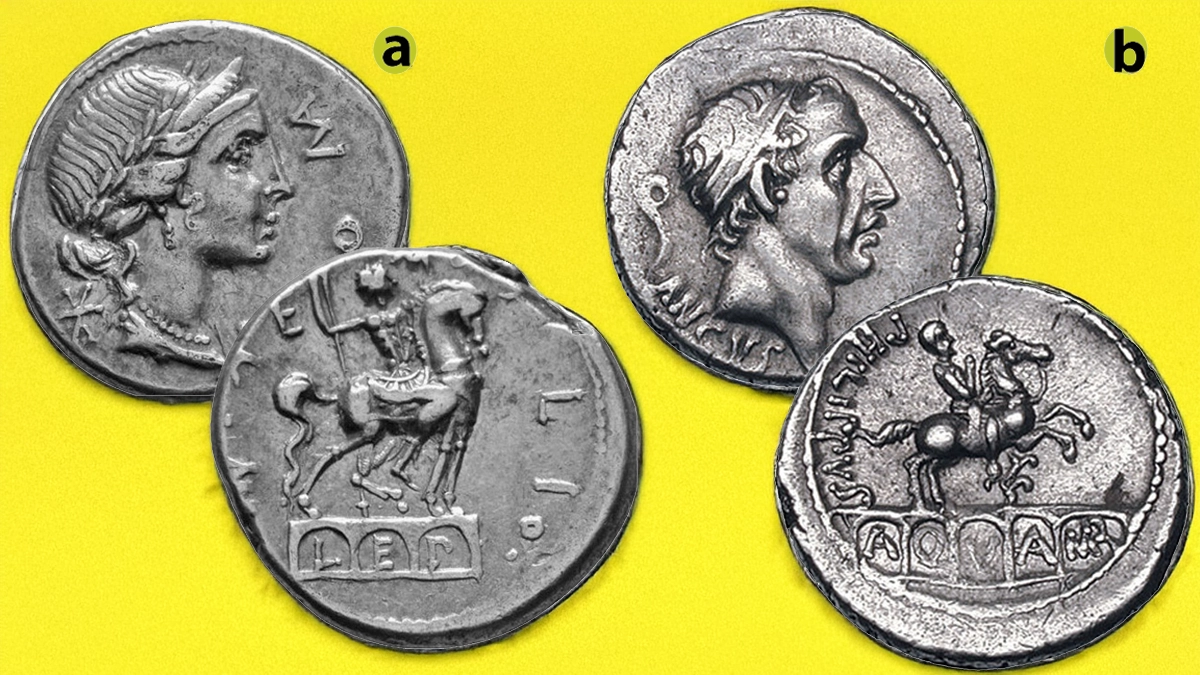
As mentioned above, triumphal arches had their origins in the 3rd century BCE but didn’t catch on as a popular type of monument until the Principate. Figure 2a shows a denarius minted by Manius Aemilius Lepidus in 114-113 BCE with Roma on the obverse and a triumphal arch on the reverse. The legend on the obverse is ROMA, and the reverse shows Lepidus’ name with LEP within the arches. What the arch refers to is not known; it could have been one erected by Lepidus for some civic or military accomplishment, or it could have been an existing arch. There seem to be many such denarii in the sources. The second denarius (see Figure 2b) was issued by Marcius Philippus around 56 BCE and features King Ancus Marcius (the fourth king of Rome) on the obverse and an equestrian statue on an aqueduct on the reverse. Within the arches is the lettering A Q V A MAR (“water Marcius”). The aqueduct was supervised and partially funded by the Praefectus Quintus Marcius in 144-140 BCE (?). This is an example of creating a triumphal arch from an existing aqueduct, as mentioned above. I assume that this coin was made by the moneyer Philippus to honor his ancestors.
Augustus
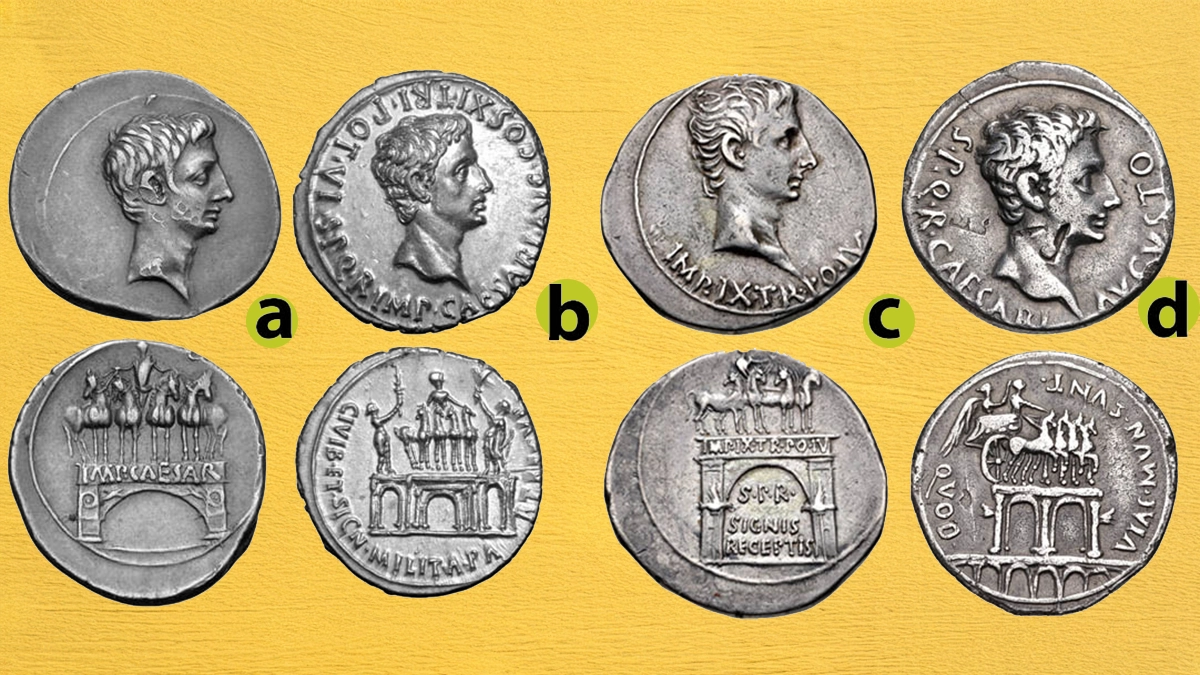
The building of triumphal arches went into high gear when Augustus became Emperor (“first citizen”). During his 40-year reign, the Senate and principalities authorized the building of these arches not only in Rome but throughout the Empire. One of the first ones built by Augustus (Octavian at the time) was in 30-29 BCE (Figure 3a) to celebrate his victory at Actium over Mark Antony and Cleopatra. It has a single arch with IMP CAESAR on the architrave. However, this monument was not popular because, even though Octavian claimed it was for the victory over Cleopatra, the Roman public knew it was for the defeat of a fellow Roman, Mark Antony. So, in 20 BCE, the Senate authorized Octavian to build an arch to commemorate the return of the standards taken by Parthia (losing an aquila or signum was a disgrace to a unit). The Actium arch was reworked to add two new arches with statues on top: one holding a standard and the other holding an aquila and bow (some versions have an archer on the left and a slinger on the right) (see Figure 3b). The inscription was changed to CIVIB ET SIGN MILITA PART RECVPE (“citizens and military ensigns recovered from the Parthians”). This arch spanned the road between the Temple of Castor and Pollux and the Temple of Caesar. This particular coin type was minted in both gold and silver. Figure 3c shows another version of the Parthian arch on a cistophorus minted by Pergamum, which has only one arch and IMP V TR POT IV in the entablature and SPR / SIGNIS / RECPTIS under the arch. Figure 3d shows a denarius that commemorates Augustus’ extensive work to repair and improve the network of roads used to control the Roman Empire. The reverse has the legend QVOD VIAE MVN SVNT (“because the roads have been repaired”). It features the arch atop what appears to be an aqueduct, as mentioned above. Augustus later decreed that triumphs and triumphal honors were to be confined to members of the Imperial family.
Drusus
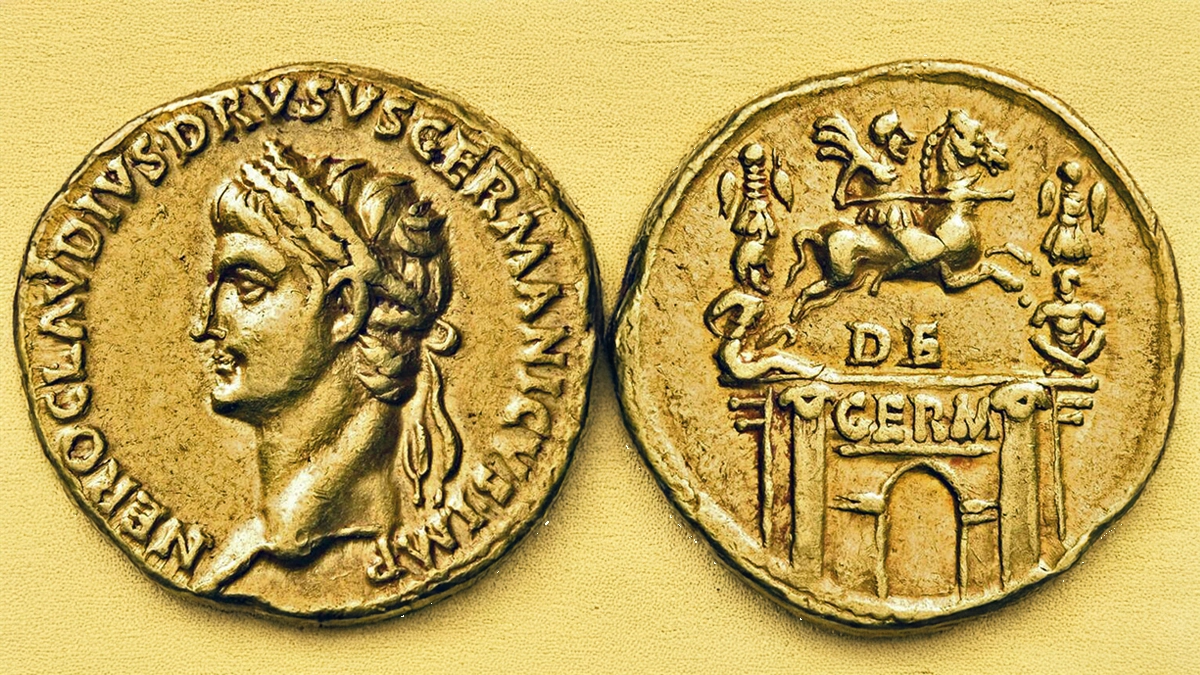
Figure 4 shows an aureus with the triumphal arch of Nero Claudius Drusus on its reverse. Drusus was the brother of Claudius and father of Germanicus. The arch commemorated Drusus’ victories over the Germans. An equestrian statue of Drusus is on top of the arch, and a military trophy and bound captive are to the left and right of the horse. DE GERM is on the architrave. The arch was built soon after his death in 9 BCE and was located on the Appian Way. Later, Claudius minted many sestertii with his portrait on the obverse and Drusus’ arch on the reverse (see Figure 5).
Claudius
There seems to be no mention of triumphal arches for either Tiberius or Caligula, though the former ruled long enough to have one built. As mentioned, Claudius minted sestertii with the Drusus arch on the reverse (see Figure 5a); some incorrectly believe this arch is for Claudius because his portrait is on the obverse (he didn’t fight in Germany). The Senate did authorize the building of two arches for Claudius to celebrate his conquest of Britain: one in Rome and one in Gaul, both of which are no longer extant. The one in Rome was built by converting one of the arches of the Aqua Virgo aqueduct, where it crossed the Via Flaminia, into a triumphal arch (Figure 5b). [Note that this photo is not to scale; the aureus is much smaller than the sestertius.] The structure has one arch with an equestrian statue of Claudius on top and trophies to the left and right. The legend DE BRITANN is inscribed on the architrave. Fragments of the dedication have survived. It reads in part: “… because he received into surrender eleven kings of the Britons conquered without loss and he first brought the barbarian peoples across the Ocean under the authority of the Roman people.”
![Figure 5: Claudius, 41-54. a) Sestertius (33.06 g), Rome, circa 41-50. Laureate head of Claudius to right. Reverse: The Arch of Nero Claudius Drusus consisting of a single arch with four columns and surmounted by statue of Nero Claudius Drusus on horseback, RIC 98; b) [Not to scale] AV Aureus (7.72 g.). Rome mint. Struck CE 46-47. Laureate head right. Reverse: Equestrian statue left on triumphal arch, trophies to left and right. RIC 33.](webp/fig_5_claudius.webp)
Nero
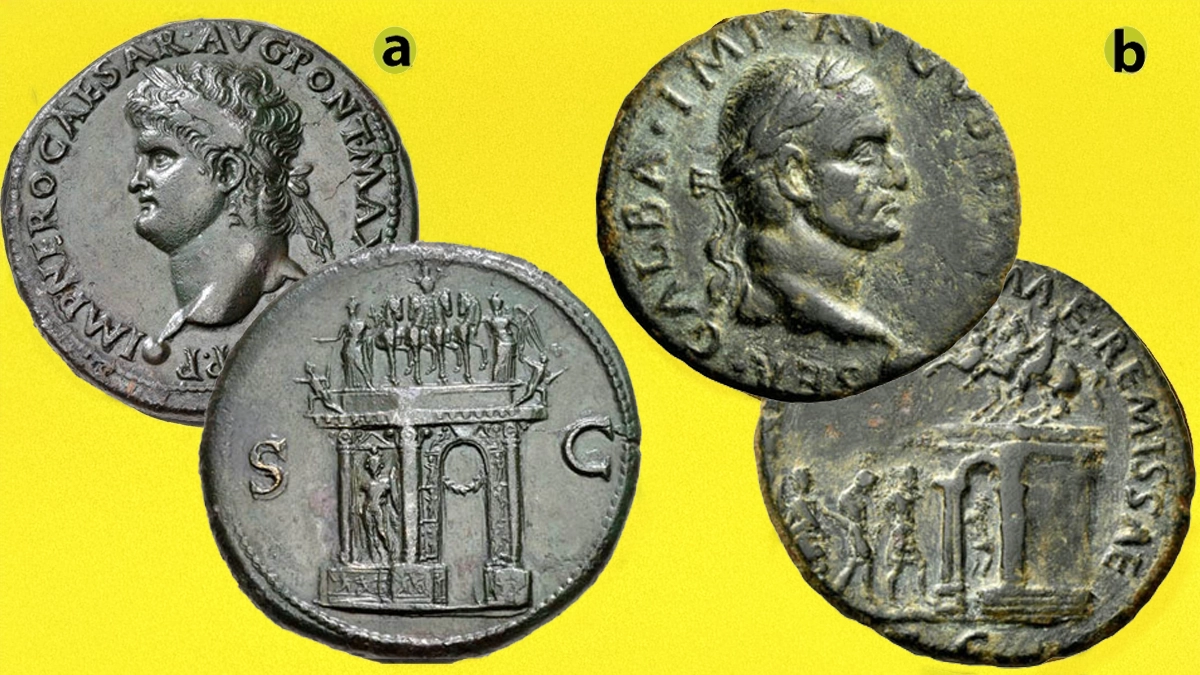
The Senate authorized the building of a triumphal arch for Nero on the Capitoline Hill in front of the Temple of Jupiter Capitolinus in 63 CE. He built this to commemorate his “victory” over Parthia, which was not a military victory but a political one. We have a good idea of what the arch looked like because Nero minted many attractive sestertii with the arch on the reverse (Figure 6a). It was a single arch with a statue of Mars in a side niche and was elaborately decorated. Nero in a quadriga was on top. Some say the horses ended up over St. Mark’s in Venice, though others dispute this. The arch was dismantled soon after Nero’s reign ended, and the artwork was used elsewhere.
Galba
No triumphal arches were built for Galba, probably because he didn’t have any victories worthy of an arch, and his rule was only nine months long. But he did put some examples on his coins. Figure 6b shows an AE as with prisoners walking under a triumphal arch, followed by a Roman soldier (sub-jugum). It is probably the Arc de Barà near Tarragona, Spain. The legend on the reverse is QVA DRAGENSVMAE REMISSAE (“the fortieth is remitted”) and refers to the remission of a tax, which is strange for a triumphal arch. He also minted a denarius with an elaborate arch and the legend AUGUSTUS on the reverse, and another AE as with a triumphal arch similar to the Arc de Barà.
Domitian
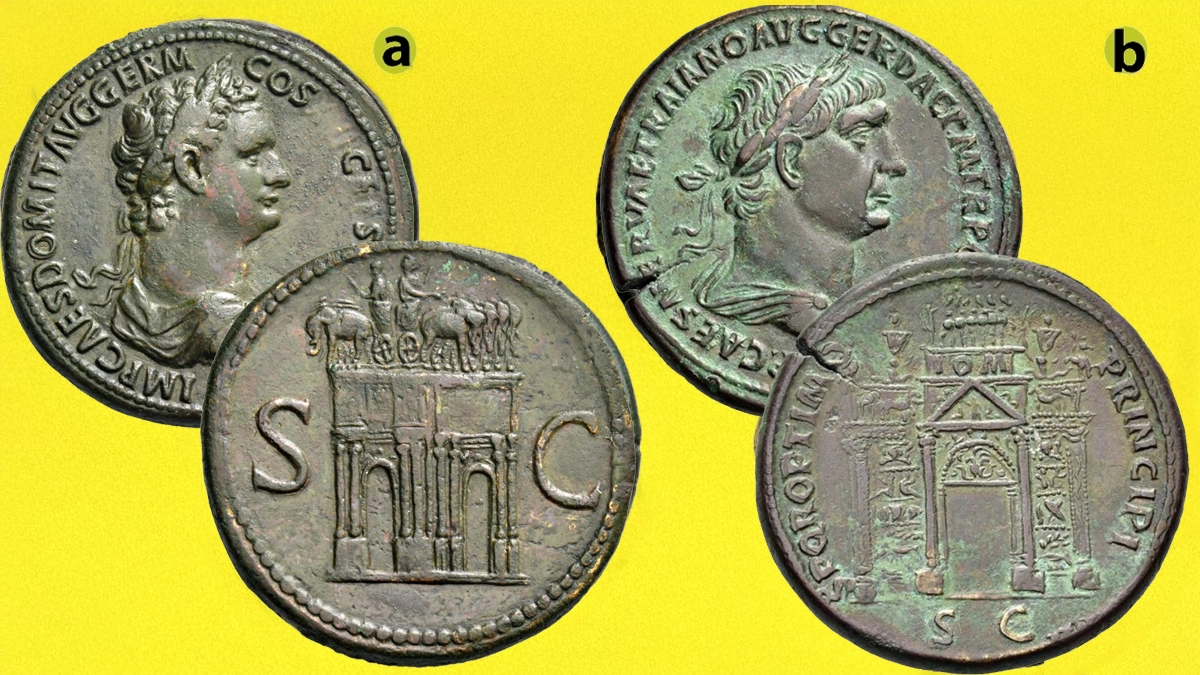
Domitian was the son of Vespasian and brother of Titus and succeeded his brother upon his death in 81 CE. His father and brother had many triumphal arches erected, especially to their victory over Judea (Titus’ arch is still extant), but they did not put them on their coins. Domitian was different and did put them on his coins. Figure 7a shows a sestertius with Domitian’s quadrifrons on the reverse. The arch was built in 85 CE and commemorated both Domitian’s victory over the Germans and his fifteenth anniversary as emperor. It has panels with elaborate sculpted friezes and two bigae of elephants surmounting the arch. The arch’s location is believed to have been at the intersection of the Via Flaminia and Pallacinae. Suetonius stated that the emperor erected so many arches in Rome that a Greek punster wrote on one of them, “enough.”
Trajan
By the time he became emperor in 98 CE, Trajan had a number of military victories against the Germans. One of his earliest arches is shown in Figure 7b, which was built in Rome sometime before 103 CE (Trajan’s fifth anniversary). It was probably celebrating Trajan’s victories in Germany since it seems too early for his victories in the Dacian Wars (101-106 CE) and Parthian War (115-117 CE) to have been included. The arch was very elaborate, the architect having thrown everything he could think of into the design. The roof’s entablature was inscribed with IOM (“Iove Optimus Maximus”). As a result of his victories in Dacia and Parthia, he had several triumphal arches constructed, not only in Rome but also in the provinces. In Benevento, Italy, there is a Trajan arch, built between 114 and 117 CE, that is in excellent condition and has depictions of these later victories. Trajan also minted several denarii and aurei coins with a reverse showing the Arcus Traiani (entrance to the Forum Traiani), which looks very much like a large triumphal arch.
Septimius Severus
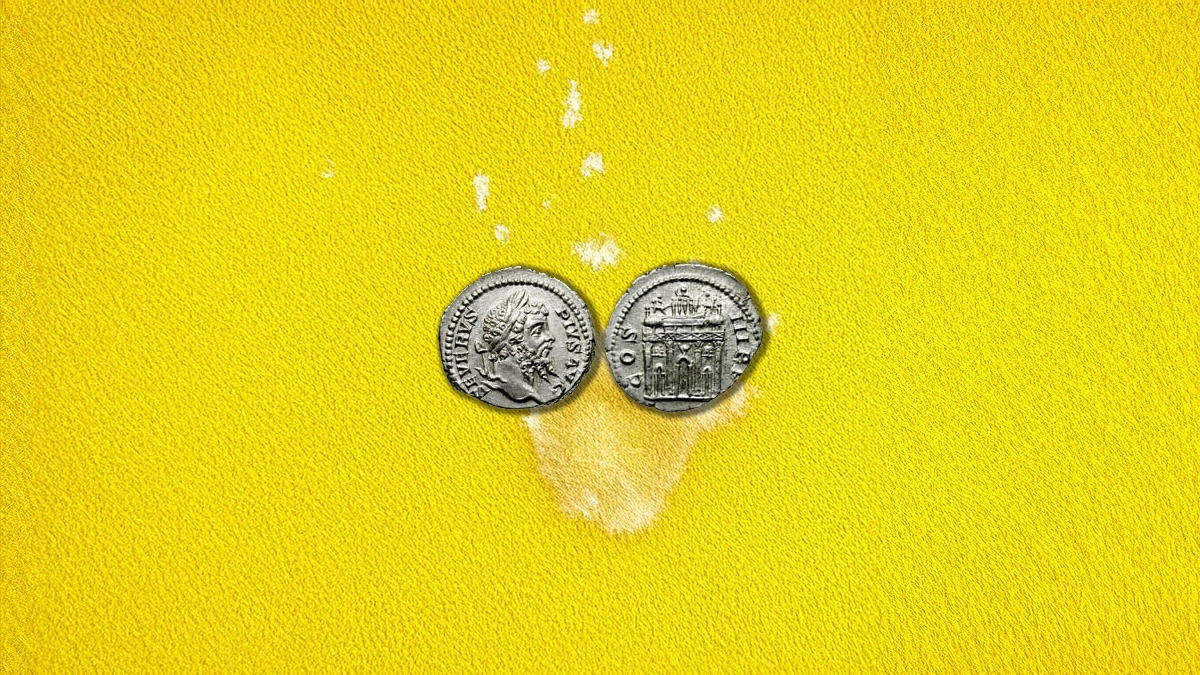
Septimius Severus was a very successful general who managed to defeat all his rivals during the civil war following the death of Pertinax in 193 CE. After becoming emperor, Septimius conducted a successful campaign against the Parthians and then against the tribes in Britain. Figure 8 shows a denarius with Septimius’ Parthian triumphal arch on the reverse (the same as in Figure 1). Parthian prisoners and scenes from battles are depicted in reliefs along the sides. Septimius and his son, Caracalla, minted denarii and AE asses with this arch on their reverse. This arch still exists in the Roman Forum today.
There are many triumphal arches in Italy and the provinces that are in excellent shape. Some of the best-preserved arches are in Jordan, Libya, Turkey, and France. Also, the idea of triumphal arches did not die out with the Roman Empire, and modern triumphal arches include the Brandenburg Gate in Germany and the Arc de Triomphe du Carrousel in France. The coins mentioned in this article tend to be a little pricey, as monumental coins are always pricey, especially the gold ones.
Reference
Acsearch.info: an auction database.
Classical Numismatic Group (CNG): an auction database.
Wildwinds: an auction database.
Boardman, John, Jasper Griffin, and Oswyn Murray. The Oxford History of the
Classical World, Oxford University Press, New York & London (1993).
Hornblower, Simon, Spawforth, Antony (ed.). The Oxford Classical Dictionary.
Oxford (1996).
Madden, F., C.R. Smith, and S.W. Stevenson. A Dictionary of Roman Coins. London
(1889).
Ortega, Ivan Fumado. “Triumphal Arches,” National Geographic (Jan/Feb 2025).
Sutherland, CHV, and RAG Carson. The Roman Imperial Coinage, Spink and Son,
London (various years).
Tameanko, Marvin. Monumental Coins, Krause Publications, St. Iola, WI (1999).







One of the things I truly love about ancient coins, especially of the Roman periods, is the amount of history you can find beyond the dynastic names. From the captives beside the palm tree to the Triumphal Arches to Constantine’s Victoria “evil German Tribe of the Week”, no other coinage has so consistenly painted a picture of the world.