


by Charles Morgan for CoinWeek…
Money, in its various forms —physical coins, paper currency, or the abstract concept of wealth and financial status —has consistently served as a profound and pervasive theme in popular music. Money reflects deeply ingrained societal values, personal struggles, and universal human desires, providing a unique lens through which we can examine cultural trends throughout history.
An in-depth study of the subject throughout history would likely yield hundreds of interesting tunes in the genre of money songs, but for the purpose of this article, I’d like to focus on several popular songs recorded starting in the late-19th century to more recent songs familiar to all who listen to pop music on the radio.
19th Century Songs: Money as an Ever Present Social Factor
In the 19th century, popular songs often reflected the direct impact of wealth on social standing, relationships, and individual aspirations, often with a pragmatic or even cynical view of its power, given that many popular songs during this period were popularized through performance.
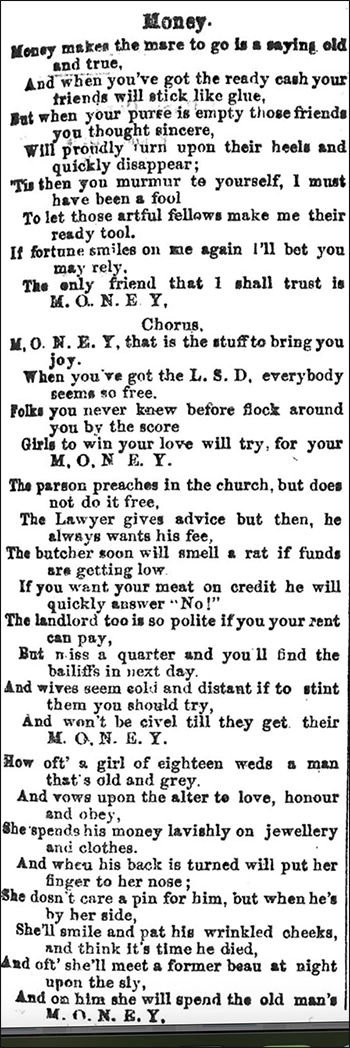
M.O.N.E.Y or Tis money makes the mare to go – C.A. Page
“M.O.N.E.Y or Tis money makes the mare to go,” a British music hall song first published in 1886 with words and music by C.A. Page, directly addresses the pervasive influence of money on social relationships and personal well-being.
The lyrics are based on the old English proverb “money makes the mare to go,” asserting that “when you’ve got the ready cash your friends will stick like glue,” but quickly disappear when your purse is empty.
The song critiques how various professions—from parsons and lawyers to butchers and landlords—are driven by fees and payment, and even suggests that wives might become “cold and distant” without money. It also touches on the transactional nature of marriage, depicting a young woman marrying an older man for his wealth, which she then spends lavishly. The song’s popularity highlights a widespread recognition of the power of money in Victorian society, where financial status often dictated social standing and personal interactions- a fact not lost on the majority of people working long hours just to scrape by.
The Man Who Broke the Bank at Monte Carlo – Fred Gilbert
“The Man Who Broke the Bank at Monte Carlo,” published in 1891 by Fred Gilbert, is another popular British music hall song that captured the public’s imagination. Popularized by comedian Charles Coborn, the song was inspired by the real-life gambler and confidence man Charles Wells, who famously won vast sums at the Monte Carlo casino. The song’s lyrics are essentially a boastful narrative from the perspective of a newly wealthy individual, reveling in his newfound riches and the attention it brings. Lines like “As I walk along the Bois de Boulogne / With an independent air / You can hear the girls declare / ‘He must be a millionaire'” capture the fantasy of wealth and its power to attract admiration and desire.
The song reflects a fascination with sudden wealth and the glamorous, albeit sometimes illicit, means of acquiring it, embodying a 19th-century version of a rapper’s boast about having money and women. Its enduring popularity from the 1890s through the late 1940s, and its continued referencing in popular culture (e.g., Lawrence of Arabia), underscores a timeless human fascination with extreme wealth and the dramatic stories of those who acquire it.
Songs of the Great Depression: Hardship, Hope, and Escapism
The Great Depression (1929-1939) profoundly impacted American society, and popular music of the era often reflected the widespread economic hardship, disillusionment, and, at times, a yearning for escapism. This was also the period where penny boards became common as collecting low value coins became a popular pastime.
How Can A Poor Man Stand Such Times and Live – Blind Alfred Reed
Recorded on December 4, 1929, just after the stock market crash, Blind Alfred Reed’s “How Can A Poor Man Stand Such Times and Live” is considered an early protest song directly addressing the economic hardships of the Great Depression. The lyrics lament the drastic increase in the cost of basic necessities like food and clothing, contrasting them with earlier, cheaper times. Reed also critiques the cost of education, the perceived greed of doctors and preachers (“Most all preachers preach for gold and not for souls”), and the burden of taxes, all contributing to the overwhelming struggle of the poor. The song’s raw depiction of everyday financial strain and its questioning of how ordinary people can survive such conditions captures the immediate despair and frustration felt at the onset of the economic crisis.
“How Can A Poor Man Stand Such Times and Live” was recorded on Victor Records V-40236 in 1929 and remained a popular song through the 1930s.
Brother, Can You Spare a Dime? – E. Y. Harburg & Jay Gorney
Released in 1931, “Brother, Can You Spare a Dime?” became an iconic anthem of the Great Depression, vividly portraying the widespread suffering, disillusionment, and loss of hope experienced by millions. The song’s poignant lyrics tell the story of a man who once contributed to America’s industrial might—building railroads, skyscrapers, and fighting in wars—only to find himself jobless, homeless, and begging for a dime. It highlights the stark contrast between the prosperity of the “Roaring Twenties” and the sudden, devastating poverty of the 1930s, questioning how a nation that once celebrated its workers could abandon them. The plea “Brother, can you spare a dime?” symbolizes the breakdown of social support systems and the profound sense of betrayal felt by those who had contributed to the American Dream, only to see it collapse. The Bing Crosby version was recorded in late 1932 and the song gained further popularity from being featured in the Broadway musical “Americana.”
The Gold Diggers’ Song (We’re in the Money) – Al Dubin & Harry Warren
In the 1933 Warner Bros. film Gold Diggers of 1933, Ginger Rogers delivers a spirited and iconic lead performance in the opening musical number “We’re in the Money” (also known as “The Gold Diggers’ Song”), written by Harry Warren and Al Dubin.
Choreographed by Busby Berkeley, the sequence features Rogers as a showgirl named Fay, singing and dancing amid a chorus of scantily clad performers in a lavish, aspirational celebration of wealth during the Great Depression. Rogers begins the song in close-up, her face framed by the elaborate set, and she famously performs one verse entirely in Pig Latin- a creative addition inspired by Berkeley overhearing her speaking it on set.
The costumes are a highlight, with Rogers and the other showgirls adorned in outfits covered with large imitation cardboard coins modeled after the “Barber” design, which were minted from 1892 to 1916. These metallic-looking coins strategically cover their bodies, emphasizing the theme of money while pushing pre-Code boundaries with their revealing nature. The dancers manipulate the larger coin props during the performance, holding them up to create visually striking patterns, such as formations resembling a many-armed Indian goddess. Giant coins fill the background, two of which were silver dollars of the Peace and Morgan design.
Rogers’ vocals are playful and confident, delivering lyrics that directly reference silver and gold, including lines like “The silver dollar has returned to the fold, With silver you can turn your dreams to gold.”
The number builds to a humorous climax when the sheriff interrupts to shut down the show for unpaid bills, attempting to seize the costumes and props, including a risqué gag about removing a coin bag that cover’s a woman’s bottom.
Even though Rogers’ performance is energetic and charismatic, blending song, dance, and comedy, the sequence ends with an acknowledgement that even in showbiz one can’t escape the Depression.
The Rock and Roll Era : Money as an Object of Desire and Status
In the 1950s and 1960s, for a generation of Americans born after World War II into an increasingly strong economic climate, a narrative shift took place in popular songs.
Whereas during the Depression, songs about money were predominantly sung by or were about working people and those on the margins, during the rock ‘n’ roll era, it was young people singing about money and how they would like to acquire it. For many of these rock ‘n’ rollers, these songs helped them achieve their aims.
Money (That’s What I Want) – Barrett Strong
“Money (That’s What I Want)” emerged from a spontaneous recording session at Motown’s Hitsville studio in Detroit in 1959. Co-written by Tamla founder Berry Gordy and Janie Bradford, with Barrett Strong performing the vocals, the song was a direct, pragmatic response to the prevailing sentiment of more idealistic tunes like “The Best Things in Life Are Free”. It asserted an undeniable, almost primal, need for money. This composition became the first national hit for Gordy’s nascent Motown enterprise, distributed nationally on Anna Records, reaching number two on the R&B charts and crossing over to the Top 40. This success was pivotal, laying a foundational stone for what would become a music empire.
The lyrical content is a straightforward declaration: “Well now give me money (that’s what I want)”. This simple yet powerful message directly links financial acquisition to personal liberty and autonomy. The song’s essence lies in its articulation of money as a fundamental necessity for survival and well-being, rather than a critique of wealth itself. It embodies a basic human desire for resources.
The enduring appeal of “Money (That’s What I Want)” is evidenced by its numerous high-profile covers across decades and genres. The Beatles famously included it on their second album, With the Beatles (released in the UK in 1963 and the US in 1964), having performed it in their Hamburg sets as early as 1960. John Lennon’s “impatient, angry, and snotty” delivery suited the song’s directness, solidifying his “rocker” image within the group. Later, the Flying Lizards’ quirky new-wave rendition in 1979 brought the song back into the Top 5 in the UK, showcasing its remarkable adaptability. Other notable artists who covered it include Etta James, The Doors, and Pearl Jam.
Money – Pink Floyd
“Money,” released on Pink Floyd’s seminal 1973 album The Dark Side of the Moon, stands as a sharp critique of materialism, greed, and the corrupting influence of wealth. Written by bassist Roger Waters, the song emerged during a decade marked by cynicism, including the “great recession” of the 1970s, which fostered a broader cultural shift towards questioning the endless pursuit of wealth.
The lyrical themes engage in sarcastic commentary on consumerism, highlighting the allure of wealth while simultaneously exploring the alienation it can cause. “Money” satirizes hyper-materialistic individuals who prioritize wealth and what it can buy, such as a “new car, caviar, four-star daydream” or even “a football team”.
Waters’ lyrics convey the initial appeal (“Money, it’s a gas”) but transition to a detached, critical view, exploring the contradictions inherent in the desire for money. The song is fundamentally an anti-capitalist anthem, critiquing greed, consumerism, and the corrupting power of money.
A hallmark of “Money” is its iconic opening sound effects, which feature the distinct sounds of cash registers, coins, and paper tearing. These sounds create an immediate auditory motif that directly reflects the song’s theme and critique of wealth. The explicit incorporation of these numismatic-related sounds as the first notes of a masterful musical composition is every bit as powerful as the visuals in the Busby Berkley number and are instantly recognizable. From here, one of the most famous bass lines in rock n’ roll history drives the point home. In the band’s official visuals for the song, released in 1973, opens with a montage of Britain’s newly introduced decimal coinage.
For the Love of Money – The O’Jays
“For the Love of Money,” a funk-infused song recorded by Philadelphia vocal group The O’Jays, was released as a single in 1973. Often misinterpreted as a celebration of wealth, the song is, in fact, a stark warning about the corrupting influence of money, drawing its core message from the biblical verse 1 Timothy 6:10: “For the love of money is the root of all evil.”
The lyrics explicitly detail the negative actions people will undertake for financial gain: “For the love of money / People will steal from their mother / For the love of money / People will rob their own brother.” It highlights how money can lead individuals to lie, cheat, hurt others, and even sell their bodies. The song’s writers, Kenneth Gamble and Leon Huff, penned it during a period when they were experiencing significant financial success, prompting them to reconcile their newfound wealth with their spiritual beliefs. The repeated chorus of “Money, money, money, money” has made it a popular choice for promos, TV shows, and movies that depict greed or the pursuit of the “almighty dollar.” The song’s unique sound, featuring a filtered bass with a reverse echo, contributed to its distinct presence on the airwaves.
“For the Love of Money” peaked at number 3 on the U.S. Billboard R&B chart and number 9 on Billboard’s Pop Singles chart in spring 1974. The track was certified Gold by the RIAA on June 12, 1974, for selling one million copies. It was also nominated for a Grammy Award for Best R&B Vocal Performance by a Duo or Group with Vocals and was inducted into the Grammy Hall of Fame in 2016.
The song gained further prominence as the opening theme for the NBC show The Apprentice, helping to build Donald Trump’s brand as a brilliant businessman, which ultimately opened the door for his hostile takeover of the Republican Party and two terms as President.
Money, Money, Money – ABBA
“Money, Money, Money,” released on November 1, 1976, as the second single from ABBA’s Arrival album, is sung from the viewpoint of a woman who, despite hard work, struggles to maintain financial stability. The song captures a universal longing for financial ease and the dream of a “better life”.
The central theme revolves around the desire for a well-off man as a means to escape financial woes. This reflects a traditional, yet often relatable, fantasy of marrying into wealth to solve economic problems. The music video, inspired by the film Cabaret, visually contrasts the protagonist’s “determined presence in reality during the verses” with “dream sequences about money and ‘the good life’ in the chorus,” further emphasizing the aspirational nature of the lyrics. Several Swedish coins make an appearance in the visuals.
The song gained renewed prominence and cultural penetration through its inclusion in the popular musical Mamma Mia! and its film adaptation, where the character Donna sings it to explain her financial struggles and dreams.
Moneytalks – AC/DC
“Moneytalks,” released in 1990 on AC/DC’s album The Razors Edge, stands as a hard rock commentary on wealth and its societal impact. Despite its title, which might suggest a celebration of money, the song’s lyrics offer a critical perspective, serving as a working class takedown on the wealth-obsessed and the powerful.
During AC/DC’s Razors Edge World Tour, a unique numismatic-related element was incorporated into their live performances: thousands of promotional “Angus Bucks” (dollar bills featuring guitarist Angus Young) were dropped onto the audience during the song. The music video for “Moneytalks” also opens with one of these “Angus Bucks” being set on fire, visually reinforcing the song’s critical stance on money. While these “Angus Bucks” are now collectible items, valued at around $15 each, their distribution during concerts sometimes led to audience members fighting each amongst themselves to collect them.
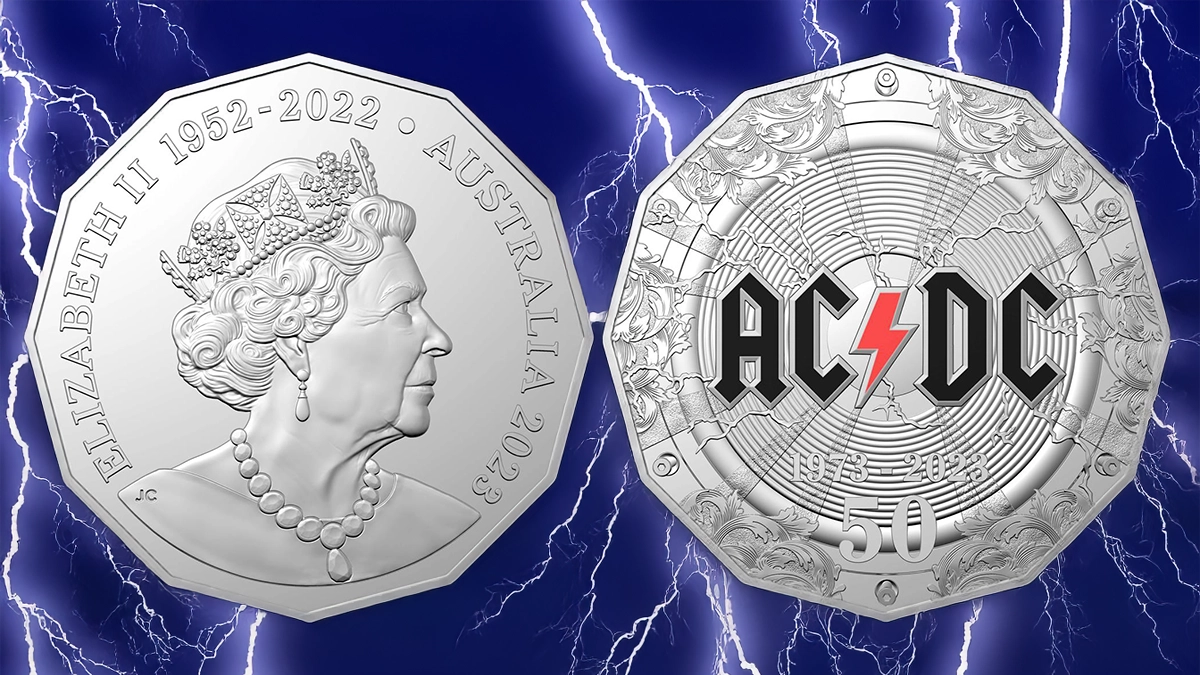
Beyond these promotional items, official AC/DC collectible coins have also been issued, notably in 2023 by the Royal Australian Mint. These coins feature designs inspired by the band’s electrified iconography and logo, commemorating their anniversaries and musical legacy.
Silver and Gold – Carl, Greg, and Stan Perkins
Dolly Parton’s “Silver and Gold,” released in May 1991 as the second single from her album Eagle When She Flies, is a narrative-based song that discusses moral values passed from one generation to the next.
In the song, Parton’s character encounters a disheveled old man- perhaps someone whose experience with deprivation dates back to the Depression. The man says, “silver and gold can’t buy you a home when this life has ended, and your time is gone.” Instead, it suggests that a person can “live in a world where you’ll never grow old, and things can’t be bought there with silver and gold. And time can’t be bought back with silver and gold.” These lyrics invoke Matthew 19:24, which state “And again I say unto you, It is easier for. camel to go through the eye of a needle than for a rich man to enter into the kingdom of God.”
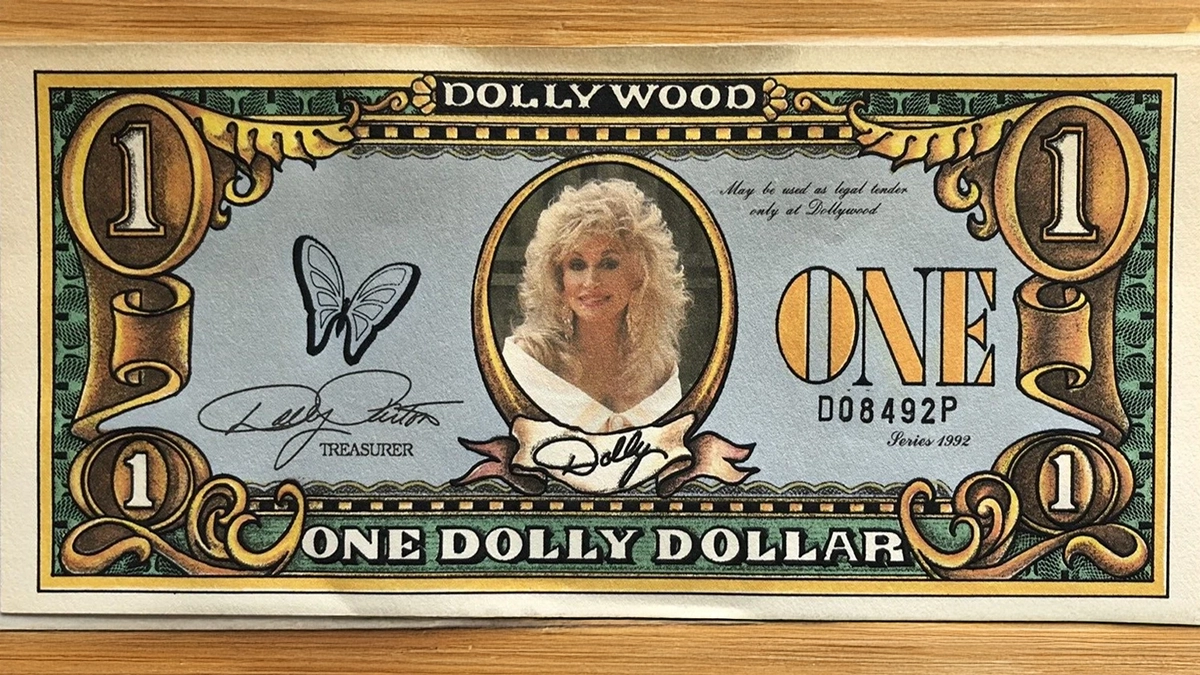
Dolly Parton has also has connections to numismatics beyond this song. She was a guest of honor at an April 2008 United States Mint ceremony where a young eaglet was released into the wild after being rescued by the American Eagle Foundation. This event was tied to the U.S. Mint’s sale of commemorative clad half dollars, silver dollars, and $5 gold pieces for the 35th anniversary of the Endangered Species Act of 1973. Surcharge income from these coins supported the American Eagle Foundation, an organization Parton supports. Additionally, Dolly Parton “Dollywood Dolly Dollars,” issued from 1991-2016, are also popular collector items.
C.R.E.A.M. – Wu-Tang Clan
In the 1920s, the raw, emotional storytelling of the blues, which openly addressed life’s hardships and struggles, significantly influenced folk music by expanding its thematic scope beyond traditional narratives, and in turn, rap music would later draw from these folk roots to become the voice of the inner city, using its own unique rhythm and poetry to document the realities and struggles of its communities.
“C.R.E.A.M.” (an acronym for “Cash Rules Everything Around Me”) is the third single from Wu-Tang Clan’s iconic 1994 debut album, Enter the Wu-Tang (36 Chambers). The song provides a gritty, realistic portrayal of poverty, systemic racism, and the cycle of crime and incarceration, emerging from the members’ experiences growing up poor and Black in the United States.
The lyrics describe a young Black male’s struggle within racist economic systems, detailing a cycle of poverty, drug dealing for survival, brief periods of wealth (“champagne and Cadillacs”), and his inevitable incarceration.
The song explicitly states that “cash rules everything around me” but paradoxically is the pursuit of cash on the streets leads to a life of crime, eventually incarceration, or young death. In this context, money is just a instrument for fleeting moments of self-indulgence. From the safety of the suburbs or more affluent areas of the country, it’s easy to look down on this existence, but even greater financial crimes take place in company boardrooms, in the halls of power, and amongst the elite.
“C.R.E.A.M.” is widely regarded as one of the greatest hip-hop songs of all time, and for good reason.
The Enduring Resonance of Songs About Money
The songs discussed in this article form just a sample of popular songs about money. Though recorded during different periods by artists with little connection to one another, the subject matter of the songs collectively demonstrates the multifaceted nature of money in popular culture—as a source of desire, a target of critique, a means of escape, a symbol of oppression, and a catalyst for empowerment.
From 19th-century observations on its social power, through the stark realities and escapist fantasies of the Great Depression, to Barrett Strong’s foundational declaration of need, Pink Floyd’s satirical commentary on greed, The O’Jays’ moral warning, ABBA’s aspirational fantasy, AC/DC’s hard rock critique, Dolly Parton’s reflection on spiritual wealth, Wu-Tang Clan’s stark portrayal of systemic economic hardship, each track contributes to a rich tapestry of perspectives about wealth and poverty and speak to the complex issues that arise from societies use of money.







I’m not sure how this rating scale works, I didn’t see any guidelines. So, hopefully this is ok. I found the article “What 150 years…” by Charles Morgan to be quite interesting and informative. I’ve always loved music, mostly all kinds, but I had never really noticed how many songs of yesteryear and today’s music has “Money” in the title! These songs pretty much cover the gamut of anything related to money in their lyrics. I enjoyed this article and recommend reading it.