By Mike Markowitz for CoinWeek …..
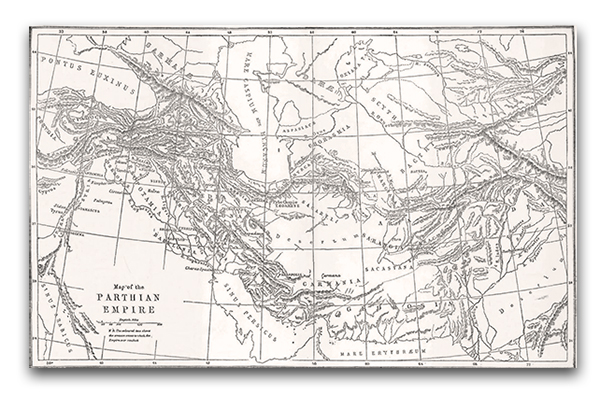
PARTHIAN ROYAL HISTORY (c. 247 BCE – 228 CE) is a dismal record of sons murdering fathers, and brothers slaying brothers to seize a shaky throne. Yet for most of this era, Parthia provided reasonably efficient government to a population of Greeks, Persians, and Arabs; tolerating Christians, Jews, Pagans, Zoroastrians, and Buddhists. Parthia fought the declining Seleucid Empire, resisted the rising power of Rome, held off waves of invading nomads from Central Asia and kept the Silk Road to China open.
Rise of Parthia
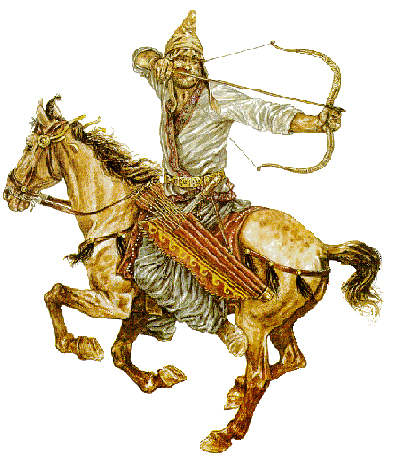
About 430 BCE, Herodotus, the “father of history,” described the customs of the Persians:
Their sons are carefully instructed from their fifth to their 20th year, in
three things alone—to ride, to draw the bow, and to speak the truth.
[The Histories, 1:136]
Parthian excellence in horsemanship and archery compensated to some degree for their limited numbers and unstable politics. Roman legionaries learned to fear the accuracy and power of a “Parthian shot”, from the short, stiff bow of a retreating horse archer.
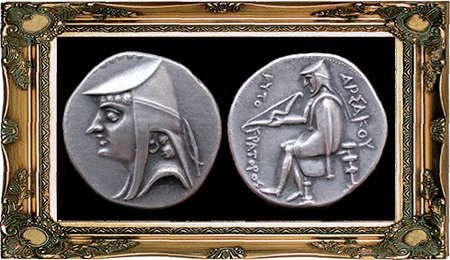
The Parthians began as a semi-nomadic Iranian tribe, the Parni, who migrated into northeastern Iran, which broke away from the crumbling Seleucid Empire around 250 BCE. The Parni soon issued their own coins, depicting their beardless chieftain Arsaces wearing the bashlyk, the distinctive soft felt cap of steppe horsemen. On the reverse, a seated archer holds a bow, and the name Arsaces is inscribed in Greek. On the earliest examples, the title “General” is added; on later issues, he is styled “King” and then “Great King” in Greek.
Under Mithridates I (ruled 171-139 BCE) and his nephew Mithridates II “The Great” (121-90 BCE) the kingdom conquered much of modern Iran and Iraq.
“Friend of the Greeks”
The Parthians struck silver and bronze; there are no authentic gold issues. Gold was reserved for jewelry. Initially the silver was of high purity (95%). By the end of the empire it was a debased alloy with over 60% copper and other metals. The most common denomination was the drachm of about four grams. After the Parthians conquered the great Seleucid capital of Seleucia on the Tigris (about 20 miles south of modern Baghdad) the city struck handsome tetradrachms (4 drachms) in fine Hellenistic Greek style. Small change consisted of bronze chalkoi in denominations of 8, 4, 2 and 1 unit, with 48 chalkoi equal to one silver drachm.
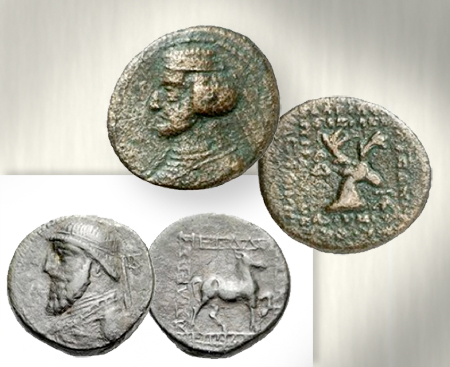
About 50 Parthian rulers issued coins, but the name “Arsaces” became immobilized as the dynastic title (much as “Caesar” became a Roman title rather than a personal name). Few Parthian coins bear a ruler’s personal name, so establishing which coins go with which kings has challenged generations of numismatists. Like Roman emperors, Parthian kings loved to display their titles on coins; unlike Romans they spelled everything in full, without abbreviations.
For example, Orodes II (ruled 57-38 BCE) styled himself:
“King of Kings, Arsaces The Benefactor, The Just, The Illustrious, Friend of the Greeks.”
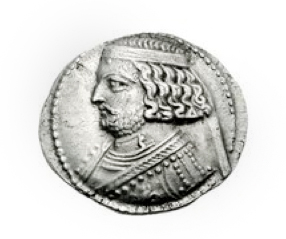
The die cutters struggled to make everything fit, and the titles often run off the edges of the coins. Many tetradrachms bear a date (some with the month as well as the year!) according to the Seleucid era, and some 14 different mints have been identified.
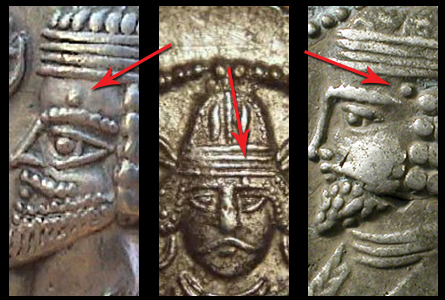
A peculiarity of the coinage is the “royal wart” – a dot on the king’s forehead that appears on coins of some 18 rulers beginning with Mithridates II (123 – 88 BCE). In some cases, a lock of hair discreetly conceals the wart. According to one theory (Hart) this “wart” is a trichoepithelioma, a benign facial tumor that is partly hereditary. Parthians might have regarded this as a mark of royal blood.
War with Rome
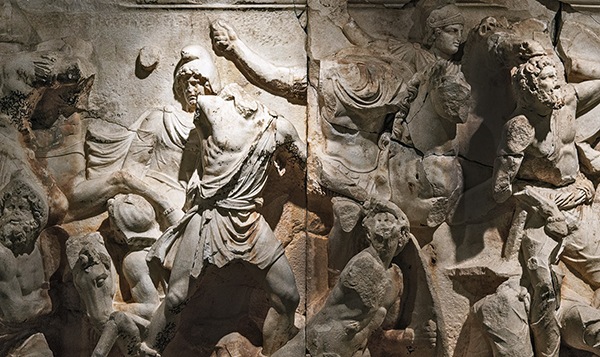
In 53 BCE, seven Roman legions under Marcus Licinius Crassus (who had crushed the slave revolt of Spartacus) advanced into Parthian territory in Syria. They were annihilated by a Parthian cavalry force a quarter their size. Crassus and his son were killed and the sacred legionary eagle standards were captured.
Julius Caesar was planning a campaign against Parthia to avenge this defeat when he was assassinated in 44 BCE. In the ensuing civil wars Parthia sided with Caesar’s assassins. A Roman general, Quintus Labienus, joined a Parthian prince, Pacorus, fighting the troops of Mark Antony and Cleopatra in Anatolia. A military mint moving with Labienus struck magnificent gold aurei and silver denarii, showing a Parthian warhorse on the reverse.
In 20 BCE, in a triumph of Roman diplomacy, Augustus obtained the return of the legionary eagles lost by Crassus. This event was commemorated on the reverse of a Roman denarius, depicting a kneeling Parthian offering the sacred object, with the proud inscription SIGN[IS] RECE[PTIS] – “the standards returned.”
Decline and Fall
As a diplomatic gift, Augustus sent Parthian king Phraates IV an Italian slave girl named Musa. She bore the king a son. In 2 BCE, she poisoned the king and ruled as regent for her young son, Phraataces, shocking the Parthians by marrying him. On her rare coins (inscribed “Heavenly Goddess, Queen Musa”), she wears an elaborate tiara that looks rather like a modern wedding cake. The incestuous couple was overthrown and killed about 4 CE.

The river Euphrates was a natural boundary between Roman and Parthian power. There were long periods of truce between recurrent wars. Roman armies sacked Ctesiphon the capital (now Salman Pak, Iraq, 15 miles south of Baghdad) in 116, 164, and 197. Rome could never maintain control over Mesopotamia – a frustration many subsequent conquerors have experienced.
The decline of Parthia is evident in the coinage of the third century. Die cutters no longer attempted Greek – the inscriptions are a garbled mix of Aramaic letters and random strokes and dots. Vologases VI (ruled 208-218) and his brother Artabanus V (216-224) fought a 16-year civil war that fatally weakened the empire. Engravers can no longer model a realistic portrait, so the king’s image is simplified to a cartoon-like drawing. Similarly, the seated archer reverse, endlessly repeated on Parthian coins, is reduced to a crude stick figure. In 224, Ardashir, tributary ruler of a southern client kingdom, overthrew the last Parthian king and established the dynasty that we know as the Sasanian Empire.
Collecting Parthia
In numismatic references and auction catalogs, the coinage of Parthia falls under the heading of “Oriental Greek” or “Further Asia”. The standard references in English–Sellwood (1980) and Shore (1993)–are out of print and very expensive if you can find a copy. Fortunately, a superbly documented and illustrated website, www.parthia.com, provides an accessible source of information on the coinage and its geographic and cultural context.
Parthian tetradrachms typically sell for a few hundred to a few thousand dollars.
Common drachms in nice condition can be found for two hundred dollars or less. The bronzes are inexpensive but usually well-worn and seldom seen in auctions. The highest recorded price I could find for a Parthian coin was $39,584 USD for an tetradrachm of Orodes I (ruled 90-80 BCE)
There are probably fewer than 20 serious collectors of Parthian coins in the world today. Yet the dearth of written and archaeological sources for this long era makes the coins an essential resource for establishing the “who, what, where and when” — which in turn, help us to understand the “why”.
In researching this coinage I was astonished at how many places mentioned in the old books appear in current headlines. We read, for example, that the retreating Roman army of Severus held off the Parthians in 196 by retreating into the Sinjar mountains — the very terrain where Kurds today are struggling to hold off the fighters of ISIS.
Our own monumental ignorance of Iranian history is both ironic and unfortunate, considering that the countries that make up this vast culture area — Iran, Iraq, Afghanistan, Turkey, Syria, Central Asia and the Caucasus are the battlegrounds of so many current conflicts.
* * *
References
Caley, Earle. “Notes on the Chemical Composition of Parthian Coins with Special Reference to the Drachms of Orodes I”, Ohio Journal of Science 50:3 (1950)
Colledge, Malcolm. The Parthians. Praeger. 1967
Curtis, Vesta S. “Parthian Coins: Kingship and Divine Glory”, The Parthian Empire and its Religions: Studies in the Dynamics of Religious Diversity. P. Wick and M. Zehnder (eds.). Gutenberg. (2012)
Farrokh, Kaveh. Shadows in the Desert: Ancient Persia at War. Osprey. (2007)
Hart, Gerald D. “Trichoepithelioma and the Kings of Ancient Parthia”, Canadian Medical Association Journal 94. (1966)
Sellwood, David. An Introduction to the Coinage of Parthia (2nd edition). Spink. (1980)
Sellwood, David. “Parthian Coins”, The Cambridge History of Iran, v. 3, The Seleucid, Parthian and Sasanian Periods. Ehsan Yarshater (ed.). Cambridge. (1983)
Shore, Fred B. Parthian Coins and History: Ten Dragons Against Rome. CNG: Quarryville, PA. (1993)
Wroth, Warwick. Catalogue of the Coins of Parthia. British Museum. (1903)
* * *