By Levi Donohoe for CoinWeek …..
Why the William IV Gold Sovereign Commands Such Strong Premiums Today
Since the British gold sovereign returned to circulation in 1817, every reigning monarch has appeared on the coin’s obverse. Struck by The Royal Mint, these sovereigns once powered Britain’s economy under the gold standard. Even today, they retain legal tender status in the United Kingdom.
However, not all sovereigns trade on equal terms in the modern market. Specific designs command dramatic premiums, often worth many times their intrinsic gold value. Among them, the gold sovereigns struck during the reign of King William IV (1831–1837) stand out as some of the most desirable.
A Short Reign Creates a Scarce Sovereign
William IV ruled for just seven years, from 1830 until his death in 1837. As a result, the window for striking sovereigns bearing his portrait remained narrow. Naturally, limited production translated into fewer surviving examples, a reality that continues to fuel collector demand.
To put that scarcity into perspective, consider the sovereign production periods of adjacent monarchs:
- George III: 1817–1820 (3 years)
- George IV: 1821–1830 (9 years)
- William IV: 1831–1837 (6 years)
- Victoria: 1838–1901 (63 years)
Consequently, William IV sovereigns sit between two much longer-running series. Collectors seeking a challenging pre-Victorian type often find them impossible to ignore.
An Unlikely King With a Compelling Backstory
Interestingly, William IV never expected to become king. As the third son of George III, he stood well behind his elder brothers, George IV and Frederick, in the line of succession.
Nevertheless, history intervened. George IV left no legitimate heirs, and Frederick died childless. Because of these circumstances, the crown passed to William. Had events unfolded differently, sovereigns bearing his portrait would never have existed at all.
The One-Year Type Half Sovereign Collectors Often Miss
William IV half sovereigns typically date from 1835 to 1837. Yet, one year stands apart. In 1834, The Royal Mint quietly altered the coin’s specifications.
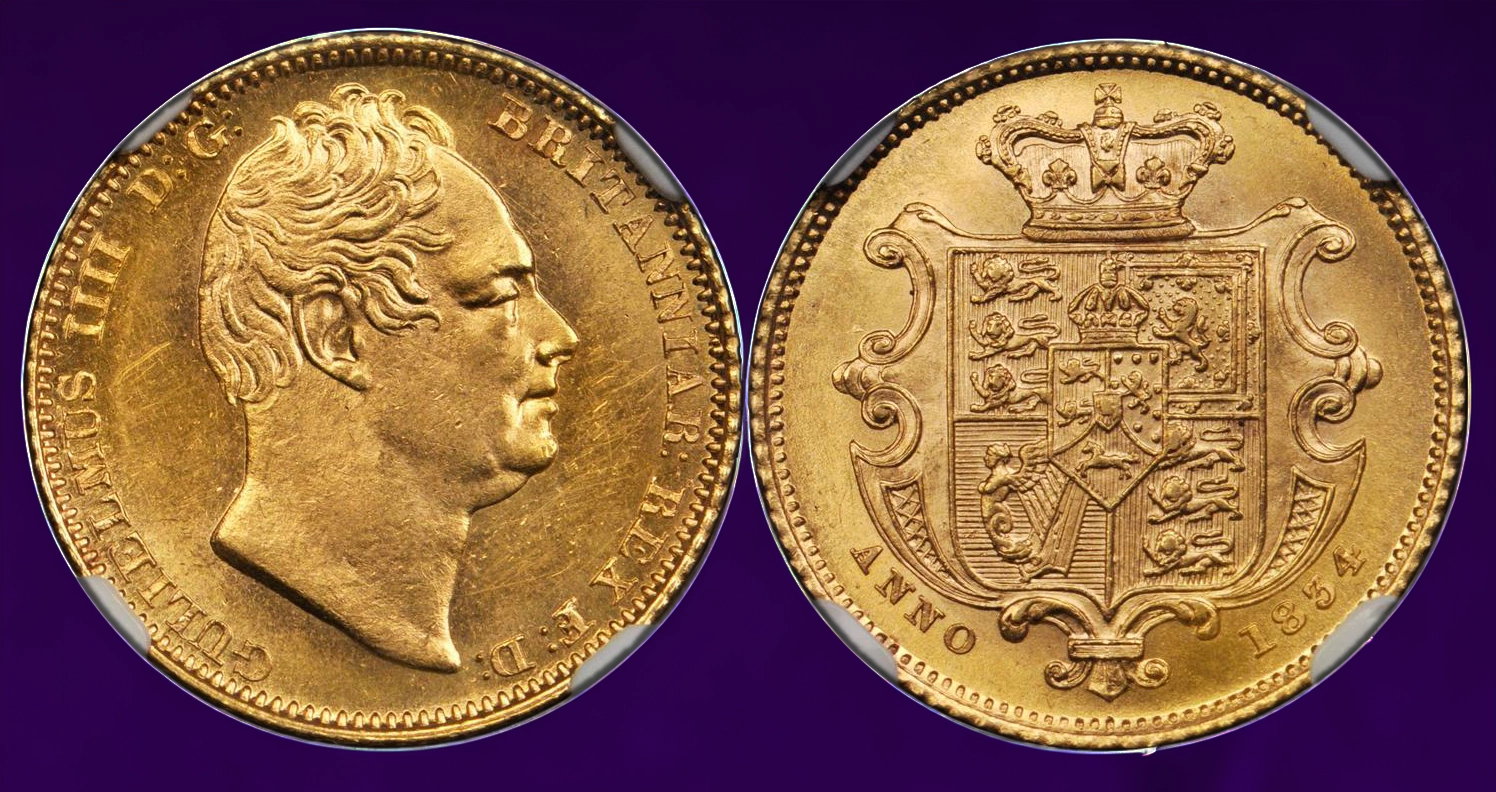
Although the gold content remained unchanged, the diameter shrank from the standard 19.3 mm to 17.9 mm. The goal was simple: differentiate the half sovereign from the similarly sized sixpence. Unfortunately, the experiment backfired. The reduced size proved impractical, and the Mint quickly reverted to the original dimensions the following year.
As a result, the 1834 half sovereign exists as a one-year type, an important numismatic detail that many collectors still overlook.
Condition Challenges in Today’s Market
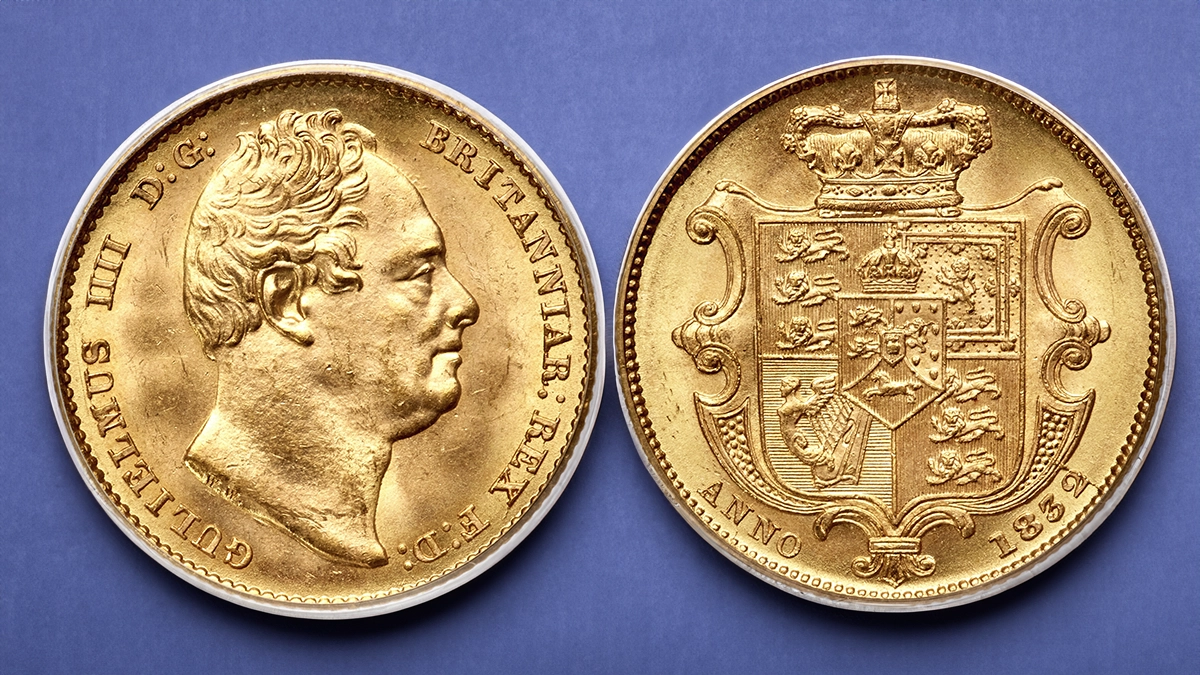
Because Britain operated under a gold standard during William IV’s reign, most surviving sovereigns circulated heavily. As expected, many examples show wear, particularly on the King’s hair and ear.
Moreover, raw coins frequently reveal problems. Rim repairs from past jewelry mountings appear often, while evidence of cleaning remains widespread. Although polishing may have enhanced display appeal in 19th-century shop windows, it significantly reduces collector premiums today.
That said, top-grade examples tell a different story.
In 2021, an NGC MS65 William IV sovereign sold for just over $40,000 at Heritage Auctions, underscoring how fiercely contested these coins become in true Mint State. Meanwhile, Almost Uncirculated examples trade at several multiples of their gold value and continue to attract British investors who want strong eye appeal without paying elite-level premiums.
The Last Great Pre-Victorian Rarity
Importantly, the William IV sovereign represents the final high-premium rarity before Queen Victoria’s long reign dramatically increased sovereign mintages. Victoria, William’s niece, inherited the throne after his death, as none of his legitimate children with Queen Adelaide survived into adulthood.
Once Victoria took the crown, scarcity gave way to volume, a shift that permanently changed the sovereign market.
Proof Sovereigns for the Elite Collector
For advanced collectors, Proof William IV sovereigns sit at the pinnacle of the series. Although official mintage figures have disappeared into history, grading data tells a compelling story.
To date, only 77 Proof sovereigns have been reported by NGC and PCGS combined. Even more intriguing, a Proof double sovereign dated 1831 exists, with just 69 examples certified. No bullion versions of the double sovereign are known.
While no official explanation survives, low-mintage Proof coins often served as diplomatic gifts or were set aside for institutions such as museums, adding further mystique to the series.
A Sovereign That Continues to Gain Momentum
Ultimately, the William IV gold sovereign remains one of the most sought-after types in the British coin market. Premiums have risen steadily in recent years, driven by limited supply, historical significance, and growing collector awareness.
Pre-Victorian sovereigns continue to dominate collector wish lists, and among them, William IV’s sovereign stands shoulder-to-shoulder with the very best.
* * *