


By Mike Markowitz for CoinWeek
“Despite an endless series of forays and several invasions intended to be permanent, the Muslims never succeeded in establishing a stable state much north of the line below which the olive grows…” — Pratt (1956) page 92
Short History of the Muslim Conquest of the Iberian Peninsula
In April 711, a Muslim force of roughly 7,000 men crossed the Strait of Gibraltar and landed on the Iberian Peninsula. Within just seven years, these armies dismantled the Visigothic kingdom and brought most of Iberia under the control of the Umayyad Caliphate. The conquerors named this territory al-Andalus [1].
Although the Visigothic capital had stood at Toledo in the peninsula’s center, the new rulers established their capital farther south at Cordoba (Qurtubah), a city favored by Europe’s warmest climate. From there, Muslim forces pushed northward and even occupied portions of Aquitania in southern France.
However, resistance persisted. In the rugged northern regions of Spain, several Christian kingdoms survived. As a result, for nearly seven centuries, warfare, diplomacy, and shifting alliances between Muslims and Christians shaped the peninsula’s history.
The term Reconquista [2]—meaning “reconquest”, emerged much later. Nineteenth-century nationalist historians coined it, and Spain’s Franco regime (1939–1975) promoted it as the dominant historical framework.
In reality, the situation proved far more complex. Christian states frequently fought one another for land, wealth, and prestige. At the same time, periods of conflict alternated with eras of Convivencia [3], “living together”, marked by religious tolerance, trade, and cultural exchange.

The Carolingian Dynasty
Meanwhile, Frankish rulers of the Carolingian dynasty (c. 751–987) launched a counteroffensive across the Pyrenees into northeastern Spain. In 801, Louis “the Pious,” son of Charlemagne, captured Barcelona. Nevertheless, the city would change hands multiple times in the centuries that followed.
During this period, rare silver deniers bearing the name of Louis, HLUDOVVICUS in Latin, were struck at the Barcelona mint. These coins prominently display the city’s ancient name, BARCINONA, in bold letters on the reverse [4].
Barcelona and the End of Frankish Protection
Over time, the County of Barcelona drifted toward independence from the Carolingian Empire. In 985, Muslim forces led by Almanzor [5]—Abu ʿAmer Muḥammad ibn ʿAbdullāh (c. 938–1002), known as al-Mansur, “the Victorious”, attacked and burned the city, then ruled by Count Borrell II.
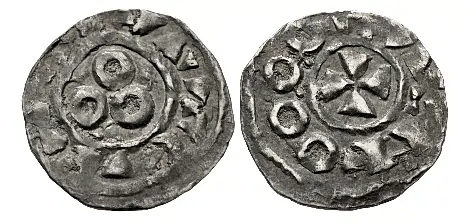
Borrell fled into the mountains, expecting Frankish aid that never came. In the aftermath, he issued small, heavily debased silver diners [6], weighing about 0.6 grams. These coins show three rings on one side and a cross on the other, accompanied by garbled inscriptions, clear evidence that literacy and administrative stability had declined during these turbulent years.
Barcelona Ascends in Catalonia
Ramon Berenguer I, known as “the Old,” ruled as Count of Barcelona from 1035 to 1076. Born around 1023, he succeeded his father, Berenguer Ramon I “the Crooked,” in 1035.
During his reign, Barcelona rose to dominance in Catalonia. Ramon Berenguer I campaigned aggressively against Muslim states, extracting heavy tribute and, in turn, fueling a wave of prosperity. At the same time, Catalan naval power expanded across the western Mediterranean, while Barcelona gained land and influence north of the Pyrenees.
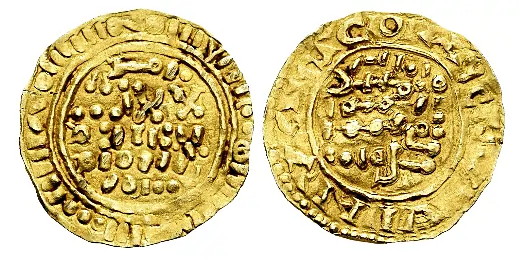
After his death, his twin sons, Ramon Berenguer II and Berenguer Ramon II, succeeded him. Ramon’s gold coinage notably imitates the dinar of Yahya al-Mutadi, Caliph of Cordoba (c. 1021–1036). These coins display his Latin name and title, RAIMVNDVS COMES, surrounding garbled Arabic inscriptions [7].
Spanish Christian States and Navarre
For centuries, the small kingdom of Navarra (Navarre), with its capital at Pamplona, functioned as a buffer between the Umayyad Caliphate and the Carolingian world.
In 987, Sancho II assumed the title “King of Navarre.” Under Sancho III “the Great” (r. 1004–1035), the kingdom expanded significantly and sought to unify Christian Spain against an increasingly fragmented Muslim south.
After Sancho III’s death, Sancho IV ascended the throne in 1054 at just 14 years old, following the death of his father, García Sánchez III, in battle against León. Sancho IV likely became the first Navarrese ruler to strike coins in his own name.
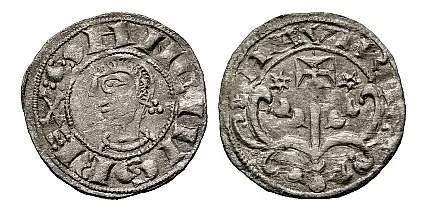
His debased silver dinero bears a crude profile bust and the Latin inscription SANCIUS REX. The reverse shows a stylized floral motif topped by a cross and stars, accompanied by the kingdom’s name, NAVARA [8].
Alfonso VIII of Castile
One of the most fascinating monetary developments of twelfth-century Spain was the emergence of the morabitini.
Alfonso VIII of Castile, whose realm contained a large Moorish population and who maintained close ties with the Islamic world, struck gold morabitini (alfonsini) at Toledo from the 1180s onward. Although written in Arabic, these coins conveyed explicitly Christian messages.
Remarkably, they were dated neither by the Christian calendar nor by the Hijra, but instead by the Spanish Era, calculated from Augustus’ conquest in 38 BC [Grierson, page 103].
Born in 1155, Alfonso VIII, son of Sancho III of Castile and Blanche of Navarre, became king in 1158. Because he inherited the throne as a child, factional struggles plagued his early reign. However, by age 15, he secured control of Toledo, located roughly 42 miles (68 km) southwest of modern Madrid.
In 1170, Alfonso married Eleanor of England, daughter of Henry II and Eleanor of Aquitaine.
The Almoravids
The morabitino, or maravedi, derives its name from the Almoravid dynasty (), which ruled parts of Iberia and North Africa from approximately 1050 to 1147.
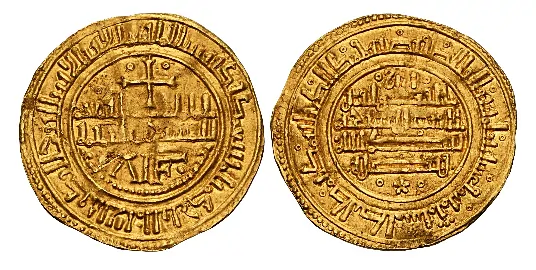
Almoravid gold dinars circulated widely across Spain and served as models for Christian coinage. Alfonso’s coins display elegant Arabic Kufic script, interrupted only by the bold Latin letters ALF, abbreviating his name. A prominent cross on the obverse clearly proclaims Castile’s Christian identity [9].
The obverse inscription declares in Arabic, “The imam of the Christians is the Pope,” while a surrounding Biblical verse (Mark 16:16) warns of salvation and condemnation. The reverse names Alfonso as “Prince of the Catholics” and records the coin’s striking at Tulaitula (Toledo) in 1188 CE.
Medieval Spain – Alfonso VIII
As a tangible symbol of medieval Spain’s multicultural society, where Islamic, Christian, and Jewish traditions coexisted, the morabitino of Alfonso VIII ranks among the greatest medieval coins.
Pratt (1956) described Alfonso vividly, portraying him as both a chivalric hero and a deeply flawed man, beloved by troubadours and notorious for excess [Pratt (1956) page 104].
Peter II
Peter II, King of Aragon and Count of Barcelona from 1196 to 1213, earned the title “the Catholic” after being crowned in Rome by Pope Innocent III.
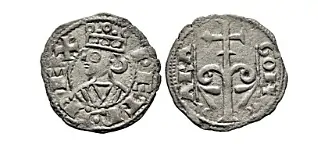
Through marriage to a French princess, Peter expanded his holdings in southern France. At the pivotal Battle of Las Navas de Tolosa in 1212 [10], he commanded the left flank of a united Christian army that shattered the Almohad Caliphate.
His debased silver dinero shows a crowned profile portrait with the inscription PETR REX [11]. The reverse depicts a cross above a tree, a symbol that still appears in Aragonese heraldry.
Peter’s intervention in the Albigensian Crusade proved fatal. He died in battle at Muret in 1213 [12], leaving the throne to his son, James I “the Conqueror.”
Sancho VII “the Strong”
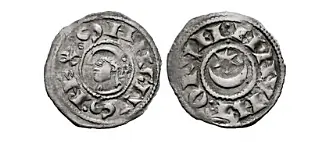
Sancho VII of Navarre, known as “the Strong,” ruled from 1194 until 1234. Standing an estimated 7’3” (2.2 m) tall, he led the decisive charge at Las Navas de Tolosa that killed the Almohad Caliph Muhammad al-Nasir.
Legend holds that the Caliph’s slave warriors were chained together, inspiring the golden chain motif that became Navarre’s royal arms [13].
Sancho’s rare silver dinero bears the inscription SANCIVS REX [14]. Surprisingly, the reverse features a star and crescent, symbols often associated with Islam, an intriguing reflection of Navarre’s relative tolerance and cultural sophistication.
James I “the Conqueror”
James I of Aragon reigned for an unprecedented 62 years beginning in 1213. A skilled administrator and lawgiver, he expanded Aragonese power by conquering the Balearic Islands and Valencia from Muslim rule.
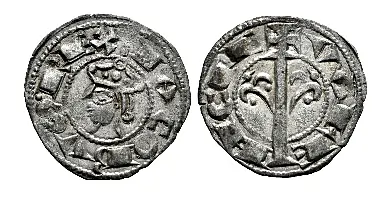
A patron of culture and literature, James authored an autobiography in Catalan. His silver dinero, struck at Valencia, shows a crowned bust with IACOBVS REX, while the reverse displays a stylized tree surmounted by a cross [15].
Ferdinand III
Born around 1200, Ferdinand III unified the crowns of Castile, León, and Galicia. Between 1228 and 1248, he led a series of successful campaigns against the Almohads, capturing Cordoba in 1236 and Seville in 1248.
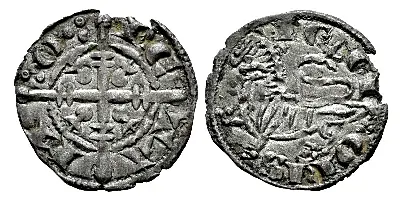
Canonized in 1671, Ferdinand left a lasting legacy. His silver dineros omit his name, instead bearing MONETA and the mint name, such as LEGIONIS, alongside a lion symbol [16].
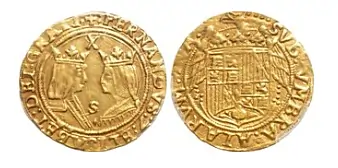
Ferdinand and Isabella
The marriage of Ferdinand of Aragon and Isabella of Castile in 1469 united Spain’s most powerful kingdoms. Together, they completed the Reconquista, expelled the Jews, launched the Inquisition, financed Columbus, and laid the groundwork for a global empire.
Their gold double excelente [17] displays their facing crowned busts and a richly symbolic reverse bearing the combined arms of Spain beneath a Biblical inscription from the Psalms.
Collecting the Reconquista
Medieval Spanish coins appear mainly in the auctions of Spanish and Portuguese coin dealers. They did not circulate widely outside the Iberian peninsula.
The American Numismatic Society in New York holds an important collection originally assembled by the legendary collector Archer M. Huntington (1870- 1955) for the Hispanic Society of America.
The standard reference in English is Crusafont et. al. (2013).
[1] https://coinweek.com/al-andalus-coinage-of-islamic-spain/
[2] https://en.wikipedia.org/wiki/Reconquista
[3] https://en.wikipedia.org/wiki/Convivencia
[4] Aureo & Calico Auction 429, March 14, 2024, Lot 40, realized €7,500 ($8,166)
[5] https://en.wikipedia.org/wiki/Almanzor
[6] CNG E-Auction 531, 25 January 2023, Lot 1475, realize $700
[7] Tauler & Fau Auction 160, June 24 2025, Lot 85, realized €4,000 ($4,647)
[8] Cayon Numismatica, May 16,2012, Lot 221, realized €420 ($535)
[9] CNG Islamic Auction 9, April 25, 2025, Lot 146 realized $3,250
[10] https://en.wikipedia.org/wiki/Battle_of_Las_Navas_de_Tolosa
[11] Cayon Numismatica,June 10, 2021, Lot 1766, realized $146
[12] https://en.wikipedia.org/wiki/Battle_of_Muret
[13] https://en.wikipedia.org/wiki/Coat_of_arms_of_Navarre
[14] Tauler & Fau, Auction 144, June 24, 2024, Lot 1117, realized $697
[15] Tauler & Fau, Auction 150, October 28, 2024, Lot 126, realized $195
[16] Tauler & Fau, Auction 121, January 31, 2023, Lot 86, realized $272
[17] CNG Electronic Auction 587, May 21, 2025, Lot: 1108, realized: $2,250
References
Carson, R.A.G. Coins of the World. New York (1962)
Carvajal de la Vega, David. “Castilian monetary system during the Middle Ages:
continuity and change.” in Money and Its Circulation in Western Eurasia in the
Pre-Modern Times. Kumamoto, Japan (2020)
Crusafont, Miquel, Anna Balaguer and Philp Grierson. Medieval European
Coinage 6: The Iberian Peninsula. Cambridge (2013)
Grierson, Philp. Coins of Medieval Europe. London (1991)
Mackay, Angus and David Ditchburn. Atlas of Medieval Europe. London (1997)
Pratt, Fletcher. The Battles that Changed History. Mineola, NY (1956)






This is a very good article very interesting
Interesting account of the Coins and history of Medieval Spain.
Excellent article. I have been collecting Iberian coins for years and this article is most helpful