


Indian Head Quarter Eagle: History, Design, and Collecting Insights
By CoinWeek Notes
A New Era of U.S. Coin Design
The early 20th century marked a transformative period for United States coinage. During this time, the nation introduced some of its most celebrated designs.
In 1907, Augustus Saint-Gaudens debuted the $20 double eagle and the Indian Head $10 eagle. Soon after, in 1909, Victor David Brenner introduced the Lincoln Cent. This coin commemorated the centennial of President Abraham Lincoln’s birth and became the first circulating U.S. coin to feature a president.
Design innovation continued. In 1913, James Earle Fraser released the Buffalo Nickel. Then, in 1916, Adolph A. Weinman introduced both the Mercury Dime and Walking Liberty Half Dollar. That same year, Hermon A. MacNeil created the Standing Liberty Quarter.
Meanwhile, the Panama-Pacific International Exposition produced notable commemorative coinage. These included gold and silver issues designed by Charles E. Barber, George T. Morgan, and Robert Aitken.
Against this backdrop, President Theodore Roosevelt sought to improve the remaining gold denominations: the $2.50 quarter eagle and the $5 half eagle.
Replacing the Liberty Head Design
By 1908, the Liberty Head Quarter Eagle had circulated since 1840. Similarly, the Liberty Head Half Eagle dated back to 1839. Both designs required modernization.

Although Saint-Gaudens had begun work on these smaller gold coins, he died in 1907 before completing the designs. As a result, the Mint turned to Bela Lyon Pratt.
Pratt worked with Dr. William Sturgis Bigelow, a close associate of Roosevelt. Bigelow proposed a bold idea. Instead of raised designs, he suggested incuse relief, designs recessed below the coin’s surface, inspired by ancient Egyptian art.
Roosevelt approved the concept. Pratt completed the designs in January 1908.
A Groundbreaking Portrait
Pratt used the same obverse portrait for both the $2.50 and $5 gold coins. The image depicts Brulé Lakota Chief Hollow Horn Bear (March 1850 – March 15, 1913).
Importantly, the coin does not identify the figure by name. However, historical research supports this attribution. Therefore, Hollow Horn Bear represents the first real person, and the first living individual, depicted on a U.S. coin, although the Mint did not officially acknowledge this at the time.
On the reverse, Pratt adapted an eagle design inspired by Saint-Gaudens. The eagle stands on arrows intertwined with an olive branch, symbolizing both strength and peace.
Controversy Over the Incuse Design
The incuse format immediately sparked debate.

Supporters argued that recessed designs would reduce wear. However, critics raised concerns. For example, Philadelphia coin dealer Samuel H. Chapman strongly opposed the design.
Some critics claimed that recessed areas could collect dirt and spread disease. Others questioned the artistic choices or worried about counterfeiting and stacking issues.
Despite these objections, Roosevelt moved forward. The Mint implemented the design in 1908.
Production History
The Indian Head Quarter Eagle saw regular production from 1908 through 1915. After that, production paused for a decade.
The Mint resumed striking the coin in 1925 and continued through 1929. The series ended as economic conditions worsened following the stock market crash of 1929.
Collecting the Indian Head Quarter Eagle
Market Trends and Value
In recent decades, the Indian Head Quarter Eagle gained popularity among collectors. A strong two-way market supported this demand for a time.
However, a surge in newly graded coins eventually overwhelmed the market. As a result, prices declined. Numismatist Doug Winter discussed this correction in August 2017.
View more Individual Date profiles here:
- 1908

A 1929 Indian Head Quarter Eagle graded CAC MS64. Image: Stack’s Bowers. - 1909
- 1910
- 1911
- 1911-D
- 1912
- 1913
- 1914
- 1914-D
- 1915
- 1925-D
- 1926
- 1927
- 1928
- 1929
Today, these lower prices create opportunities. Many collectors now view the series as an accessible entry point into classic U.S. gold coinage.
Key Date and Rarity
The series includes one major key date: the 1911-D.
Collectors pursuing high-grade examples should expect significant costs. For instance:
MS64+ to MS65 examples typically range from $30,000 to $60,000
Higher-grade coins can exceed $150,000
In general, most dates remain affordable through MS64. However, Gem-quality coins (MS65 and above) are scarce. At the MS66 level and beyond, they become rare.
Counterfeits and Buying Advice
Collectors must exercise caution. The Indian Head Quarter Eagle ranks among the most frequently counterfeited U.S. gold coins.
Therefore, CoinWeek strongly recommends purchasing only certified examples from trusted grading services such as:
- CAC Grading
- Numismatic Guaranty Company
- Professional Coin Grading Service
Additionally, collectors should avoid “details” coins. Problem-free examples remain widely available.
Proof Coinage: Then and Now
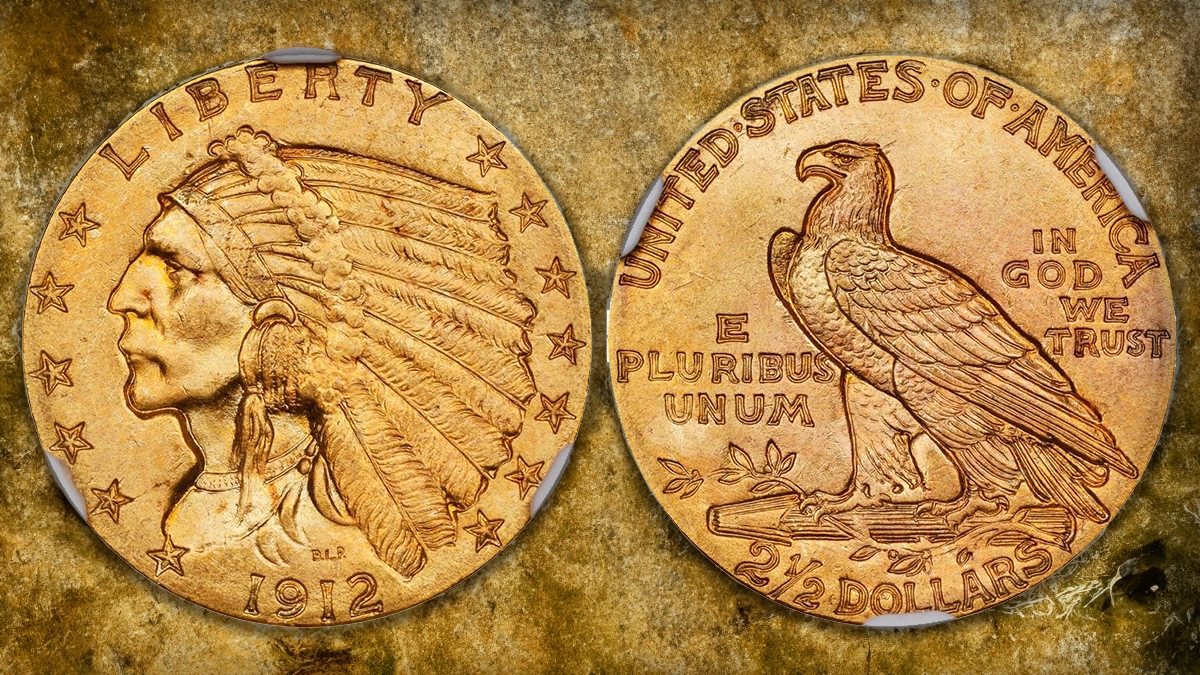
The Mint produced matte Proof Indian Head Quarter Eagles from 1908 through 1915.
Here are two examples:
Today, experts report approximately 1,200 certified examples. However, this number likely includes resubmissions and crossovers.
At the time of issue, collectors did not favor the matte finish. Consequently, many Proof coins went unsold and were later melted.

Today, the situation has reversed. Collectors now value these coins highly. Even a single Proof example can serve as a centerpiece in a collection.
Design Details
Obverse
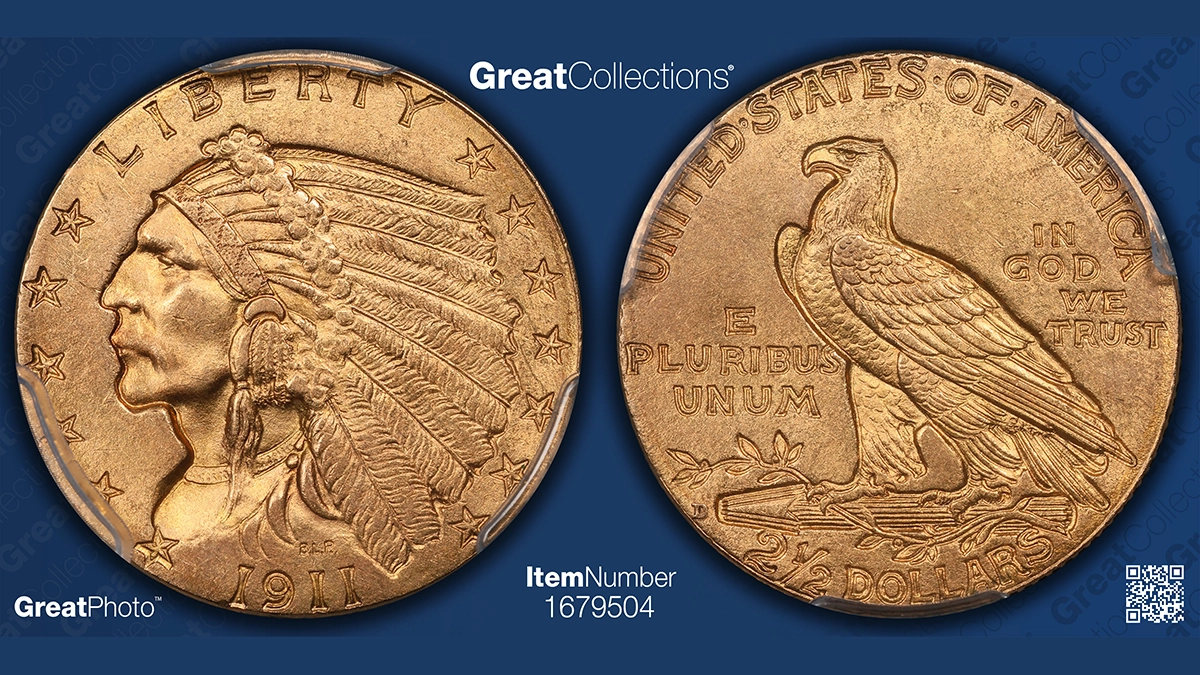
The obverse features a left-facing Native American chief wearing a full-feathered war bonnet. LIBERTY appears at the top, while the date sits below.
Six stars appear to the left of the portrait, and seven appear to the right. Pratt’s initials, B.L.P., appear below the portrait.
Reverse
The reverse depicts a standing eagle facing left. The bird rests on a bundle of arrows combined with an olive branch.
UNITED STATES OF AMERICA appears at the top, while the denomination, 2 1/2 DOLLARS, appears at the bottom. E PLURIBUS UNUM sits to the left of the eagle, and IN GOD WE TRUST appears on the right.
Incuse Features
Unlike traditional coins, all design elements appear recessed below the surface. Only the Denver mintmark rises above the field.
Edge
The coin features a reeded edge.
Varieties
The series includes one notable variety: the 1911-D Weak D.
This variety shows a faint or nearly invisible mintmark. Collectors generally avoid it because strong mintmark examples command higher premiums.
Specifications
- Years of Issue: 1908–1929
- Circulation Mintage:
- High: 722,000 (1913)
- Low: 55,680 (1911-D)
- Proof Mintage:
- High: 682 (1910)
- Low: 100 (1915; none after)
- Composition: 90% gold, 10% copper
- Weight: 4.18 grams
- Diameter: 18.00 mm
- Edge: Reeded
- Designer: Bela Lyon Pratt (obverse and reverse)Further Reading
Collectors interested in deeper study should consult standard references, including works by David Akers, Q. David Bowers, Walter Breen, Jeff Garrett, Ron Guth, and others. Allan Schein’s The Gold Indians of Bela Lyon Pratt offers a specialized study of the series.

CoinWeek wrote an essay about Alan Schein’s 2016 book on the series that is worth reading before you seek out the book.








I live on a farm in NC that used to be a tobacco plantation. Yesterday I found a Indian Head Quarter Eagle in about 3 inches of dirt. I can see the Indian on one side and the eagle on the other but can’t read the numbers or letters. How do I clean it so I don’t damage it. I appreciate any help.
This is a nice one, hadn’t seen this before. Entered this weeks contest!
Great article I didn’t know any of the background of this coin.
Always love reading about the origin of coins.
All that glitters is Gold
interesting
Such a beautiful coin!