


In the world of pre-1933 U.S. gold, few coins generate the excitement and intrigue of the 1911-D Indian Head Quarter Eagle. With a paltry mintage of just 55,680 coins, it claims the lowest production figure of the entire Indian Head $2.50 series. For perspective, the second-lowest mintage, a 1914 issue, was struck nearly four times as often.
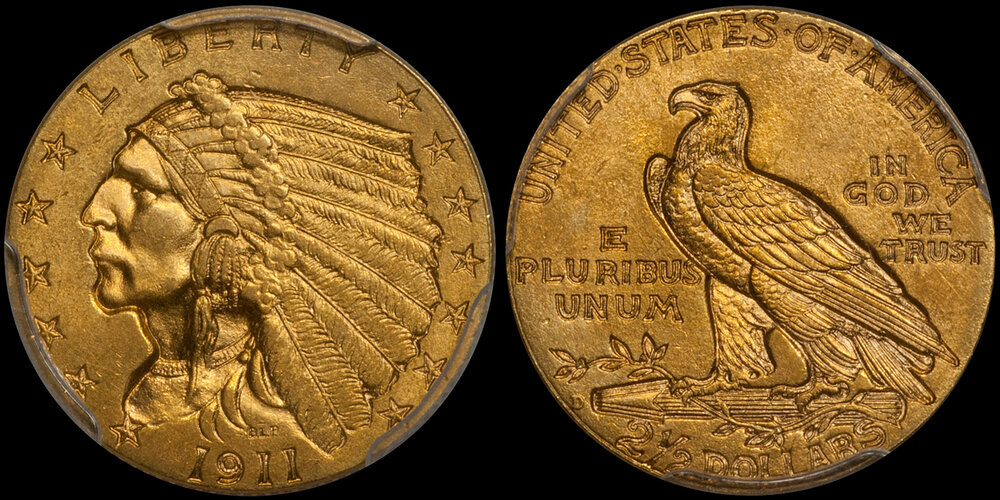
But the 1911-D is more than a low-mintage key. It’s a historic centerpiece shaped by presidential ambition, artistic revolution, and the modern-day threat of counterfeit risk.
The Birth of an Incuse Icon
The dawn of the 20th century marked a renaissance for U.S. coin design. President Theodore Roosevelt, dissatisfied with what he viewed as uninspired designs, spearheaded a full-scale artistic overhaul of American coinage. This initiative led to masterpieces like the Saint-Gaudens $20 Double Eagle, the Mercury Dime, and the Buffalo Nickel. Yet the most radical of them all may be Bela Lyon Pratt’s Indian Head Quarter Eagle, introduced in 1908.
Encouraged by Roosevelt and inspired by Egyptian reliefs admired by Boston physician and art patron Dr. William Sturgis Bigelow, Pratt’s design was unique: incuse engraved rather than sculpted in relief. The bold decision drew immediate criticism. Some feared the recessed surfaces would collect dirt and spread disease, a claim that proved unfounded. Others disliked the aesthetics. Yet Roosevelt stood firm, and the quarter eagle and half eagle adopted the format.
Design Details
The obverse features a sharp, left-facing portrait of a Native American chief in a feathered war bonnet. Above his head arcs LIBERTY, while the date anchors the bottom. A total of 13 stars, six left, seven right, grace the rim. Tucked subtly above the date are the initials B.L.P. for Bela Lyon Pratt.
The reverse depicts a standing eagle facing left, perched atop arrows and an entwined olive branch. Around the rim, “UNITED STATES OF AMERICA” and the denomination “2 ½ DOLLARS” appear in period dots-separated typography. The national mottos E PLURIBUS UNUM and IN GOD WE TRUST flank the eagle.
Unlike most U.S. coinage, every design feature is incuse, including the legends. Only the mintmark, located left of the arrows, is raised, a crucial point when authenticating the 1911-D.
A Tough Find in High Grade
Although struck at both the Philadelphia and Denver mints, the Denver Mint’s 1911-D is far scarcer. And when it comes to Mint State examples, true gems are exceedingly rare. According to PCGS, only 435 coins have been graded MS63, with fewer than 400 higher. The finest known piece, a lone MS66+, has never crossed an auction block.
Adding complexity, many genuine 1911-Ds have weakly struck mintmarks. NGC designates these as “Weak D” coins, while PCGS only acknowledges well-defined “Strong D” examples. A strong D is not just desirable, it’s essential for premium marketability.
The Counterfeiter’s Favorite Target
Scarcity and value make the 1911-D a magnet for forgers. Counterfeiters frequently alter common 1911 Philadelphia coins by adding a fake “D” mintmark. One method, known as “chasing”, involves carving the mintmark directly into the field with metal tools, often leaving behind telltale gouges or oddly shaped letters.
Worse yet, counterfeiters may attempt a full date alteration. One reported specimen began life as a 1914-D. Its original date was filed away and recarved as “1911”. Under magnification, inconsistencies became obvious: the three “1” digits were misaligned and mismatched in size, and hairline scratches surrounded the manipulated area. Collectors should always scrutinize date spacing and serif style when verifying a 1911-D.
Because of these risks, experts strongly recommend buying only certified examples from reputable services like PCGS or NGC. The small premium paid for authentication protects collectors from multi-thousand-dollar mistakes.
Why This Coin Matters
More than a key date, the 1911-D Indian Head Quarter Eagle is a coin that encapsulates a transformational moment in U.S. numismatic history. It bridges high art and functionality, political will and private artistry. And while its critics once dismissed it, today’s collectors admire its minimalist beauty, unique incuse design, and undeniable rarity.
Whether you’re a seasoned collector or a new enthusiast drawn by its mystique, the 1911-D offers a lesson in both art and caution. It teaches us to appreciate bold design and to respect the fine line between genuine and fake in the world of rare coins.
Key Facts Recap:
- Mintage: 55,680 (Lowest of the series)
- Designer: Bela Lyon Pratt
- Metal: 90% gold, 10% copper
- Diameter: 18 mm
- Mintmarks: Only Denver (D), to the left of the arrowheads
- Known for: Incuse design, weak mintmarks, high counterfeit risk
- Top Grade: MS66+ (1 example, no public sale recorded)
* * *




What a coin. In my opinon best ever made. I learn alot from these articles Thank You
Beatirful coin I’d love to own!!!
What a beautiful coin! I would love to own it.
Very nice.
Incuse designs are beautiful
My favorite gold coin.
Beautiful rustic look. Would love to own one. Isn’t like the shinny ones of today
I’ve always loved this design, such a beautiful coin.
I’ve always loved this design.