


By Kyle Knapp for Professional Coin Grading Service
Introduction to Coin Grading: Understanding Coin Grading Beyond the Basics
Every introduction to coin grading begins with broad, theoretical descriptions of each grade category. For example, “Good” coins show mostly full rims. Meanwhile, “Fine” coins display generally complete lettering.
However, experience changes how collectors interpret grades. As collectors specialize, they must apply issue-specific analysis. This deeper approach helps them understand how a numeric grade truly reflects a coin’s condition.
Three essential concepts support this advanced interpretation:
- Grade distribution
- Condition census
- Provenance
These tools do not always determine a grade on the Sheldon grading scale. However, they provide critical context. As a result, collectors make better decisions. Experts also improve authentication and grading accuracy. In addition, these concepts add historical depth to important coins.
Grade Distribution: Understanding the Big Picture
The grade distribution of a coin issue shows how certified examples spread across the Sheldon scale. For coins with large populations, this distribution usually follows a bell-shaped curve.
Therefore, most coins cluster around a central grade. Fewer examples appear at the highest and lowest ends.
This concept gives meaning to a numeric grade. It also places a coin within its survival and availability context.
Example: 1880-S Morgan Dollars
The 1880-S Morgan Dollar provides a clear example. This issue shows a roughly normal distribution, with an average grade around MS64.
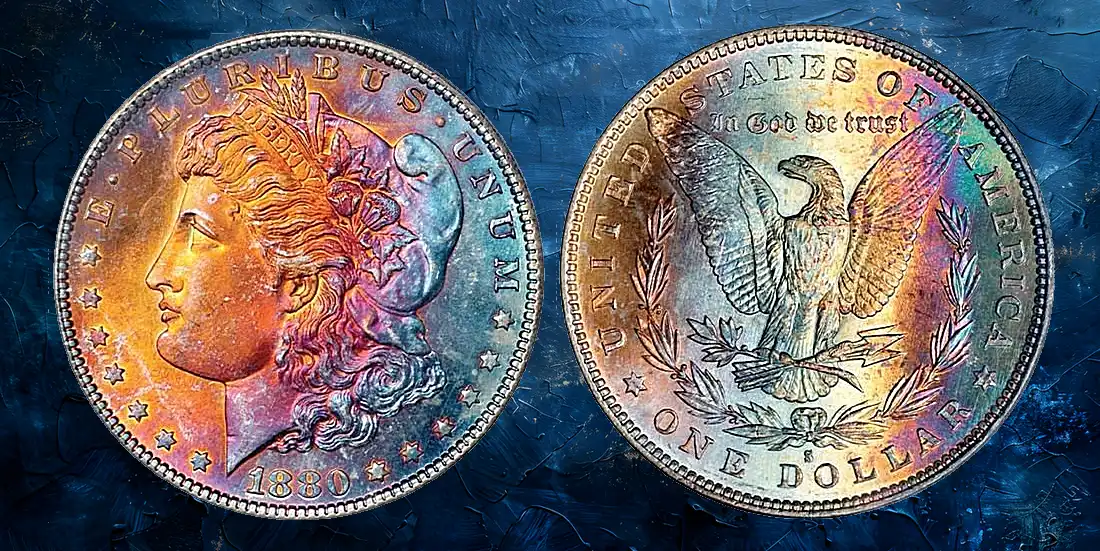
The U.S. Mint produced these coins in large numbers. Many remained in bank and government vaults for years. As a result, high-grade examples exist in abundance.
However, the Mint struck these coins for circulation. Workers handled them in bulk. Consequently, many pieces show bag marks and minor abrasions.
In contrast, coins struck for collectors, such as proofs or commemoratives, cluster at higher grades. Meanwhile, coins that entered circulation immediately tend to peak at lower grades.
Condition Census: Identifying the Finest Known Coins
While grade distribution looks at all coins, the condition census focuses on the very best examples. Specifically, it ranks the finest-known pieces in order of quality.
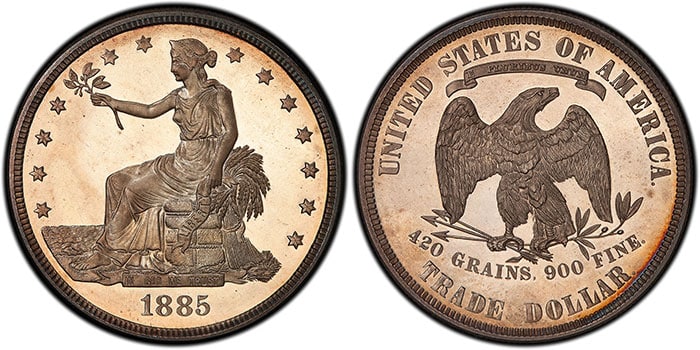
For rare issues, the condition census may include every known coin. For instance, all five known 1885 Trade Dollar examples appear in its census.
Grading professionals rely on this data. They compare newly submitted coins to the finest known pieces. This process helps them detect inconsistencies or signs of damage. It also ensures accurate ranking within the issue.
Research and Documentation
Some coin series offer extensive condition census research. For example:
- Large cent collectors use detailed, leather-bound references with photographs.
- The 1794 Flowing Hair Dollar has dedicated reference volumes.
- The 1802 Half Dime also benefits from specialized studies.
However, many series still lack complete documentation. This gap creates opportunities for collectors and researchers. In fact, studying and building condition censuses remains one of the most rewarding areas in numismatics.
Provenance: The Story Behind the Coin
Provenance records a coin’s ownership history over time. It tracks appearances at auctions and inclusion in major collections.
Each documented transfer adds to the coin’s unique story. Many collectors describe this history as a “provenance chain.”
Why Provenance Matters
Provenance adds both historical and financial value. It also strengthens confidence in authenticity.
Some coins trace directly back to the U.S. Mint. For example, collectors like George Clapp and Walter Childs purchased proof coins at the Philadelphia Mint in the early 20th century. Other famous collectors whose names are important Provenance inflection posts are Louis Esienberg, John Jay Pitman, Harry Bass, James Stack Sr., D. Brent Pogue, Robert Simpson , and the list could go on and on.
Other coins trace to early American auctions from the mid-19th century. These records create a continuous ownership timeline.
Provenance also helps prevent fraud. In addition, it aids recovery efforts for stolen coins.
The Professional Coin Grading Service uses verified provenance in specific cases. For example, unopened mint boxes can confirm eligibility for “First Strike” and other special designations.
Final Thoughts: Why These Concepts Matter
Grade distribution, condition census, and provenance each provide a different perspective. Together, they transform how collectors evaluate coins.
- Grade distribution explains availability.
- Condition census defines excellence.
- Provenance reveals history.
Collectors who understand these concepts gain a clear advantage. They make smarter purchases. They also develop a deeper appreciation for the coins they own.
* * *








I have 1999coin struck twice 1999what would that be worth get back to me.??
Thanks for article.