


Chickens on Coins, the Bird That Changed the Ancient World
Chickens may seem ordinary today. However, in antiquity, they carried deep meaning.
Modern chickens descend from jungle fowl native to Southeast Asia. Archaeology shows that the Phoenicians introduced domesticated chickens to the Mediterranean around 2000 BCE. From there, their importance spread quickly.

At first, chickens symbolized wealth. Both meat and eggs counted as luxury foods. Soon after, they gained religious and cultural meaning.
By 700 BCE, chickens appeared in Western art. Corinthian pottery provides the earliest known depictions. Not long after, they entered the world of coinage.
And once they did, they stayed.
Sacred Chickens and Roman Superstition

and below chickens’ heads, an eight rayed star. Rev. Two tridents pointing inwards; between them, two dolphins
snout to snout. Haeberlin pl 53, 1. Thurlow-Vecchi AS 24, pl. 23. Crawford 12/1.
Numismatica Ars Classica Auction 52 7 October 2009 Lot: 201 realized: 130,000 CHF Approx. $125,847
The Romans took chickens seriously. In fact, they treated them as oracles.
Priests observed how sacred chickens ate. If the birds fed eagerly, the omen was good. If they refused, disaster might follow.
One famous story proves the point.
In 249 BCE, Roman admiral P. Claudius Pulcher prepared for battle at Drepana. Unfortunately, the sacred chickens refused to eat. That signaled danger. Pulcher ignored it. Instead, he mocked the birds and ordered them thrown overboard. He reportedly said, “Then let them drink.”
He lost the battle.
This belief even appears in early Roman currency. A bronze aes signatum bar, dated c. 280–260 BCE, shows two feeding chickens [1]. The piece weighs 1,461 grams (3.22 pounds). In 2009, it sold for over $125,000 in a Swiss auction [2].
Himera: A Rooster That Speaks in Wordplay

fine.Nomos Auction 35 – 15 June 2025 Lot: 131 realized: approx. $3,448
Greek cities often used animals as symbols. Himera, in Sicily, chose the rooster.
Founded around 648 BCE, Himera began striking silver coins circa 550 BCE. The metal likely came from Carthaginian traders.
The rooster symbol may not be random. It likely forms a pun. The Greek word for “day” is hemera. Roosters announce the dawn. Therefore, the bird reflects the city’s name.
Himera also stood at the center of conflict. Two major battles took place there. The Greeks defeated the Carthaginians in 480 BCE [3]. Later, Carthage destroyed the city in 409 BCE [4].
Collectors still prize these coins. In 2025, an archaic drachma sold for over $13,000 [5]. Another example shows a hen in a square frame on the reverse [6].
Phokaia’s Mysterious “Rooster” Creature
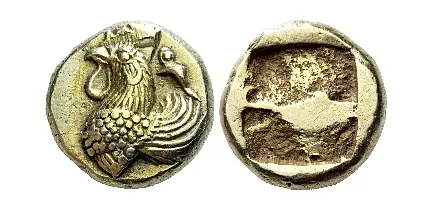
left. Rev. Irregular incuse square. Bodenstedt 40. Extremely rare, a splendid and beautifully struck piece, probably the finest known example.
Good extremely fine. – Nomos Auction 6 – 8 May 2012 Lot: 91 realized: approx. $13,525
Phokaia, an early Greek mint, began issuing electrum coinage around 600 BCE. One common denomination was the hecte, worth one-sixth of a stater.
At first glance, one rare type shows a rooster. However, experts now disagree.
Careful study reveals something unusual. The creature has decorative dots on its chest. Its wing curls in a stylized way. These features match mythological beasts, not real birds.
As one cataloguer explains:
“…previous commentators… have always assumed that the obverse type was simply a rooster. Careful examination shows this is not the case…” [7]
Instead, the image likely represents a hybrid or mythological creature. This discovery adds intrigue, and value, to the type.
Lesbos Coinage: Small Coins, Big Symbolism
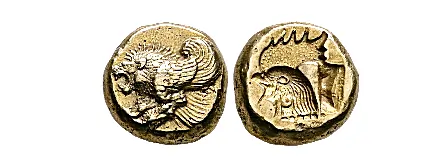
On the island of Lesbos, chickens appear in multiple forms.
Methymna issued tiny silver hemiobols between 500 and 460 BCE. These coins show a rooster beneath a crescent moon [8]. The imagery may reflect time, cycles, or divine symbolism.
Meanwhile, Mytilene produced a wide range of electrum coinage. One hecte (c. 521–478 BCE) features a winged lion on the obverse and a rooster head on the reverse [9].
The rooster design appears incuse. That means the image is recessed below the surface. Modern collectors may recognize this feature from early 20th-century U.S. gold quarter eagles.
Karystos: A Name, A Pun, A Symbol
Karystos, on the island of Euboea, used the rooster as its civic badge.
The choice likely reflects wordplay. The Greek word karyx means “rooster.” Therefore, the symbol echoes the city’s name.

A rare didrachm from the early 5th century BCE shows a rooster with a simple “K” inscription [10]. In 2023, one example sold for over $44,000. That result proves strong collector demand.
Later staters (c. 411–336 BCE) expand the inscription. They spell out ΚΑ-ΡΥΣΤΙΩΝ, meaning “of the Karystians” [11].
A Small Rooster on Alexander’s Coinage
After Alexander the Great died in 323 BCE, his coinage continued. Many cities struck tetradrachms in his name.
Amphipolis served as a major mint. These coins show Herakles on the obverse and Zeus seated on the reverse.

However, small details matter.
On one type (Price 79), a tiny rooster appears beneath Zeus’s hand [12]. The symbol may identify the mint or issue. Even so, it adds another layer to the coin’s story.
Italy and Asia Minor: The Rooster Spreads
The rooster motif did not stay in Greece.
In Italy, the city of Cales produced coins with roosters on the reverse. Many include a star alongside the bird [13] [14].
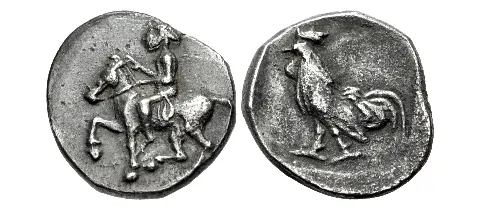
Farther east, Dardanos in the Troad used the rooster as a civic emblem for centuries. A small obol (c. 405–360 BCE) shows a horseman on the obverse and a rooster on the reverse [15].
Despite its size, just 0.65 grams, the coin carries strong identity.
Sophytos: A Greek Echo in Central Asia
The story reaches even farther east.
Sophytos ruled in Bactria around 300 BCE. His exact identity remains debated [16]. However, his coins provide clear evidence of Greek influence.
He copied the rooster design from Karystos. This connection shows how Greek imagery traveled across vast distances.
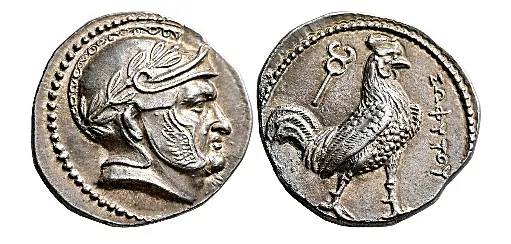
One silver didrachm, praised for its artistry, sold for over $11,000 in 2024 [17].
A Collector’s Dream: Thematic Possibilities
Collectors love themes. Chickens offer one of the most surprising.
The CoinArchives Pro database lists over 2.7 million auction records. A search for chicken-related terms returns more than 10,000 results.
Many examples hide the bird in small details. Others place it front and center.
As a result, collectors can build a diverse set. The theme spans:
- Multiple metals
- Wide price ranges
- Numerous cultures
Few subjects offer such variety.
From Ancient Symbols to Modern Coins
The rooster never disappeared.
France issued a famous 20 Franc gold coin between 1898 and 1914. The reverse shows a proud rooster, known as “Le Coq,” designed by Jules-Clément Chaplain [18]. The type returned in 1921 and again from 1952 to 1960.
Ireland followed with a different approach. Its bronze penny (1928–1968) features a hen with five chicks, designed by Percy Metcalfe.
Clearly, the symbolism endured.
Why Chickens Matter in Numismatics
At first glance, chickens seem trivial. However, ancient coins tell a deeper story.
They reveal:
- Religious beliefs
- Linguistic wordplay
- Civic identity
- Cultural exchange
From Roman omens to Greek puns and Central Asian rulers, the humble chicken connects civilizations.
That connection gives these coins their true value.
Citations
- [1] https://en.wikipedia.org/wiki/Aes_signatum
- [2] NAC Auction 52, October 7, 2009, Lot 201, realized $125,847
- [3] https://en.wikipedia.org/wiki/Battle_of_Himera_(480_BC)
- [4] https://en.wikipedia.org/wiki/Battle_of_Himera_(409_BC)
- [5] Nomos Auction 35, June 15, 2025, Lot 129, realized $13,547
- [6] Nomos Auction 35, June 15, 2025, Lot 131, realized $3,448
- [7] Nomos Auction 6, May 8, 2012, Lot 91, realized $13,525
- [8] Nomos Obolos 38, July 20, 2025, Lot 249, realized $137
- [9] Leu Auction 17, May 31, 2025, Lot 185, realized $2,678
- [10] NAC Auction 138, May 18, 2023, Lot 179, realized $44,184
- [11] Gemini XI, January 12, 2014, Lot 117, realized $850
- [12] Eid Mar Auction 25, October 26, 2025, Lot 49, realized $610
- [13] https://en.wikipedia.org/wiki/Coinage_of_Cales
- [14] CNG E-auction 555, February 7, 2024, Lot 9, realized $140
- [15] CNG E-auction 585, April 16, 2025, Lot 114, realized $275
- [16] https://en.wikipedia.org/wiki/Sophytes
- [17] Leu Auction 15, June 1, 2024, Lot 176, realized $11,064
- [18] https://en.wikipedia.org/wiki/Gallic_rooster
References
- Holt, Frank. Thundering Zeus, The Making of Hellenistic Bactria. Berkeley (1999)
- Jenkins, G. K. Ancient Greek Coins. New York (1972)
- Kraay, Colin. Archaic and Classical Greek Coins. New York (1976)
- Melville Jones, John. A Dictionary of Ancient Greek Coins. London (1986)
- Price, Martin J. The Coinage in the name of Alexander the Great and Philip Arrhidaeus. London (1991)
- Taylor, Lloyd. “Birds of a Feather, Brothers in Arms: The Coinage of Andragoras and Sophytes.” American Journal of Numismatics 31 (2019)






Who knew!!!! Fasinating info!
Chickens on coins. The Roosters are crowing.
Interesting coins.
What a cornucopia of tales of these ancient coins. Fascinating.
Great article – Wonderful that it carries through to modern coins like the Irish penny
I thought the only depiction of a chicken was the pre-1914 French gold 10 and 20 francs!
I have several French coins with roosters and a few Irish “hen and chicks” coins. I don’t have any ancient coins depicting roosters.
Very interesting.
Very cool coins!