By Charles Morgan and Hubert Walker for CoinWeek Notes …..
The story of the Indian Head Quarter Eagle $2.5 gold coin, also known as the Pratt-Bigelow Quarter Eagle, is, at its core, a story of two presidential cousins. Presidents Theodore and Franklin Roosevelt were responsible for the inception and termination of the series. In a 1904 letter, Theodore Roosevelt called 19th-century U.S. coinage “atrocious hideousness” and began his crusade to redesign all of America’s coins towards the end of his first term.
While it took Congressional approval to change the designs of some denominations, the president had the authority to immediately order the redesign of the quarter eagle, the half eagle, the eagle, and the double eagle. When the famed Saint-Gaudens design debuted in 1907, the United States Mint assumed that the smaller half- and quarter-eagle denominations would be scaled-down versions of the double eagle. Chief Engraver Charles Barber quickly ran into trouble including all the legally mandated inscriptions on such a small planchet. This necessitated a complete redesign, and opened the door for the president’s friend, one Dr. William Bigelow, to suggest not only that the Mint work with Boston sculptor Bela Lyon Pratt but also that the coins bear an incuse or “Egyptian” relief.
However, like many of the nation’s coins, the gold quarter eagle fell to the Great Depression. Due to the severe economic downturn in late 1929, the Mint suspended production of all gold coins. While there might have been plans to resume minting when the economy recovered, 1929 proved to be the last year of production for this denomination. This was due to Executive Order 6102, which halted the production of gold coins and also prohibited the “hoarding of gold coin, gold bullion, and gold certificates within the continental United States”.
Due to the Great Depression, many quarter eagles struck in 1929 were not released to the public and few entered into circulation. When coupled with the fact that gold coins were melted in the 1930s because of Executive Order 6102, the surviving population of 1929 Indian Head Quarter Eagles is much smaller than the original mintage of 532,000.
How Much Is the 1929 Quarter Eagle Worth?
Despite having an average mintage, the 1929 is a major conditional rarity for the quarter eagle series. PCGS and NGC collectively have graded only seven examples as MS66 – but surely this is an over-count. Only a few years ago, experts like Jeff Garrett, David Hall, and David Akers stated that a limited number (less than seven) of examples survive in anything above MS65. As such, all are quite valuable, with MS66 pieces selling for seven to 10 times as much as the much more common MS65. In fact, while the average MS65 sells for between $4,000 and $6,500, the auction record of $54,625, set in the Heritage Auctions March 2010 sale, is held by a spectacular MS66.
While there are 578 total pieces graded MS65 by PCGS and NGC, in just one grade lower there are over 5,300. This dramatic jump in population is mirrored by a corresponding drop in price. During the past two years, the average price for an MS64 quarter eagle has stood at just under $900 – between five to six times less than an MS65.
Dropping down in grade again, MS62 to MS63 examples command prices between $500 and $750.
In high AU (AU53 to AU58), collectors can reliably find examples at auction for between $400 to $500. With few examples recorded in grades below AU50, all lower grades are worth only a slight premium over melt and as such sell for approximately $250. As of publication, the quarter eagle contains roughly $321 of gold bullion.
The issue is known to feature good strikes, but the overall quality is not as nice as the 1926 through ’28 issues. David Akers comments that the gold for this issue tends to be yellow, but many coins exhibit a greenish tint. Also interesting is that many examples were struck from buckled dies. 6/15 in Gem, according to Akers.
* * *
1929 Indian Head Quarter Eagle Market Data and Noteworthy Specimens
Top Population: PCGS MS67 (1, 12/2024). NGC MS66 (9, 12/2024). CAC MS65 (17:0 stickered:graded, 12/2024).
- PCGS MS66 #40323762: Heritage Auctions, September 17, 2020, Lot 10134 – $20,400. Simpson on insert.
- PCGS MS66 #29616946: Heritage Auctions, June 5, 2014, Lot 4791 – $30,550.
- NGC MS66 #1808197-001: Heritage Auctions, August 9, 2007, Lot 1867 – $23,000; Heritage Auctions, October 14, 2011, Lot 4818 – $20,700.
- PCGS MS66 #21893055: “The Atherton Family Collection, Part Two,” Heritage Auctions, March 26, 2010, Lot 2197 – $54,625.
- NGC MS65+ #6605864-004: Heritage Auctions, July 20, 2023, Lot 3853 – $7,150.80.
* * *
Design
Obverse:
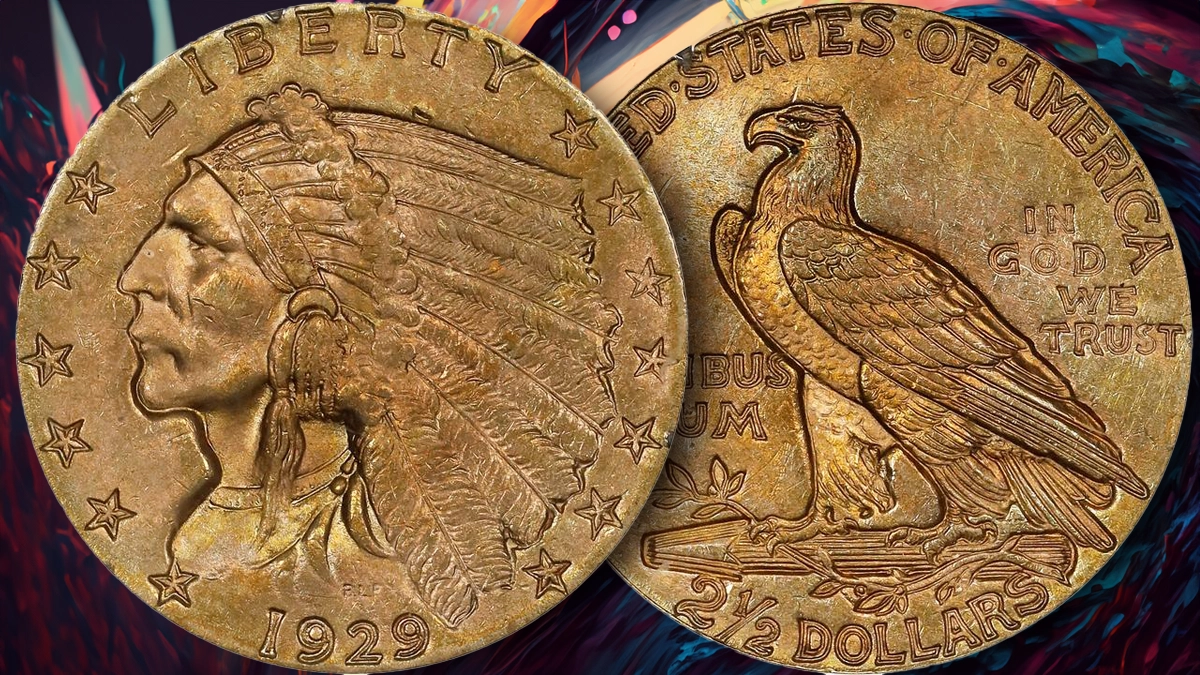
As the first and so far only incuse U.S. coin design, the Indian Head obverse design is set into the surface of the coin. The design is centered around a lifelike portrayal of Chief Hollow Horn Bear of the Sioux. As a departure from previous depictions of anglicized Native American figures on U.S. coinage, this is the first realistic depiction of a Native American chief. The left-facing bust wears a traditional feathered headdress. Filling almost the entire obverse field, the bust is flanked by 13 five-pointed stars representing the 13 original US colonies.
At the top of the design is the word LIBERTY and at the bottom is the date 1929. Between the date and bottom of the bust are the designers’ initials BLP.
Reverse:
The quarter eagle reverse features a bald eagle perched with folded wings holding a stylized bundle of arrows wrapped with an olive branch in its talons. The eagle was based on the reverse of Theodore Roosevelt’s inaugural medal designed by Pratt’s mentor, noted American sculptor Augustus Saint-Gaudens.
The denomination 2 ½ DOLLARS is directly below the arrows, and the legend UNITED STATES OF AMERICA is above. The eagle is flanked by the mottos IN GOD WE TRUST in the right field and E PLURIBUS UNUM in the left field.
Edge:
The edge of the 1929 quarter eagle is reeded.
Designer
Born on December 11, 1867, it became apparent quite early in life that Bela Lyon Pratt was quite a talented artist and sculptor. At the young age of 16, he enrolled at the Yale University School of Fine Art. Later, while attending the Art Students League of New York, Pratt studied under American sculptor and coin designer Augustus Saint-Gaudens, who was to prove instrumental in his career. While never an official Mint employee, Pratt worked with Mint staff to design the new $2.5 and $5 gold coins as a pet project for President Theodore Roosevelt. However, Pratt would never work with the Mint again, returning instead to a highly successful private art career.
Coin Specifications
| Country: | United States of America |
| Year of Issue: | 1929 |
| Denomination: | $2.50 (USD) |
| Mintmark: | None (Philadelphia) |
| Mintage: | 532,000 |
| Alloy: | .900 Gold, .100 Copper |
| Weight: | 4.18 g |
| Diameter: | 18.00 mm |
| Edge: | Reeded |
| OBV Designer: | Bela Lyon Pratt |
| REV Designer: | Bela Lyon Pratt |
| Quality: | Business Strike |
* * *