


Since at least 1995, the United States Mint has operated a program that sells retired and defaced coinage dies to the public. Each die is accompanied by a Certificate of Authenticity (COA). These certificates document key technical and operational details from the die’s service life.
The certificates typically list the die’s date range of use, the number of strikes produced, the denomination, the press type, and the stated reason for retirement. Additional information sometimes appears as well. Together, these records offer an unusually detailed view into modern Mint production practices.
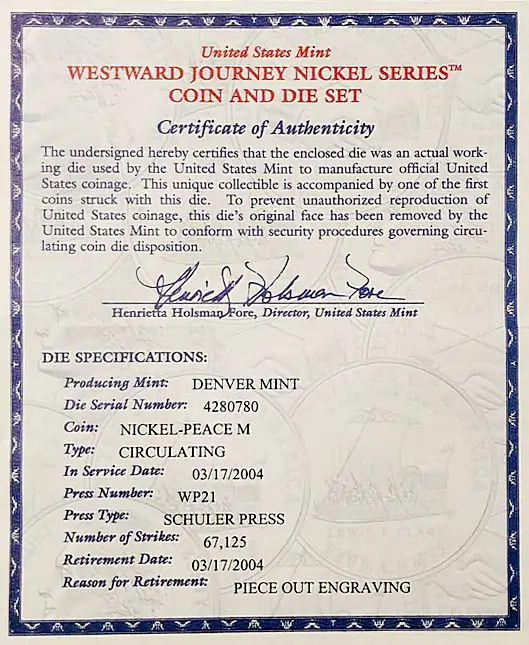
This article summarizes findings from a growing body of certificates and explains why this information matters to collectors and researchers.
Sources and Scope of the Data
The data referenced here comes from two primary sources. The first includes publicly posted images of Certificates of Authenticity and their corresponding dies on online selling venues. The second consists of certificate copies provided directly by private individuals.
At present, the dataset contains just over 150 recorded dies. While this sample size limits statistical certainty, it still provides meaningful insight into press configurations, die orientations, and common causes of die retirement.
What Certificates of Authenticity Can Tell Us
One major benefit of compiling COA data lies in its ability to document press types and die orientations. These details often receive little or no attention in official Mint publications.
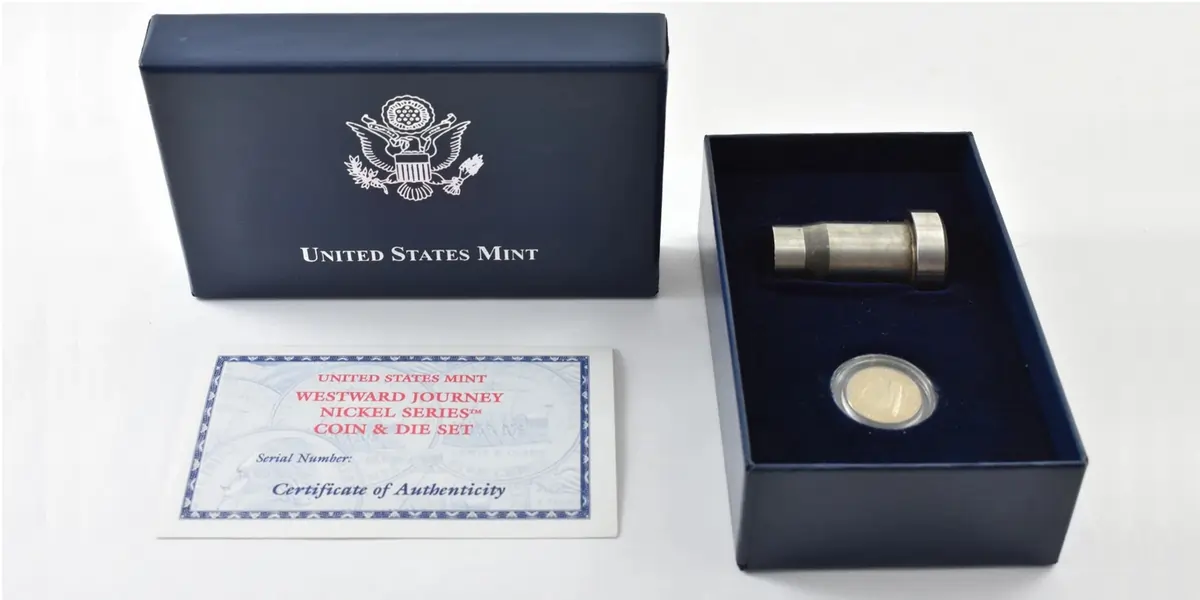
For example, the certificates show that at least four Schuler presses operating at the Philadelphia Mint exhibited a vertical stroke orientation. To the author’s knowledge, no other published resource explicitly documents this configuration.
This information helps fill gaps in the historical record and provides a clearer picture of how specific presses operated during particular periods.
Press Types and Feeder Mechanisms
Knowledge of press types also aids in understanding feeder mechanism design. In a study of die scrape patterns found on struck coins, the author identified correlations between specific scrape patterns and likely feeder mechanism types.
Although the current dataset remains too small to support definitive statistical conclusions, the observed patterns offer useful context. These findings suggest that feeder design plays a measurable role in the formation of certain die-related marks.
Die Orientation and Error Coin Production
In some cases, error frequency appears to correlate with both press model and die orientation. This relationship is especially relevant for errors linked to inverted die setups, where the reverse die functions as the hammer die.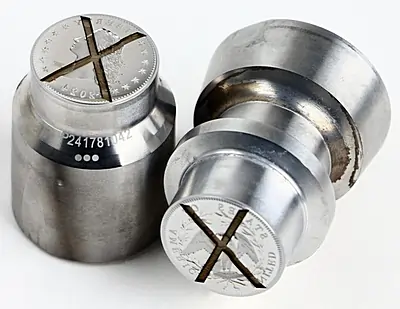
Numismatic researcher Mike Diamond has presented evidence that the Denver Mint began using inverted dies as early as 1989.[1] This practice has important implications for understanding modern error coinage.
One notable association involves anvil die collar clash on reeded coins struck by the Schuler press. According to Diamond, collar clash affecting the anvil die became more common after the Mint adopted the high-speed Schuler press. He further notes that this press is associated with inverted die setups and a horizontal striking mechanism. Diamond has stated that the increased frequency of anvil die collar clash on 21st-century dimes and quarter dollars likely connects to the use of horizontally oriented dies. [2]
Die Retirement and Quality Control Insights
Certificates of Authenticity also provide valuable insight into quality control and die retirement practices. Based on the current dataset, approximately 15% to 20% of the recorded dies were retired due to wear. The remaining 80% were retired primarily because of cracking, clashing, breakage, or chipping.
While this sample size does not allow for firm statistical conclusions, these percentages appear to serve as a reasonable indicator rather than an anomaly. At the time of retirement, most of these dies had begun producing substandard coins. Those coins were presumably scrapped, and the dies were removed from service for reasons other than routine wear.
The Mint’s inspection practices support this conclusion. Press operators used low-power magnification, typically between 3× and 7×, to inspect coins against a visual standard. [3] That standard likely guided decisions about when a die should be retired.
Further context comes from the Mint’s 2014 Baseline Die-Life Determination Trials. Those trials indicate that some “piece out” conditions, which may include minor die chips, do not automatically require immediate die retirement.[4]
Strike Counts and Die Failure Context
The certificates also document the number of strikes per die, which allows for comparison against known Mint targets. The Mint has identified 500,000 strikes as a target threshold for nickel dies.[5] This benchmark provides a useful reference point for evaluating when and why dies failed relative to their expected service life.
Ongoing Research and Future Expansion
The author intends for this compilation to serve as the foundation for a more comprehensive reference. As additional certificates become available, new records will be added to expand the dataset and refine these observations.
The author also extends special thanks to Mike Diamond for his editorial support and contributions to the interpretation of the data.
Copyright ©2026 Pete Apple
Editors Note: Here is a page URL on Die Making at the U.S. Mint
Citations
- [1] “When did the Mint start using inverted dies?” By Mike Diamond, COIN WORLD, December 11, 2023, page 42
- [2] “Bifacial Collar Clash Error Coins Seldom Encountered”, CoinWeek, November 6, 2025
- [3] From a 2005 Letter from the US Mint to Ken Potter.
- [4] Alternative Metals Study, Phase II, Coin Industry Stakeholder Feedback, 2014 Biennial Report to the Congress United States Mint, Department of the Treasury, FINAL, September 1, 2014, Page 109.
- [5] Ibid., Page 110.







I never knew about these Pete!
I find them fascinating!
Awesome content as always, my Friend!
THANK YOU, Jack.
I appreciate your support!
I have seen these before, but, I didn’t know you could get them from the mint. How would one go about getting a set?
Suggest watch for secondary offerings on sites such as eBay.
Where I can find, buy one?
Suggest watch for secondary offerings on sites such as eBay.
That is an awesome story!
THANK YOU! It has been an interesting journey!
Pete, I appreciate you taking over where I left off! I was hoping for that! :)
Thank you Ken! I appreciate your support and encouragement on this project and over the years!