Among all surviving works of ancient numismatic art, few objects command as much admiration as the Syracuse decadrachms. Struck in silver during the late fifth and early fourth centuries BCE, these large-format coins represent the highest synthesis of artistic vision, technical mastery, and cultural ambition achieved by ancient Greek die engravers.
Although these coins were likely produced for practical purposes, their influence on Greek coinage, portraiture, and artistic convention was profound and enduring.
Why the Decadrachms of Syracuse Were Struck
Ironically, the decadrachms of Syracuse were probably issued for a functional, even mundane, purpose: the payment of mercenaries. As high-denomination silver coins, they were well suited for large military expenditures during periods of political instability.
Most examples appear to have circulated only briefly. Many were likely melted shortly after issue, which helps explain their rarity today. Their scarcity is further reinforced by their unusually large denomination, a factor that consistently limits survival rates in ancient coinage.
Yet despite their short circulation life, the designs themselves became widely known throughout the Greek world. In particular, the portrait of the nymph Arethusa proved enormously influential. Die engravers adopted and adapted these compositions for centuries, even far beyond Sicily.
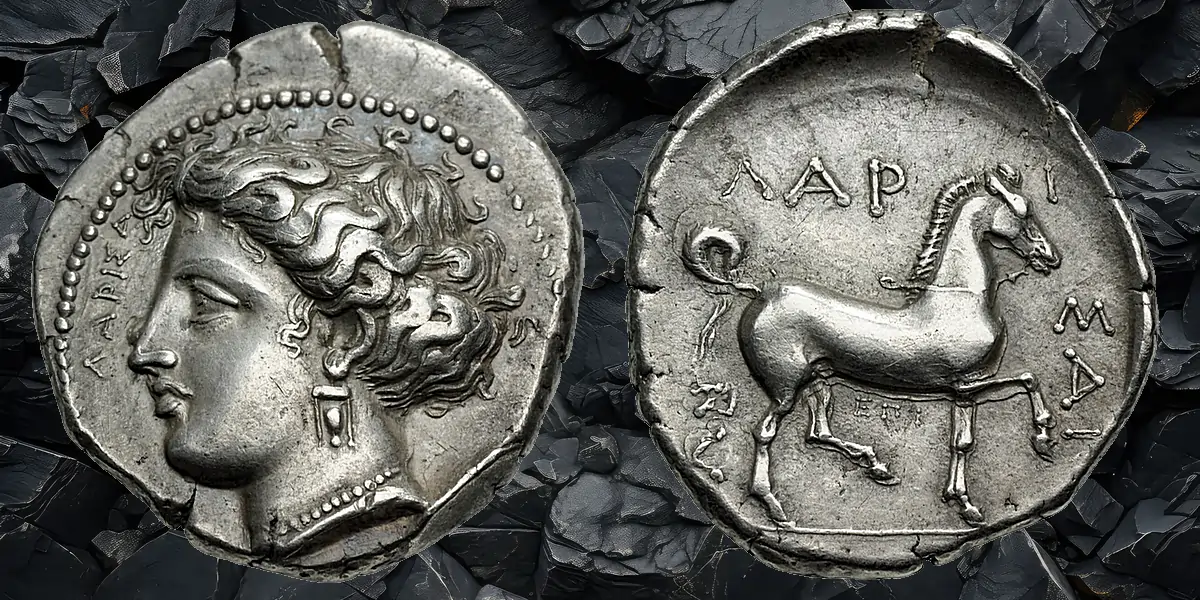
A silver stater from Larissa in Thessaly, dated to approximately 380–370 BCE, demonstrates this legacy clearly. Its depiction of the nymph Larissa is directly inspired by the compositional innovations introduced by Euainetos.
The Artistic Revolution of the Syracusan Decadrachm
The most celebrated decadrachms are those signed by Kimon and Euainetos. On these issues, artistic evolution is unmistakable.
The quadriga, long a standard motif, was transformed. Earlier depictions showed horses in static poses. On the signed Syracusan dies, however, the horses surge forward at full gallop. The charioteer leans into the motion, urging the team onward, while the winged figure of Nike flies above, ready to crown the victor.
Perspective also advanced dramatically. The scene is rendered in three-quarter view, with overlapping forms and fully articulated anatomy. Depth, movement, and tension are all conveyed within the confined space of a coin die.
On the reverse, the head of Arethusa appears in higher relief than ever before. Her portrait is no longer symbolic alone; it is individualized, expressive, and sculptural.
Kimon: Pride, Innovation, and the Signed Die
Kimon’s contribution to Syracusan coinage is both artistic and conceptual. He signed his dies multiple times, an act that suggests personal pride and artistic self-awareness.
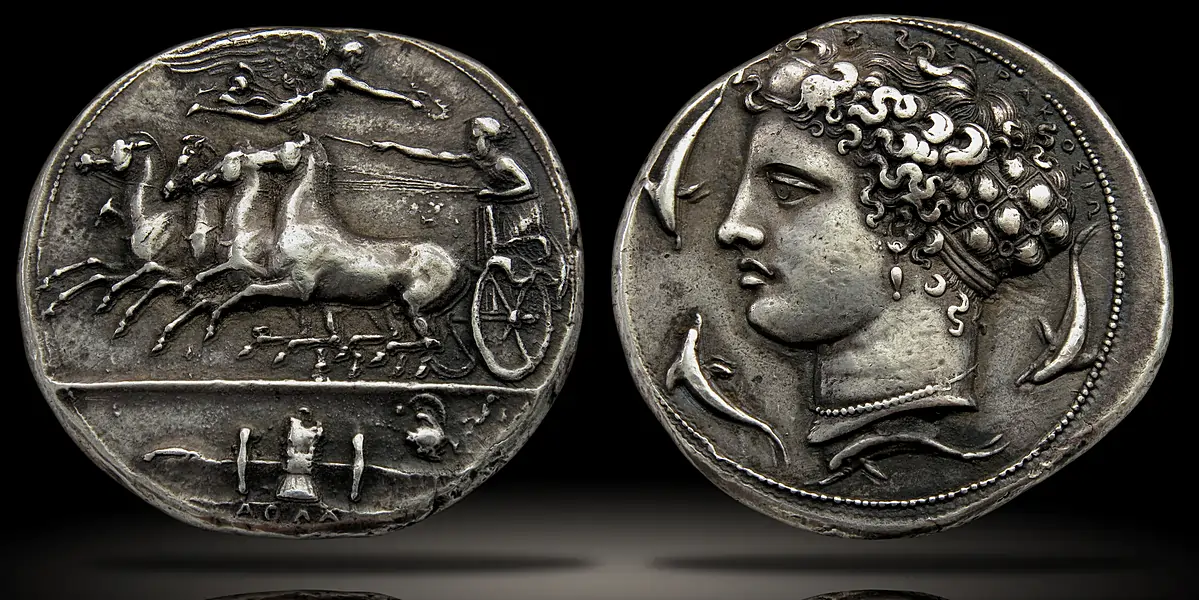
On several decadrachms, Kimon’s signature appears on the dolphin beneath Arethusa’s neck. In other cases, it is integrated into her metallic headband, often abbreviated as a single “K.” On these dies, Arethusa wears her hair drawn up into a net, creating a refined and controlled appearance.
A later tetradrachm signed by Kimon includes the name “Arethusa” inscribed above her head, although this inscription is off the flan on some surviving specimens. This choice reinforces the increasingly explicit identification of the figure and highlights the engraver’s confidence in his work.
Kimon was also responsible for one of the most celebrated innovations in Greek coinage: the three-quarter facing head of Arethusa. This daring composition required exceptional technical skill and would influence die engravers across the Greek world.
Euainetos: Refinement, Continuity, and Enduring Influence
Euainetos’ signed work appears slightly later than that of Kimon. Because of this chronological sequence and stylistic continuity, scholars have suggested that Euainetos may have been an apprentice or understudy of Kimon. This remains a possibility rather than a certainty.
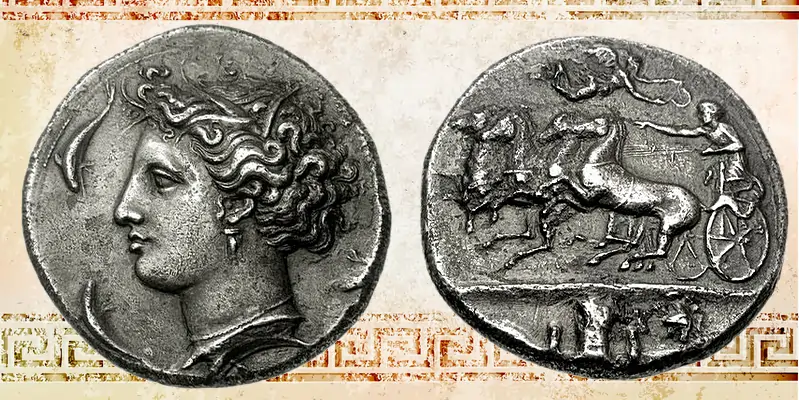
What is clear, however, is that Euainetos refined and extended the artistic vocabulary established by his predecessor.
On his dies, Arethusa wears a wreath of reeds rather than a metallic headband. Her hairstyle appears looser and more naturalistic, emphasizing movement and texture. The facial modeling is subtle, with carefully graduated contours that contrast with the energetic treatment of her hair.
Euainetos continued producing dies through the end of the reign of Dionysios I, just before the middle of the fourth century BCE. His influence endured long after that period, both within Syracuse and beyond.
Workshops, Assistants, and Mass Production
Despite their fame, Kimon and Euainetos likely engraved only a small number of master dies. These were then copied and reproduced by assistants within organized workshops.
This practice would explain the consistency of design across large outputs while preserving the distinctive stylistic hallmarks of each master. It also suggests a highly structured minting operation capable of meeting significant military and economic demand.
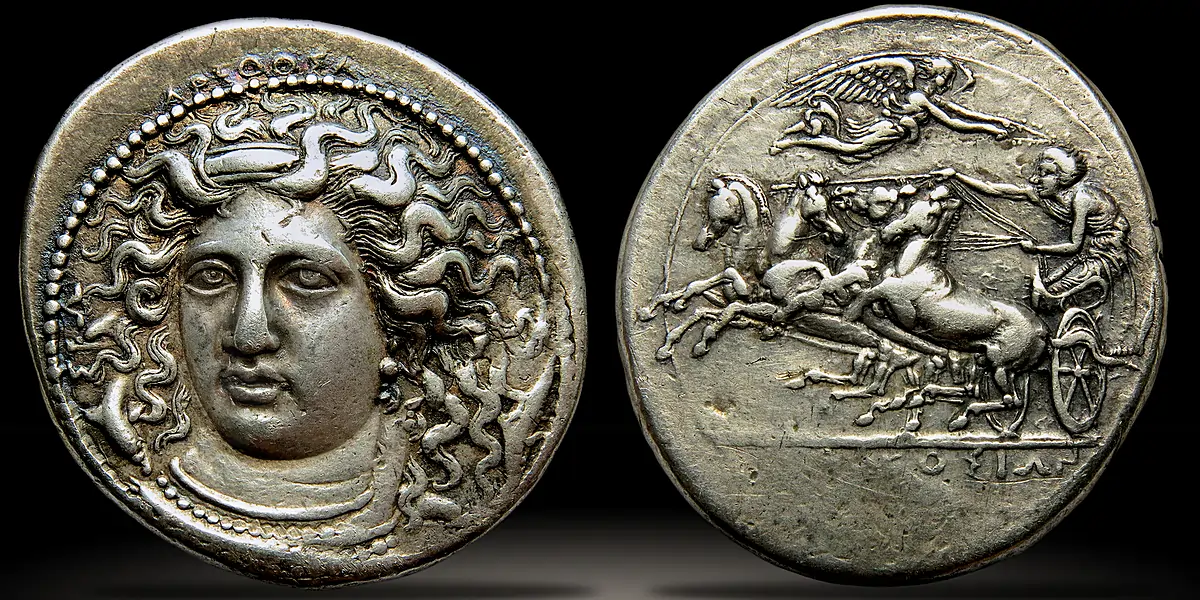
Kimon and Euainetos were also prolific beyond the decadrachm. Both engraved dies for tetradrachms, smaller silver denominations, and gold coins. During this period, facing heads were introduced more broadly into Greek coinage, representing a major artistic shift.
Other engravers were active as well. Eukleidas produced a remarkable facing portrait of Athena Parthenos at Syracuse. Euainetos engraved a facing head of the river god Hipparis at Kamarina. Herakleidas created a striking facing head of Apollo for Katane. Together, these artists defined a golden age of ancient numismatics.
Why Were the Dies Signed?
The decision by engravers to sign their dies remains imperfectly understood.
It was a bold departure from convention. Coinage traditionally emphasized the issuing authority rather than the individual artisan. Whether these signatures elevated the engravers’ social status is unknown.
Another unresolved question concerns the purpose of the decadrachms themselves. Many are inscribed with the Greek word ΑΘΛΑ, the plural of athlon, meaning both “games” and “prize.” One interpretation is that these coins were awarded as prizes in competitive events.
It is also possible that, during periods of political unrest, private workshops assumed control of minting operations. Under this model, contracts may have been awarded through competitions among engravers, with decadrachms serving as both payment and prestige objects. This interpretation remains scholarly conjecture rather than established fact.
Iconography: Arethusa and the Quadriga
The iconography of Syracusan coinage was deeply political and symbolic.
The quadriga honored the tyrants of Syracuse, who were among the wealthiest rulers in the Greek world. These leaders frequently sponsored chariot teams and hosted races as public spectacles. Victories enhanced their prestige and reinforced their authority.
The reverse image of Arethusa drew upon local myth. Pursued by a river god, the nymph sought the aid of Artemis and was transformed into an underground stream. She reemerged as a sacred spring on Ortygia, the historic heart of Syracuse.
On Kimon’s signed decadrachms, Arethusa appears facing left, adorned with an ampyx, necklace, earrings, and hair net. Four dolphins surround her head, with one often bearing the engraver’s signature. The ethnic inscription of Syracuse appears partially behind her portrait.
The level of detail in her hair, jewelry, and facial features remains astonishing, even by modern standards.
Technical Mastery and Die Wear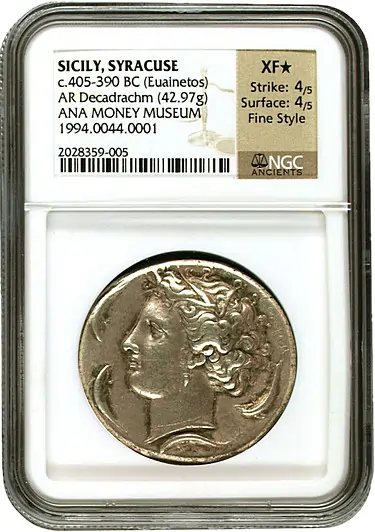
The exceptional relief of these dies came at a cost. Many surviving examples exhibit die breaks, particularly across Arethusa’s forehead, eye, and hair. These fractures are consistent with prolonged use and the mechanical stress imposed by deep engraving.
Roughness in the fields is sometimes present, though it is generally stable. Such features serve as reminders of the physical demands placed on these tools and the ambition of their creators.
On some decadrachms, Kimon signed his work three times. This rare practice leaves little doubt as to his pride in the achievement.
Legacy and Enduring Importance
Today, the decadrachms of Syracuse are among the most coveted coins in all of numismatics. Collectors prize them for their beauty, rarity, and historical significance.
More importantly, they stand as tangible evidence of the artistic heights achieved in ancient Greece. Through their work, Kimon and Euainetos transformed coinage from a functional medium into a vehicle for artistic expression.
Even centuries later, their influence remained visible. Their portraits were copied, adapted, and admired throughout the Greek world. In this sense, their names occupy a place in numismatics comparable to that of history’s most celebrated artists.
Within ancient coinage, few engravers are known by name. Fewer still are remembered as masters. Kimon and Euainetos belong firmly in that highest tier.