

What Is a VAM Dollar?
A VAM Dollar refers to a collectible die variety of a United States Morgan or Peace silver dollar. Collectors identify and catalog these varieties using the system developed by Leroy Van Allen and A. George Mallis, whose surnames form the acronym “VAM.”
These varieties result from differences in the working dies used to strike coins. Common diagnostics include doubled design elements, repunched mintmarks, die cracks, clashed dies, and other deviations that go beyond standard date-and-mint combinations. Importantly, all VAM dollars are normal, officially issued coins. However, some varieties are scarce, visually dramatic, or historically significant. As a result, they command strong interest from collectors and specialists.
Among hundreds of known VAMs, two 1888-O Morgan dollar varieties stand above the rest in terms of fame, demand, and market recognition: “Hot Lips” and “Scarface.”
The 1888-O “Hot Lips” Morgan Dollar
The 1888-O “Hot Lips” Morgan dollar ranks among the most famous die varieties in all of American numismatics.

Its appeal rests not only on its striking visual characteristics, but also on its central role in the development of Morgan dollar variety collecting.
A Coin That Changed Numismatic History

Before the early 1960s, Morgan dollars did not occupy the central place they hold in today’s hobby. That began to change when the U.S. Treasury Department released long-stored bags of uncirculated Morgan dollars into the marketplace. For the first time, collectors could search large quantities of coins directly. This shift made die variety collecting more accessible and more systematic.
A key moment occurred in 1963, when numismatist Francis X. Klaes published Die Varieties of Morgan Silver Dollars. The book included some of the first widely distributed photographs of Morgan dollar varieties. One of those illustrated coins was the 1888-O Hot Lips variety. Klaes is recognized as the discoverer of the variety.
Those images had a profound impact on Leroy Van Allen, who soon located a Hot Lips example of his own. That experience drew him deeply into variety research and ultimately led to the creation of the VAM cataloging system. Van Allen’s first book on Morgan dollar varieties appeared in 1971, marking a foundational moment for the field.
Dramatic Die Doubling
The defining feature of the Hot Lips variety is dramatic die doubling on the obverse portrait of Liberty.
Die doubling occurs when a working die receives more than one misaligned impression during its creation. When that die strikes coins, elements of the design appear doubled. In some cases, the effect is subtle. In others, it is unmistakable.
On the 1888-O Hot Lips dollar, the doubling is especially pronounced on Liberty’s lips. Strong examples show what appears to be a complete second set of lips superimposed over the upper lip. Additional doubling may also appear on the nose and other facial features. While doubled inscriptions are more familiar to many collectors—such as the famous 1955 Doubled Die Obverse Lincoln cent—this variety demonstrates how dramatic doubling can be in portrait details as well.
The nickname “Hot Lips” emerged organically from the coin’s appearance and has remained part of numismatic vocabulary ever since. While popular culture associations are sometimes suggested, no documented connection exists, and such parallels remain speculative.
Market Values and Collector Demand
The 1888-O Hot Lips remains a high-demand variety across all grades. About Uncirculated examples can reach prices near $10,000, while Mint State coins often exceed twice that level. Extra Fine specimens typically sell for several hundred dollars. Prices become comparatively accessible only in lower circulated grades, such as Fine.
The 1888-O “Scarface” Morgan Dollar
If Hot Lips is known for precision doubling, Scarface commands attention through sheer visual impact.

A Late-Stage Die Break
The 1888-O Scarface Morgan dollar features a prominent raised line that runs across Liberty’s cheek, jaw, and neck. The effect resembles a deep scar, giving the variety its enduring nickname.
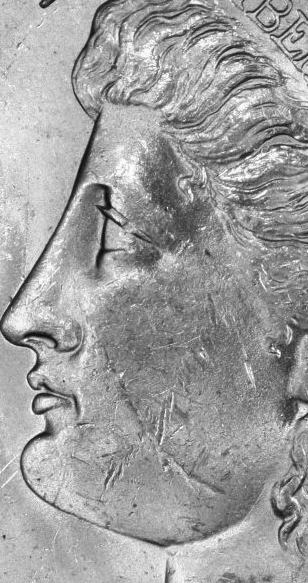
This feature results from a late-stage die break. In numismatics, a die break refers to a crack in the die, not a complete fracture. A fully broken die would be incapable of striking coins. However, in advanced stages, these cracks can widen and deepen, producing bold raised lines on the struck coin.
Scarface represents one of these advanced die states, making it among the most dramatic die break varieties in the Morgan dollar series.
Understanding Die States
To fully appreciate Scarface, it helps to understand die states. Numismatists describe a die’s life cycle in three general stages:
- An early die state reflects a newly prepared die. Design elements appear sharp, surfaces are relatively clean, and defects are minimal.
- A middle die state shows increasing wear or minor repairs. Coins struck at this stage often display early cracks, polishing lines, or softened details.
- A late die state represents the final phase of a die’s usable life. These dies often exhibit extensive cracks, heavy wear, or metal displacement. While attractive coins can still result, quality was not the primary concern at this stage. The Mint’s priority was production.
Scarface originates from this final phase.
The New Orleans Mint Context
The New Orleans Mint served as the primary business-strike workhorse during much of the Morgan dollar era. Many New Orleans issues show weaker strikes compared to coins from other mints. Against that backdrop, a visually strong late-stage variety such as Scarface becomes especially desirable.
Low Mint State examples routinely command prices in the several-thousand-dollar range, reflecting both scarcity and collector demand.
Why These Varieties Matter
The enduring popularity of Hot Lips and Scarface underscores an important truth about coin collecting. Perfection alone does not define desirability. Instead, history, process, and character often matter just as much.
These two varieties illustrate the human and mechanical realities of 19th-century coinage. They also demonstrate how overlooked production quirks evolved into some of the most celebrated collectibles in the marketplace today.
More than a century after their creation, Hot Lips and Scarface remain benchmarks for Morgan dollar variety collecting—and gateways for new collectors entering the world of VAMs.


Splendid explanations. What can you tell me about the VAM1C variety for the 1888-O Morgan dollar?. I’ve been on a mission for > decade, collecting every O-mint Morgan, with the intention of completing a Gem or highest grade collection, or as high grade ad possible, the mission being to have representations of every O-mint variety particularly noted in Bowers Morgan book, and Coin Facts…I have 17 (of 26) MS 65 or greater O-mints. some are not achievable in Gem,,,,so I have an 1886-O ms63+, 1891-O ms64+ (1892-O is ms65) , 1893-O ms61, 1894-O ms62, raw (not yet graded) 1895-O, 1896-O ms 61 and 4 BU 1896’s, one in a ring of cobalt blue, not yet graded. And yes, it’s been very difficult to find reasonable grades or a coin I am willing to purchase—the Hotlips & Scarface varieties will be essential to a complete O-mint Morgan collection, although mint state, as noted, is not available. I am willing to drop some funds for the right coin, but not 10grand. I would readily drop 1/4 that for an appealing AU of either 1888-O variety, and up to 5 K, if I really like the coin–all I need is availability! Anyway, besides these famous two, what can you tell me (if anything) about the VAM1C 1888-O Morgan? I’m curious. I love your write-up! Peace.
Great info thanks!
Interesting article! The only “hot lips” I knew of before this article was Major Margaret “Hot Lips” Houlihan on MASH!
I really have not delved into varieties much (just the Bicentennial Ike Dollars really). This makes me want to check these out more.
I like those old Morgans.
Another very informative article. Keep up the good work.
I would love to own one of these!!!
Great article
I think they go a little crazy with VAMs , every little hair or minor die crack becomes a VAM. I do have a spitting eagle 1891 CC though.
I have noticed that after a while they will reclassify; presuming that they lump similar variations into one type.
It makes sense, as you will have coins with the same type of variation, yet at a different stage of a run.
I look at mine and don’t always see the pictured variation. I don’t assume it is rare, but just one that many haven’t registered being in a much later stage of the minting process.
I hope they go more crazy (deeper study) with VAMs, yet also become more specific as to condense them as well. Heck, is it any more crazy than what they label graded modern coins with “advanced delivery”, “first day of issue”, “first strike”, or “last day of issue”. I would say that is more crazy.
Another day, another (new) error.
The explanation you give is great. Even I can understand and have a better grasp.
I definitely prefer “hot lips” over “scarface”. Great article.
Love the nicknames.
I’m going to have to go back and check mine.
The first coin I ever received and kept was an 1881 silver dollar. It was in a Christmas stocking my dad’s employer distributed at their annual Christmas party in the early 60s.
excellent description of these errors. Thank you.
Well, my grandfather told me to try to learn something new each day…..I just did!
Thank you for a concise article with clear photos. A new list of things to look for.
Good info about this coin
Thanks for the article! All of these die variations are very interesting.
Something to search for among those O – mint Morgan dollars.
Very interesting article.
Interesting and informative.
Awesome
interesteing article
would love to own a Morgan
Great article! There’s info in here that I have never seen. Well researched!
One of my favorite parts of the Hobby, the hunt for that little extra on a coin.
The scarface variety is my favorite.
Good to know.
One of the prettiest coins! Thank you for posting different types of errors for us to look for.
Great article! Learned something new about O mint mark Morgans. I have a low grade “Hot lips” Morgan. Looking for a bargain Scareface Morgan to add to my top 100 VAMs collection.
Never knew of these. Thanks!
Another great article. Thanks.
I think some coin graders should read more articles like this.
I had a bunch of coins graded by one of the big 3 companies and a few I was beyond disappointed with. One coin, being a nice 1890-O, which I would have graded a minimum MS62 with a soft strike. After reading this article, I would classify it as the middle die state. It has a weak center strike like many O’s do, but I wasted fiat currency when they didn’t grade it at all, and insulted me by saying it was polished.
Do they not know about die states or polished dies? Or do they assume because it looks good that someone must have polished it? I know polished coins. I have some of them and they lose that natural luster. I did not send anything remotely like that to be graded.
I am also a bit upset that these so-called big 3 don’t really do VAM, but you have to twist their arm and do the work for them. ANACS, who seems to often be belittled, does designate VAM. I don’t work or get any benefit from them, but why do they seem to recognize these specialized variations, while the big dogs seem historically lazy?
Always enjoying learning new things!
Loved the information in this article and all your other articles too. Wish I could afford to
own some of these coins.
I have a number of Top 100 Vams in my collection. I had been focusing on them for a few years some time ago but I havent added to what I currently have for some time….. I find them fascinating…
There’s always something new to learn great article
Sometimes it is a fine line between scratches and collectible varieties.
Always wondered about the “hot lips variety”. Now I know, Thank you!