

A Discovery That Rewrites What We Know
Every so often, a coin surfaces that forces collectors to rethink what is possible. This newly documented 1963 Franklin Half Dollar does exactly that. It was struck on a 75% silver, 25% copper planchet and weighs 12.60 grams, a composition that does not match standard U.S. Mint specifications.
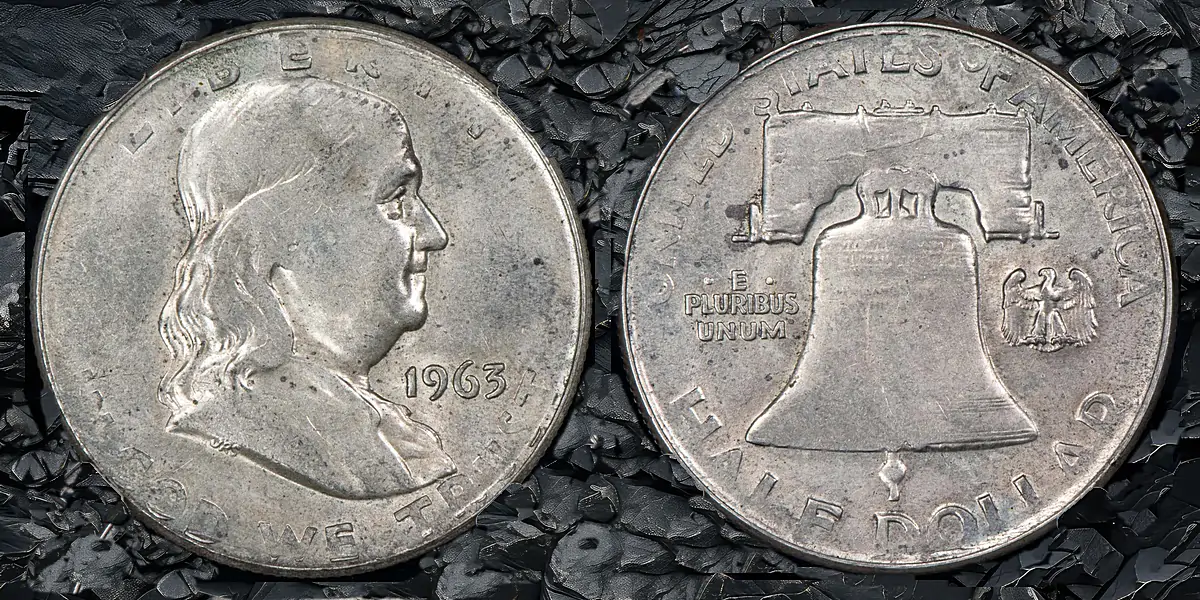
Even more compelling, the piece has been authenticated and certified by NGC as a mint error. Yet, the evidence suggests something far more significant. This coin may not simply be an error. Instead, it likely represents an experimental test strike tied to one of the most important transitions in U.S. coinage history.
The Crisis That Changed American Coinage
To understand this coin, we must return to the early 1960s.
By 1963, the United States faced a growing silver shortage. Government data revealed a deficit of 209 million ounces of silver, while demand for circulating coinage continued to rise. As silver prices climbed, the Treasury Department needed a solution, and fast.
Therefore, officials turned to outside expertise. In 1963, the Treasury contracted the Battelle Memorial Institute to study alternative metallic compositions for U.S. coins.
This decision set the stage for sweeping change.
Experimental Coins and the Martha Washington Designs
Battelle did not work alone. The U.S. Mint actively participated in testing new alloys. Together, they produced experimental coins using a special set of dies.
Sculptor-engraver Edward R. Grove designed the obverse featuring Martha Washington
Sculptor-engraver Philip Fowler created the Mount Vernon reverse
These dies were used to strike dime-, quarter-, and half dollar-sized experimental pieces in a wide range of compositions, including:
- Silver-copper alloys
- Silver-clad materials
- Fully clad compositions
Importantly, these experiments were not always fully documented. As a result, new discoveries continue to emerge decades later.
A Coin Without a Perfect Match
The 1963 Franklin Half Dollar in question does not match any officially recorded experimental composition from the Battelle report. However, that fact does not weaken its case, it strengthens it.
Why? Because the historical record is incomplete.
The U.S. Mint has a long tradition of producing experimental and pattern coins dating back to its founding in 1792. Yet, many of these pieces exist only as brief mentions in government reports. Others were never recorded at all.
Therefore, when a coin appears with a precise but unusual composition, like 75% silver and 25% copper, it demands serious attention.
Physical Evidence Points to an Experimental Strike
This coin tells its story through its physical characteristics:
- Weak strike: The harder alloy resisted full detail under standard striking pressure
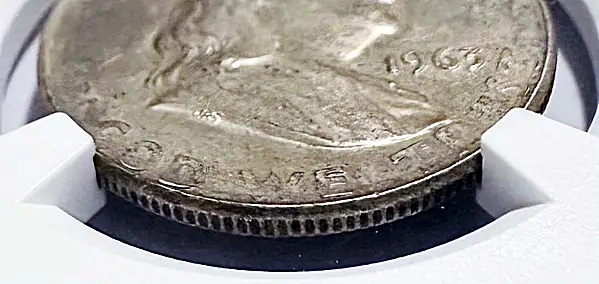
- Partial collar: The planchet did not seat properly during striking
- Incomplete reeding: Visible only along part of the edge
- Uncirculated condition: Full luster with light, original toning
These traits align with known experimental and off-metal strikes. Because the dies were calibrated for standard 90% silver planchets, the different alloy produced an imperfect impression.
Eliminating the Alternatives
Experienced specialists quickly ruled out two common explanations.
Not a Foreign Planchet
The U.S. Mint did strike coins for foreign nations. However, none match this composition and size. While the Mint produced 75% silver coins for the Philippines, those planchets were smaller and thinner than a Franklin Half Dollar.
Not an Improper Alloy Mix
NGC conducted metallurgical analysis and confirmed a precise 75% silver / 25% copper ratio. That level of consistency does not occur in accidental alloy errors.
Improper alloy errors typically show only slight deviations from standard compositions. For example, a mix close to 90% silver would suggest a blending issue. This coin does not fit that pattern.
The Most Likely Scenario
So what happened?
The most logical explanation ties directly to the Mint’s experimental program.
During the early 1960s, the Mint tested multiple silver-copper ratios. Therefore, a 75% silver planchet could have been:
Intentionally placed into the press for testing with Franklin dies
Accidentally mixed with standard planchets during production
Either scenario leads to the same conclusion. This coin was struck during a critical transitional period, when the Mint actively experimented with new compositions.
A Pattern of “Impossible” Errors

Although unique, this coin is not without precedent.
The U.S. Mint has a documented history of striking coins on the wrong planchets during periods of change. Famous examples include:
- 1943 copper Lincoln cents
- 1944 steel Lincoln cents
- Eisenhower dollars struck on silver planchets
These cases prove an important point. Even in highly controlled environments, planchet mix-ups do occur, especially during transitions.
Why This Coin Matters
This 1963 Franklin Half Dollar stands at the crossroads of history.
It represents:
- The end of 90% silver coinage
- An experimental phase leading to clad coinage
- A incomplete documentation of Mint testing programs
Most importantly, it reminds us that numismatics is still evolving. New discoveries continue to reshape our understanding of the past.
Final Thoughts: A Coin That Bridges Two Eras
This coin is more than a mint error. It is a physical artifact from a moment when the U.S. Mint faced unprecedented pressure to modernize.
Because of that, it occupies a rare space in numismatics, somewhere between error, pattern, and experimental strike.
And that is what gives it its “wow” factor.
Coins like this do not just fill holes in collections. They fill gaps in history.

Interesting
As a collector of Franklin Halves this is very interesting. Particularly that there may be coins, perhaps even Franklins, that were never recorded. Especially experimental ones.
Imagine how many experimental coins went to the refinery because no one recognized them as 75% Silver 25% Copper.
Fascinating article!
I wonder if other “test” examples would typically be destroyed. If not, I imagine there are other similar examples still in existence.