


By Vic Bozarth for PCGS ……
The Panama-Pacific Exposition ranked among the largest and most popular world fairs, drawing millions of visitors over several months. Earlier expositions had taken place in the western United States, including the 1905 Lewis and Clark Expo in Portland, Oregon, but no world’s fairs had occurred west of St. Louis. Organizers did not consider the Lewis and Clark Exposition a true world’s fair.
The West Wants a World’s Fair
The 1906 earthquake devastated San Francisco, but nearly a decade later, the city sought to showcase its revival and growth after the region recovered. World’s fairs resemble large circuses that stay in one place, but they require far more complex logistics and financing. Organizers typically keep these events open to the public for months, while construction takes several years beforehand and demolition can require another year afterward.
Two key themes connect the first five expositions covered in my recent series: remarkable cooperation and strong support from countless individuals, companies, and government entities. These groups drove the success of each event. Thousands of people contributed, and planners often began their work years in advance.
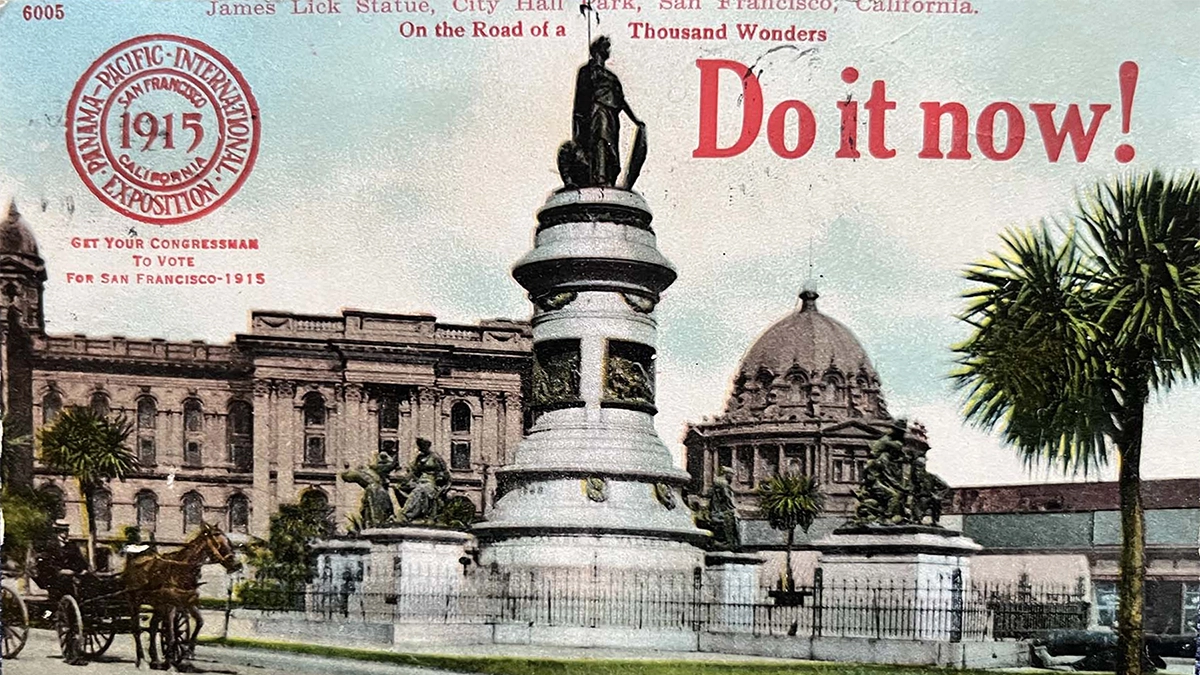
The postcard pictured above helped solicit support for a potential Panama-Pacific Exposition. It featured two messages: “Do It Now!” and “Get your congressman to vote for San Francisco-1915.” Someone mailed and postmarked it from Woodland, California, to Blacks Station, California, in 1910, five full years before the fair.
Organizing the Exposition
Although San Diego already hosted another fair, organizers in San Francisco quickly built momentum for their own exposition. Builders undertook major construction projects to create the grounds and facilities, complete with lavish buildings and landscaped areas. Planners also addressed what would happen after the fair, often intending to remove most buildings and structures.
Beginning with the Columbian Exposition, builders used a construction method known as “staff” for many of the largest buildings and structures. This material, similar to concrete, combined plaster, cement, and jute fiber and lasted for the duration of the fair without serving as a permanent solution. Others described staff as a mixture of plaster of Paris and hemp fibers applied over a wooden frame.
Although builders intended some structures to remain, such as the New York State Building at the 1901 Pan-American Expo in Buffalo, New York, they designed most buildings and fairgrounds for temporary use. After each fair ended, crews returned the grounds to their original state or repurposed the land. The use of staff significantly reduced construction costs and made demolition faster and easier.
Panama-Pacific Commemorative Coins
The Panama-Pacific Exposition commemorative issues represented the pinnacle of classic U.S. commemorative coin production. The San Francisco Mint struck a $2.50 gold quarter eagle, two $50 gold coins, one round and one octagonal that echoed Gold Rush-era slugs, a commemorative half dollar, and a gold dollar. Numismatic promoter Farran Zerbe offered the complete five-coin set and provided specially made holders that collectors still prize today.
The United States Mint-issued coins for the Panama-Pacific Exposition include:
- PCGS #9357 – 1915-S Panama-Pacific Half Dollar
- PCGS #7449 – 1915-S Panama-Pacific Gold Dollar
- PCGS #7450 – 1915-S Panama-Pacific Quarter Eagle
- PCGS #7451 – 1915-S Panama-Pacific $50 Round
- PCGS #7452 – 1915-S Panama-Pacific $50 Octagonal

Medals from the Panama-Pacific Exposition
Like earlier fairs and expositions, organizers produced medals and tokens for the Panama-Pacific Exposition alongside the official U.S. Mint coin issues.
Many people overlook the problems and delays that affected production of the Panama-Pacific commemorative coinage. The Mint did not offer the coins for sale when the fair opened. Weeks, and even months, passed during the event without commemoratives available for purchase. As a result, sales fell short of expectations, and visitors often chose other souvenirs, such as medals or tokens.
The U.S. Mint created a single official Panama-Pacific Expo medal design, which collectors list among So-Called Dollars as:
- PCGS #513227, HK-399 – Silver $1; $1.50 or $2 Swoger (Rarity-5)
- HK-400 – Bronze 25 Cents (R-4)
- PCGS #514203, HK-401 – Gilt 50 Cents (R-4)
American sculptor Robert Aitken designed the official commemorative medal, and the Department of Official Coins and Medals sold it under the direction of Farran Zerbe. Workers struck these medals at the Mint Exhibit on the fairgrounds, where A.W. Downing of the Philadelphia Mint operated the press. As they had at the St. Louis and Portland expositions, staff offered mounting or added a loop to the medals for a small additional charge.

Aitken’s design for the Panama-Pacific official medal ranks among the most attractive U.S. Mint commemorative medal designs. His talent also stands out on the 1915-S Panama-Pacific $50 Round and Octagonal coins, both of which he designed. Collectors also value his work on the 1921 Missouri Commemorative Half Dollar and the 1935 and 1936 San Diego Commemorative Half Dollars for the California Pacific International Exposition.
The So Called Dollars
The Panama-Pacific Exposition also featured additional medals, including So-Called Dollar numbers HK-402 through HK-425. Collectors often refer to many of these pieces as State Fund Dollars. Individual states that participated in the exposition sponsored these medals and sold them in advance to raise funds for their exhibits. Most states sold the medals for $1 and struck them in bronze, though some issued pieces in other metals.
The State Fund Dollar series includes issues from Alabama, Arkansas, Florida, Georgia, Kentucky, Louisiana, Maryland, Mississippi, Montana, North Carolina, Oregon, South Carolina, and Tennessee. These medals span HK-402 for Alabama through HK-413a.
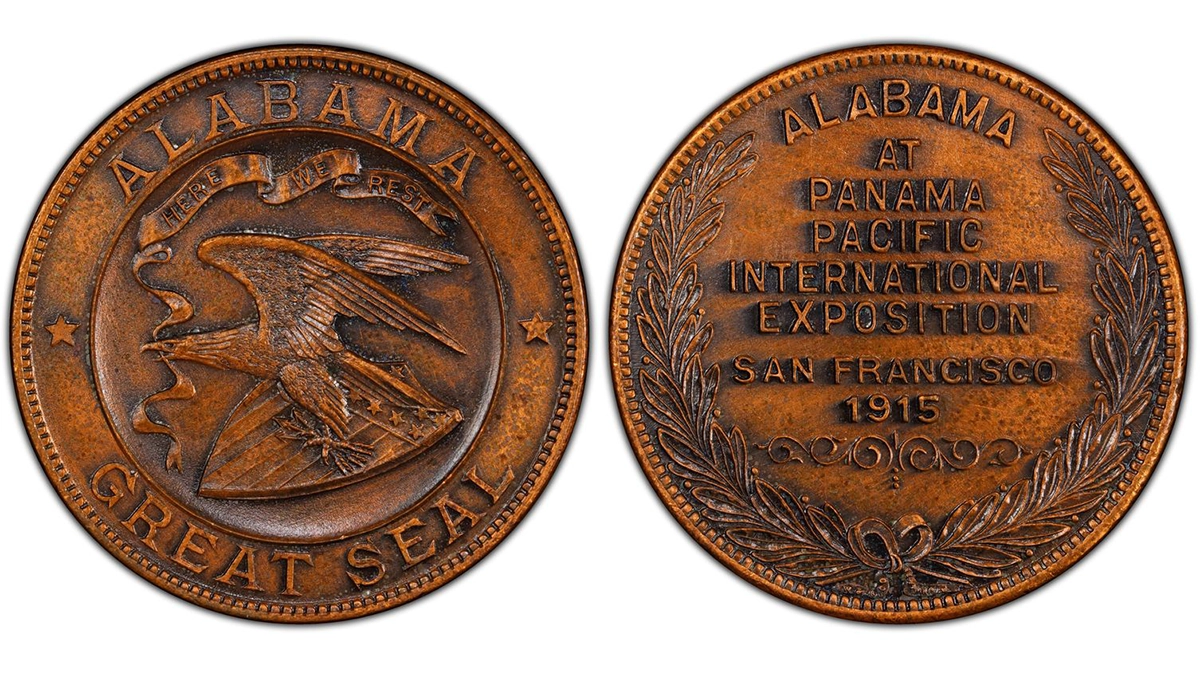
Another group of So-Called Dollars Medals are called Exposition State Medals and comprise HK-414 through HK-416a. Several of these impressive medals share the Tower of Jewels motif and/or a ship passing through the completed Panama Canal as the central designs.

Several other Panama-Pacific Exposition So-Called Dollars offer interesting designs, including the Exposition City, Baroque Shield, Four Portraits, and U.S. Expositions types, which span HK-417 through HK-422. Among the most intriguing pieces, two octagonal designs echo one of the most iconic Territorial $50 gold issues. Collectors identify the Type One pieces as HK-423 and HK-424 in gilt, while HK-425 represents the Type Two example, also struck in gilt. Collectors prize both types for their distinctive octagonal shape.
- PCGS #643928, HK-423 – Silver Plated (R-8)
- PCGS #643929, HK-424 – Gilt Bronze (R-6)
- PCGS #803593, HK-424b – Gilt Bronze Uniface NL in So-Called Dollars book
- PCGS #643930, HK-425 – Gilt Bronze (R-6)
Irvine & Jachens of Daly City, California, produced these medals using oreide, a commercial bronze alloy.

HK-1030 is a Panama-Pacific Medal listed in So-Called Dollars as a “gold dollar” and issued by coin dealer Thomas Elder, who had the medal struck in 1910 in anticipation of the exposition. This 19-millimeter gold Proof medal was privately made by a New York City jeweler named H. Kroll.
Other Panama-Pacific Expo Souvenirs
The big attraction of the Panama-Pacific Exposition was the Tower of Jewels, an edifice covered with thousands of faceted crystals. Its reflectivity and brilliance was enhanced by crystals in multiple colors. Batteries of searchlights magnified the Tower of Jewels’ gorgeous spectacle at night. Visitors left the exposition with a sense of awe having never before experienced color and light in such amazing clarity. In many ways, the Tower of Jewels was the first true “light show” of the 20th century.
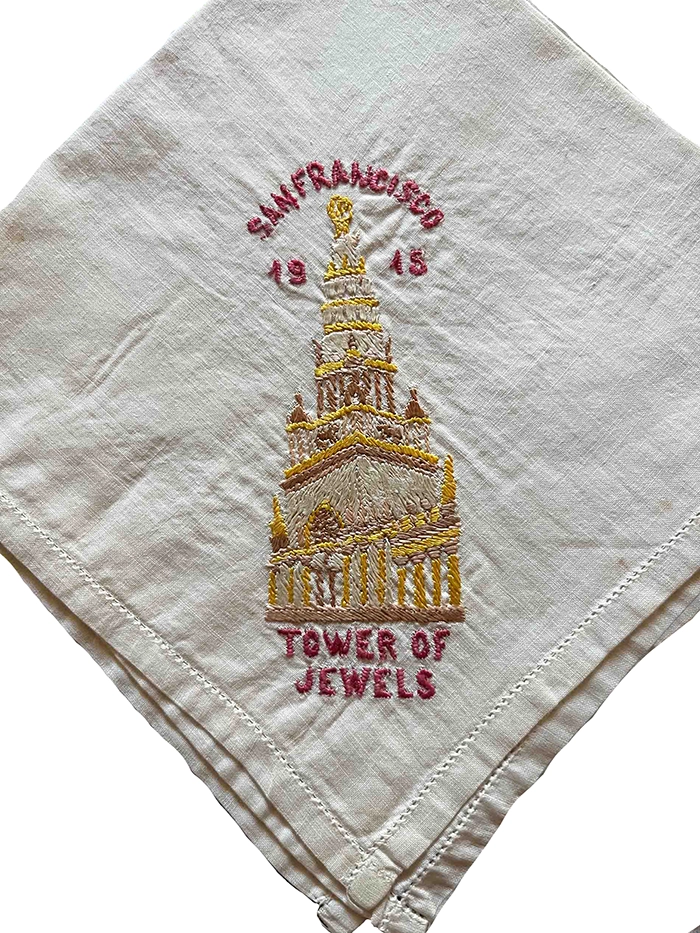
Visitors to the fair were treated to many intriguing sights and sounds, as well as new technologies and products. Many visitors were Californians, but scores of others traveled substantial distances and made arrangements for accommodations while traveling and visiting the fair. How did one make reservations for both the travel and the stay in 1915?
How to Get There
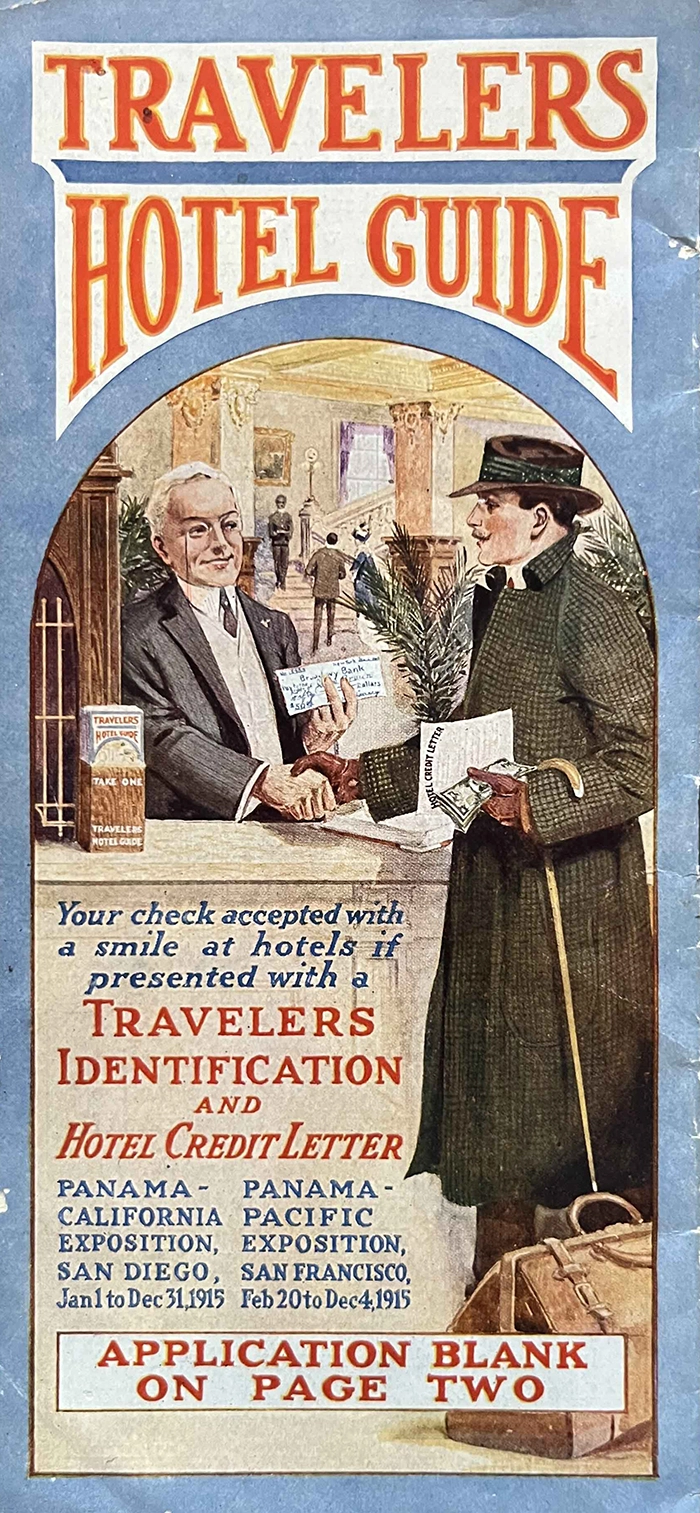
Logistics for personal travel in 1915 were quite daunting. The Travelers Hotel Guide was a 20-page advertisement focusing on the potential attendees for both the Panama–Pacific Exposition in San Francisco and the Panama-California Exposition being held in San Diego. Basically this is an early letter of credit one could present when traveling to not only secure lodging but also cash personal checks. The guide lists hundreds of participating hotels across the U.S. in 1915.
Postcards from the fair were immensely popular. After all, bragging rights are a big deal. No kidding, the social media of the day were postcards. With very inexpensive postage (one cent domestic, two cents international!), an interesting subject, and space to write a small personal message, this was the preferred medium of exchange in 1915.

The Panama-Pacific Exposition was a great success. The coins and medals struck for the fair are some of the most iconic of the U.S. commemorative coin series. The locale of the event, too, is historic, with the five expo-related coins being the first U.S. commemorative coins struck at the San Francisco Mint.
Eleven years would pass before another major exposition was held, this time in Philadelphia for the United States Sesquicentennial (150th anniversary) in 1926.
* * *
For more information from PCGS, the sponsor of this article, click on the image below.
* * *







Good stuff Vic!
I have a question: Is a souvenir coin from the Panama Pacific International Exposition of interest to collectors?
This souvenir coin is approximately 3.8mm in diameter, and appears to be bronze. One side reads “State Of Oregon – 1859” and in small print the words “THE UNION”. The other side reads “Panama Pacific International Exposition – San Francisco 1915” with an engraving of a building in perspective, which is labeled “OREGON STATE BUILDING”.
Great stuff
I have the Silver Half in MS65. I also have 2 pieces of the Florida State Panama-Pacific Silver Half as well. Great article.
OMG, I LOVE the history!
Vic,
I have one of the souvenir “slugs” HK 424. This has the CG Brinker line on the bottom, but it looks to have some doubling, or ghost letters. Any advice as to where I might get more information?
Thanks.