By Roger W. Burdette, special to CoinWeek …..
The 1915 Panama-Pacific International Exposition boasted more high-quality numismatic designs than any other American exposition before or since. There were four distinctive official United States commemoratives: a gold one-dollar coin designed by Charles Keck; a silver half dollar and gold $2.50 quarter eagle designed by United States Mint Chief Engraver Charles E. Barber and engraver George T. Morgan; and round and octagonal $50 gold coins designed by Robert Aitken. A souvenir medal struck at the exposition was designed by Robert Aiken, and an official Medal of Award, the subject of this column, was designed by sculptor John Flanagan.
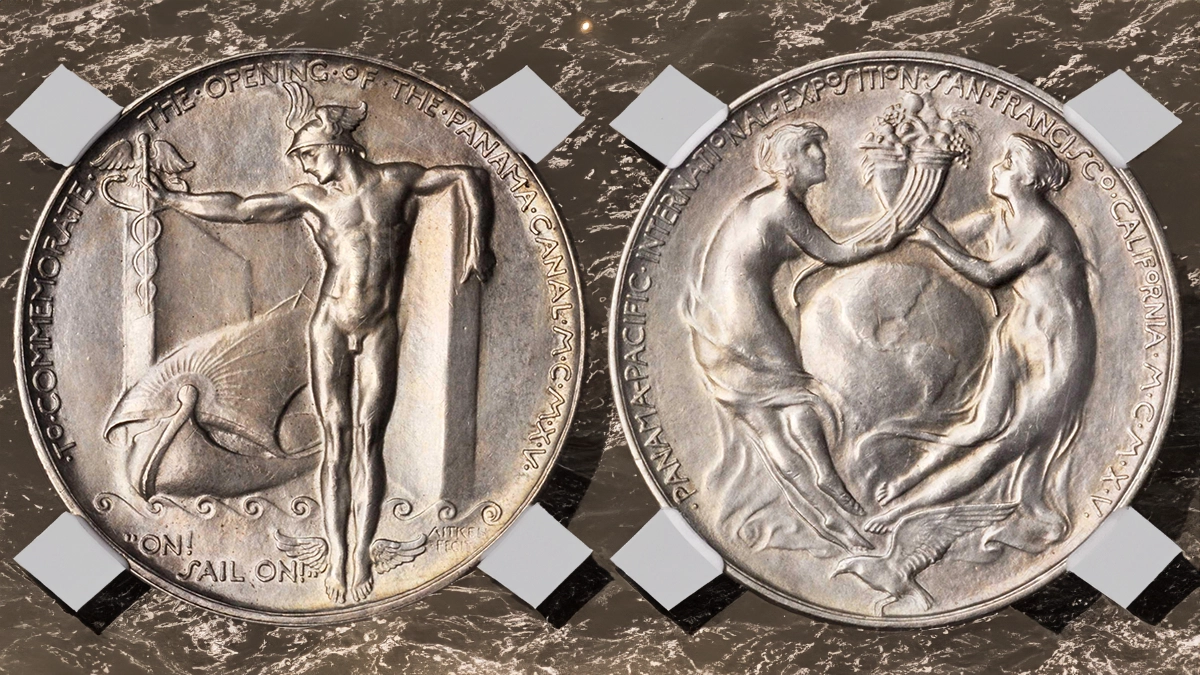
Aitken’s design (above) was unencumbered, more easily understood, and produced in larger quantities. But it was Flanagan’s work that was highly prized by Exposition participants. Award medals and certificates of merit (also called “diplomas”) were used by winners to brag about their achievements and promote their products to the public. Engravings of these awards often appeared on company letterhead and in brochures and advertisements many years after the event.[1]
Printed diplomas and award medals were generic items later customized by the Panama-Pacific International Exposition Committee. Diplomas were delivered to the Panama-Pacific International Exposition International Award System Committee with a blank space above the rainbow. A printing company in San Francisco added the words “gold medal”, “silver medal”, “bronze medal”, and so forth as required. A typist then added the recipient’s name, location, and product. As can be seen in the illustration, typed characters were not always uniform or evenly aligned.

A similar approach was adopted for award medals. All were struck at the Philadelphia Mint in bronze on hydraulic medal presses. All of these were delivered to Panama-Pacific International Exposition offices to have the gold and silver award medals thinly plated with the appropriate metal. Bronze awards were delivered as they came from the Mint.
The medals measure 69.85 millimeters (2.75 inches) in diameter[3] and weigh 133 grams. The obverse features two nudes representing the Atlantic and Pacific oceans arising from the sea to join at the Isthmus of Panama. The inscription is DIVINE DISTIVNCTA IVNXIT HOMO (“Man United What Was Divinely Separated”). Flanagan’s monogram JF is in the center of the final “O” in HOMO. The reverse shows a detailed rendering of architect Thomas Hastings’s 435-foot Tower of Jewels[4] behind sculptor Alexander Stirling Calder’s Fountain of Energy. The inscriptions are PANAMA-PACIFIC INTERNATIONAL EXPOSITION / MCMXV. Lower in the center on a plain cartouche is MEDAL OF AWARD. Unlike the 1892-3 Columbian Exposition medal, there was no place for a recipient’s name. Thus, all the medals are anonymous and attested to only by the diplomas.

Following the exposition, 20,000 medals were distributed.[5] They were struck in batches of 500 or 1,000 pieces and delivered from November 5, 1915, through December 20, 1916. Manufacture was a little unusual.
Normally, a medal received finishing treatment with chemicals or sandblasting to impart its final appearance. That was done for 3,000 bronze medals intended to be issued without change. However, these finishing processes interfered with uniform silver and gold plating. This meant that the Mint’s Medal Department had to prepare 17,000 smooth surface (“satin”) medals without the usual “antiquing” enhancements expected of artistic medals. Exposition officials had the smooth medals plated and evidently the contractor attempted to improve their appearance. The work was not successful, and many plated specimens are dull and unattractive.[6]
Several award recipients wanted their medals struck in real silver or gold, and the Mint Bureau was prepared to accommodate them. The first request seems to have been in October or early November 1915.
Will you please advise the Bureau by return mail of the cost of striking a Panama-Pacific International Exposition medal in silver, it being understood that the person desiring such a medal shall present a certificate from the Exposition Company that he is entitled to such a medal in that metal. I would suggest that if such requests are received in due form from individuals, the Mint should be reimbursed for the cost of making the medal, as well as for the cost of the metal contained.[7]
The next we hear of silver or gold medals is about six months later.
Referring to your letter of the 24th instant stating that the cost of silver medals of award of the Panama-Pacific International Exposition will be $2.50 in addition to the cost of the silver, which varies from day to day, I beg to request that a definite price be stated. If $6.00 will cover the cost of the silver and that of making the medal, I would prefer to state such a price. If, in your estimation, that is not enough, please state the amount which should be named.[8]
Checking available U.S. Mint medal records failed to show any solid gold or silver medals. However, there are several fine silver examples known, and at least one fine gold medal is supposed to exist. A copy struck in fine silver (0.999) should weigh about 5.01 Troy ounces, and a 0.999 gold strike would weigh approximately 9.21 Troy ounces. A silver medal would have cost about $6 and a gold version about $195 in 1915-16.
* * *
Notes
[1] RG104 E-235 Vol 411. Memorandum for Philadelphia Mint dated July 30, 1915, noting approval of the Solicitor of the Treasury for advertising use.
[2] [untitled article “At the Panama Exhibition,”] Oamaru Mail, August 28, 1915. 4. National Library of New Zealand.
[3] The official diameter is 2.75 inches. Some sources say the diameter is 70.6 mm, and others state 71.1 mm.
[4] According to SanFranciscomemories.com, the “radiance of the 435-foot Tower of Jewels came from huge searchlights aimed at it from a circle of hidden stations. Perhaps the most exquisite and dazzling feature of the fair, the Tower, with its 102,000 pieces of glittering multicolored cut Bohemian glass, optimistically called “Novagems,” refracted and reflected both sunlight and nighttime illumination. The glass pieces were 47mm wide and backed by mirrors. They were mounted on brass hangers with a small mirror behind them to further increase their reflectivity, and individually attached to the structure so they would move in the wind. This created a shimmering effect over the building’s façade.”
[5] This is the quantity ordered and delivered according to Exposition Company letters and Mint records. Some sources state 20,344 without explaining the difference.
[6] A gold-plated example graded NGC MS65 was offered by Tipsico Coin Co. of Eagle, Indiana in 2019. This showed sloppy plating and antiquing which resembled dirt buildup.
[7] RG104 E-235 Vol 412. Letter dated November 4, 1915, to Joyce from Woolley.
[8] RG104 E-235 Vol 414. Letter dated March 27, 1916, to Joyce from Woolley. The price of $6 assumes about 5 ounces of fine silver would be used at $0.66 per ounce. The direct wants to simplify transactions by quoting potential buyers a price that covers any reasonable increase in silver cost.
* * *