


ReverseBy CoinWeek
Collectors enjoy the Franklin half dollar for many reasons. Some chase the famous “Bugs Bunny” pieces for their nickname and visual charm. Yet when specialists talk about the series’ most dramatic proof variety, they almost always return to one coin: the 1961 Proof Doubled Die Reverse Franklin half dollar. PCGS calls it one of the most dramatic, exciting, and valuable Franklin half dollars, while Stack’s Bowers has described it as the strongest known doubled die in the series.
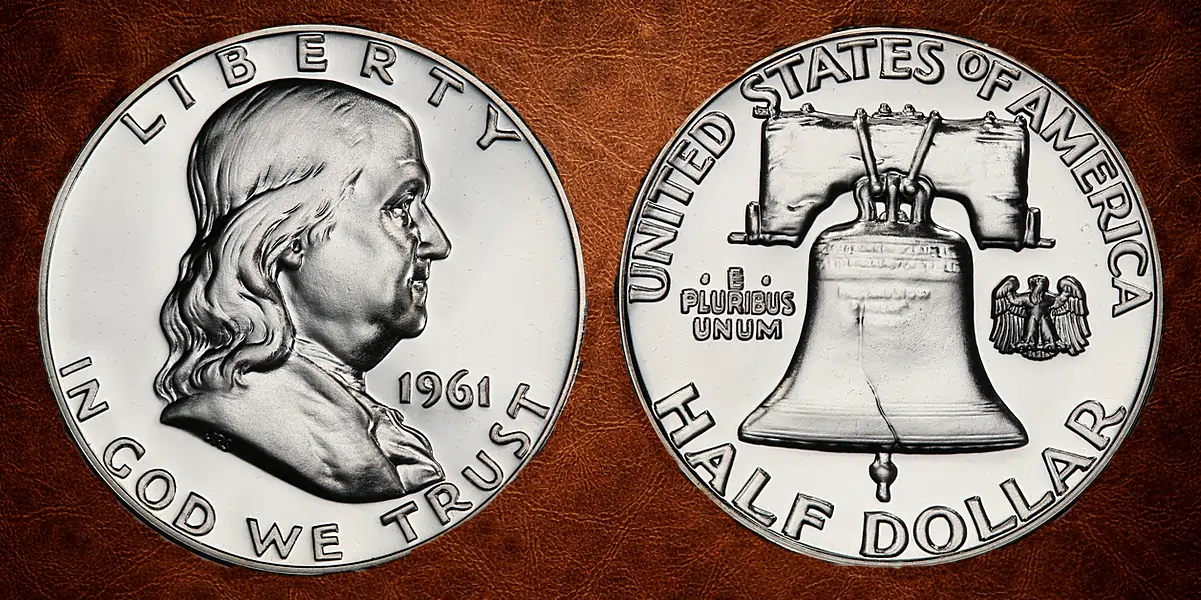
Why the 1961 Doubled Die Reverse Matters
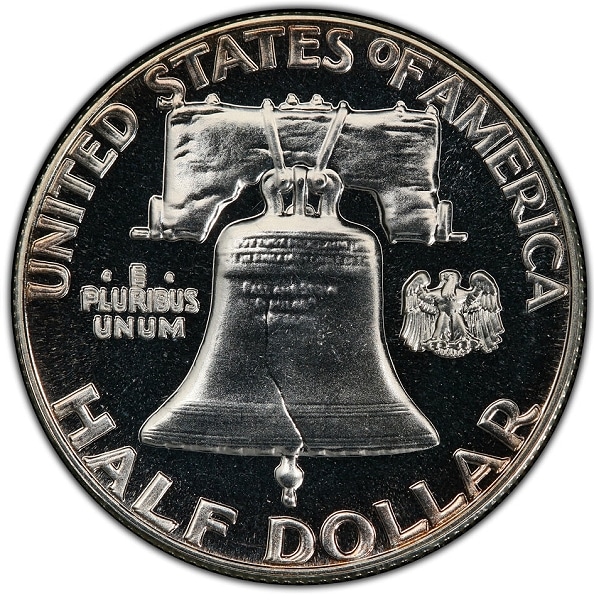
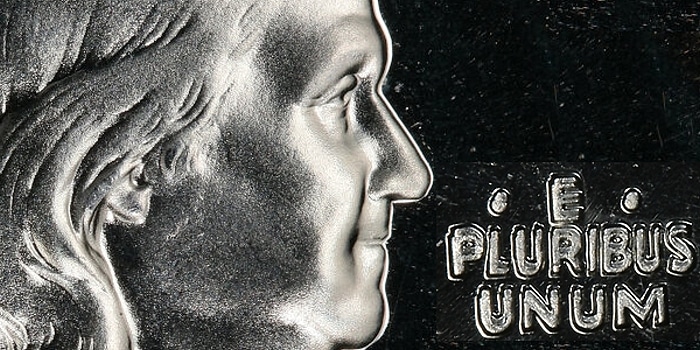
The 1961 Proof issue does not offer just one reverse-doubled die. Heritage notes that three different doubled die reverse varieties exist for the date. However, collectors overwhelmingly prefer FS-801. That major variety shows the boldest spread and commands the strongest premium. PCGS also warns collectors that other 1961 reverse doubled dies exist, but the important one shows strong doubling in E PLURIBUS UNUM, UNITED STATES, and HALF DOLLAR.
That bold spread explains the coin’s appeal. Many doubled dies require magnification. On a strong example, a collector can see the separation with the naked eye. In fact, the reverse motto and denomination make the diagnosis easy, even for collectors who do not specialize in varieties. GreatCollections made the same point in its 2017 coverage of an NGC Proof-68 CAC example, and PCGS still highlights the same pickup points today.
What Collectors Should Look For
Start with the reverse. Then focus on E PLURIBUS UNUM first. Next, move to UNITED STATES and HALF DOLLAR. On FS-801, the letters show wide, clear separation. Heritage described that spread as especially strong along the left and lower margins of the lettering. That strength sets FS-801 apart from the lesser 1961 doubled-die reverses.
This variety also carries real registry weight. PCGS includes the Fivaz/Stanton varieties in its Franklin Half Dollars Complete Variety Set, Proof (1950-1963). That set currently lists 29 required items. So, registry-minded Franklin collectors do not treat the 1961 DDR as a curiosity. They treat it as a key slot.
Rarity Drives the Demand
No official mintage exists for the doubled-die variety itself. The Philadelphia Mint struck 3,028,244 proof Franklin half dollars in 1961 overall. Still, specialists have long believed that only a small portion left the Mint with the defective reverse die. GreatCollections reported in 2017 that numismatists speculated that perhaps 1,500 to 2,000 pieces escaped before Mint staff replaced the die. Today, PCGS estimates that roughly 1,000 examples survive across all grades, with about 370 pieces at PR65 or better.
That rarity explains the coin’s staying power. It also explains why advanced Franklin collectors and modern variety specialists continue to fight for premium pieces. Stack’s Bowers has called the coin “the king of the 20th-century Proof half dollar error varieties,” citing Rick Tomaska. That label fits the market behavior.
[Image Placeholder: Close-up of reverse lettering showing doubling in E PLURIBUS UNUM]
Registry Pressure Keeps Prices Strong
Lower-end examples still start high for a Franklin proof variety. Greysheet currently places the regular-proof FS-801 in a broad value range of about $495 to $15,840. Meanwhile, PCGS auction pages currently show guide values of about $3,150 in PR65, $5,000 in PR66, and $5,750 in PR67. In other words, collectors do not need a top-pop coin to spend serious money on this variety. They only need a problem-free example with strong eye appeal.

The top end climbs much faster. Heritage sold a PCGS PR66+ Cameo CAC example for $14,100 on November 1, 2016. Then Stack’s Bowers sold a PR68 example for $15,000 in November 2020. Those results confirmed the coin’s long-standing strength in elite grades.
Cameo and Ultra Cameo Coins Push the Ceiling Higher
Older discussions of the 1961 DDR often treated Cameo pieces as major rarities and Deep Cameo examples as unknown. That older language no longer tells the full story. Stack’s Bowers noted that Cameo pieces remained extremely rare and cited data showing that PCGS had awarded the CAM designation only four times in the source it used. Then GreatCollections handled an NGC Proof-67 Ultra Cameo CAC example in 2021 and described it as the only Ultra Cameo graded by NGC or PCGS at that time. NGC’s 2025 Registry Awards coverage still highlighted the 1961 Doubled Die Reverse as an Ultra Cameo rarity.
That upper tier now defines the modern market. PCGS Auction Prices currently lists $22,800 as the top recorded price for the variety, realized by a PCGS PR67CAM coin at Stack’s Bowers on June 16, 2023. By contrast, the base CoinFacts page still shows $15,000 as the auction record for a PR68 regular proof example. Those two figures do not conflict. Instead, they track different slices of the market, and together they show how strongly collectors reward cameo contrast on this issue.
A Historic Franklin Variety with Modern Momentum
The 1961 Proof Doubled Die Reverse Franklin half dollar still stands at the center of the variety conversation for the series. The reverse offers dramatic naked-eye doubling. It holds an important registry position. And issue itself combines rarity, visual impact, and strong auction history in a way that few postwar proof varieties can match. That mix keeps demand high. More importantly, it keeps the coin relevant every time the Franklin market heats up.
* * *







One the best coins ever made, I have many.
Thanks for another great article!
took me a while to see it
Great article! Thanks!!
i could not see where it was doulbled
Thats a good looking coin
I would like to add this to my collection
1961 very special year for me & a very special coin indeed
Great article
Thanks, great article
Very Nice ! Like to have some of these.
That was very interesting. Thanks for sharing the article.
Always loved this design with the Liberty Bell.
I just don’t have a good eye for spotting the doubling.
Great article.
There’s something about the Franklin Halve. The simplicity and the boldness, plus how can you go wrong with Benjamin Franklin and the Liberty Bell.
What a beautiful coin
Pretty coin
Great article. I’ll be looking for this coin now. Cool!
beautiful coin
Wonderful coing