


By CoinWeek …..
Because of its cost and status as a key date, the 1916-D Mercury Dime attracts a devoted following even in the lowest grades. The Denver Mint struck the entire mintage of 264,000 coins after producing more than 6.5 million dimes with the Barber design. Officials released all of these coins into circulation in November of that year.
The term “circulation” matters here, as population data from CAC, NGC, and PCGS show that most surviving 1916-D dimes exhibit significant wear.

The table above expresses the certified population of low-grade, circulated 1916-D Mercury dimes at CAC, NGC, and PCGS. Keep in mind that the CAC data includes coins encapsulated by CAC as well as coins encapsulated by NGC and PCGS that also carry a CAC-approved sticker.
This data shows that roughly three-fourths or more of all certified 1916-D Mercury dimes fall into these lower grades. We can infer that a substantial amount of time passed between the coin’s mintage and the point when collectors pulled most surviving 1916-D dimes from circulation.
The 1916-D Mercury Dime Not Understood to Be Scarce Until the Late 1930s
Throughout his career, numismatist David Lange wrote extensively about how coin boards and albums expanded the popularity of coin collecting. Joseph Kent Post devised the first coin board in 1934 while working as an engineer for the Kimberly-Clark Corporation. He self-funded a small business that sold the boards in local and regional stores before selling the invention to Whitman Publishing. Whitman expanded Post’s concept and distributed coin boards, and later coin albums, nationwide.
Early coin board collectors quickly realized that locating a 1916-D Mercury dime, or a 1909-S VDB Lincoln cent, posed a greater challenge than finding other dates. However, a silver dime pulled from circulation after 10–15 years of use typically would not grade as low as AG3 to Fine. Instead, we must look to the explosion in coin collecting during the 1950s, when collectors across the country rushed to pull valuable coins from circulation and sell them for profit.
Following this logic, young collectors and aspiring dealers likely sought out and found 1916-D dimes in low grades. At the same time, a group of unscrupulous operators began adding D mintmarks to otherwise common 1916 Mercury dimes from Philadelphia.
The large number of surviving 1916-D dimes in grades AG3 to F10 reflects the entrepreneurial drive of a generation of paperboys and cashiers turned coin enthusiasts.
Before You Grade Circulated 1916-D Mercury Dimes, Authenticate
Always start the grading process with authentication. This step matters especially for coins like the 1916-D Mercury dime, which counterfeiters have frequently targeted.
Authentication becomes easier with Mint State coins because their design details remain fully visible. Heavily circulated coins offer fewer diagnostic features. At a minimum, check the coin’s size and weight, confirm that the remaining design elements match known specifications, and verify the position of the D mintmark. Even if a coin passes all of these checks, it will not command full market value unless a reputable third-party grading service guarantees its authenticity.

The Mercury dime measures 17.9 mm and weighs 2.5 grams when struck. In well-worn condition, a silver coin typically loses about 3–4% of its original weight. You should treat all raw 1916-D Mercury dimes with suspicion, especially if they weigh less than 2.4 grams in well-worn condition.
The 1916-D Mercury dime uses the same mintmark punch as the 1914-D Lincoln cent. In well-worn grades, wear often flattens the mintmark’s details, so you should examine it closely.
Grading Heavily Circulated 1916-D Mercury Dimes
Common Mercury dimes carry value well above face because of the silver content in their 90% silver planchets. At a silver spot price of $72.42 (as of April 2, 2026), a 90% silver dime contains about $5.24 in silver, roughly 52 times its face value. In the collector market, common-date Mercury dimes often sell for $8 to $12 in About Good to Good grades.
The 1916-D Mercury dime does not fall into the “common” category. Certified examples in AG3 condition regularly sell for between $800 and $1,000.
So how do professional graders decide whether a 1916-D Mercury dime qualifies as AG3 or VG10? Let’s break it down.
About Good (AG3)

An AG coin will be heavily worn. The rim will be almost completely gone and the flatness of the coin will encroach halfway into the letters. In this grade, the date may only be partially visible and the rim will be flattened to the point where it touches the base of the 6 (at a minimum). Liberty’s eyes and lips will be visible, but most of the detail on the cap and her hair will be worn flat. On the reverse, the mint mark may be worn down to the point where the opening inside of the D is indistinguishable from the raised part. The fasces will be worn flat and the branch will show a silhouetted outline but no fine details.
It is not unusual if coins in this grade exhibit stains or light circulation damage
Good (G4)
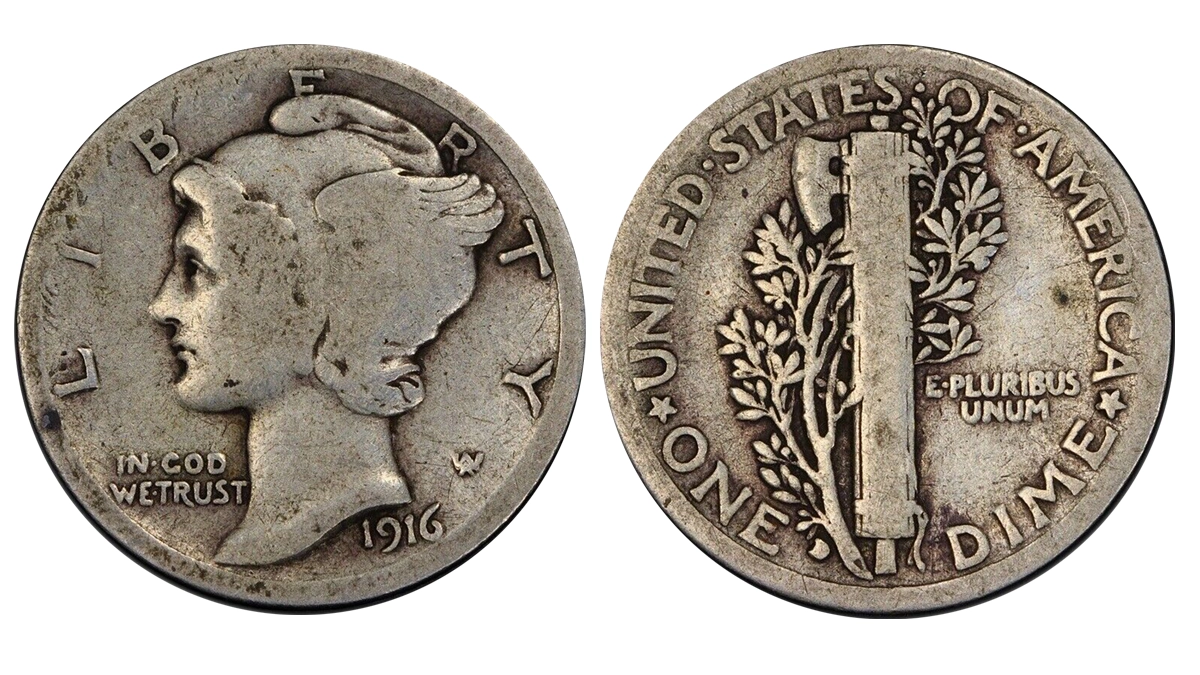
Wear along the rims stops at the beginning of the letters. Outlines of the wing on Liberty’s cap may show some soft detail, faint separation between Liberty’s jaw and neck will be visible. Separation of some of tips of the feathers will be visible and the indention at the curl of Liberty’s hair will be present (to the left of where her ear would appear, if visible). On the reverse, faint outlines of some of the fasces bands are visible along the edges. The leaves and the branch are less flattened than they appear in AG3, but lack detail.
It is not unusual if coins in this grade exhibit stains or light circulation damage
Good-6 (G6)

Coins graded G6 are a skosh better than those in the base grade of Good-4.
Letters and the date are now fully visible. There is separation between the rim (or what’s left of it) and the devices.
Sporadic hair and wing details are apparent. Nothing is consistent, detail-wise, at this grade.
Very Good (VG8)

1916-D Mercury dimes graded Very Good still appear well-worn, but they will exhibit more details than coins graded Good-6. Starting at the rims, Very Good Mercury dimes will have complete rims that show clear separation between the edge of the rim, the field, and the peripheral lettering. The date will be clearly separated from the rim.
The curvature of Liberty’s face is not much better defined, but the jawline is clearly defined. Feather and hair details will remain scant.
On the reverse, the pit in the D mintmark should be conspicuous. The fasces lines at the edges will be more visible, although not necessarily complete. The outline of the bands will start to show at the edges. Leaves appear to have more detail. At this grade, look for coins with pleasing color and blemish-free surfaces.
At this grade, examples sell for about twice the cost of a Good-4, so it’s a good idea to be able to tell the difference.
* * *







Great article. I started collecting Mercury dimes in 1959 (I was 10yo). My dad would take me to the bank on Saturday and would exchange 2 rolls of dimes for 2 more rolls of circulated dimes. I believe it was 1961-62, I found a 1916-D. We took it to a local coin dealer in San Antonio TX. The dealer graded the coin AG.
I have several of these dimes that I really need to get graded. What kind of shops can I take them to to have this done? This was a very interesting article for me.
You have several 16-D dimes! Wow! Did you personally find them when you were younger? Must have gone through a lot of change back then you find them. What’s the backstreet on how you found them?
Very very educational. thanks
Cool!
Great information on a good looking coin.
Insightful article, Inspired to revisit my dimes.
Would love to find one to add to my collection
Very interesting insight.
Excellent article. I was always hesitant to but a key coin in even Good condition, not to mention AG. As such, some of the rarer coins I wanted kept getting more expensive because of my ignorance in what this article explained. Wish I read this many years ago.
Is the 1916 the only one targeted by counterfeiters?
Interesting
Interesting to read about a coin decidedly NOT in mint condition – I love to see the wear on these old silver coins.
Very interesting article. I’ve learned a lot.
Looking forward to the gold mercury dime this year at the mint.
Love mercury dimes, Very educational
Very educational. Just so cool. Thanks.
To think – this was during WW1 and no person on earth has outlived this coin
Love this date. Been a must have coin since I started collecting. Would someday love to acquire a moderately higher grade specimen.
Wish I had one in my collection.
Nice
Very informative. Thank You
Great Article
An interesting and informative article about grading 1916-D Dimes. I have owned a few of these over the years and always appreciated their rarity!!!
I own 3graded examples grades 2,3 and 4
I collected Mercury dimes in the late 50s, early 60s. My dad would take me tom the bank every week to get 2 rolls of dimes to search. I found a 1916-D Mercury dime. Condition was AG but I didn’t care. I found one.
I’ve searched hundreds of Mercury dimes in the search for a 1916-D. Hopefully there are still some left to be found!
The article mentions “a generation of paperboys and cashiers turned coin enthusiasts.” That was my dad. As a young man he worked a game machine route, and went through the change. He was fortunate enough to find a 16-D, which got passed on to me, one of my most prized possessions. Probably at some point need to get it professionally certified. My grading checks all the boxes of am AG-03.
I learned a lot.
Always interesting articles on CW