


With gold trading above $4,500 per ounce, buyers face a crucial decision.
Should you put your money into modern bullion coins, or are common-date numismatic gold coins currently trading at little to no premium? What is the superior value play?
When gold reaches historic levels, spreads widen, premiums shift, and market psychology changes. The result is a landscape where the simple choice (“just buy bullion!”) is no longer so simple.
Below is a breakdown of the pros and cons of each category to help investors evaluate where the real value lies.
Modern Bullion Gold Coins
American Gold Eagle, Canadian Maple Leaf, Gold Buffalo, Krugerrand, Britannia, etc.
World gold bullion coins represent one of the most trusted and globally recognized forms of modern precious metals investment. Moreover, because they are issued by national mints with strict quality standards, coins such as the American Gold Eagle, Canadian Maple Leaf, South African Krugerrand, Austrian Philharmonic, and British Britannia offer a consistent blend of purity, liquidity, and authenticity.
Additionally, each coin carries distinctive design elements that reflect its country of origin, which further strengthens international appeal and broadens resale opportunities.
Furthermore, these coins are produced in widely accepted fractional and one-ounce formats, making them highly adaptable for both new investors and seasoned gold holders. Even in periods of heightened volatility, world gold bullion coins maintain strong bid-ask spreads, largely because dealers and collectors trust their weight and fineness without hesitation. Consequently, although premiums may vary, investors often view them as a dependable, portable, and universally marketable store of value. Altogether, world gold bullion coins remain a cornerstone for anyone seeking long-term financial security in physical gold.

Pros
1. Highest liquidity in the gold market
Bullion coins are the world’s most recognized gold products.
When the price surges above $4,200/oz, liquidity becomes even more important—buyers, dealers, and refiners all prefer easy-to-trade items.
2. Transparent, market-driven pricing. Bullion trades very close to spot, allowing investors to:
- track value easily
- execute large transactions quickly
- convert to cash without specialized buyers
3. IRA-Eligible and globally standardized
For U.S. buyers, most modern bullion coins qualify for precious-metals IRAs.
This maintains a steady demand base that supports liquidity and resale value.
4. Tight spreads during high-volatility periods
Even at high spot levels, bullion buy–sell spreads are usually much tighter than numismatic coins—important when protecting short- to medium-term gains.
Cons
1. Premiums rise when spot spikes
Ironically, at very high gold prices, dealer premiums on popular bullion often increase, driven by:
- supply bottlenecks
- mint production delays
- heightened investor demand
You may pay 4–10% over spot, even when the spot price is exploding.
2. No potential for numismatic appreciation
Bullion is priced almost entirely on gold content. If gold falls, bullion falls with it, no collector base to cushion sell-offs.
3. Easily counterfeited
Widespread global production and recognizability make modern bullion a major counterfeiting target, requiring careful sourcing.
Common-Date Numismatic Gold (Low-Premium Pre-1933 U.S.)
Low-premium Pre-1933 U.S. Generic Gold and world gold coins offer investors a compelling bridge between historical numismatics and practical bullion value. Although these coins were once everyday circulating money, they now trade primarily for their gold content, which often places their premiums surprisingly close to modern bullion pieces.
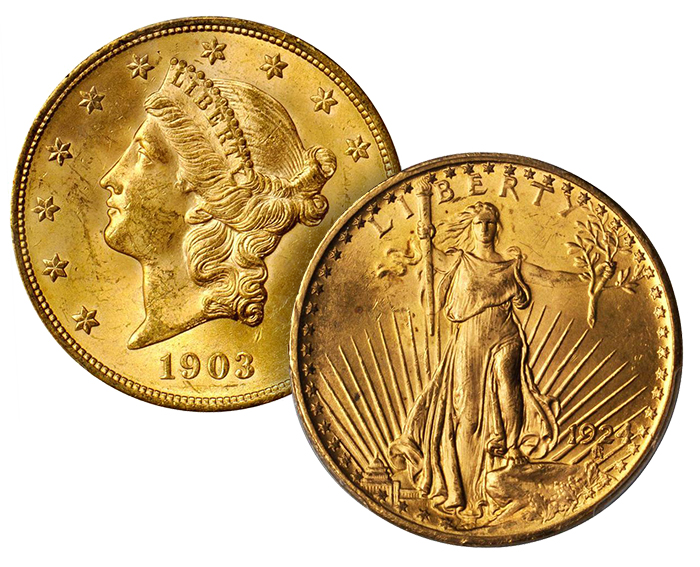
Moreover, because many were struck by respected national mints, such as the U.S. Mint, various European state mints, and Latin Monetary Union countries, their weight and fineness remain well documented and widely trusted.
Additionally, these coins provide a level of character and historical depth that modern bullion cannot match, yet without imposing the steep numismatic prices associated with rare dates or exceptional grades. Consequently, they attract both investors seeking low premiums and collectors drawn to their vintage appeal.
Furthermore, these older gold issues enjoy strong international liquidity, since buyers recognize their long-standing pedigree. Altogether, low-premium Pre-1933 gold coins deliver a unique combination of value, history, and market flexibility.
Today, many of these historically significant gold coins trade at almost zero premium above melt value, a rarity in the market.
Pros
1. Currently undervalued compared to historical norms
Common-date pre-1933 U.S. gold, for example, traditionally carried 20–60% premiums over melt during most of the last 30 years.

Today, many trade for 0–5% above melt, making them unusually cheap relative to:
- their historical marketplace behavior
- true collector interest
- scarcity compared to mass-produced modern bullion
2. Embedded optionality: numismatic value can rise independently of gold
If numismatic demand returns, which often happens after major gold bull runs, premiums can expand sharply.
- This creates a double-upside possibility:
- the gold price can rise
- premiums can rise
- Bullion can only do one of these.
3. Supply is finite
Pre-1933 gold will never be produced again. Population reports suggest far fewer of these coins exist than people believe, especially in higher circulated grades.
Scarcity becomes more appreciated during long bull markets.
4. Higher counterfeit resistance
Numismatic pieces are often less targeted by cheap fakes due to:
- lower premiums
- more complex designs
- grading company protection (PCGS/NGC)
Cons
1. Liquidity is lower than bullion
While still very liquid, numismatic coins require:
- more specialized dealers
- slightly more time to appraise
- grade verification
This can matter during panic-selling cycles.
2. Wider spreads compared to bullion
Buy–sell spreads for common-date U.S. gold may run 5–12%, sometimes more.
This diminishes short-term trading efficiency.
3. Grades and condition matter
Two coins of the same type may differ in price dramatically due to:
- Cleaning
- Hairlines
- Eye appeal
- Details
This creates complexity for newer buyers.
4. IRA ineligibility
Most pre-1933 gold coins are not IRA-eligible, reducing demand from retirement accounts
For pure investors focused on liquidity …. Modern Bullion
If your priority is:
- fast resale
- IRA holdings
- tracking spot closely
- hedging volatility
…bullion is the straightforward choice.
For value seekers and long-term strategic buyers …. Numismatic Gold
When common-date pre-1933 gold trades at bullion-like pricing, it becomes:
- a historically rare buying opportunity
- a potential future premium play
- a hedge against numismatic cycle rebounds
- a superior long-term scarcity asset
Many seasoned gold buyers argue that common-date numismatic gold at melt is one of the most overlooked asymmetrical trades in the whole precious-metals market.
Final Assessment

If you want maximum liquidity and low complexity, choose modern bullion.
Looking for the best long-term value and upside potential, choose common-date numismatic gold at near-zero premiums.
But should you want to get a little more agressive, Take a look at Common Date Saint Guadens and Liberty Head $20 double eagles Certified by NGC or PCGS in MS-63, or preferably MS-64.
If and when the market “normalizes” these coins will do exceptionally well.
NOTE: On April 11th. Stevens Auctions will be holding an auction with both a substancial amount of 90% silver coins in rolls and flips, but they also have a exceptional run of Generic $20 Liberty Head Gold Double eagles certified by PCGS and NGC from Grades rangeing from MS-61 to MS-64. This sale is well worth examining or anyone looking for 90% silver and Generic Gold. Good Luck @
In a world where gold exceeds $4,500/oz, scarcity and historical importance matter more than ever.
And when numismatic gold carries no premium, it is arguably not just an alternative to bullion, it may be the better bargain outright.








Thank you for a very interesting and informative article.
I agree with buying common date Saints in 63 or 64 condition….but I don’t know how their premiums re-appear or expand unless gold takes a big drop. If gold holds in the $4000’s or should it continue to rise and go higher from here in the years to come, then those coins will trade as pure bullion coins with NO numismatic premium.
We could even one day see 65’s and 66’s trade with no premiums.
It’s a Brave New World.
I am curious if this holds true with other nations early gold bullion such as Swiss Vrenli, French Roosters etc