


By John Dannreuther, Gordon Wrubel, Craig Sholley, Brian Greer, Chuck Link, Tony Terranova, Chris Victor-McCawley, David McCarthy, and Erik Goldstein for PCGS ……
Over the past several years, numismatists have debated the status of Fugio Cents. Many collectors have asked a critical question: Do Fugio Cents represent the first regular-issue United States coins?
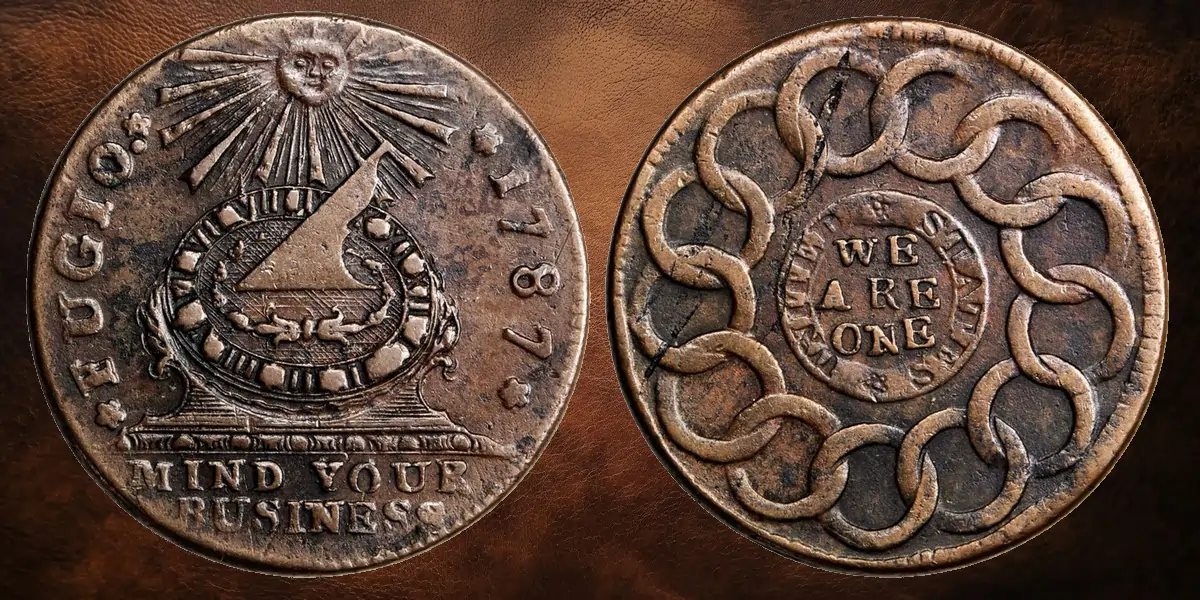
1787 Fugio Copper. Club Rays. Newman 5-HH. Rarity-8. Concave Ends, UNITED STATES. AU-50 (PCGS). CAC.
For decades, confusion has surrounded these coins. Some experts questioned whether contract coinage qualifies as a national issue. Others doubted whether Congress legally authorized the Fugio Cents at all. As a result, earlier references often labeled them as patterns rather than circulating coinage.
However, the historical record tells a different story. Today, experts, including PCGS, recognize Fugio Cents as regular-issue coins. In fact, PCGS has listed them as such for more than a decade. [SEE Listing at end of Article for an Stack’s Bowers Auction Listing that ends April 6th ]
A Shift in Numismatic Classification
Modern research confirms a clear conclusion: Fugio Cents were the first regular-issue coins of the United States.
Congress authorized these coins under the Articles of Confederation. Furthermore, the government contracted James Jarvis to produce them. These facts firmly establish their legitimacy.
Because of this evidence, PCGS now places Fugio Cents within regular-issue copper coinage. The service also identifies their denomination as one cent on holders. Still, PCGS continues to include them in the Colonial Set Registry as a nod to tradition.
Early Numismatic Authorities Recognized Fugio Cents
Numismatic scholars have long acknowledged the importance of Fugio Cents.
In 1860, James Ross Snowden described them as federal coinage. He also cited their authorizing legislation and contract production.
Then in 1875, Sylvester Sage Crosby called them “the earliest coins issued by the authority of the United States.”
And finally, in 1984, Walter Breen classified them as federal contract cents.
Despite this strong foundation, later confusion emerged. Eric P. Newman referred to them as “coppers” rather than cents in his updated work. Still, even Newman identified them as United States coinage.
Earlier researchers, including Breen, Don Taxay, Damon Douglas, and James Spilman, consistently called them cents. In fact, 19th-century auction catalogs used names like:
- Fugio Cents
- Franklin Cents
- Mind Your Business Cents
- Ring Cents

Why Proper Classification Matters
Today, many experts agree: Fugio Cents belong with regular-issue U.S. coinage.
Although modern editions of the Red Book list them under “Federal Issues – Contract Coinage and Patterns,” this placement still falls short. The coins deserve full recognition alongside other regular-issue coins.
This distinction matters. It affects how collectors study, categorize, and value these historic pieces.
Were Fugio Cents Legally Authorized?
Some authors have questioned whether Congress legally authorized Fugio Cents. However, the historical record provides a clear answer: Yes, Congress fully authorized them.
Under the Articles of Confederation:
- Article V established a representative Congress.
- Article IX required approval from at least nine states to coin money.
On April 20, 1787, Congress approved the Jarvis contract. Records show that representatives from 10 states attended and voted. Therefore, Congress met the legal requirement.
The official language, “Congress assembled” and “Resolved”, confirms that lawmakers formally approved the coinage.
Were Fugio Cents Actually “Cents”?
Critics often point out that Fugio Cents do not display a denomination. However, this argument does not hold up.
Many early U.S. coins lacked denominations, including:
- Half dimes
- Dimes
- Quarters
- Gold coins
Congress never required denominations to appear on coins. Instead, legislation defined each denomination by weight.
On August 8, 1786, Congress established the cent as:
- One hundredth of a federal dollar
- Equal to 2¼ pounds of copper per 100 cents
Therefore, any copper coin struck to that standard qualifies as a cent.
Jarvis confirmed this standard in his proposal. He agreed to strike coins at the federally mandated weight. This detail further supports their classification as cents.
[IMAGE SPACE]
Do the Weights Support the Classification?
Weight data from surviving coins shows variation. Some coins appear lighter than expected. However, this inconsistency does not invalidate their status.
Different studies produced conflicting averages:
- Bank of New York hoard: ~149.73 grains
- Private collections: ~151.2 grains
- ANS collection (uncirculated): ~153 grains
- ANS circulated coins: ~155.05 grains
Because these datasets conflict, they cannot determine the original standard.
Instead, government records provide reliable evidence.
Treasury documents show that officials valued Fugio Cents at the correct federal standard. For example:
8,968 pounds of coins equaled $3,985.77. This calculation matches the legal standard.
Officials accepted the coins without objection. Therefore, they must have verified the weight.
Debunking the “Lightweight Coin” Theory
Some claim that Jarvis produced underweight coins to increase profits. This claim fails under scrutiny.
Jarvis received payment based on weight, not coin count. If he struck lighter coins, he would need to produce more pieces. That process would increase costs and reduce profits.
Therefore, the theory contradicts the contract itself.
Did Fugio Cents Circulate as Cents?
Another criticism focuses on circulation. Some argue that Fugio Cents did not circulate at one cent.
However, this argument also fails.
During the late 1780s, a “Copper Panic” disrupted circulation. This event affected all copper coins, including:
- Massachusetts cents
- Machin’s Mills halfpence
- British halfpence
Despite this disruption, collectors still recognize those coins by their denominations.
A coin’s denomination comes from legislation, not market behavior.

Are Contract Coins National Issues?
Some critics argue that contract coinage cannot qualify as national coinage. However, global examples prove otherwise.
Governments have long used private mints, including:
- British coins struck at Soho Mint
- Coins produced by the Royal Canadian Mint
- Contract issues from other national mints
All these coins count as official national issues.
Therefore, Fugio Cents should receive the same treatment.
Are Fugio Cents Federal Coins?
Some also claim that Fugio Cents cannot be federal coins because they predate the Constitution.
However, historical usage proves otherwise. At the time:
- The government called itself “federal”
- Newspapers used the term widely
- Later government reports confirmed this terminology
Thus, the term “federal” applies correctly to Fugio Cents.
The Mystery of the “Missing” Coins
A discrepancy exists between:
- Jarvis & Co. records: 11,910 pounds shipped
- Government records: 8,968 pounds received
Some researchers trust Jarvis’ figures. However, this approach creates problems.
Jarvis faced accusations of fraud and bribery. His records remained unaudited. In contrast, government accounts underwent official review.
Additionally:
- Government contract books recorded deliveries
- Jarvis never protested the figures
- He failed to challenge them in court
These facts strongly support the government’s numbers.
Conclusion: The Case for Fugio Cents as Regular-Issue Coins
The evidence leads to a clear conclusion:
- Congress legally established the cent denomination
- Congress authorized the Fugio Cent coinage
- Jarvis agreed to strike coins at the federal standard
- Government records confirm proper production and delivery
- The official mintage equals 398,577 coins
Therefore, Fugio Cents represent the first regular-issue United States coins.
They were:
- Federally authorized
- Properly denominated
- Struck and delivered as cents
It is time for all references to reflect this reality. Fugio Cents deserve full recognition as the foundation of United States coinage.
Presently For Sale:

The 1787 Fugio Cent pictured above, [Pointed Rays. Newman 18-U, W-6960. Rarity-3. STATES UNITED, 4 Cinquefoils. AU-53 (PCGS)]. is in the upcoming Stack’s Bowers Spring 2026 Collectors Choice Auction on April 6th. This is the Official Auction of the PCGS Trade & Grade.
* * *
For more information from PCGS, click on the image below.

* * *






what a cool coin, very creative.