

A Confederate-Era Dahlonega Gold Dollar with a Story to Tell
In August 2024, an extremely rare 1861-D $1 Gold with a dramatic lamination mint error realized $26,400 at the Stack’s Bowers Galleries August 2024 Global Showcase Auction, Session 3 – Rarities Night (Lot 3274).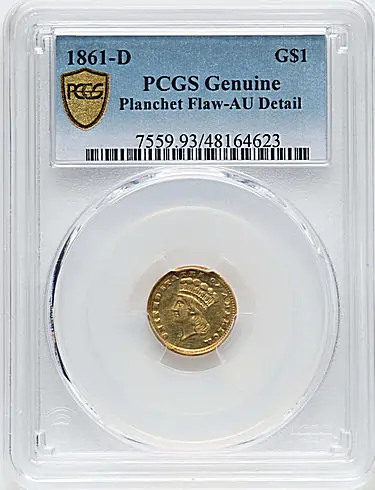
At first glance, PCGS certified the coin as AU Details, identifying a planchet flaw, and encapsulated it in a PCGS Genuine holder. However, that label does not fully explain the coin’s significance. In reality, this piece represents a true Mint error. The correct terminology is lamination.
That distinction matters. Moreover, it directly affects how collectors evaluate rarity, desirability, and long-term value.
The Only U.S. Coin Struck Entirely Under Confederate Authority
The 1861-D gold dollar occupies a singular place in American numismatics. The Dahlonega Mint struck this issue in Dahlonega, Georgia, during the opening months of the Civil War. Most importantly, it stands as the only United States coin struck entirely under Confederate authority.
The Dahlonega Mint closed in June 1861. By that time, it had produced a very small number of gold dollars dated 1861-D.
PCGS estimates a mintage of 1,000 pieces. Meanwhile, the A Guide Book of United States Coins lists an estimate of 1,250. Regardless of which figure one prefers, the total output remains extremely limited. Survivors remain rare in every grade.
Furthermore, the mint struck all 1861-D gold dollars from a single die pair. Production quality suffered during this chaotic period. As a result, many examples display defects such as splits, cracks, and laminations. These flaws do not represent damage. Instead, they reflect the working conditions and metallurgical challenges of a Southern branch mint operating amid political upheaval.
Understanding the Lamination Mint Error
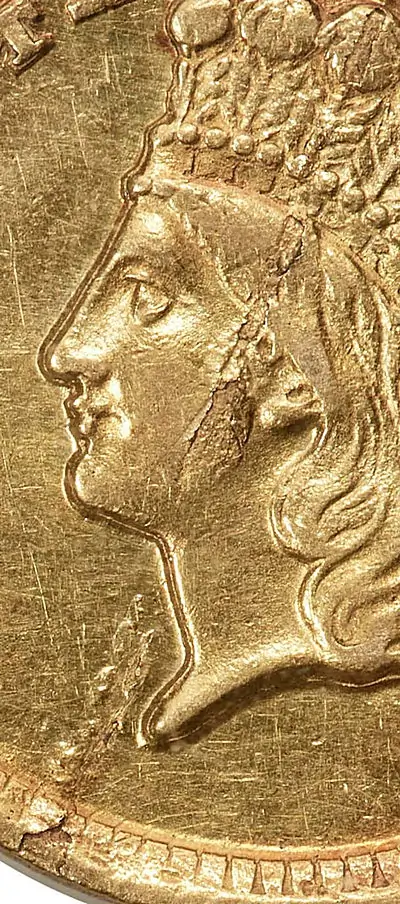
Stack’s Bowers described the coin as “minimally marked and unusually well-composed for the assigned grade,” noting wispy hairlines solely for accuracy. Upon close inspection in hand, the coin displays strong eye appeal, considerable luster, and original surfaces with attractive toning.
I would conservatively assign the piece a minimum grade of AU 55. However, several world-class experts specializing in early Branch Mint U.S. gold examined the coin in person and graded it AU 58. More importantly, they agreed that the piece qualifies as a Mint error and belongs in a standard PCGS holder with a numerical grade and a Mint Error designation.
The lamination occurred during the rolling of the gold strip that created the planchets. Metal impurities or stress within the strip caused a fissure in the metal before striking. When the dies struck the planchet, the defect appeared on the finished coin. Therefore, the flaw originated at the Mint during manufacture.
This fact proves crucial. Collectors routinely distinguish between post-strike damage and Mint-made errors. In this case, the lamination formed before the coin left the dies. Consequently, the coin reflects the minting process itself.
A Market Comparison That Tells the Story
The broader market confirms the importance of the 1861-D gold dollar. Recently, Heritage Auctions sold two PCGS AU 55 examples for $72,000 and $78,000. In addition, Heritage realized $84,000 and $96,000 for two PCGS AU 58 specimens.
Those results provide critical context. Against that backdrop, $26,400 represents a compelling price for a high-end almost uncirculated example with a dramatic Mint-made lamination.
Rarity drives the equation. Condition amplifies it. Historical significance elevates it even further.
This piece exhibits considerable luster, strong remaining detail, and original surfaces. Moreover, it ranks among the more visually appealing examples available to collectors. When experts consider both grade and error status, the value proposition becomes clear.
The Second Most Valuable Gold Dollar in the Series
The 1861-D stands as the second most valuable gold dollar in the entire series. Only the 1849-C Open Wreath variety surpasses it in overall value and prestige.
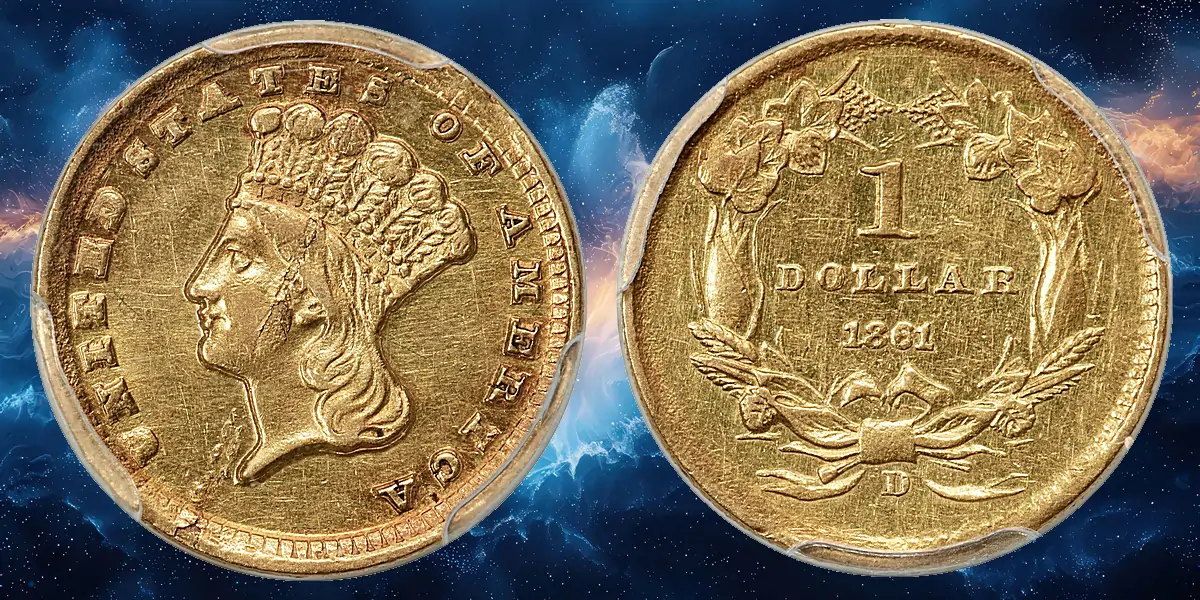
That ranking underscores the importance of every surviving example. Collectors pursuing complete gold dollar sets face formidable challenges when they reach the 1861-D. Even well-worn pieces command strong prices. High-end almost uncirculated examples command premium attention.
Therefore, this lamination Mint error carries layered appeal. It represents a scarce Confederate-era branch mint issue. It displays a dramatic Mint-made defect that tells the story of wartime production. And it offers strong eye appeal in a desirable grade range.
In short, this coin embodies American history in gold. It connects collectors directly to a turbulent moment in 1861. At the same time, it highlights the importance of accurate attribution and careful examination.
For advanced collectors and serious investors alike, the 1861-D gold dollar remains a cornerstone rarity. This particular example, with its confirmed lamination Mint error and strong technical quality, stands as one of the notable opportunities of 2024.


Truly a unique coin to have in a collection of the Lincoln era.
Wow such a beautiful coin. Would love to have it !!
Love the gold Dahlonega mints.
Amazing to see what they created in those days!! Beautiful!!
This is so fascinating! Love learning more about the mint error!