


By CoinWeek Notes …..
1877 Indian Head Cent: The Coin That Defines a Generation
The 1877 Indian Head Cent does more than complete a collection. It defines the Indian Head series. Moreover, it reflects a nation in financial distress and a Mint adapting to economic pressure.
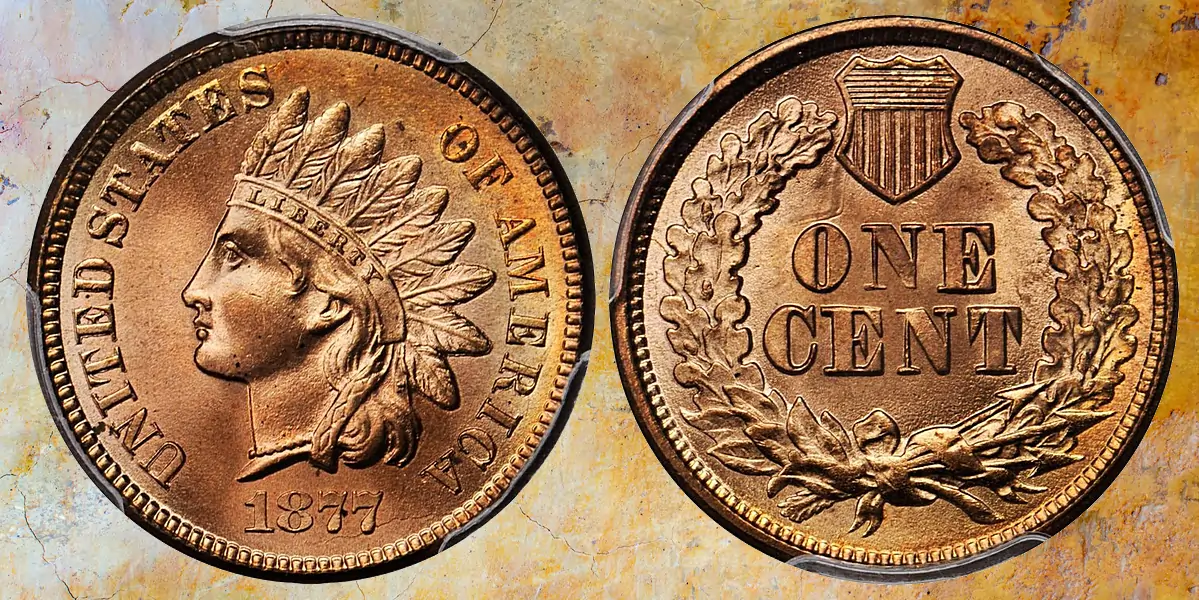
Collectors have long recognized this issue as the key date. While the 1909-S records a lower mintage, the 1877 has carried the structural and psychological weight of the series for generations. Demand remains constant. Supply remains limited.
Before examining its rarity, we begin with the coin itself.
Obverse: Liberty wearing a feathered headdress inscribed LIBERTY; UNITED STATES OF AMERICA around; date below
Reverse (Type of 1860-1909): Oak and olive wreath with shield above; ONE CENT within
The Mint struck this coin in bronze, not copper-nickel. That distinction matters. Earlier copper-nickel cents weighed more and proved more difficult to strike. The 1864 composition change reduced weight and production costs while improving strike quality.
A Design Rooted in American Iconography
The Indian Head cent debuted in 1859. Longacre designed the coin during his tenure as Chief Engraver of the United States Mint.
Despite the name, the obverse does not depict a Native American. Instead, it shows Liberty wearing a Native American headdress. According to Indian cent authority Rick Snow, Longacre adapted the portrait from the Liberty figure he introduced in 1849 on the gold dollar and double eagle.
The reverse changed after the first year of issue. The 1859 coin featured a wreath described in period sources as laurel, though it was intended as olive. In 1860, the Mint replaced that design with the oak-and-olive wreath and shield reverse used through 1909.
That design remained in place until Victor David Brenner introduced the Lincoln cent in 1909.
America in Crisis: Why 1877 Was Different
The 1877 mintage stands at 852,500 pieces. At the time, that figure marked the lowest small-cent production since the 1856 Flying Eagle cent.
The Panic of 1873 shaped this outcome. The financial crisis began in Europe and spread quickly to the United States. Banks failed. Railroad expansion slowed. Investment capital evaporated. Reconstruction-era projects collapsed as political influence shifted.
By 1877, the economy remained fragile. Demand for coinage weakened.
In addition, redemption policy amplified the effect. Under the Mint Act of 1871, small cents carried a legal tender limit of four cents. Banks holding large quantities could redeem them without financial loss. As a result, the Mint accumulated substantial inventories of previously struck cents.
With low demand and high redemption volume, the Mint reduced new production.
No widespread numismatic saving occurred at the time. Most examples circulated heavily. Many wore out or disappeared. Consequently, survival rates in higher grades remain limited.
Die Varieties and Proof Production
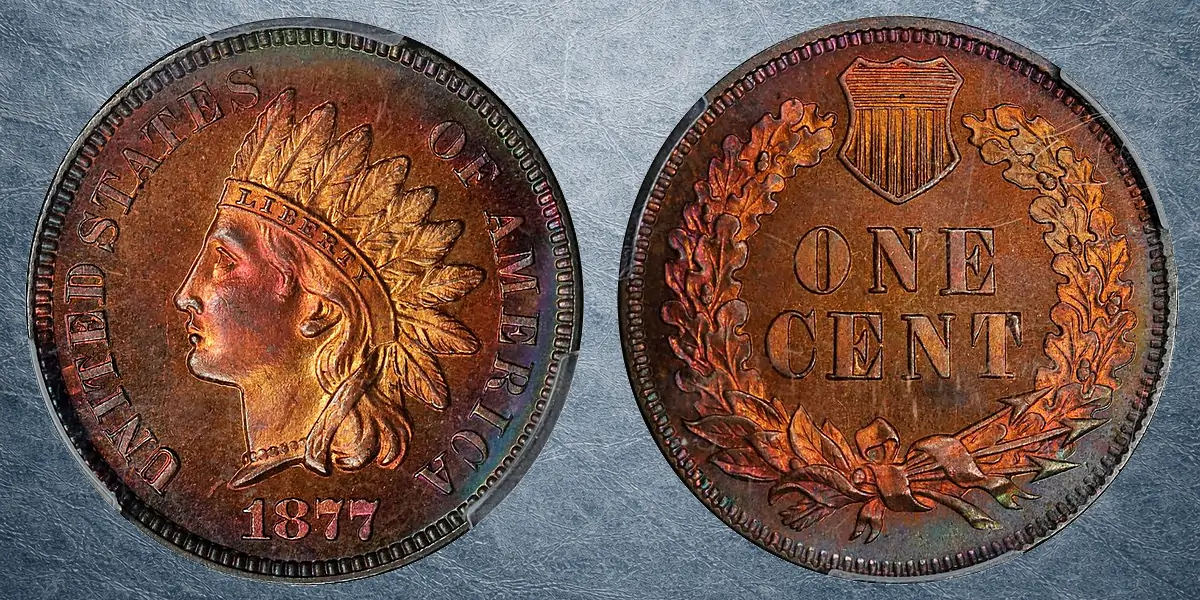
Rick Snow attributes two die pairs for the 1877 business strikes. One shows closer date spacing. The other displays wider spacing. Both develop obverse die cracks during use. The Snow-2 variety features an unbroken hub on the “D” in UNITED and a die dot near Liberty’s neck.
Proof production likely ranged between 1,250 and 1,500 pieces. These coins served collectors of the era, though contemporary demand for minor coinage remained modest compared to today.
Certified Populations Confirm Scarcity
Population reports illustrate the coin’s condition rarity.
NGC reports 4,422 circulated examples and 381 Mint State coins. Only 16 qualify as Red. The finest certified examples reach MS66 in Brown and Red-Brown and MS65 in Red.
PCGS reports 6,581 circulated coins and 1,206 Mint State examples. Among those, just 91 qualify as Red. Neither grading service lists a certified MS67 example.
The finest PCGS-certified coin, graded MS66+ Red and known as the “Golden Princess,” surfaced in Stack’s January 1999 Americana Sale. Collector Stewart Blay purchased the coin and later submitted it for certification.
Auction Performance and Market Strength
Auction data confirms consistent demand.
MS66 Red examples have realized between $100,000 and $149,000, with the strongest prices recorded between 2007 and 2009. A PCGS MS66RD CAC example sold in late 2019 for $114,000 at Heritage Auctions. Heritage records show MS66 Red coins consistently exceeding $110,000.
At MS65 Red, prices hover around $30,000. MS63 Red examples trade near $7,500.
Red-Brown and Brown coins offer lower entry points. However, premium eye appeal can significantly influence results.
Across grades, the market remains active. Collectors view the 1877 as essential.
The Enduring Key Date
Every major U.S. series has a defining coin. For Indian Head cent collectors, the 1877 holds that position.
It represents economic hardship, reflects reduced production, and demonstrates how survival rates shape rarity. Most importantly, it anchors the set.
The specifications remain simple: a 19-millimeter bronze cent weighing 3.11 grams. Yet the story behind that modest planchet carries national significance.
In American numismatics, few small cents command more respect than the 1877 Indian Head Cent.
1877 Indian Head Cent Specifications
The 1877 Indian Head Cent follows the standard bronze format adopted in 1864:
- Designer: James Barton Longacre
- Mint: Philadelphia (no mintmark)
- Mintage (Business Strikes): 852,500
- Estimated Proof Mintage: 1,250 to 1,500
- Composition: 95% copper, 5% tin and zinc
- Weight: 3.11 grams
- Diameter: 19 millimeters
- Edge: Plain







I have one of the 1877 Indian Head coins but I’m wanting to sell if anyone could help that would be great
How do I gey penny certified
What would a 18 89 Indian head penny grade 66 be worth
Thanks for the history. It is even more interesting when you consider this coin is dated 101 years after the Declaration of Independence.
The indian cent I do not have. wish list
I have a bunch of Indian head pennies someone interested let me know