

Original article by Mike Byers in MintErrorNews – Edited and Reformatted by CoinWeek
Experimental coins often reveal hidden chapters of Mint history. Occasionally, one surfaces in the most unexpected place. In this case, the discovery occurred inside a routine bag of cents.
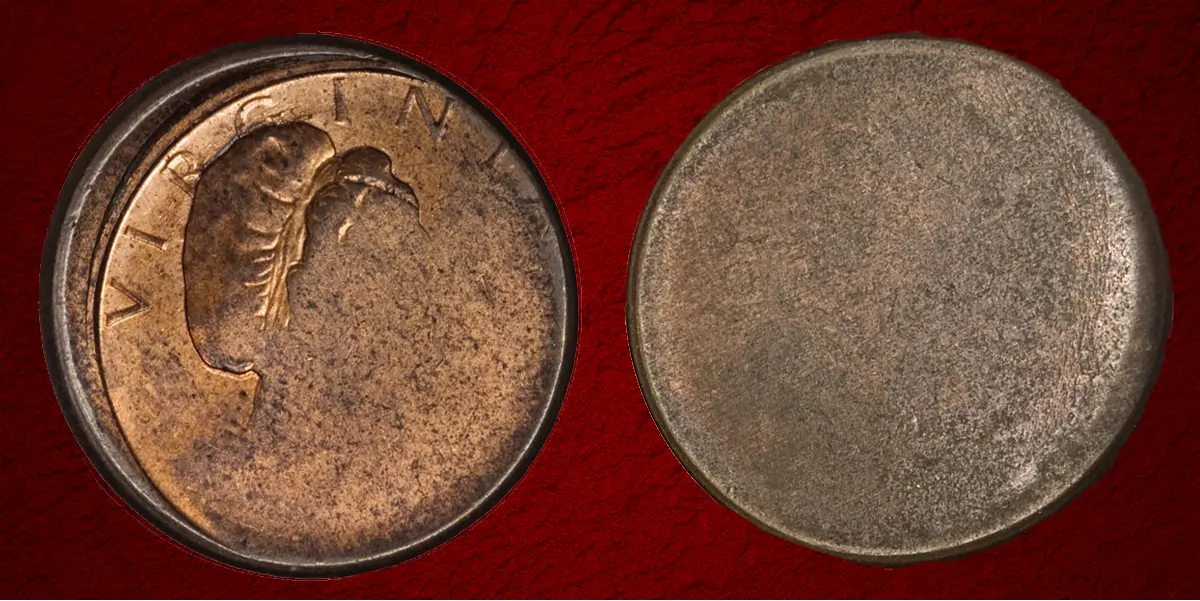
A rare Martha Washington test piece discovered in 1999 provides an intriguing glimpse into metallurgical testing connected with the creation of the Sacagawea dollar. The unusual strike also demonstrates how older dies sometimes find new life during experimental production.
A Discovery in an Ordinary Bag of Cents
The story begins with an unlikely discovery. A Brinks employee reportedly found the piece while examining a bag of 1999 Lincoln cents. The coin immediately stood apart.
Instead of the familiar Lincoln portrait, the obverse displayed Martha Washington.
The experimental strike remains in Gem Mint State condition. Its surfaces show red and brown toning, which suggests minimal circulation after its creation.
The Coin World Revelation
The April 10, 2000 issue of Coin World reported important background information about these dies. According to that article, the Martha Washington/Mount Vernon dies had recently served in metallurgical die trial testing for the Sacagawea dollar.
However, soon after that initial article, numismatist Michael S. Byers brought the discovery coin to wider attention. His find appeared in a front-page article in the August 7, 2000 issue of Coin World [See Below]
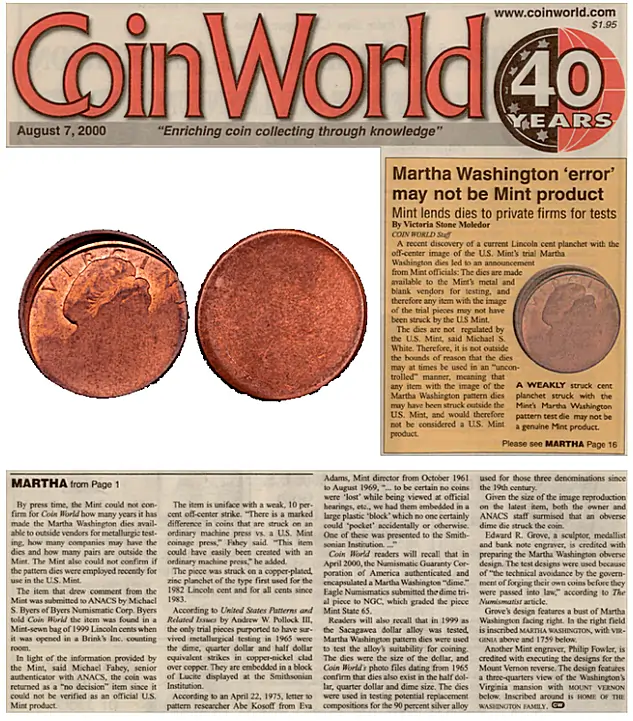
from Page 1 and Page 16 of the August 7, 2000 issue of COIN WORLD, Sidney, OH (coinworld.com)
There were questions if this was an actual U.S. Mint product. After further investigation the Die Trial revelation provided key context on experimental testing and the use of Martha Washington dies by outside firms to run these tests for the U.S. Mint.
Die trials play an essential role in coin production. Engineers and metallurgists use them to test planchet compositions, striking pressure, and die durability. As a result, test strikes sometimes appear on unexpected planchets or with incomplete designs.
The discovery of this Unusual and Unique Martha Washington cent led to the U.S. Mint’s acknowledgement of their experiments for the Sacagawea Dollar with Martha Washington dies in 1999.
Design Details of the Test Strike
The experimental piece carries several distinctive features.
The obverse shows a right-facing bust of Martha Washington. The inscription MARTHA WASHINGTON appears in the right field. Above the portrait sits the word VIRGINIA, while the date 1759 appears below.
The coin struck on a 2.5-gram zinc-copper cent planchet, the same basic composition used for modern Lincoln cents.
However, the strike did not produce a normal coin. Instead, the piece shows a 10 percent off-center strike and a uniface reverse. In other words, the reverse displays no design.
These unusual characteristics strongly support its role as a die trial experimental strike.
Not a Product of 1965
Early speculation once suggested the piece might date to 1965. However, evidence quickly disproved that theory.
Researchers determined that the U.S. Mint had distributed these dies to private vendors for testing purposes. Known recipients included IDX Inc., PMX Industries, and the Olin Brass Corporation.
These companies worked with the Mint to test planchets and metal compositions. Such testing often required striking coins using older dies. As a result, the Martha Washington dies resurfaced decades after their original use.
The U.S. Patterns website and United States Pattern, Experimental and Trial Pieces by J. Hewitt Judd list this unique Martha Washington cent test piece under 1982 since it was struck on a 2.5 gram copper plated zinc planchet and the Mint began using them in October of 1982.
Auction Appearances
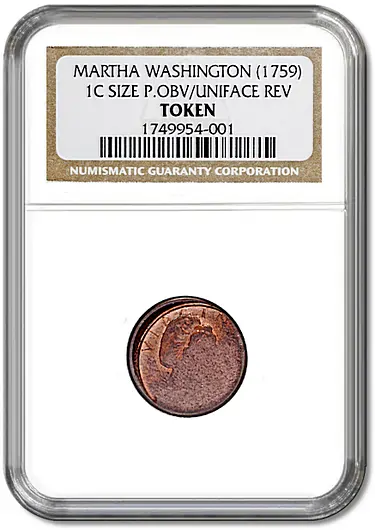
After the discovery gained publicity, the piece entered the numismatic marketplace.
The coin first appeared in an eBay offering by Michael S. Byers. Later, it crossed the auction block in three notable sales:
- Lot 1972 in Ira & Larry Goldberg’s October 2000 sale
- Lot 996 in Bowers and Merena’s January 2003 sale
- Lot 2902 in Heritage May 30, 2008 Sale
These appearances brought wider attention to the unusual trial strike.
Ongoing Questions About the Dies
Despite the available documentation, some uncertainty remains. Specialists still debate whether the dies used in the trial originated from cent or dime die sets.
However, at least one example struck on a cent planchet has been documented by Michael Byers.
Regardless of the exact die classification, the piece stands as a fascinating relic of modern Mint experimentation.
Why This Coin Matters
Experimental strikes rarely reach collectors. Most remain inside laboratories or Mint archives.
However, a small number escape into circulation or private hands. When that happens, they provide rare evidence of the testing process that shapes U.S. coinage.
The Martha Washington test piece represents one such survival. It connects several different stories at once:
- Early American commemorative designs
- Modern Mint metallurgical testing
- Development of the Sacagawea dollar
Even more remarkably, the coin emerged not from a laboratory archive but from a bag of ordinary cents.
For collectors, discoveries like this remind us that the history of coinage often hides in plain sight.
And sometimes, the most fascinating pieces appear where no one expects them.


This is interesting, I’ve never heard of this. Glad I came across this article
This is quite an interesting read/article