


By Louis Golino – Updated and reformatted by CoinWeek
Revisiting the Woman Behind the Morgan Dollar
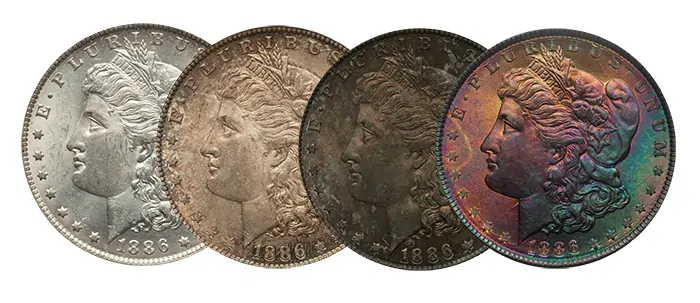
Ask most collectors who the model was for the obverse of the Morgan silver dollar, struck from 1878 to 1921, and the answer usually comes quickly: Anna Willess Williams. Born in 1857, Williams was a Philadelphia schoolteacher known to friends and family as “Nannie.” For more than a century, numismatic lore has held that her likeness appeared on one of the most widely collected American coins.
 That belief became deeply embedded in hobby culture. It also carried historical weight. Contemporary press accounts described Williams as the first real person believed to have appeared on a circulating United States coin. However, those accounts relied on secondary reporting rather than direct testimony from Williams herself.
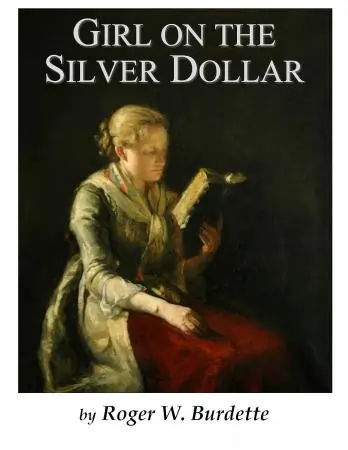
In Girl on the Silver Dollar (Seneca Mill Press, 2019), award-winning numismatic researcher Roger W. Burdette reexamines that long-accepted narrative. Based on documentary evidence, he concludes that the Liberty head on the Morgan dollar was not modeled directly on Williams. Instead, Burdette argues that the design was most likely a composite. It combined features of Morgan’s wife, Alice, with classical Greek motifs filtered through French academic tradition. If Williams’ features appear at all, Burdette states that their presence is more likely coincidental than intentional (Burdette, p. 31).
Composite Liberty and American Coinage
Burdette’s conclusion aligns with established practices in American numismatic art. Designers frequently created allegorical figures of Liberty using composite imagery. They blended classical ideals with modern influences rather than portraying a single identifiable individual.
A well-documented example appears on Augustus Saint-Gaudens’ $20 gold double eagle. That Liberty figure combined Greco-Roman imagery with features drawn from a real model, Hettie Anderson, an African-American woman from South Carolina. Anderson also modeled for Adolph Weinman. Such artistic methods were common, especially when artists depicted allegorical subjects rather than portraits.
Against this historical backdrop, Burdette argues that the Morgan dollar belongs firmly within this tradition rather than representing a literal likeness.
What the Documentary Record Shows
Burdette does not dispute that Anna Williams modeled for George T. Morgan in 1876. At that time, Morgan was developing designs for a new silver dollar obverse. However, Burdette’s research indicates that Williams’ identifiable features and youthful appearance do not appear on the adopted Morgan dollar design.
Instead, her likeness corresponds more closely with other pattern issues. These include the 1879 “School Girl” silver dollar pattern and a contemporary half eagle pattern. One specific detail supports this conclusion. The chin on the Morgan dollar obverse closely resembles that of Morgan’s wife, Alice, who arrived from England in 1877, rather than that of Williams.
Burdette bases these findings on extensive archival research. His sources include United States Mint and Treasury records from the National Archives, contemporary newspaper accounts, numismatic periodicals, and direct visual comparisons. He also examines the documented relationships among Williams, Morgan, and the artist Thomas Eakins, who introduced Williams to Morgan and for whom she also modeled.
Morgan’s Training and Artistic Intent
George T. Morgan arrived in the United States in 1876 after the Deputy Master of the Royal Mint recommended him to United States Mint Director Henry Linderman. Morgan came to Philadelphia with formal academic training. That training emphasized copying classical models, with a strong reliance on French interpretation (Burdette, p. 12).
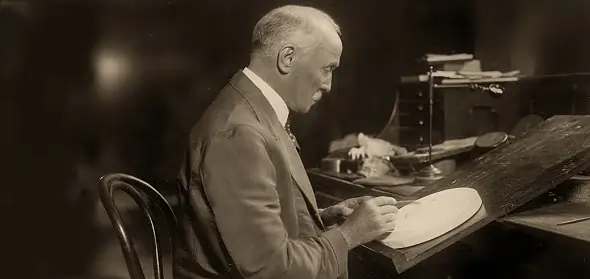
Before his arrival in America, Morgan had already begun work on a Liberty head silver dollar. Linderman hired him specifically to create new silver dollar designs. Dissatisfaction with the existing Barber coinage drove that decision. Linderman sought a “classical head of Liberty,” rooted in Greco-Roman ideals, that could potentially serve across most silver denominations except the Trade dollar (Burdette, p. 10).
As a result, Morgan’s Liberty designs consistently display the “Grecian nose and forehead” regarded as classical beauty in the late 19th century (Burdette, p. 30). At the same time, Morgan expressed a desire to give his work a distinctly American character. He drew inspiration from the appearance of young American women he encountered in Philadelphia after his arrival.
How the Story Took Hold
Given the strength of Burdette’s evidence, a key question remains. Why did the belief that Anna Williams was the Morgan dollar model become so widespread?
The surviving record points to unreliable journalism and uncritical repetition. Late 19th-century newspapers often presented conjecture as fact. Later numismatic writers repeated those claims without independent verification.
A notable example appeared in an 1896 issue of The Numismatist. The article, titled “The Silver Dollar Girl,” described Williams’ face as “known to more people than that of any other woman of the American continent.” Ray Levato later cited that statement in “Numismatic Nostalgia: The Girl on the Morgan Dollar” (Coinage, November 2015). As Burdette notes, no documented numismatic writer ever interviewed Williams directly.
Privacy, Publicity, and Personal Cost
According to the traditional narrative, Williams hesitated to model because of prevailing social norms. As a schoolteacher, she reportedly feared professional consequences if her role became public. The story holds that she agreed to pose only if her identity remained confidential. A cover explanation attributed the design’s inspiration to a Greek statue Morgan studied at the Philadelphia Academy of Art.
An August 13, 1879 article in the Philadelphia Record identified Williams as the model for the silver dollar obverse. Other newspapers repeated the claim. Over time, repetition transformed the story into accepted fact. Yet the historical record does not clarify whether the information originated with Williams, her acquaintances, or reporters themselves. Burdette suggests that journalistic invention remains a plausible explanation.
The resulting publicity brought Williams unwanted attention. Although it diminished, it never disappeared entirely. Williams later referred to the episode as “an incident of my youth” (Levato, p. 31) and “a casual and easily forgotten affair” (Burdette, p. 33). Other press accounts indicate that the notoriety may have contributed to the cancellation of her planned marriage.
Artistic Contradictions of the Era
While Williams’ modeling for Morgan drew criticism, she also posed nude for Thomas Eakins. That fact underscores the contradictions within late 19th-century moral standards. Burdette strengthens his analysis by reproducing and comparing paintings and sketches believed to depict Williams with Morgan’s final coin designs and pattern issues.
Beyond the Morgan Dollar Narrative
Burdette devotes roughly the first third of Girl on the Silver Dollar to resolving Williams’ role in the design process. The remainder of the book expands well beyond that issue.
He documents Williams’ later career as an educator. She published extensively on educational and philosophical subjects. She ultimately became Superintendent of Kindergartens for Philadelphia. Modeling, which she pursued from approximately 1876 to 1880 or 1881, served only as a brief supplement to her income.
Burdette also examines the broader origins of the Morgan dollar program. He reviews competing Liberty head designs by Morgan, Chief Engraver William Barber, and Philadelphia artist Hermann Faber. He details the production challenges of 1878, including reverse feather modifications and the creation of new hubs and dies. These changes explain the numerous major die varieties collectors encounter for the first year of issue.
Later Revisions and Legislative Impact
The book further traces Morgan’s frustration at being passed over for Chief Engraver until 1917. That year, he modified Hermon MacNeil’s Standing Liberty quarter for part of its inaugural production. In 1921, following the Pittman Act, the Mint revived the Morgan dollar. Morgan revised his 1878 design with shallower relief and modified details.
When critics objected to the broken sword on the original Peace dollar reverse, Morgan again intervened. He recut the hub and die to remove the sword entirely.
The 1895 Dollar and the Pittman Act Meltings
The final chapters address two longstanding Morgan dollar questions. The first concerns the 1895 issue. Although 12,000 Mint State coins were reportedly struck, only proofs survive today. The second focuses on the 1918 Pittman Act, which authorized the melting of 270,232,722 Morgan dollars, approximately half of the total mintage to that point (Burdette, p. 133).
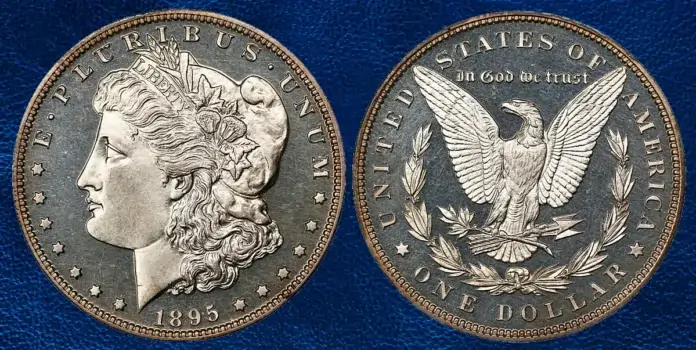
Mint records document only the aggregate number of coins melted. They do not identify specific dates or mintmarks. That lack of detail created permanent gaps in Morgan dollar history. Researchers have attempted to estimate surviving populations, most notably Q. David Bowers. The melted coins became bullion sold to Great Britain to stabilize silver prices during World War I. Newly mined American silver later replaced the destroyed coinage.
Greco-Roman Ideals and an “American” Liberty
Before Burdette’s study, one of the strongest counterarguments to the Williams story came from an undated letter written by Morgan’s youngest child, Mrs. Mervyn Graham. In the letter, she recalled her father stating that he never copied models directly and instead created the obverse from his own imagination (Burdette, p. 9).
An August 11, 1879 New York Times article offers further clarification. It reported that while the “Grecian nose and delicate lips” resembled Williams, the “full rounded chin” reflected Morgan’s wife, Alice. The article concluded that by the time Morgan completed the design, no direct resemblance to Williams remained (Burdette, p. 45).
Cornelius Vermeule later addressed this contradiction in Numismatic Art in America (1971). He noted the conflict between Morgan’s own statements and what he described as an “apocryphal, romantic legend” surrounding a young female model (Vermeule, p. 69). Vermeule further observed that the story reflected contemporary cultural ideals. Many believed Liberty had to embody chastity, beauty, and modesty. A young schoolteacher fit that expectation precisely (Vermeule, p. 71).
Reassessing a Familiar Narrative
Girl on the Silver Dollar exemplifies original numismatic research capable of reshaping long-held assumptions. Burdette’s work demonstrates how artistic conventions, social values, and unreliable reporting combined to create a durable myth.
For Morgan dollar specialists and students of American coinage, the book is essential reading. It clarifies the origins of one of the nation’s most iconic designs. It also deepens our understanding of late 19th-century American art, culture, and social norms.
* * *







I know the concept of beauty at the time Morgan dollars were made may have changed significantly later in the 20th century. I always thought whoever it really is posing as Liberty on the Morgan is one of the least attractive women I’ve ever seen. To me, the model as Liberty on the Peace dollar is a far better representation of both beauty, and Lady Liberty.
It’s the Eurocentric standard of beauty that prevails.
I don’t know who the model was for the new Liberty Semiquincentennial dime, but when I look at it, I am reminded of Taylor Swift. I wonder if anyone else has noticed that resemblance.
Standards, well done.
So, it’s no one..