


Mexico’s numismatic history stretches back more than 250 years before the establishment of the United States Mint. As a result, Mexican coinage funded commerce across both the New World and the Old. That legacy also shaped early American trade, in which Mexican coins circulated widely alongside U.S. coins.
For United States collectors, this shared history begins with the Spanish Milled Dollar, a Mexican-made coin that appears first in Whitman’s Guide Book of United States Coins. Mexican silver filled a critical gap at a time when the Philadelphia Mint could not meet domestic demand. In fact, Mexican and other foreign coins carried legal-tender status in the United States for the nation’s first 81 years.
Yet Mexican coinage offers more than monetary utility. Instead, it reflects political change, cultural identity, and national symbolism. Few issues demonstrate this more clearly than the Mexican Un Peso Caballito.
These themes stand at the center of Mexican Beauty: Un Peso Caballito by Allan Schein, a detailed study of one of Mexico’s most celebrated silver coins.
A Coin Shaped by Art and Upheaval
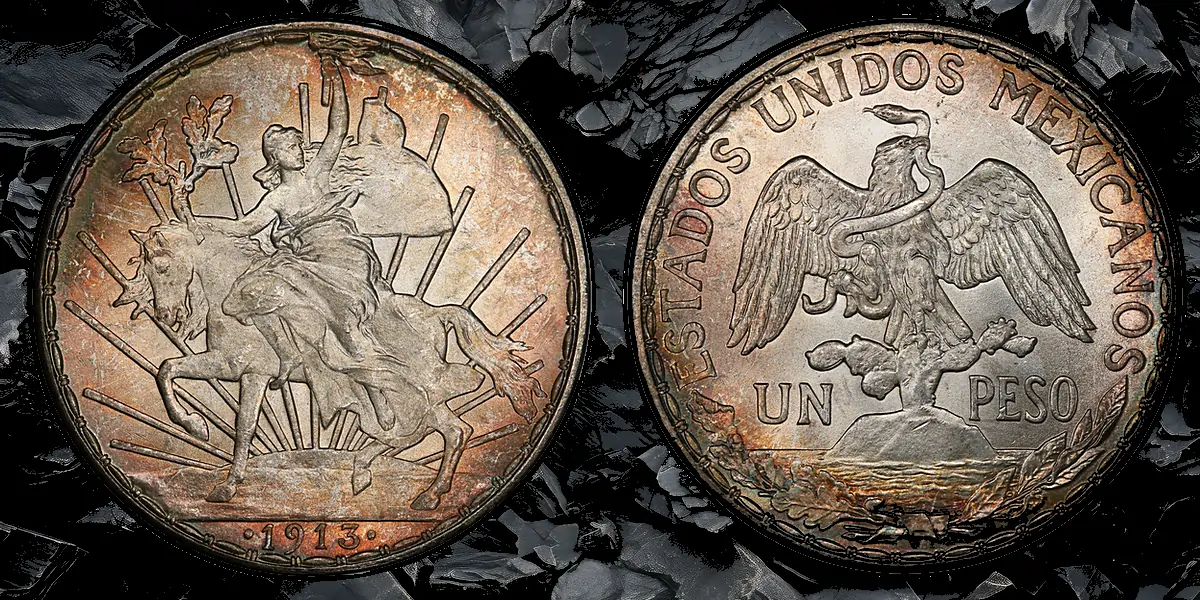
The Caballito Peso was struck from 1910 through 1914 to commemorate the centennial of the start of the Mexican War of Independence. Officially denominated as one peso, the coin quickly earned its nickname, Caballito, or “Little Horse”, from its dramatic reverse design.
Those years, however, marked one of the most volatile periods in modern Mexican history. Production coincided with the overthrow of Porfirio Díaz, the outbreak of the Mexican Revolution, the assassination of Francisco Madero, and the rise of Victoriano Huerta, known historically as El Chacal.
As Schein emphasizes, the Caballito stands at the intersection of political symbolism and national crisis. While the coin celebrated independence, its brief production run reflected instability rather than continuity.
Beaux-Arts Origins and Transnational Design
The Caballito design originated in Beaux-Arts–era France. It evolved from a 50-centavo pattern created in 1907 by French sculptor Charles Pillet (1869–1960). Later refinements were introduced by Charles Barber, then Chief Engraver of the United States Mint.
The reverse depicts a female personification of Liberty riding side-saddle on a rearing, unshod horse. She holds a torch aloft in one hand and a branch, identified by Schein as Encino oak, in the other. Behind her, rays of the rising sun reinforce the theme of national rebirth.
Although many observers mistakenly describe this side as the obverse, the actual obverse features Mexico’s national emblem. An eagle perches atop a cactus growing from an earthen mound while grasping a snake in its beak and talon.
The Eagle Debate and National Symbolism
The identity of the eagle has generated decades of scholarly debate. Some numismatists have argued that the bird resembles a caracara, a scavenger species native to the region. Schein, however, presents extensive evidence in favor of the Golden Eagle interpretation.
Regardless of taxonomy, the sculptural quality of the design remains central to the coin’s appeal. Collectors do not need ornithological expertise to appreciate its balance, movement, and symbolism.
Specifications of the Mexican Caballito Peso
The Caballito Peso reflects both artistic ambition and technical precision:
- Composition: 0.903 silver, 0.097 copper
- Weight: 27.07 grams
- Diameter: 39 mm
- Mint: Mexico City Mint
- Obverse: Porfirian Eagle, the national coat of arms used during Díaz’s regime
- Reverse: Liberty on horseback with torch, branch, and rising sun
These specifications remained consistent throughout the series.
Market Performance and Collector Demand (2026)
As of February 2, 2026, the Caballito Peso’s value depends heavily on both date and condition. While its silver melt value stands at approximately $66.93, numismatic premiums remain substantial.
Circulated examples in Very Fine to About Uncirculated condition typically trade between $295 and $360. In contrast, Mint State coins graded MS63 to MS64 often realize $1,995 to $2,000 or more.
Among the regular issues, the 1914 peso ranks as the scarcest. The 1910 and 1913 issues appear more frequently on the market. Many coins were hoarded or melted during the Revolution, which likely contributed to the series’ relative scarcity when compared to other historic Mexican pesos.
Scholarship, Translation, and Lasting Significance
Schein’s work functions both as an introduction to the Caballito Peso and as a focused study of Pillet’s broader artistic output. The volume includes a side-by-side Spanish translation by Roberto del Bosque of Mexican Coins and More in Brownsville, Texas, expanding accessibility for a bilingual readership.
Ultimately, the Caballito Peso remains a defining example of how art, politics, and history converge in coinage. Its continued popularity reflects not speculation, but sustained collector interest rooted in design quality, historical context, and limited availability.








A beautiful coin — of which I had no knowledge of as to this date. It is difficult to see that the horse is “unshod.” It is also easy to see why most mistakenly look at the obverse of the coin and think that it is the reverse (Mexican coins are noted for the eagle being on the reverse). Great artwork. Great symbolism. Wonderfully done.
Beautiful coin.