


In honor of St. Patrick’s Day, CoinWeek is pleased to present a bit of numismatic history on the Irish nation’s favorite saint.
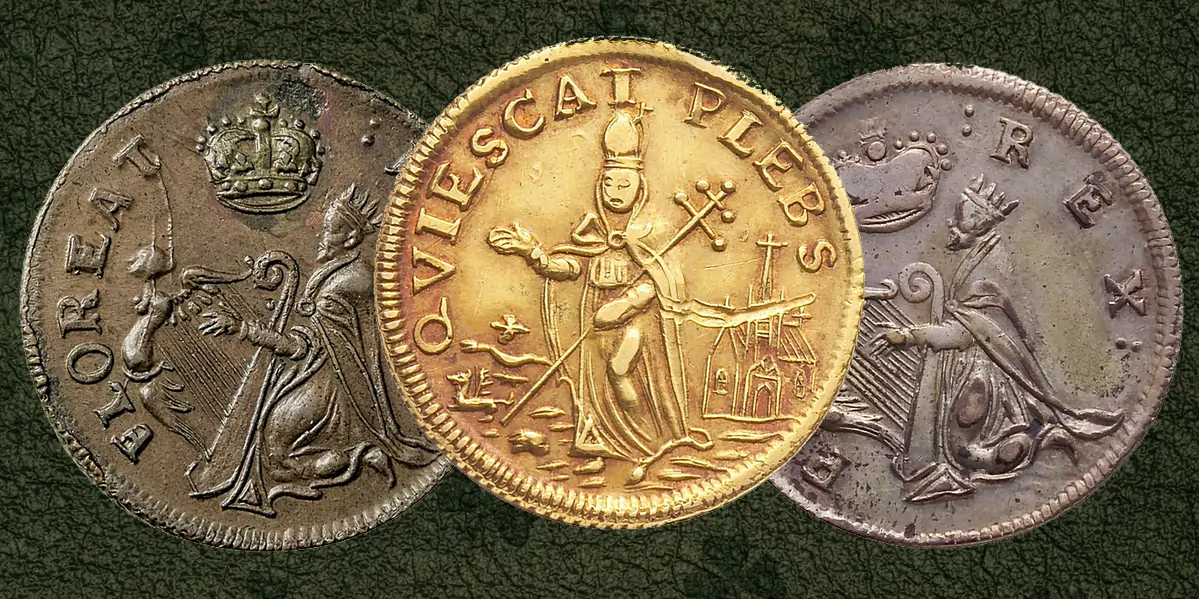
The Irish Coin that Helped Solve Colonial America’s Money Shortage
Few colonial coins carry a story as dramatic as the St. Patrick Farthing. Struck in Ireland during the 17th century, this unusual coin traveled across the Atlantic and became one of the earliest forms of money used in what is now the United States.
The series is famous for its striking religious imagery, its connection to early New Jersey history, and its appearance in three metals: copper, silver, and gold. Most collectors encounter the copper version. However, silver pieces are scarce and the gold issue is unique.
Together they form one of the most intriguing chapters in colonial numismatics.
Irish Origins in the Mid-17th Century
The St. Patrick Farthing was struck in Dublin, Ireland, likely between 1658 and 1670. The precise purpose of the issue remains uncertain. Nevertheless, the design clearly reflects the political and religious symbolism of the era.
The obverse shows King David kneeling while playing a harp, a traditional emblem associated with Ireland. Above the harp is a crown. The legend reads FLOREAT REX, meaning “May the King flourish.”
The reverse depicts St. Patrick in episcopal robes driving serpents from Ireland, a symbolic representation of the triumph of Christianity over paganism. A church appears in the background. The reverse legend reads QVIESCAT PLEBS, translated as “May the people be at peace.”
These motifs give the coin a powerful visual message that blends religion, monarchy, and national identity.
The Mark Newby Connection
The St. Patrick Farthing became important in American history through Mark Newby, an English Quaker.
In 1681, Newby emigrated to West New Jersey and brought with him a substantial quantity of these copper coins. At the time, the American colonies faced a severe shortage of circulating coinage.
Therefore, colonial authorities took an unusual step.
In May 1682, the General Free Assembly of West New Jersey officially recognized the St. Patrick halfpenny and farthing as legal tender. This decision allowed the coins to circulate locally and helped alleviate the colony’s shortage of small change.
As a result, the St. Patrick Farthing became one of the earliest coins used in everyday commerce in colonial America.
The Famous Brass Plug
Most copper examples include a distinctive feature. A small brass plug appears on the obverse beneath the crown.
This insert was designed to give the crown a golden appearance, reinforcing the symbolism of the monarch’s authority. Over time, the brass often develops a different tone from the surrounding copper, making the feature easy to identify.
Collectors sometimes call this insert the “brass splasher.”
The Three Metals of the St. Patrick Farthing
The St. Patrick Farthing exists in three different metals. Each tells a different part of the coin’s story.
Copper: The Colonial Circulation Issue
Copper examples are the standard issue and the pieces most often associated with colonial circulation.
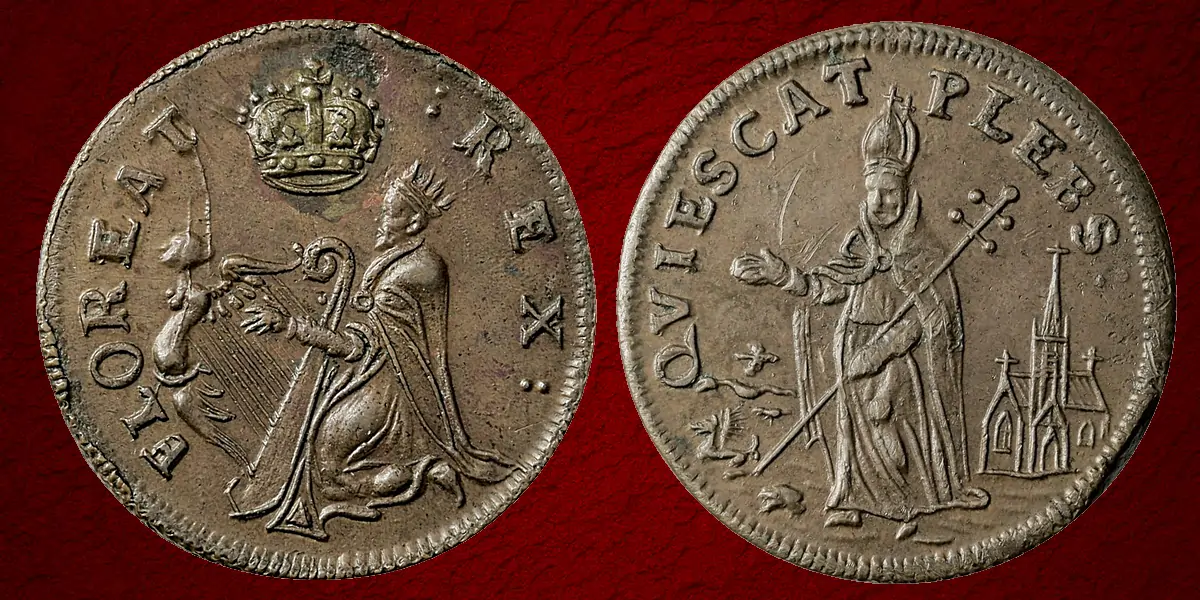
Stacks Bowers described one exceptional specimen of the type as follows.
An Undated (circa 1667) St. Patrick (Mark Newby) Farthing, Breen 208, weighing 101.3 grains, survives in remarkable preservation. The coin displays lustrous mahogany-brown surfaces that are unusually attractive for the series. Many examples are porous or heavily worn, yet this specimen shows outstanding quality.
The strike is uncommonly bold, and the centering is perfect, with denticles visible around the full circumference of both sides. Only slight cabinet friction and a few minor marks interrupt the surfaces.
The brass splasher appears well centered below the crown and displays an olive-gold metallic tone, accompanied by the verdigris commonly found around the insert. The legends read clearly FLOREAT :REX: on the obverse and QVIESCAT PLEBS: on the reverse.
Because of its remarkable condition and eye appeal, this coin would rank near the top of any condition census for the series.
Silver: Rare Presentation Pieces
Silver examples are much rarer than the copper issues. Experts believe they were likely struck as presentation pieces or special strikings rather than coins intended for circulation.
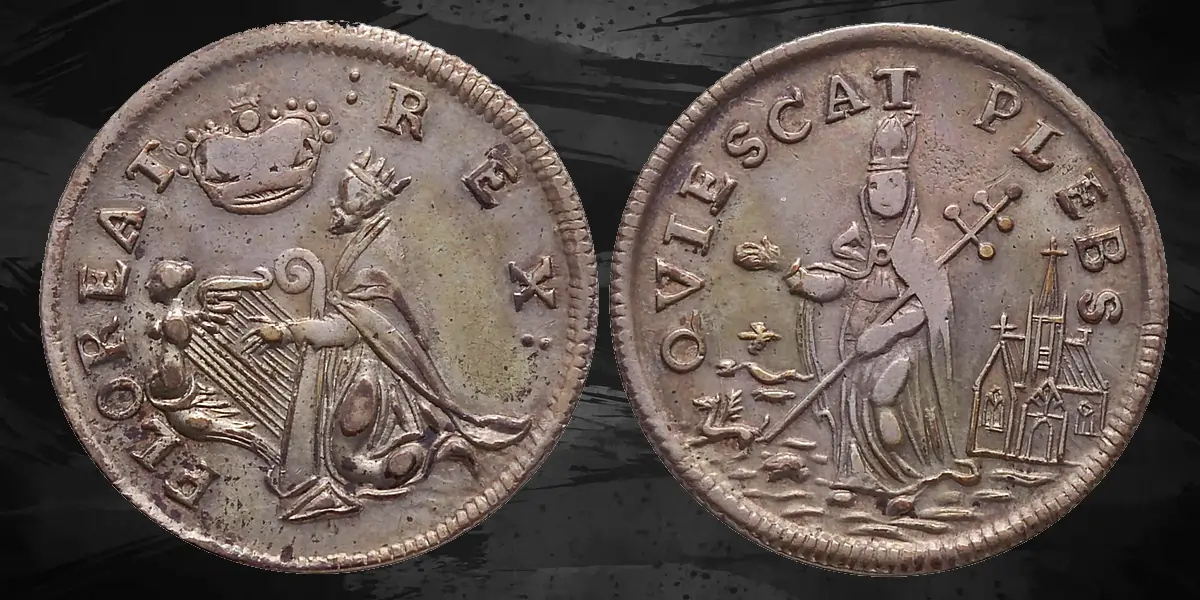
Stacks Bowers offered an impressive example described as Nice Choice Extremely Fine, weighing 98.1 grains.
Both sides display pale silver-gray toning accented by subtle traces of rose and gold iridescence. The reverse shows slight softness at the center. However, the obverse figure of kneeling King David remains sharp and clearly defined.
Nearly complete outer beaded borders appear on both sides, enhancing the coin’s visual appeal. Overall, the piece represents a lovely and well-preserved example of this scarce silver issue.
Several dozen silver specimens are believed to exist today.
Gold: A Unique Colonial Rarity
The most extraordinary St. Patrick Farthing is the unique gold example.
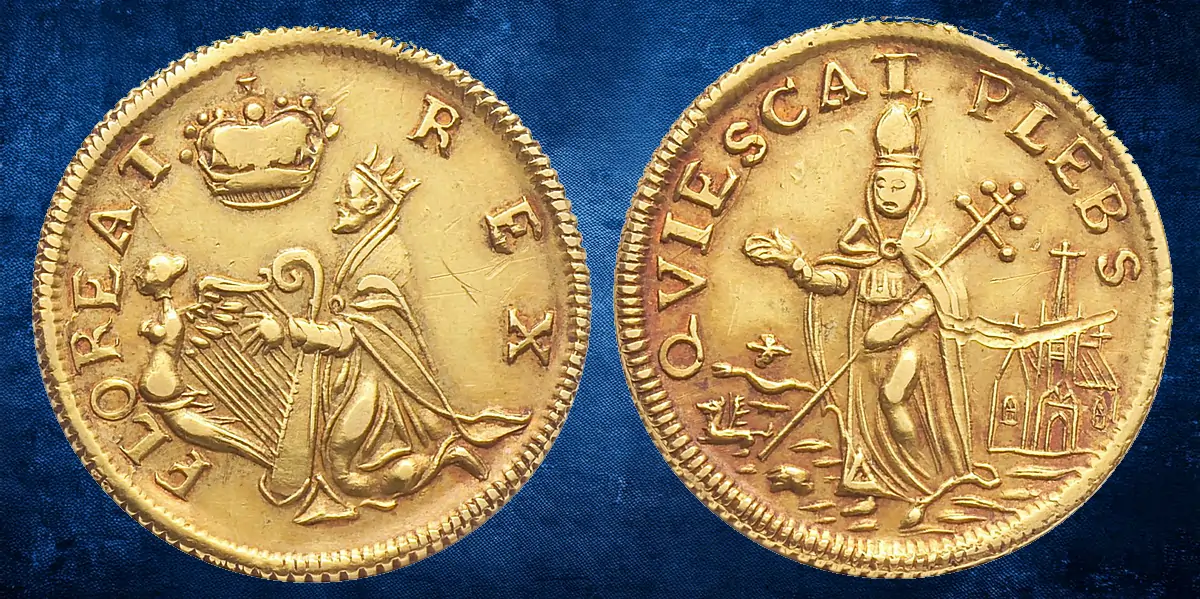
Stacks Bowers described this remarkable coin as About Uncirculated, weighing 184.9 grains.
The piece displays deep yellow gold color with natural peripheral toning that developed over time. The strike is bold and well centered, with the reverse nearly perfectly aligned. Details in both King David and St. Patrick remain strong, although the face on the obverse is somewhat softer than usually seen on copper pieces.
The flan is thick and constricted, and the edge is reeded, similar to the silver issues. The variety lacks punctuation in both obverse and reverse legends.
Importantly, specialists consider this piece unique, with no other confirmed gold specimens known. While struck from authentic dies, its fabric suggests it may have been produced slightly later than the main farthing coinage, possibly in the early 18th century.
Its provenance stretches back centuries. The coin once formed part of the Rashleigh Collection, later passing through famous collections including Colonel E.H.R. Green, F.C.C. Boyd, and John J. Ford, Jr.
The coin realized $184,000 in a 2005 Stacks Bower public auction.
A Coin That Bridged Two Worlds
The St. Patrick Farthing stands at a remarkable crossroads of history.
It connects Ireland, England, and colonial America. It reflects the economic struggles of early settlements. And it demonstrates how coins could travel across oceans and become essential tools of everyday commerce.
For collectors, the series offers a unique blend of religious imagery, colonial history, and extreme rarity. Copper pieces recall their use in early New Jersey. Silver examples suggest ceremonial presentation. And the unique gold specimen stands among the most remarkable rarities in colonial numismatics.
Few coins illustrate the early Atlantic world as vividly as the St. Patrick Farthing.








Wonderful history. Thank you for this informative article.
A most interesting article on the St. Patrick farthing.
Thanks so much for this article. I’ve been collecting for over half a century and still keep learning new things about our fascinating hobby.
Some fun trivia: The use of “V” in the word QVIESCAT links back to the Roman alphabet which lacked the letter U, as well as J. The characters V and I could serve as numerals, vowels, or consonants; you had to determine their usage by context.
During the 1500s the new letter U started to take over V’s duties as a vowel but only became common in English during the early to mid 1600s, while J split off from I even later. It’s thus not surprising that a Latin inscription on a 17th-century coin would continue to use Roman lettering.
I love learning new things about our history and this is so neat!
Very Good Information, more people need to read info provided.
Never knew about this!