

1944-D Lincoln Steel Cent: Rarity, Values, and Famous Specimens
The 1944-D Lincoln Steel Cent ranks among the most important error coins in United States numismatics. Collectors prize it for its rarity, its dramatic origin story, and its connection to the famous 1943 bronze cent error.
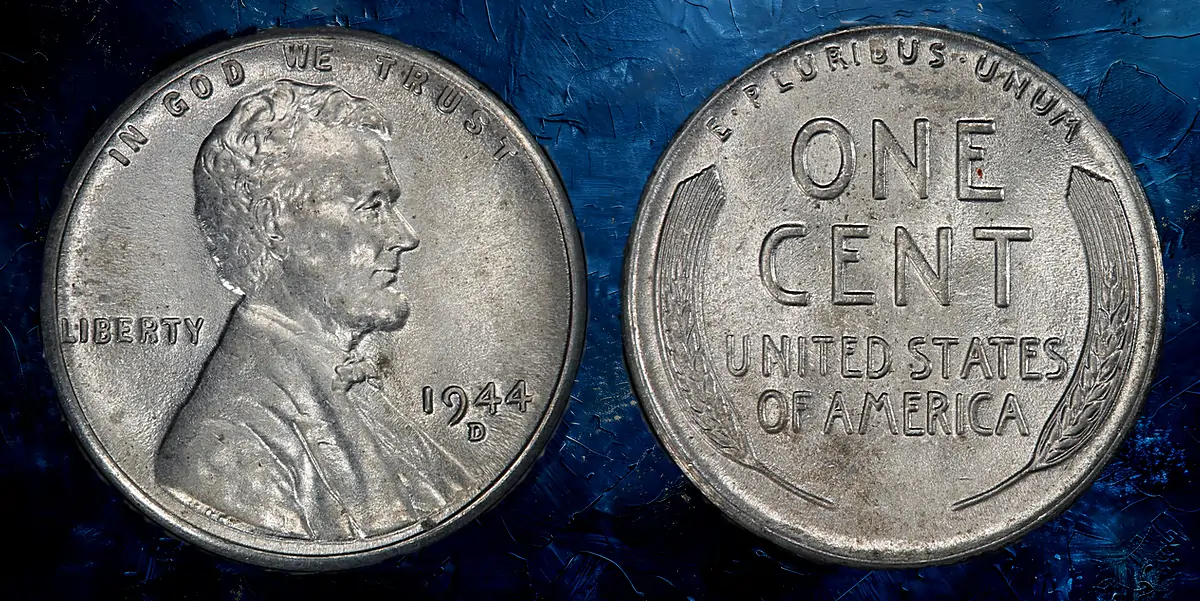
Only an estimated 7 to 10 examples exist today. As a result, demand remains intense. Moreover, certified populations confirm their elite status among 20th-century mint errors.
A Wartime Mistake at the Denver Mint
In 1943, the United States Mint struck Lincoln cents on zinc-plated steel planchets to conserve copper for the war effort. In 1944, the Mint returned to a copper-based alloy.
However, leftover 1943 steel planchets remained in the production stream. Consequently, mint workers struck a small number of 1944-dated cents on steel planchets by mistake.
This error mirrors the famous 1943 bronze cent. Yet it represents the opposite mistake. In 1943, a few bronze planchets slipped into production. In 1944, steel planchets did.
Although collectors celebrate the 1943 bronze cent more widely, the 1944 steel cents remain exceptionally rare. In fact, professional grading data supports that conclusion.
Discovery of the 1944-D Steel Cent
The second known 1944-D steel cent surfaced in 1966 in California. A 23-year-old collector named Robert Collins found the coin in circulation in Pacifica CA.
Collins regularly swapped copper cents for steel cents whenever he found one in change. On this occasion, he noticed something unusual. The coin carried a 1944 date but showed the silver-gray appearance of steel.
He brought the piece to two coin dealers. They found no reason to doubt it. Afterward, the coin went to noted authenticator Walter Breen, who declared it genuine.
At the time, newspapers reported the discovery with the headline: “Pacifican Finds Penny, One of 2 in the World.” A photocopy of that article accompanied the coin in later auction appearances.
Today, experts estimate that about 10 examples of the 1944-D steel cent survive. Therefore, the Collins coin represents one of the earliest confirmed specimens.
Importance in U.S. Error Coinage
The 1944-D steel cent stands as a major 20th-century mint error. It serves as the counterpart to the 1943 bronze cent.
In 2010, Nicholas Brown, David Camire, and Fred Weinberg ranked it #15 in 100 Greatest U.S. Error Coins. That ranking cemented its place among the most celebrated American mint mistakes.
Interestingly, collectors did not always value the coin at six-figure levels. Twenty years ago, examples sold for a fraction of today’s prices. Over time, however, registry competition and broader awareness drove values higher.
Population Data and Market Reality (As of May 2025)
Professional Coin Grading Service (PCGS) and Numismatic Guaranty Company (NGC) confirm the coin’s extreme rarity.
Top Certified Populations (5/2025):
- PCGS MS63: 1 example
- NGC MS62: 1 example
- CAC MS62: 1 stickered example (1:0 stickered to graded)
PCGS reports a surviving population of seven 1944-D steel cents. Meanwhile, the Philadelphia Mint examples number a few dozen. Even so, Denver Mint coins remain far scarcer.
Record Sales and Notable Auction Results
- Prices reflect rarity and condition.
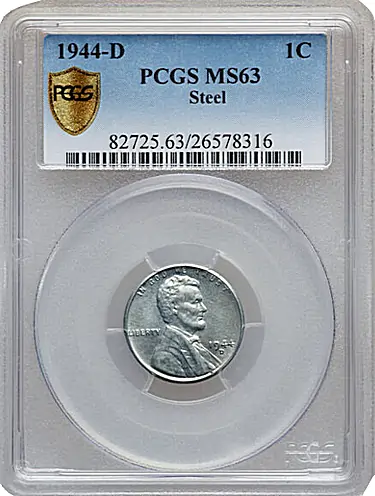
1944-D 1C On Steel Planchet PCGS-63 - MS63 NGC (August 2007) realized $115,000.
- MS63 PCGS Secure (January 2013) realized $82,250.
- The same PCGS MS63 example brought $79,312.50 in August 2013.
That MS63 PCGS coin now ranks as the finest certified example across PCGS and NGC populations. Notably, NGC no longer lists the earlier MS63 coin, and experts confirm the two coins do not match.
Lower-grade examples also command strong prices:
- NGC MS62 (January 2008) realized $92,000.
- NGC MS61 (January 2012), the Robert Collins discovery coin, realized $58,201.50.
- AU55 NGC (June 2010, Brenda John Collection) realized $60,375 after conservation and a five-point upgrade.
- ANACS AU55 (May 2007) realized $69,000.
- PCGS AU53 examples traded between $30,550 and $37,375 from 2010 to 2013.
- NGC AU Details – Cleaned (November 2023) realized $21,600.
Earlier auction records from the 1990s and early 2000s show four-figure prices. However, modern registry demand transformed the market.
Famous Collections and Provenance
Several advanced collectors pursued these off-metal errors.
Bob R. Simpson assembled a groundbreaking set of 1943 and 1944 P-D-S off-metal strike Lincoln cents. His collection included a 1944-D steel cent that later crossed from NGC MS63 to PCGS MS62 with CAC approval.
Brenda John owned two examples of the 1944-D steel cent. Her coins appeared in major Heritage Auctions sales in 2010.
These pedigrees strengthen market confidence. Moreover, provenance often enhances value for elite error coins.
Design of the 1944-D Lincoln Wheat Cent
Obverse
Victor David Brenner designed the obverse. A right-facing portrait of Abraham Lincoln dominates the field.
- IN GOD WE TRUST appears at the top inside the rim.
- LIBERTY sits to the left of Lincoln.
- The date 1944 appears to the right.
- The “D” mintmark sits below the date.
Brenner’s initials “VDB” appear on the shoulder bevel on post-1918 issues.
Reverse
The reverse features:
- ONE CENT at the center top.
- UNITED STATES OF AMERICA below.
- E PLURIBUS UNUM arcing along the upper rim.
- Two stylized wheat ears framing the design.
Collectors often call this type the “Wheat Cent” for that reason.
Coin Specifications
- Country: United States of America
- Year: 1944
- Denomination: One Cent
- Mintmark: D (Denver)
- Estimated Survivors: 7–10 known
- Alloy: Zinc-coated steel
- Weight: 2.7 grams
- Diameter: 19.0 mm
- Edge: Plain
- Designer: Victor David Brenner
- Strike Type: Business Strike
Why the 1944-D Steel Cent Matters Today
The 1944-D Lincoln Steel Cent represents a dramatic wartime production error. It links directly to the alloy transition of 1943 and 1944. Furthermore, it remains obtainable, at least in theory, at prices below the legendary 1943 bronze cent.
Nevertheless, its certified population confirms extreme rarity. Registry competition continues. Therefore, demand should remain strong for high-grade and well-pedigreed examples.
For collectors of elite U.S. error coins, the 1944-D steel cent stands as a cornerstone rarity.


I’ve got a 1944 Lincoln wheat that is magnetic. It sticks just as if it was a 43 Steelie. The weight diameter and all match but this 44 is covered in copper which I’ve only heard of a handful before. Mine is in excellent shape. I would just like to hear about what I should do. I’ve also got 1 1943 no mint that has a line diagonal from top to bottom right thru the I&b of Liberty. I also have a 1943 s steel that all looks good but faint. The 4 in 1943 didn’t strike good and it’s just a spot. This one is non-circulated. Please help point me in the right direction.
Send them to a third party grader. PCGS, NGC or CAC..
I would like more guidance with this penny I know someone that has this same exact one in hand!
Send it to a grading company
I have one of those 44 D steel pennies wt. Dia. Meets all that you described in your paragraph. What or how do I go forward with this
Send it to a third party grading company
I have roughly 25of the steel Penny’s in my possession I have had them for roughly 34 years
If you have 25 steel cents, it’s HIGHLY unlikely they’re the valuable 1944 issues. Only a few of those are known to have been struck. Please re-check the dates; they’re almost certain to be 1943 cents which are the common dates generally worth 25 cents to a dollar.
I have a 1944 steel penny in good condition . Is it worth anything?
Maybe give me one of these for Christmas.
I also have a 1964 silver quarter in good condition . Is it worth anything
I have a 1943 wheat head steel penny with the tick and spots I don’t know what to do 1943 s
About a billion 1943 steel cents were struck. Unless your coin’s in top condition it’s not likely to be worth more than 25¢ to a dollar.
I have a 1849 penny, is it worth anything?
I have a 44 steel penny its wt. And dia. Is what they say it should be, but I know there are other factors that come with it so from I described pretty much what this penny worth anything?
If it sticks to a magnet you should have it examined by a coin expert. OTOH if it doesn’t stick your coin couldn’t be made of steel; that means it’s not one of the valuable errors.
I have one 1944 penny colored silver is that worth anything??
I have a 1794 penny well defined hair with hook on lowest curl star reverse with lettered edge
I have some of these pennies , 1943 Alloy zinc steel
@Michael Watson The only really valuable steel cents are dated 1944. Over a billion “steelies” were made in 1943; In average condition they’re generally worth only 25¢ to a dollar
FWIW: steel cents weren’t made of a zinc/steel alloy. They were struck on blanks made of scrap steel, then plated with zinc to deter rust.
I have a 1943 Jefferson nickel with big s on top of the dome is it worth anything
The large S indicates your coin was struck at the San Francisco mint. During WWII the nickel’s composition was also changed, and the mint mark position was moved from the side of Monticello to over the dome to indicate the change from the standard cupronickel to a silver/copper/manganese allow.
The good news is that “war nickels” contain about 1.5 gm of silver which makes them worth about $1.80 as scrap silver. That said, you’d only get about half that from a metal dealer. My own take would be to keep the coin as a conversation piece and memento of a time when even our lowliest coins made sacrifices for the war effort.
I have a 1943s silver penny
As the artile explains, 1943 cents are made of steel not silver.
I have a 1943stel penny a 1943bigS neckl. And a1969s penny
I got a steel 1943 penny the date is small to me the 3 looks funny an no mint markand it weighs 2.8 And I have 1991penny that the copper color is wore off and silver showing on edge an head and seems thinner like a dime
A weight of 2.8 gm is within tolerance for a normal steel cent. The lack of a mint mark (rather than just “mint”) simply indicates it was struck by the Philadelphia mint. As far as your 1991 cent, remember that they’re made of copper-plated zinc rather than silver. If the copper plating is worn (rather than “wore”) the zinc core will be visible. The fact that it’s thin could mean it’s been damaged, perhaps by chemical exposure.
Two of the specimens noted in the article are the same coin, with the coin undergoing restoration prior to its later sale:
ANACS AU50 #PG9738: Heritage Auctions, May 10, 2007, Lot 2036
NGC AU55 #1582235-001: “The Brenda John Collection,” Heritage Auctions, June 3, 2010, Lot 170
It’s apparent if you look at the pictures of these from the auction archives that the small series of carbon spots to the left of Lincoln’s head are exactly in the same place, just fainter for the 2010 sale. Other markers on the reverse are identical as well.
Thank you for this insightful comment. The article has been updated to reflect this.
Thank you for the quick reply and update!
Had some steel cents.
Gave one to my daughter.
A listing of known examples can be found https://nnp.wustl.edu/library/book/653208
Just love learning the history behind the jingly bits in my pocket!
The original 1943’s aren’t worth much.
I tell people to save them for their grandkids. They have a great story.
Where was the first known one found?
Great article! I’ve always been interested in this coin with it’s WWII History.
Great article! I didn’t know the 1944 steel was so rare. Would be a great find.
Don’t find many steel pennies for sale like I use too
After reading the article I wanted to go through all my wheat pennies.
I have several 43 steel cents, no 44’s. Probably had several pass through my paper boy fingers in the 50’s.
It took a good eye to find this cent. I remember as a kid periodically getting a “steelie” in change and I would keep it.
Every time I find 43 or 44 Wheat , I get excited to go home and check them out even I know they’re only worth a buck if that. Someday hopefully , one of us will get lucky in find 1 . Does anyone else check Cornstar machine returns when you go to a supermarket ? Ive found a couple silver coins in the return slot . If you don’t, you should..
Never knew they made a steel penny!
I had no idea there was ever a steel cent coin minted. So interesting! I wish I had one, even if it isn’t a valuable one. It would be cool just to have one!
More info on the history of the 1943 steel Lincoln cent
This is one penny for some thoughts : – )
Another geeat Lincoln cent article! I always enjoy these!
I need to get one of these pennies!!!
I’ve got some steel cents but in alot better state!!!
Always check your change.
I found many steel cents over the years but alas none of the rarities.
Great article.
I gave my son a few 1940s steel pennies one year for his birthday or Christmas. I’m sure they were not 1944, but I guess we should look when we get them out of a box that is somewhere in storage.
Nice article.
When I first learned about this type of error it peaked my interest in coin collecting and searching to find more errors.
This is a bucket list coin
I would love one of these!
nice read. thank you
Another good informative article.
This article is prompting me to search through my collection of “steel pennies”. Thanks for the push ;)
steel pennies always are so interesting
There are so many error coins — I feel paralyzed spending any change now, wondering if I’m giving away something I’m too ignorant to recognize as valuable. Hahaha
Awe, a coin to only dream of finding. You still can find steel cents show up in circulation. Actually, I’ve probably found half a dozen or so over the past couple of years stuck to the magnets, or in the reject bin of the coin machine at the CU I go to (of course, none of these beauties :) ). Actually my most interesting finds are usually the rejects at the coin machine. Have found several silver coins, and of course lots of foreign coins.
Love the steel coin!
Loved the article! It’s too bad there are so many counterfeit 1943 copper, and 1944 steel cents being circulated around the Internet these days. If you find one it’s pretty much guaranteed to be Made in China.
love it
I’d like to own it.
I’d love to find one of these
My grandfather had a steel penny, but I have no idea what year it was, and it seems to have been lost over the years.
I would love to find one of these in my roll hunting!
i have 2 of these coins. very pretty to look at!!
jk we all know what the replies would have been …. “ok buddy….do your research. do u even know what coin this is?” lol
A penny for your thoughts?
Love the history numismatics hold!
I would love to find one of these!
Great article. With the end of production of the penny, the only way to find one of these will be through collectors.
Cool Article!
Interesting article. Nice.
Cool history
Cool article
Fascinating article – amazing rarity value
Learned something about the collector following on this coin
Although millions were minted and they certainly aren’t a rarity, it’s always exciting to get a 1943 steel cent in a bank roll or change. Once I found about a dozen steel cents stuck to the magnet at the coin counting machine. I never bothered to check the dates, but who knows, maybe there is the elusive 1944 steel cent among those cents!
Great article. (Lot of comedians out there…)
Seek and ye may find!
Very informative article.. Thanks
I’m sure it was practical to use steel.
i was unaware of this error.Thanks for the article
The 1944 steel cent doesn’t seem to get nearly as much attention as the 1943 copper cent, but is worth a great deal of money, nonetheless.
I’ve always been fascinated by mint errors and how the come about.
This one looks like a steel!
Great article. Very informative.
I can remember touring the Denver mint as a child (probably 65+ years ago) and just being amazed.
Why am I hearing Billy Joel’s “Allentown” as a backing track to this? (Easy: Iron and coke, chromium steel – along with the striking SFX)
All my grays were nonmagnetic, shucks. Just pennies