


A remarkable 1919 Lincoln Wheat Cent graded PCGS MS-69 RD with a CAC green sticker will appear at auction through GreatCollections on March 22, 2026.
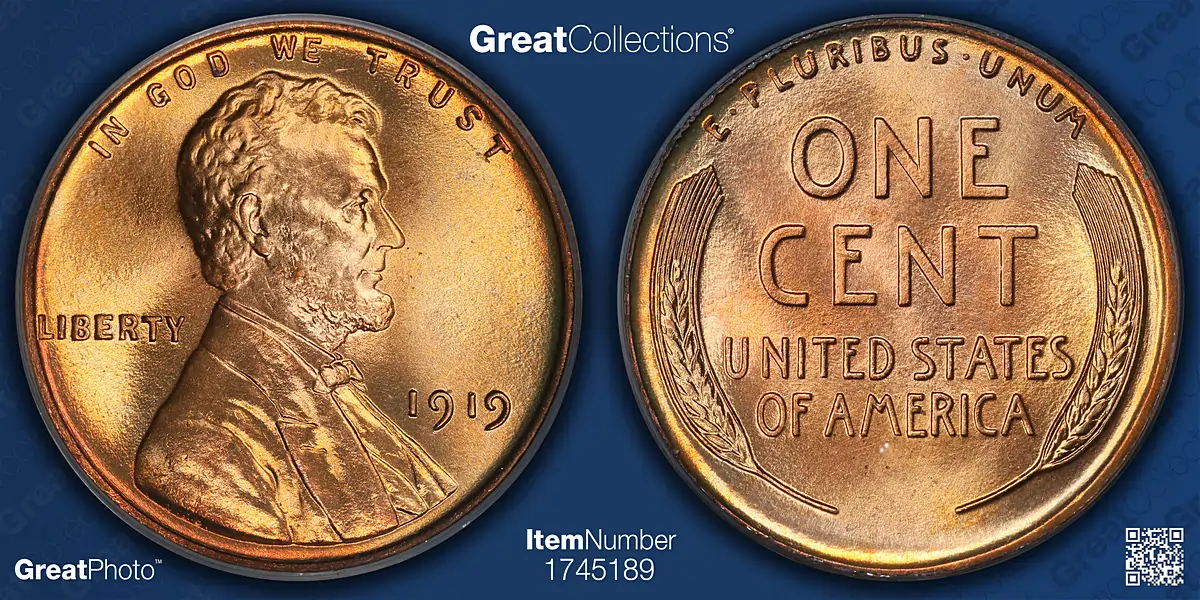
This coin represents one of the most extraordinary certified examples in the entire Lincoln cent series. Collectors rarely encounter a business-strike Wheat cent preserved at this level of quality. Even more striking, the coin comes from the renowned collection of Stewart Blay, whose registry-level Lincoln cents set several modern auction benchmarks.
For many collectors, simply seeing a copper coin struck more than a century ago in this condition feels remarkable.
A Lincoln Cent Preserved at an Extraordinary Level
Professional grading services evaluate coins on a 1-to-70 scale. A grade of MS-69 sits just one point below theoretical perfection.
This 1919 Lincoln cent carries three notable distinctions:
- Certified MS-69 RD by Professional Coin Grading Service (PCGS)
- Approved with a green sticker by Certified Acceptance Corporation (CAC)
- Exhibits full original Mint Red color
Copper coins typically darken over time as oxidation affects their surfaces. Because of that natural process, truly pristine red examples from the early 20th century remain extremely rare.

Certification records also highlight the coin’s uniqueness. PCGS lists this piece as the only pre-1934 Lincoln cent graded MS-69. In addition, CAC has not approved any other U.S. cent at the 69 level, whether business strike or proof.
These combined factors place the coin at the very top of the certified population for the Wheat cent design.
A Record-Setting Lincoln Cent
The same coin captured widespread attention in January 2023 when it sold publicly for $412,500.
The sale established an auction record for a classic U.S. small cent struck for circulation. No Flying Eagle cent (1856–1858) or Indian Head cent (1859–1909) has approached that level in auction results.
Other notable Lincoln cent sales from the Stewart Blay collection followed close behind:
- 1909 VDB Lincoln cent, Proof-67+ RD (CAC) – $357,500
- 1909-S VDB Lincoln cent, MS-67 RD (CAC) – $337,700
However, both coins represent famous key issues. The 1919 cent stands apart because it comes from a date normally considered common.
A Common Date With an Extraordinary Survivor
The Lincoln Wheat cent debuted in 1909 to commemorate the 100th anniversary of Abraham Lincoln’s birth.

By 1919, the coin had become firmly established in American commerce. The United States Mint in Philadelphia produced more than 390 million 1919 cents, the highest mintage of any Lincoln cent before 1940.
Because of that large production, examples of the date remain plentiful today. Even heavily worn pieces appear frequently in circulation finds, coin shop inventories, and old Wheat cent collections.
Lower-grade values reflect that abundance. A typical Very Fine example sells for around one dollar, while a well-worn Good-4 piece might trade for about twenty-five cents.
The MS-69 example therefore represents an extreme outlier. It demonstrates what can happen when a coin survives more than a century with virtually no disturbance to its surfaces or color.
Understanding the Certified Population
Population reports illustrate how rare elite Lincoln cents become at the highest levels of preservation.
Among Lincoln cents dated before 1934, PCGS reports 40 coins graded MS-68 RD across all dates. Nearly half of them, 19 pieces, belong to the 1919 issue.
By comparison, NGC has certified only two pre-1934 Lincoln cents as MS-68 RD, both examples of the 1909 VDB. The service reports no coins at the MS-69 level for early Wheat cents.
These statistics highlight how narrow the margin becomes between the highest certified grades. Even among coins preserved at the gem level, the difference between MS-68 and MS-69 represents an exceptionally small group of survivors.
The Stewart Blay Provenance
The coin also carries notable provenance. It once formed part of the Lincoln cent holdings assembled by Stewart Blay, a dedicated collector known for pursuing the finest certified examples available.
Blay’s collection gained attention for its concentration of top-graded Wheat cents. Several pieces from that set established new auction benchmarks during recent sales.
This MS-69 RD 1919 cent stands as one of the most remarkable coins associated with the collection.
A Century-Old Coin in Remarkable Condition
Most collectors encounter 1919 Lincoln cents in well-circulated condition. Many appear in childhood collections, blue Whitman folders, or inherited Wheat cent sets assembled decades ago.
The coin offered by GreatCollections shows what the date can look like when preserved at the highest possible level. Brilliant red color, pristine surfaces, and exceptional eye appeal combine to create a coin rarely seen even by experienced numismatists.
For collectors and researchers alike, the piece offers a glimpse of how a widely circulated American coin originally appeared when it left the Mint more than a century ago.






it looks like it was struck last Wednesday. just beautiful.
I’m having one dose one cent
I have one of them 1919 Lincoln penny and I have a lot of old coins nickels died quarters
I wish my 1919 was that nice
Beautiful coin! I have one but not anywhere near that nice.
I have a 1920 Lincoln cent. What’s the value of it?
Value depends on Condition. Just run a search on Google and you will see various listings offering the coin for sale in different conditions and price points.
I have a wheat penny for every year they made them but dont know how to sale them or were
How Much?????
$412,500 the last auction in January 2023. Will be auctioned again this month on the 22nd.
I have one 1919 wheat penny in fair condition.Would like to sell.
That’s what the article is about, hasn’t gone to auction yet.
I have a 1919 and a 1909 s and will sale if the price is rite u can text me and I will be back in touch with no low balls
I have a 1919 and a 1909 s and will sale if the price is rite u can text me and I will be back in touch with no low balls 9842200736
I have 2 wheat pennies In that same condition a 1944 without a mint mark and a 1956D In the very same condition of that 1919 wheat pennies
@ Kenneth Jenkins: Cents without mint marks are from Philadelphia. Large numbers of 1944 cents were struck and even today they’re not worth much except in high-end condition. Denver’s output in 1956 was also high, but a coin in near-uncirculated condition might bring a small premium.
I don’t know cuz I got three books full of them
This is my number if anybody interested in buying them free books an old coin 281-515-2743
I have a 1918 wheat back penny. It was my dad’s he was born in 19qq
I have found 1962 Black Penny in my change jar, and a 1930 penny and a1940 no mintmarks on them. What or they Worth. [email protected] Reply back please one more piece A quarter 1966 silver , no mintmarks And A 1967 Rare quarter No mint
@Stanley Marsh: Please check the edges of your quarters. Only a handful of silver quarters were accidentally struck after the switch to cupronickel-clad blanks in 1965. If the edge is brownish colored you have ordinary quarters; if the edge shows only silver color you should have the coin(s) checked by an expert.
To explain the lack of mint marks, their use was suspended on all coins dated 1965 to 1967 so that’s not an error on your quarters. Finally, without more information it’s not possible to know what makes your 1967 quarter rare versus the other hundreds of millions with that date.
I love my wheats!
I have a 1919 no mint mark penny and I would like to know how to get it certified. Don’t know who to trust. Please help with steps normally done by professionals. I’m not. Thanks.
@Wilber Gonzalez: As a response from Coinweek staff noted, a coin’s condition is often a major factor in its value. That being said, a 1919 (P) cent’s retail value ranges from only 15¢ or so in worn condition up to around $2.60 with minimal wear. It would cost far more than that to get it certified. My suggestion would be to keep it as a conversation piece or better yet, gift it to a new collector who’s trying to build a set of “wheaties”.
I found two1919 wheat back pennies sitting on the ground side by side about 20 years ago I don’t know what kind of a grade they would be but there in good shape.
Great information!
A very beautiful 1919 Lincoln Wheat Cent.
I have a 1919 wheat penny in excellent condition – what is the worth ?
Absolutely beautiful coin. I’m always amazed how some coins can make it over all those years and stay in such a great condition. A lot can happen in 100 plus years.
This is unbelievable. My husband found a 1919 penny in some change. It does not look brand new like the your showing, but it is still legible. I can send a picture of it if you like to see it.
I have tow 1909 pennies
Trying to find a honest and dependable buyer because I’m new to collecting old coins but think I have a few that should be worth a little something
I have a 1919 wheat cent
Hello sir. Hi this coins 19641980 1999 2000 2005 2006 2007 2009 hí Thi your need I coll+919550281625
@Shankar Unfortunately those are all common dates for US cents. Unless the coins are uncirculated they’re not likely to be worth more than face value.
I a here too much coins USA Euro 2002 your need +919550281625 I am call
Tengo un centavo de trigo de 1919 y otro de trigo 1943 de hierro y otro de 1943 de trigo bueno tengo una Colección de monedas y billetes de dólares con estrella Cuanto Vale mi Colección y la estoy vendiendo
You cant do better than this coin.
I have been collecting for years and have rolls of 1919 all in VG and better condition what would be the best thing to do with them??
Without giving them away. Just saying LMK
TY Joe
Looks awesome but why pre-1934 lot of us have 44 45 46 is in very similar shape but you’re right there’s a big difference between 67 68 and then the big 69 so all you guys hoping it drops quickly from 69 I’m talking about de Niro but thank you keep posting stuff like this it is so interesting for us little copper penny people
I have a 1917wheat penny .1909indian wheat penny.1937 dime lady on the front.i have a1937nickel much more Susan Anthony 1dolla 2of them
@Bobby Harness: As a Coin Week rep noted in another post, without knowing a coin’s mint mark (or lack of one) and condition, it’s impossible to say much about values. E.g. in circulated condition a 1917 Philadelphia cent can retail for anywhere from around 15¢ to $3.50 while 1917-D cent goes for 50¢ to $20.
With the current run-up in silver prices a 1937 is mostly worth its melt value. FWIW, the “lady” on the front is of course a representation of Miss Liberty. A 1937 nickel is only worth a couple of dollars or so, except for the famous “3 legs” variety from Denver. SBA dollars are generally only worth face value.
The term “Indian wheat penny” is confusing. Wheat cents have Lincoln on the obverse, while Indian Head cents show an image of Miss Liberty wearing a native headdress. Both types were made in 1909; again without more information it’s not possible to say anything about values.
I found two of the 1919 wheat cents one is in very good circulated condition Philadelphia mint clearly can see all dates and words I have another 1919 circulated can see the date and the words but very worn wondering if I could get rid of them and what would you suggest if I sell them as a set
I have a lot of old coins I would like to get them checked out and sale them for the right price can that happen
Definitely a beautiful looking wheat penny.
Am multe monezi nustiu ce valorisation au
I have a 1943 wheat cent made of copper that passes all of the tests to be an authentic coin.It is non magnetic ,weighs 3.11 grams and was not plated or made from another date as a forgery.In every way this coin is what I would believe to be authentic.It has obviously been in circulation and has a nice patina.Please help me to authenticate and put this rare coin into auction.Thank you.
@Josh Stanley You’ve definitely done the necessary homework! My 2¢ is that when you find a coin that checks all the “rarity boxes”, it’s time to call in the professionals to do a formal evaluation. Submit it to one of the professional coin authentication services like PCGS, NGC, or ANACS. If you choose to sell, consign, or donate the coin a pro certification can make a significant difference to the coin’s assessed value.
Beautiful. Doesn’t even look real
Remarkable how little ware it has
Beautiful Lincoln cent! The wheat ears reverse is my favorite of all the cent reverses.
wow. Such a pretty looking specimen! i thought i had some purty coins but nothing like this.
I have a lot of pennies in my collection. Lost my inventory for alll my coins so need to get busy and redo it.
I have a nice 1919 that may grade MS60 brown/red how could this penny be so clean??
great story
Stunning grade. Wow.
Gorgeous coin.
I loved talking about wheat pennies with my grandpa.
WOW nice coin
Wow! good write up on the 1919…Interesting read..Thank you..Would luv to add one of these beauties to my collection..Thank you
What an absolutely stunning example of an early Wheat cent. The fields are amazing.
Beauty.
Lincoln cents… where it all started. Beautiful example of a wheat cent.
One more good informative article. THANKS.
what a spectacular coin
This article makes a ton of “cents” ;) Sorry for the pun folks… That 1919 wheat penny is incredible!
I can’t believe that among Lincoln cents dated before 1934, PCGS reports 40 coins graded MS-68 RD across all dates. Nearly half of them, 19 pieces, belong to the 1919 issue.
1919 was indeed a great year for wheat pennies!
I love wheat pennies!!!
I have a 1919 penny
Great story
Thanks for sharing!
Think I had one of these when I was a kid. Put it on the railroad tracks. ;)
What a beautiful copper color!
Almost seems impossible for this coin to be so perfect–I have a hunch someone must have saved this early on untouched for some reason…
Best in my collection was NGC MS65RB. Gorgeous coin in amazing condition.
A 1919-P Lincoln cent – a common coin. BUT there is no other cent of any date or mint that’s THIS nice. Both PCGS and CAC agreed with the grade. I wonder who pulled it from circulation? Was it found in a roll or a bag? How long did the original finder keep it? It’s almost a miracle that this coin survived the 65+ years before it was slabbed!
Wow, one nice penny, I mean cent
Sweet coin! It amazes me that it is in such perfect shape.
Wow, stunning. Good luck on the coin giveaway everybody!
Seems almost a miracle that an early date common Lincoln could be such a beautiful high grade coin.
WOW!
What a beautiful penny in such good condition!!
One of my local coin shops had a 1909, a few months back. Sold for a 1,000 in a MS66 graded slab I think.
Beautiful coin!
Crazy how it survived
An extraordinary coin to be sure. When was it certified?
Beautiful coin!
Absolutely Stunning specimen!
That’s nice!! Nuff said..
I have a half dollar Jefferson golden coin 1776 ,2976 what is the value?
Amazing find.
Sorry Is a golden coin 1776,1976
Beautiful coin! Amazing that it was preserved!
What an unbelievable coin at over 100 years old
Amazing condition, beautiful coin.
I hope I look this freah if I ever get to be 107 years old.
I have a 1909and a 1911 1943 lead and 1944.
That is a spectacular specimen. Im not sure if I have any from any year in that condition.
What an amazing Penny!!!
amazing what these coins go for
incredible how much interest and value a penny can demand
I got a shoe box and I also got five blue books
Also got the cherrios dollar
Looking to sell wheat Penny’s
Email- [email protected]
Also got a few steelhead
Who would be the best in the world to take a complete coin collection to in the United States of America? Thank you in advance…
Any Lincoln cents uncirculated is nice!
Beautiful coin. Did someone make a time travel adventure and snagged the coin?
This is gorgeous!
I would like to say I’ve have one 1941 and 1949 selling each nyc
That is a lot of pennies in 1919! Mite be able to find one
This is one epic example of a wheat cent and a display of condition rarity at its most pronounced, for sure. Simply gorgeous.
Nice coins, sales for nice prices. They are all part of our history
I have a1919 wheat penny and 3 1943 wheat pennies also others 1958 and some war nickels
Who would have thought of all the years wheaties were minted 1919 would get the highest grade! I’ve been collecting for nearly 40 years… I love my wheaties!!
That is an unbelievable coin!! So we’ll preserved!!
love to have one
Such a beauty and a great article
Wheat Pennie’s remain one of favorite to collect I’m for one of every year minted !!!
I do love my wheats!
Outstanding coin
Wow What a beautiful coin.
WITH THE PENNY BEING DISCONTINUED, I AM SEEING MORE WHEAT PENNIES IN CIRCULATION.