


By Jesse Kraft for the American Numismatic Society…
Thirteen worn, cylindrical metal objects with various scratched and textured tops are arranged in a triangular pattern on a white background.
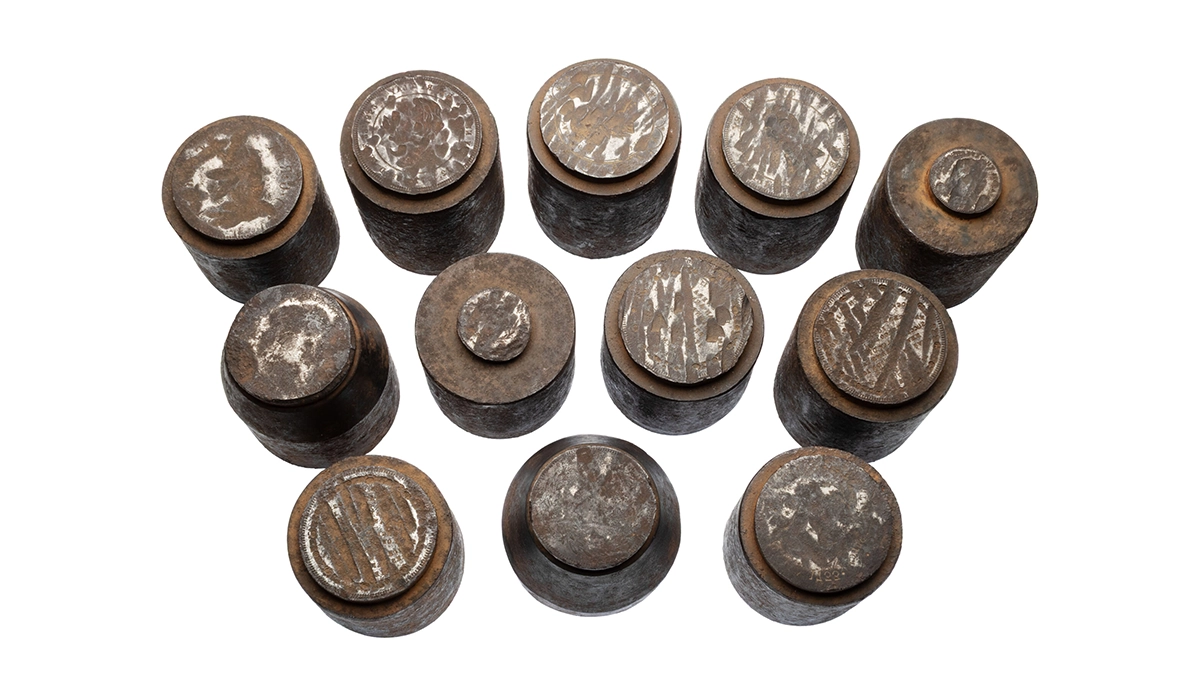
With many thanks, a recent archival donation given by Roman Golebiowski helped answer several questions regarding a long-held donation of medallic dies from the 1860s in the ANS collection (Fig. 1). A two-sided handwritten letter dated May 23, 1896 from Frank DeWette Andrews to Baumen L. Belden—at the time, the ANS librarian who later became the secretary, council member, and director—provides insight into how the ANS acquired the dies and even into the finished pieces themselves (Fig. 2).
A handwritten two-page letter dated May 22, 1896, from Frank D. Mather to Bronson C. Baldwin discussing an archaeological exhibit for the Litchfield Historical Society.
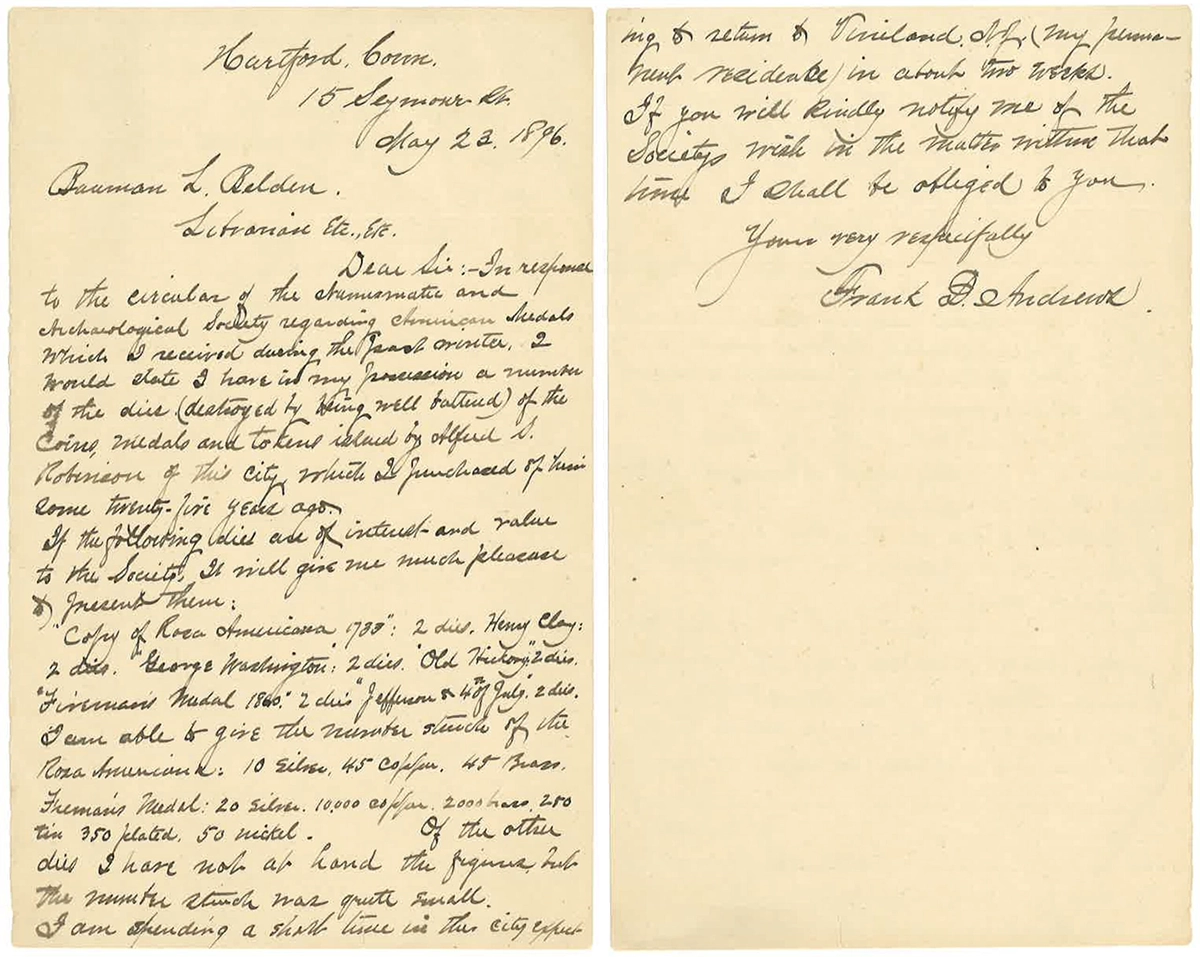
The body of the letter reads:
In response to the circular of the Numismatic and Archaeological Society regarding American Medals which I received during the past winter, I would state I have in my possession a number of the dies (destroyed by being well battered) of the coins, medals and tokens issued by Alfred S. Robinson of this city which I purchased of him some twenty-five years ago.
If the following dies are of interest and value to the Society, it will give me much pleasure to present them:
“Copy of Rosa Americana 1733”: 2 dies. Henry Clay: 2 dies. George Washington: 2 dies. “Old Hickory”: 2 dies. “Fireman’s Medal 1860”: 2 dies. “Jefferson & 4th of July”: 2 dies.
I am able to give the number struck of the Rosa Americana: 10 silver, 45 copper, 45 Brass. Fireman’s Medal: 20 silver. 10,000 copper. 2000 brass. 250 tin. 350 plated. 50 nickel. Of the other dies I have not at hand the figures, but the number struck was quite small.
I am spending a short time in the city expecting to return to Vineland, N.J. (my permanent residence) in about two weeks. If you will kindly notify me of the Society’s wish in the matter within that time I shall be obliged to you.
A handwritten ledger entry listing 12 pieces of ship fair old tiles, with names including Henry Clay, George Washington, Old Hickory, Ferdinand Noble, and Thomas Jefferson.
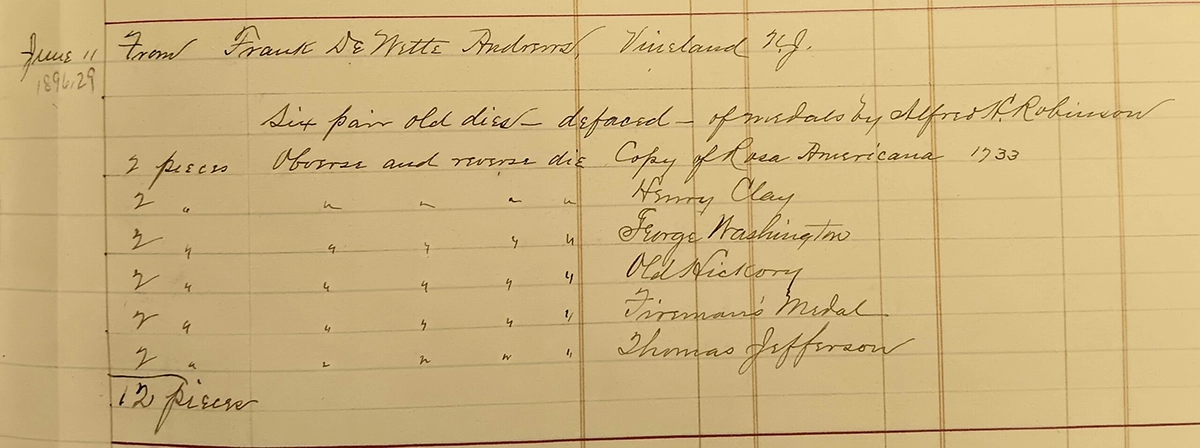
According to the accession books in the ANS Archives, the 12 dies were officially accepted into the collection on June 11, 1896, and given the accession group number of 1896.29 (Fig. 3). This is significant because the dies have long since been divorced from one another. The obverse and reverses were not only separated, but all of the dies were scattered in the die cabinet unattributed. Once digitization of the ANS collection began in the early 1980s, the dies were given numbers from the 0000.999 accession group—indicating that their accession history was unknown by that point—and they were not given consecutive numbers—indicating that their relation to one another was also lost. The recently donated letter allows us to reattribute them to the same donation from June 1896. The medals have now been reassigned with their proper numbers.
A copper coin featuring a left-facing portrait of a man with laurel wreath, surrounded by the inscription “GEORGIVS II D G REX.
A copper coin from 1733 featuring a crowned rose, the inscription “ROSA AMERICANA 1733,” and a banner reading “UTILE DULCI.”.
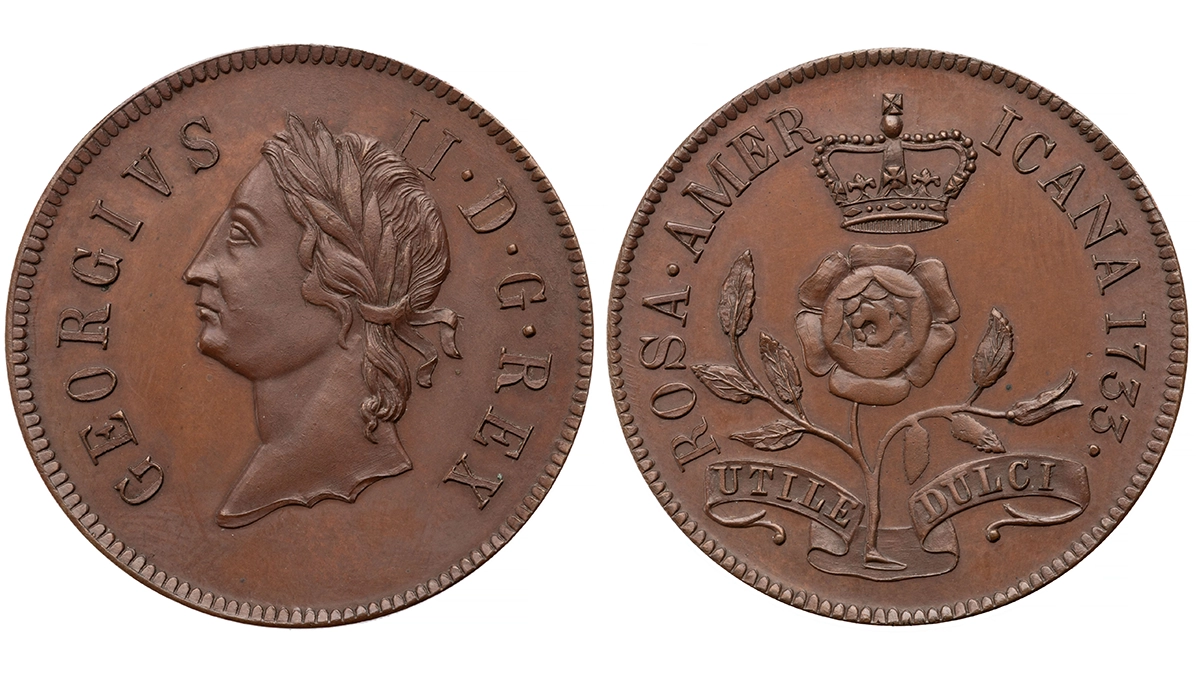
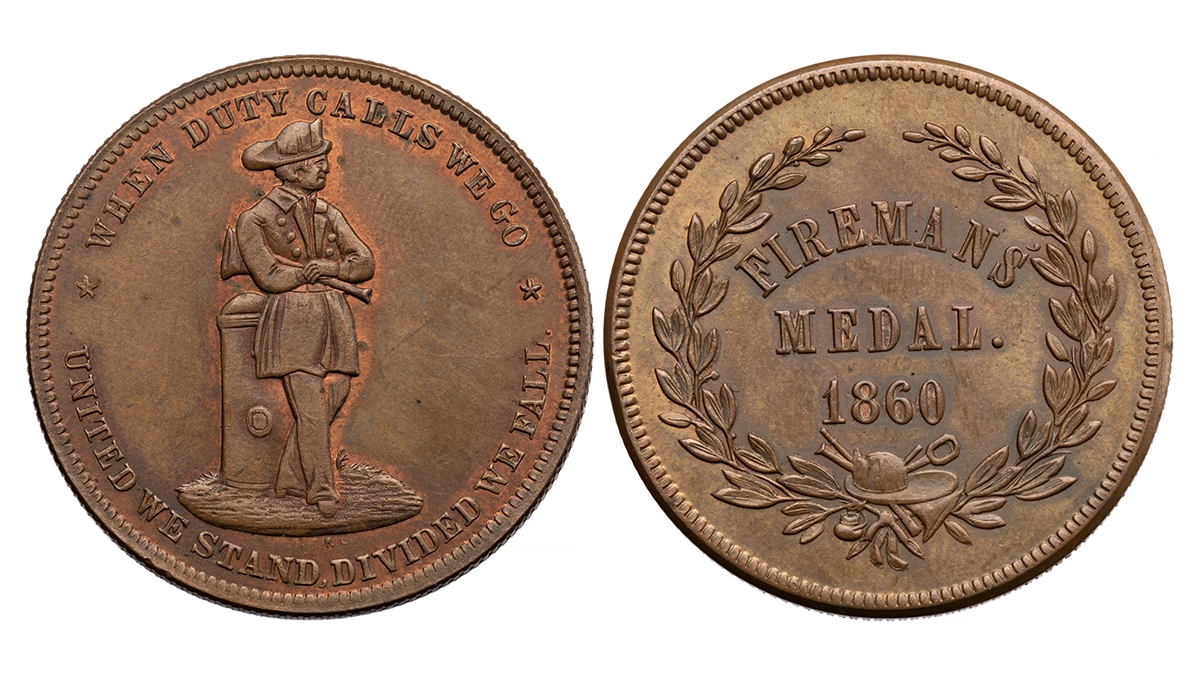
Additionally, the letter discusses various compositions and mintage figures for two of the medals—the 1733 Rosa Americana copy and the 1860 Fireman’s Medal (Figs. 4 and 5). Outside of official U.S. Mint records, such information is often lost to history, or never known to begin with. Metallic compositions are often only known through extant pieces, and mintage figures for privately issued pieces are rarely recorded. Now knowing the actual compositions and mintage figures for two of the medals represented in this group of dies is significant.
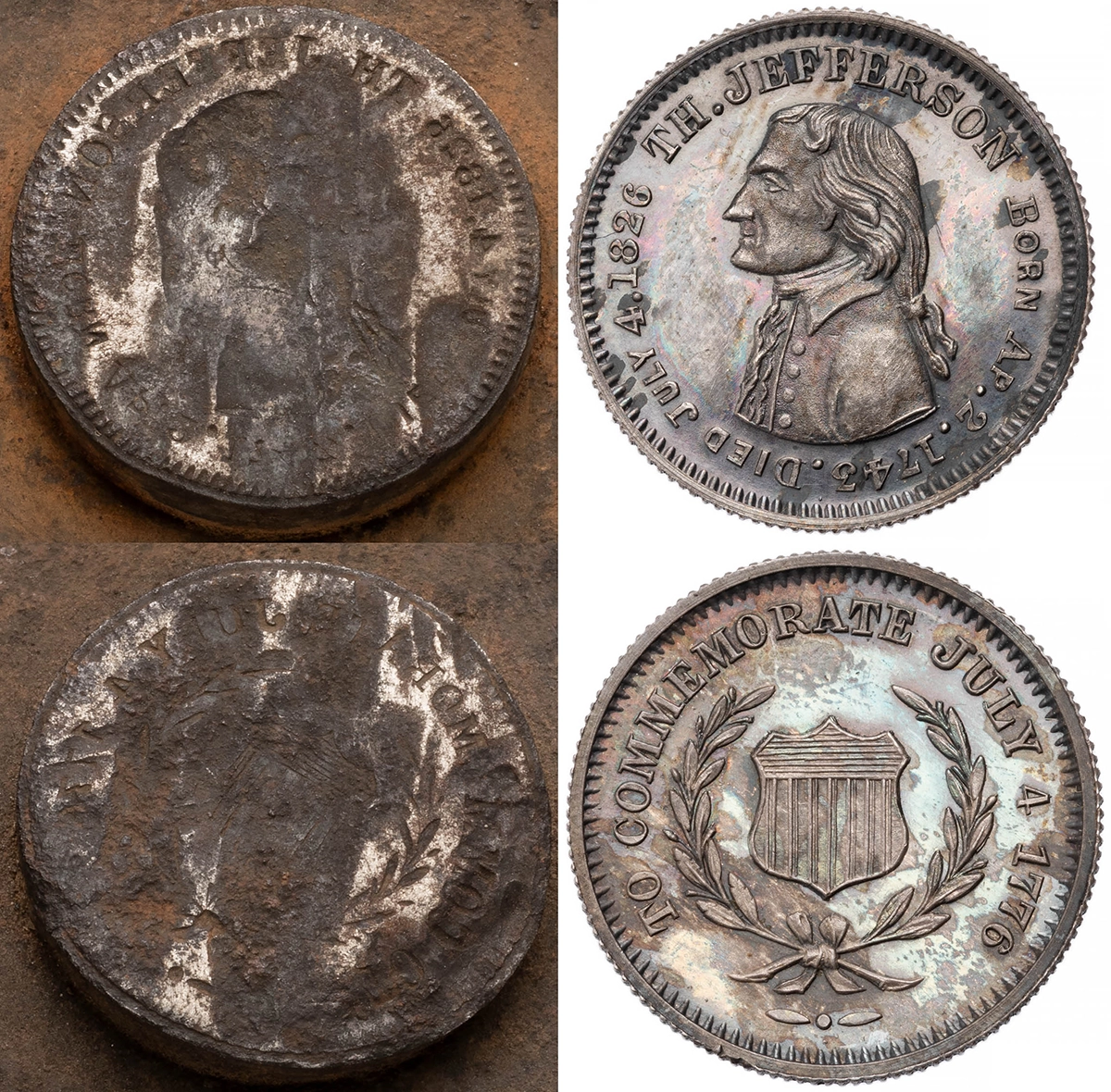
The dies are of low preservation quality, and this was intentional (Fig. 6). The faces of the dies have been “destroyed by being well battered,” as the letter states, showing that this had already occurred prior to 1896 and, in all likelihood, not long after the medals were struck in the 1860s. This was done to prevent restrikes from being made. In his advertisements, Robinson would sometimes note how many medals were produced while also indicating that the dies were destroyed in order to preserve their rarity. Despite the intentions to destroy the design, some elements are still identifiable, allowing for positive identification to be made for all 12 dies from the 1896 donation. The ANS accession book noted that the dies were “defaced.”
The Thomas Jefferson medal in Figure 6 is of further interest, as its attribution to Robinson has been questioned in the past. Writing in 1968, J. Doyle DeWitt included the piece in a section labeled “Robinson Mis-Attributions.” The only evidence that DeWitt gives for not attributing the piece to Robinson is the fact that 100 were struck in silver only, rather than a range of compositions that most of his issues employed, and that this “certainly would not have been in the nature of a Robinson enterprise.” Perhaps the fact that the dies for the Jefferson piece were retained with a group of known Robinson dies could be used as evidence that he did issue this particular medal.
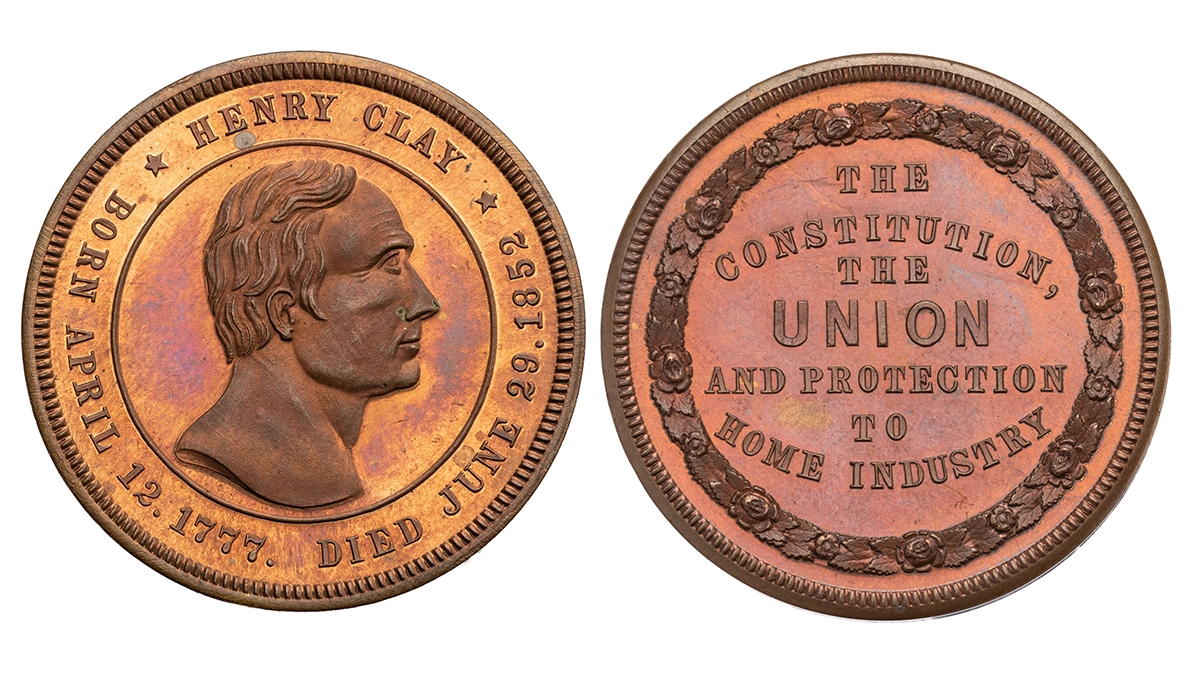
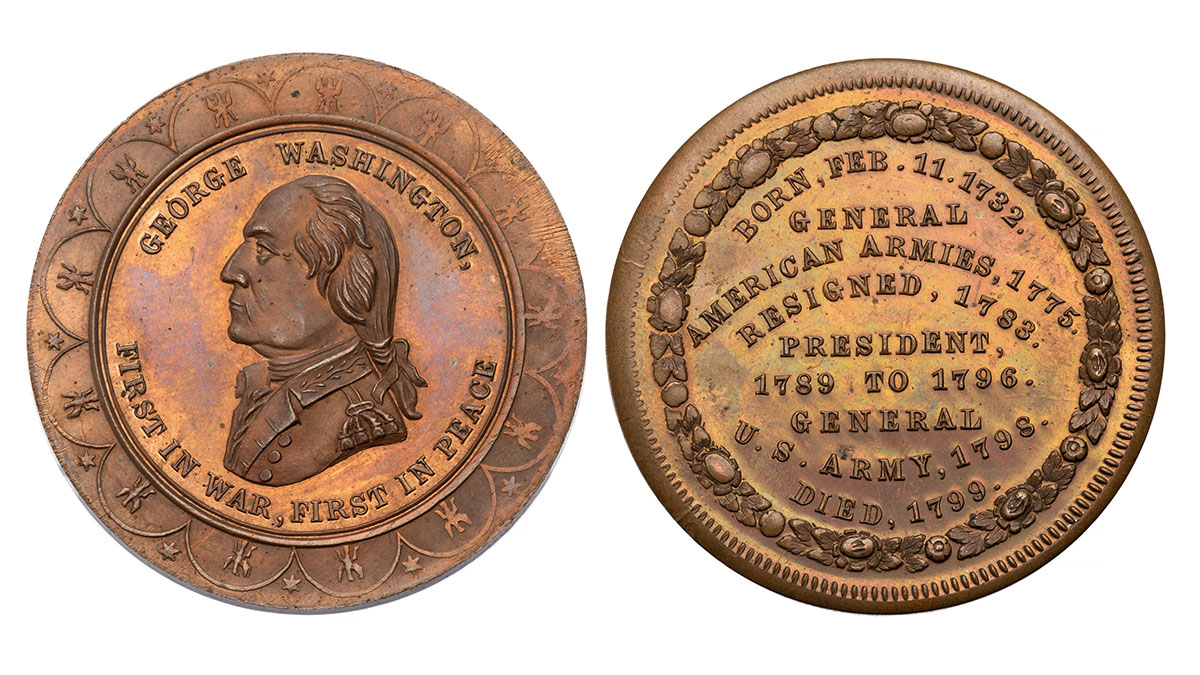
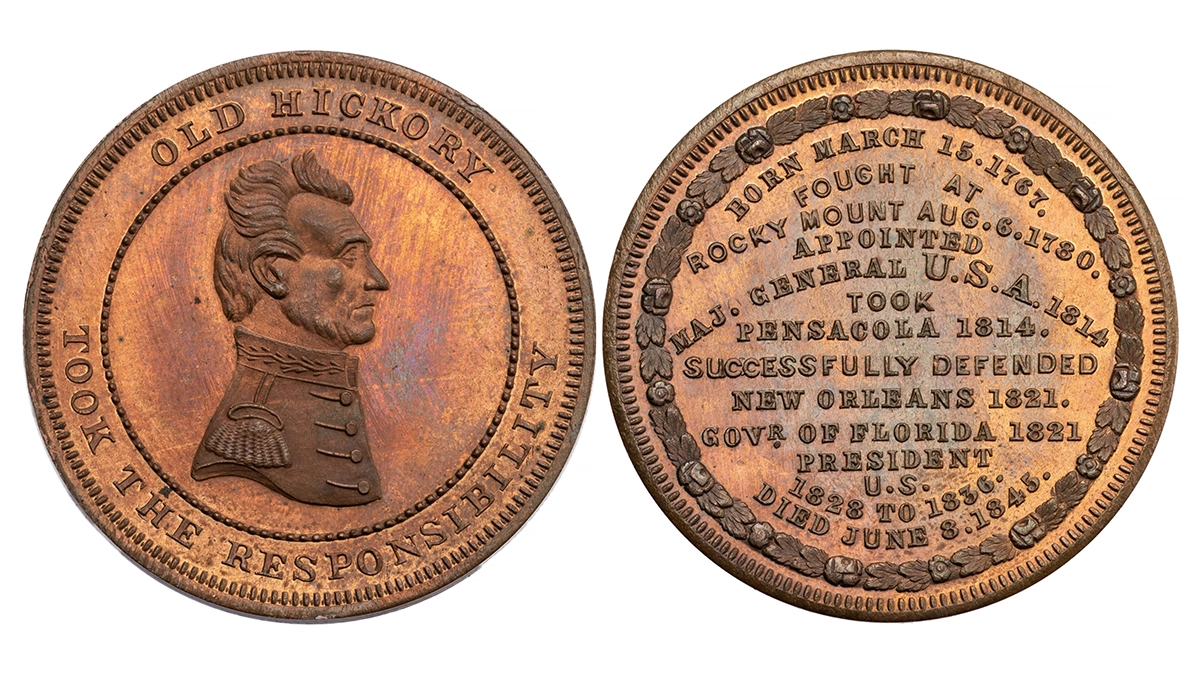
Alfred S. Robinson (1836–78) was a banker at the Banking House of George P. Bissell & Company in Hartford, Connecticut, and later under his own name, as well as a coin dealer and auction cataloger. It is not known exactly when he became interested in numismatics, but by 1860 he had acquired a famed 1737 Higley copper for his collection for $50—a price that made it into the local newspapers. That same year, he began issuing a series of medals, known as the Alfred S. Robinson Historical Series, that included a total of six medals issued through 1863. Three of the dies from the 1896 donation—those for the Clay, Washington, and “Old Hickory” medals (Figs. 7, 8, and 9)—come from the Historical Series. In total, Robinson issued several dozen different medals throughout his numismatic career.
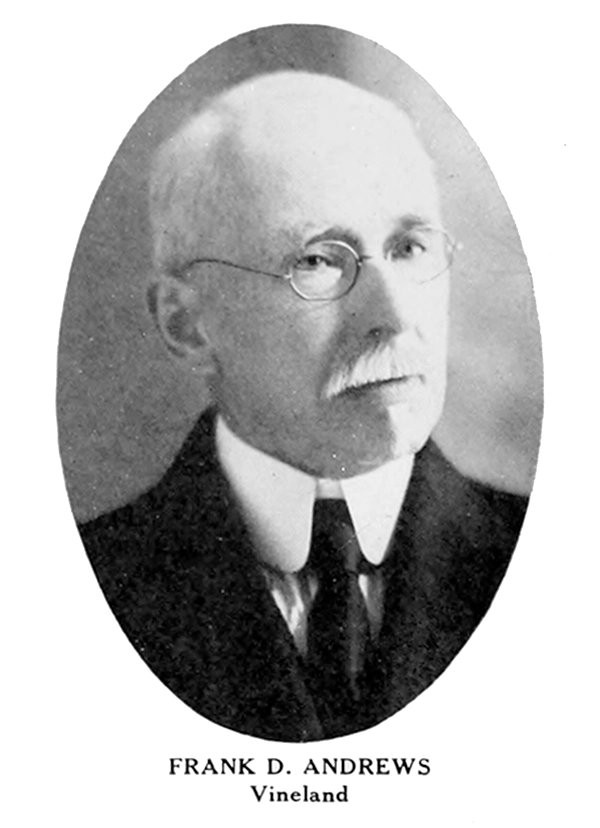
Frank DeWette Andrews (1847–1937) (Fig. 10) was a historian, as well as librarian, secretary, and treasurer of the Vineland Historical and Antiquarian Society. In 1885, he was elected as a corresponding member of the ANS. Numismatically, he is most famous for his 1881 treatise, A Description of 268 Varieties of U.S. Cents, 1816–57 in the Collection of Frank D. Andrews. Sadly, he wrote this book in the wake of his first wife’s passing, noting in the January 1885 issue of Mason’s Coin Collectors’ Magazine, “I will say here, that for the want of something to closely occupy and engage the mind, I attempted the work upon the United States cents 1816–57…There is nothing…to enable one to endure sorrow as constant occupation, which shall keep the mind from dwelling upon its loss.” Even though just 50 copies of the book were printed, it became the book on the topic for the next three generations of numismatists, being replaced only in 1944 by United States Copper Cents, 1816–1857 by Howard R. Newcomb.







I’d think it would make more sense to melt them down and recycle them if you were really intent on destroying them