


By CoinWeek Notes …..
In the early 1930s, the United States suffered from a widespread economic depression that followed the 1929 stock market crash. The “Roaring Twenties” came to a grinding halt as millions of Americans found themselves out of work without prospects of finding a job.
The crisis was made worse by a series of severe agricultural disasters caused by land erosion and southern plains dust storms due to several years of drought combined with poor farming practices. Against this backdrop of human tragedy, the Treasury Department proposed to issue a coin to mark the 200th anniversary of George Washington’s birth.
Originally, the Treasury proposed to honor Washington with a commemorative half-dollar and held a design competition to find a suitable design. The contest rules stipulated that artists must base their designs on French sculptor Jean-Antoine Houdon’s classic bust portrait of Washington.
Houdon was considered one of the greatest European portrait sculptors of the latter half of the 18th century. Houdon’s piece was done in 1785 from a life mask of Washington he had taken during a trip to Mount Vernon, a visit promoted by Benjamin Franklin, whose portrait Houdon had sculpted in 1779. Houdon’s bust of Washington is on display at the Mount Vernon Visitor’s Center.
From the Washington Half Dollar
Exercising its authority in coinage matters, Congress changed the denomination for the Washington commemorative from the half dollar to the quarter, but it was Treasury Secretary Andrew W. Mellon who most compromised the process. Mellon was a wealthy but controversial banker and industrialist in the early 20th century. He was a top art collector, but he was also known for his stubbornness. Mellon refused to accept the Laura Gardin Fraser design chosen by the Washington Bicentennial Commission not once but twice, instead favoring the submission of New York sculptor John Flanagan.
Mellon left his post in early 1932, but his successor, Ogden L. Mills, refused to change Mellon’s decision regarding the quarter. The Flanagan design was chosen and would be the quarter’s design from 1932 to 1998, and the obverse returned for only one year, in 2021.

To the Washington Quarter
Upon its release, the Washington design proved popular with the public. Instead of being a one-year commemorative issue as originally intended, production of the coin continued beyond 1932. This decision marked the end of Herman MacNeil’s Standing Liberty design.
Though Flanagan’s low-relief Washington Quarter design was easy to strike, the motto did not strike up well on the 1932 and early 1934 issues (no quarters were minted in 1931 or 1933), necessitating changes in the design to strengthen the impressions.
For the silver Washington Quarter, 1933 marked the only year that the United States Mint did not produce the coin. The coin was struck at all three active mints, and the mint mark denoting that the coin was struck at either Denver or San Francisco was located below the center of the wreath on the reverse.
The Mint Mark
This mint mark position would continue through to the end of the quarter’s production in .900 fine silver. In 1965, Congress changed the composition of the quarter to the copper-nickel sandwich metal used today.
With the exception of a few off-metal errors and silver Proof coins struck for sale to collectors starting in 1992, all Washington Quarters dated 1965 to the present are struck in clad, while all quarters struck from 1932 to 1964 are struck in silver.
The Silver Washington Quarter’s Certified Market
To date, more than 100,000 business strike Washington Quarters have been certified.. Prices are moderate for most issues through Premium Gem and even through Superb Gem for many dates. The low-mintage 1932-D is considered the series’ key, while the lower-mintage 1932-S is considered the series’ semi-key. Other valuable issues include the 1934 Doubled Die Obverse, 1935-D, 1936-D, the 1937 Doubled Die Obverse, the 1942-D Doubled Die Obverse and Doubled Die Reverse, the 1943 Doubled Die Obverse, the 1950 D over S and S over D, and 1964 Special Mint Set coins.
Thousands of Proof Washington Quarters have been certified by CAC, NGC, and PCGS, many as Cameo or Deep Cameo from the early 1950s onward. No Proof quarters were minted from 1932 through 1935 or from 1943 through 1949. Prices are modest for many dates, including Superb Gem. Higher-priced coins include Proofs from the 1930s and ’40s and Cameo and Deep Cameo examples from the early ’50s onward, some of which are very expensive at grades finer than near-Gem.
Silver Washington Quarter Date-by-Date Analysis
- 1932-D – Series Key Date
- 1932-S – Series Semi-Key

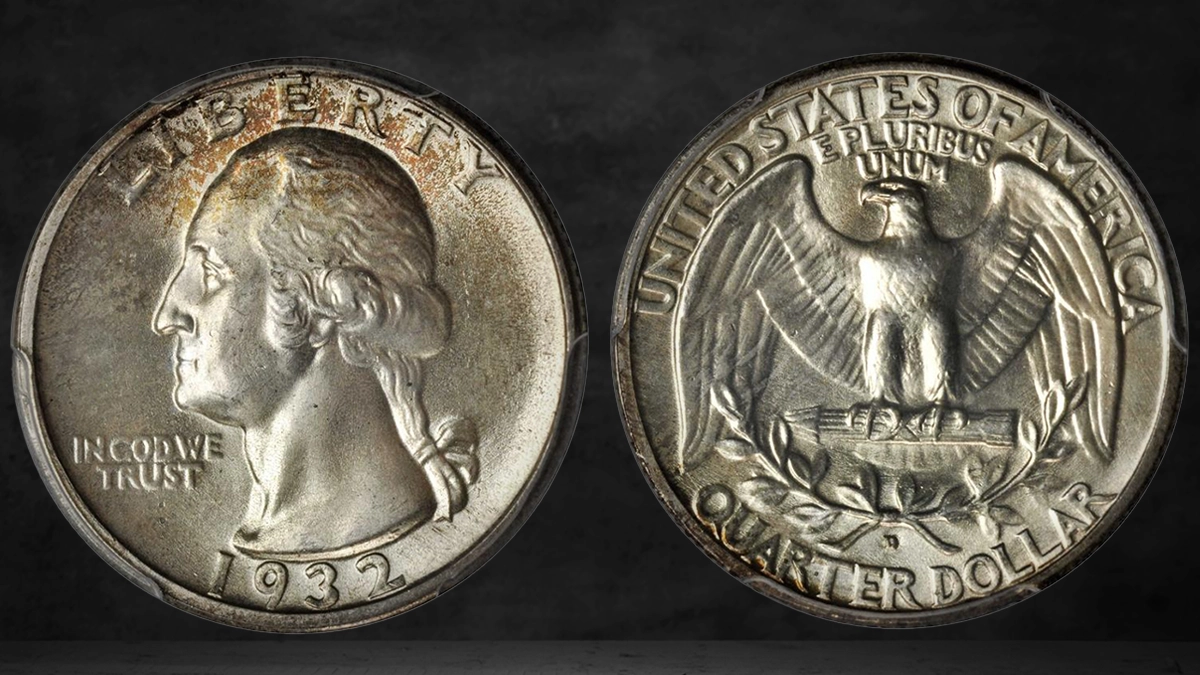
1932-D Washington Quarter PCGS 66 - 1934-D
- 1935-D
- 1935-S
- 1937 Proof
- 1950 Proof
- 1951 Proof
- 1958
- 1960
- 1960-D
- 1961-D
- 1962-D
- 1963 Proof
- 1963-D
- 1964 Proof
Condition Rarity Silver Washington Quarters

In this article from 2012, coin expert Greg Reynolds gives insights into collecting or investing in condition rarity silver Washington Quarters. When looking at several record auction prices for top pop coins and the efficacy of paying such lofty prices for coins that still have a sizable mintage from where to draw new high-end pieces. Greg even gets a dust-up of opinion from CoinWeek Editors and Coin Analyst Lou Golino over their positions. Worth reading.
Type B Proof Reverse Washington Quarters
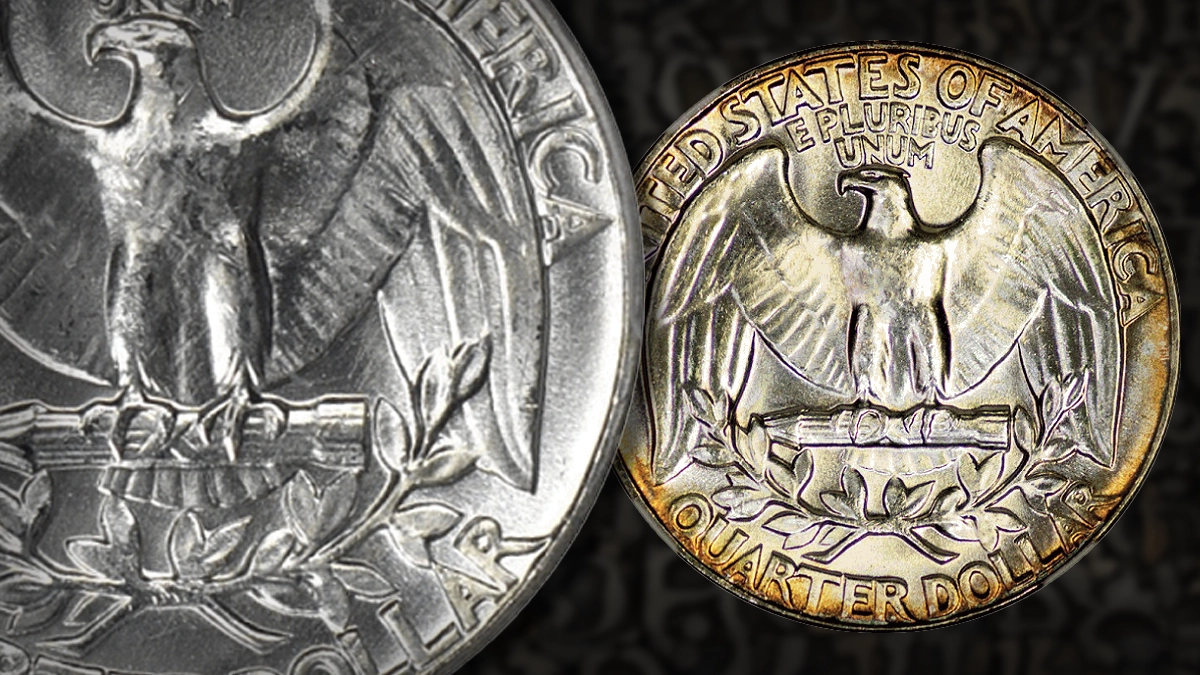
Coin dealer Dr. Richard S. Appel wrote an informative series of articles about the Type B Proof Reverse and how it became a popularly-collected Washington Quarter variety.
- Part I: Type B Proof Reverse Washington Quarters, 1956-64: An Unprecedented Variety. Introduction to the nine-coin series.
- Part II: Type B Proof Reverse Washington Quarters, 1956-64: An Unprecedented Variety. Visual Attribution and remarks about the great silver melts of the 1970s-1980s.
- Part III. Type B Proof Reverse Washington Quarters, 1956-64: An Unprecedented Variety. Date-by-date analysis and collecting tips.
Retired coin dealer Fred Weinberg shares his incredible double-tailed Washington Quarter error in the video above.
CoinWeek Editor Charles Morgan breaks down the 1976 Bicentennial Quarter in this exclusive CoinWeek video titled On Collecting Bicentennial Quarters: Risks & Rewards.
Washington Quarter Design
Obverse:
On the obverse, a left-facing portrait of Washington dominates the surface. Above all, inside a flat rim is the word LIBERTY at the top, and the date at the bottom. Meanwhile, the motto IN GOD WE TRUST is placed to the lower left of Washington, with the words arranged in two lines. In addition, the designer’s initials JF appear on the right side at the base of Washington’s neck.
Reverse:
On the reverse, a centered eagle with outstretched wings rests on a tightly bound bundle of arrows. Notably, the eagle’s wings curve along the outer edges to form an arc concentric with the raised rim.
Furthermore, when we look between the wings and the rim around the top half of the coin, we see UNITED STATES OF AMERICA. Just below this, but still above the eagle’s head, is E PLURIBUS UNUM, also arranged in two lines.
Finally, the denomination QUARTER DOLLAR follows the rim at the bottom. Additionally, two short olive branches curve above the denomination but below the eagle, with leaves partially overlapping other design elements. Moreover, Silver Washington Quarters were minted in Philadelphia, Denver, and San Francisco; D and S mint marks are located below the crossed ends of the olive branches, above ER in QUARTER.
Edge: The edge of the Washington Quarter is reeded.
Washington Quarter Varieties
Varieties include the 1934 Light Motto and Heavy Motto (“In God We Trust”); the 1934, 1936, 1937, 1942-D, and 1943 Doubled Die Obverses; the 1950 D over S and S over D; the 1953 Proof Doubled Die Obverse; and other minor die variations. The Cherrypicker’s Guide is a great resource for silver Washington Quarter variety collectors.
Additional CoinWeek Silver Washington Quarter Coverage
Coin Specifications – Washington Silver Quarter
Years of Issue: 1932-64
Mintage (Circulation): High: 704,135,528 (1964-D); Low: 408,000 (1932-S)
Mintage (Proof): High: 3,950,762 (1964); Low: 3,837 (1936)
Alloy: .900 silver, .100 copper
Weight: 6.25
Diameter: 24.30 mm
Edge: Reeded
Designer: John Flanagan
Additional References
- Bowers, Q. David. The Experts Guide to Collecting and Investing in Rare Coins. Whitman Publishing.
- A Guide Book of United States Washington and State Quarters. Whitman Publishing.
- A Guide Book of United States Type Coins. Whitman Publishing.
- Guth, Ron, and Jeff Garrett. United States Coinage: A Study by Type. Whitman Publishing.
- Taxay, Don. The U.S. Mint and Coinage. Arco Publishing.
- Yeoman, R.S., and Jeff Garrett (editor). The Official Red Book: A Guide Book of United States Coins. Whitman Publishing.






I have a 1955 silver in my collection , a Quarter can you tell me about it PLEASE ? ? ?
I look at the original design as being way undervalued; a true classic
I likeboth obverses. I am glad that the Laura Gardin Fraser design was used starting ion 1999.
@Christopher Fuccione: FWIW the Fraser design didn’t start till 2022. From 1999 to 2020 the obverse carried a modified version of the Flanagan image, reduced by about 10% to allow space for wording that was moved from the reverse to accommodate the various “themed” series. Flanagan’s original portrait made a brief return on the 2021 Washington Crossing the Delaware coins.
I always look over my quarters when I get them from stores, You never know when you’ll find a older rare coin.
I will need to go through my collection to see if i have some of the early dates for sure.
Given their rarity, these key dates ought to be worth more! They seem like a buying opportunity.
I still love getting the silver quarters as change sometimes.
Are there any legitimate coin apps for determining grades and worth of coins?
Interesting and informative article.
Favorite coin
If we only knew about all the silver quarters that we had in our hands throughout our lifetime.
I miss this design of the Washington Quarter. It was the last surviving design of the Art Deco age that was still circulating. While I understand the educational factor of the Statehood Quarters, I wish they had gone back to this when that ended.
I’m old enough to have saved pre-1965 Washington quarters. Always excited to find them in my change through the years!
This has always been my favorite series. Now collecting the many different modern state and parks for the grandkids
I have been saving these for years now! I’ll have to dig them out and check their mint marks now that I’ve read this article! Thank you !
Very nice
I collect these for silver and pass them down to my kods. Have probably a thousand of them in my safe
Wish I’d saved even a small percentage that flowed through my hands years ago… ah well.
Aren’t there some “proof” and other specially minted post 1964 quarters that are silver?
@William Van Luchene Yes. in addition to the special “Prestige” proofs mentioned in the article, 40%-silver quarters as well as halves and dollars were struck for inclusion in Bicentennial sets. They had the same designs as their cupronickel counterparts including the dual 1776-1976 date, but carried an “S” mint mark and of course weren’t put in circulation.
Love the silver quarters
Always check the change in the register at work
Constitutional silver
I have a bunch of these quarters. Holding on to them for the kids. These are one of my favorite coins.
The Washington quarter (original design) is one of my favorite coins. I save all Eagle reverse quarters even though they minted billions of them. I have a set of proof 67 from 1950-1970.
I have the 1950-1964 Washington quarters in PF67. The original design is my favorite. I thought the state quarters and then the National Parks were a bit much.
Interesting article. I didn’t know the Washington quarter was originally intended for only one year.
Minor errata:
> In addition to the high-fineness “Prestige” issues, silver quarters were also made for special Bicentennial sets that also included a half dollar and dollar coin. These were struck in the same 40% silver-clad composition that was used for 1965-70 half dollars.
> The SLQ’s designer had the unusual first name “Hermon” rather than the typical “Herman”.