


By CoinWeek Notes …..
The Walking Liberty Half Dollar was struck from 1916 to 1947. It is a complex series, made difficult to complete by several factors, including the scarcity of dates from the first decade. For most collectors, the expense of completing a date or mint run puts the series out of reach. But a run of late-date issues, made popular years ago by a Whitman coin album, gives collectors of all levels an approachable way to collect Adolph Weinman’s iconic coin.
The Short Set
The Walking Liberty Half Dollar Short Set, as it is known, comprises the 20 distinct circulation-strike issues produced between 1941 and 1947. It encompasses all date and mint-mark combinations from the Philadelphia (no mint-mark), Denver (D), and San Francisco (S) mints. These are the final issues of the renowned Adolph A. Weinman design, widely celebrated as the most beautiful 50¢ coin ever struck by the United States Mint. All are composed of 90% fine silver.
The primary appeal of the 1941–1947 Short Set is that it allows collectors to assemble a collection of uniformly high-quality coins, often in Gem Mint State (MS65). Thia avoids the prohibitive costs and extreme conditional rarity of the series’ pre-war issues, while entirely avoiding its key dates. Fundamentally a conditional rarity set, it features high mintages but limited numbers of well-struck, well-preserved examples due to attrition and inherent manufacturing flaws.

Even within this subset of non-keys are the challenging 1941-S and 1942-S issues. Due to chronic striking weakness typically seen in San Francisco coinage, these dates dictate the difficulty and overall price ceiling for a Walking Liberty Half Dollar Short Set.
For the certified coin collector, the overall quality ceiling for the set depends on how much they are willing to invest in these two dates.
A $1,000 per coin commitment can put a collector in a position to complete the set in Mint State 66 (MS66). Also coins with CAC Stickers command am exceptional premium. A collector would need to make a significant investment of hundreds of thousands of dollars to go finer.
What Makes the Walking Liberty Half Dollar Design a Flawed Masterpiece?
The Walking Liberty design, introduced in 1916, emerged from a high point of U.S. numismatic artistry, representing one of three new types adopted that year. Weinman’s depiction of Lady Liberty striding toward a rising sun, carrying an olive branch and the flag, remains highly lauded.
However, the design proved intrinsically difficult for the U.S. Mint to execute consistently. The high-relief nature of key elements, such as Liberty’s flowing gown and the eagle’s detailed stance, presented an insurmountable challenge related to poor metal flow during the striking process. Chief Engraver George T. Morgan attempted to modify the master hubs in 1918, and Assistant Engraver John R. Sinnock made further attempts in 1921, 1937, and 1938 to improve the strike characteristics. Still, these efforts ultimately failed to resolve the underlying technical defect. The 1941–1947 issues represent the final years of this series before the Mint replaced the design with the Franklin Half Dollar in 1948.
The World War II Production Surge and Its Aftermath
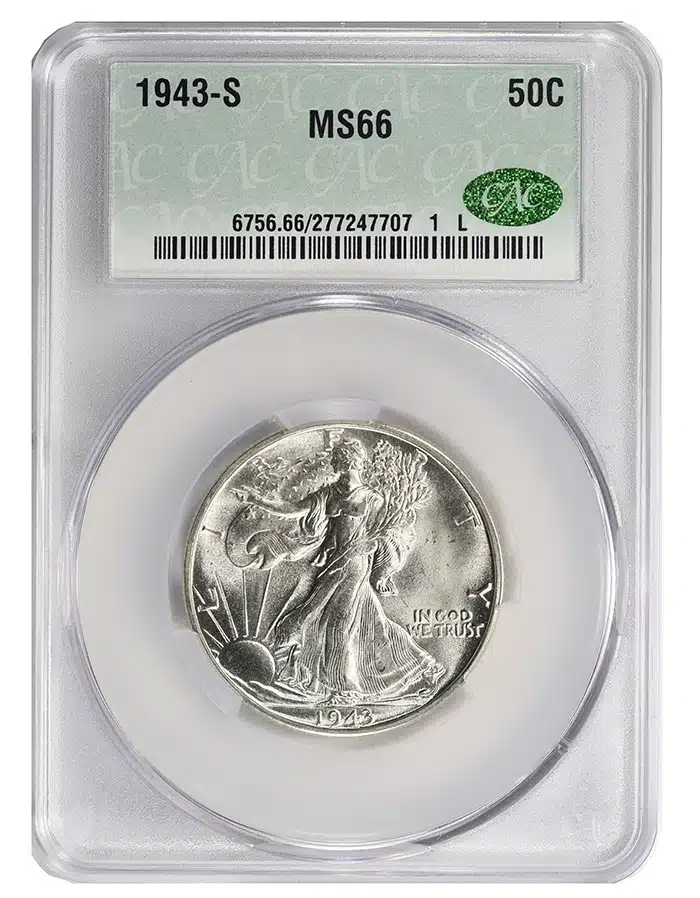
The period from 1941 to 1945 coincided with the United States’ involvement in World War II, a time of massive government expenditure and heightened demand for circulating coinage. This led to some of the highest absolute mintages of the entire series. For example, the Philadelphia Mint produced nearly 47.8 million half dollars in 1942 alone. Although this surge in production ensured a substantial number of circulated survivors, the constraints of wartime manufacturing likely amplified the inherent problems of inconsistent strike quality, particularly at the branch mints in Denver and San Francisco.
The consequence of this high-volume production, combined with technical flaws, is a unique market dynamic where the primary collection difficulty is not locating a survivor but finding a piece of high quality. For these late-date Walkers, the barrier to completion is conditional rarity, a perfect strike and preservation, rather than absolute rarity based on low mintage figures.
The numismatic community has long acknowledged this distinction. Major collecting supply manufacturers, such as Whitman, produced specific folders designated for the latter part of the series, grouping coins as “Collection #2: 1937-1947.” Although the popular short set begins in 1941, the 1937–1947 commercial grouping validates the systematic separation of these easier-to-obtain, post-Depression issues from the extremely scarce and costly earlier dates (1916–1936). This commercial infrastructure reinforces the Short Set as a recognized, commercially viable collection strategy.
Strategic Merit of the 1941–1947 Short Set
Collecting the complete Walking Liberty Half Dollar series (65 coins by date and mint mark) is a monumental task, especially in high grades. The cost is prohibitive, with key dates in the early series, such as the 1921 P, 1921-D, and 1921-S, representing severe conditional and absolute rarities. Finding these issues in Gem grades is virtually impossible for the average collector.

The Short Set, by contrast, offers a method for collectors to assemble a high-quality set for a modest investment. By limiting the scope to 20 dates and mint marks, collectors can focus on acquiring coins of uniform, top-end quality, typically targeting the MS65 level or better. The focus inherently shifts away from overcoming low-mintage absolute rarities. Instead, it centers on mastering conditional rarity, the scarcity of perfectly struck, well-preserved coins despite relatively high production numbers.
Coin Specifics: Detailed Mintage Analysis (1941–1947)
The Short Set comprises 20 unique circulation issues. Production figures during this period highlight the immense scale of wartime coinage operations, followed by a post-war reduction. Yet, they also reveal a significant discrepancy between mintage and final conditional rarity.
- 1941: Start of set. Common in MS65. Proofs ceased in 1942.
- 1941-S: Conditional Rarity Key Date in MS65. Strike is not as poor as the 1942-S.
- 1942: Highest mintage of the entire series and the most common date. Final Proof issue.
- 1942-S: Atrocious quality. For those serious about competitive registry sets, this is the coin by which all others will be judged.
- 1946: Post-war reduction. Less common than the 1946-D and 1946-S in Gem.
- 1946-D: Lowest mintage of the Short Set.
- 1946-S: Low post-war S-Mintage. Tougher than the 1946-D in MS64, MS65, and MS66.
- 1947: Final P-Mint issue of the series. More challenging than one would expect, but not as tough as the 1947-D.
* * *






Absolutely right. The 41s took me over 8 months to find just an ok strike in ms66.
They are majesticly conceived coins that deserve attention and adulation. When you find that perfect example that you have been searching for…… well, it’s a real simple pleasure of numismatic experience that every collector can and will appreciate.
They are the most beautiful coin out there imo
Sounds like something I need to be doing. Keeping my eyes open for these coins.
These are one of my favorite coins.
I have never been able to afford the high grade coins. So for the poor collector I have found pleasure in collecting only circulated coins that were used in every day transactions.
I feel lucky to have the circulated set in my possession.
Nice article; I had no idea. I have a roll or two that I need to look over.
May just need to do my research to upgrade my short set.
Still one of my favorite designs.
Fascinating article which has motivated me to collect a short set.
Nice article and coin.
Very interesting article. I think I will attempt to get a short set.
It never dawned on me that in collecting there are short sets. I’m off to check what I have in the hopes I have a good starting point.
Walkers are one of the few US coins that I like. Nice info in the article.
Very beautiful design. Glad I own the short set
Short set? I prefer the whole set!