


By Mike Markowitz
The medieval coinage of Georgia reflects a remarkable intersection of cultures, empires, and religious traditions. Located in the Caucasus region between Europe and Asia, Georgia developed a distinctive monetary system during the Middle Ages. Georgian rulers issued coins influenced by Byzantine, Islamic, Persian, and Mongol traditions.

At the same time, these coins expressed the identity and authority of the Georgian kingdom.
Archaeological evidence shows that the Georgian people have inhabited this region since prehistoric times. Early discoveries include some of the world’s oldest evidence of winemaking, gold mining, and textile production.
In the fourth century CE, Georgia adopted Orthodox Christianity, which became a central element of its culture and political identity.
From the late 11th century through the 13th century, Georgia experienced a period historians call the Georgian Golden Age [2]. During this era, powerful monarchs expanded the kingdom and issued some of the most distinctive coins in medieval Eurasia.
Bagrat IV and the First Byzantine-Style Georgian Coins
Bagrat IV (born 1018) ruled Georgia during a turbulent period. He was the son of King Giorgi I and spent part of his childhood as an honored political hostage at the court of Byzantine Emperor Basil II in Constantinople.
Bagrat became king at only nine years old after his father’s death. His mother served as regent during his early reign.
However, his rule brought constant challenges. Georgian nobles repeatedly rebelled, while the expanding Byzantine Empire threatened Georgia’s independence. In 1051, Bagrat even fled temporarily to Constantinople while negotiating Byzantine neutrality.
Soon afterward, a new threat appeared. The Seljuq Sultan Alp Arslan invaded southern Georgia and devastated several provinces.
Despite these dangers, Bagrat IV preserved the unity of his kingdom. He died in 1072, leaving behind a stable and independent Georgian state.
Bagrat IV Silver Dram
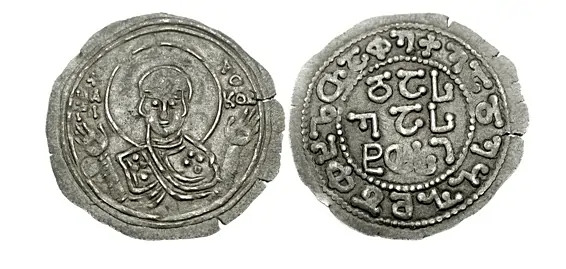
Bagrat IV issued a very rare silver dram that closely imitates the Byzantine 2/3 miliaresion of Constantine IX (r. 1042–1055). Scholars believe the coin was struck at Kutaisi, Bagrat’s capital.
The obverse shows a facing image of the Virgin Mary with the Greek inscription:
+HA/GI A/Θ/KOC
(Hagia Theotokos, meaning “Holy God-Bearer”).
The reverse contains a Georgian inscription:
“Christ exalt Bagrat, King of the Abkhazians, Sebastos.”
Abkhazia is a western region of Georgia. The title Sebastos, equivalent to the Latin Augustus, was an honor granted by the Byzantine emperor.
These coins rank among the great rarities of Georgian numismatics. Unfortunately, modern forgeries circulate widely. One example later judged to be a modern fake sold for $4,500 in a 2009 U.S. auction [3]. Another specimen believed to be genuine realized $6,000 in 2010 [4].
Giorgi II and a Kingdom Under Siege

Giorgi II, the son of Bagrat IV, inherited a troubled kingdom.
He faced rebellions by powerful nobles as well as repeated Seljuq incursions. By 1082, the situation became so severe that Giorgi accepted status as a tributary vassal of the Seljuqs.
Then, in 1083, a devastating earthquake struck Georgia.
Giorgi eventually abdicated the throne in 1089 in favor of his son. He retired to a monastery.
Giorgi II Silver Dram
Giorgi II issued silver drams that continued the Byzantine artistic tradition.
The obverse depicts the Virgin Mary, with her abbreviated Greek title:
MHP ΘV
(Meter Theou, “Mother of God”).
The Georgian inscription on the reverse reads:
“God preserve Giorgi, King of the Abkhazians and K’artli, Caesar.”
Kartli is the central region of Georgia. It includes Tbilisi, the modern capital, and Mtskheta, the ancient capital.
An example of Giorgi II’s silver dram realized $2,600 at auction in 2009 [5].
David IV “The Builder” and the Restoration of Georgia

David IV (1073–1125), remembered as David the Builder (Davit Aghmashenebeli), ranks among the greatest Georgian rulers.
He became king in 1089 at age sixteen, inheriting a kingdom devastated by Seljuq invasions. David reorganized the army, strengthened royal authority, and expelled the Seljuq forces.
Under his leadership, Georgia entered a period of revival that helped launch the Georgian Golden Age.
David IV Copper Coinage
David IV issued an extremely rare copper coin weighing 10.73 grams. The coin shows the king standing and crowned in imperial regalia, presenting him as equal to Byzantine emperors.
The Georgian reverse inscription lists the peoples he ruled:
“Lord aid David, king of the Abkhazians, Kartvelians, Ranians, Kakhetians, and Armenians.”
For many years, the only known example appeared in the British Museum collection. Since 2021, researchers have identified three additional specimens, two of which now reside in the Georgian National Museum [6].
Regular and Irregular Georgian Copper Coins
Beginning with David IV, Georgian copper coinage divided into two types:
- Regular coins, struck on prepared round flans
- Irregular coins, struck on crude and uneven metal blobs
Both types circulated simultaneously but often in different regions of the kingdom. This distinction remains a critical element in the study of medieval Georgian numismatics.
Giorgi III and Islamic Artistic Influence
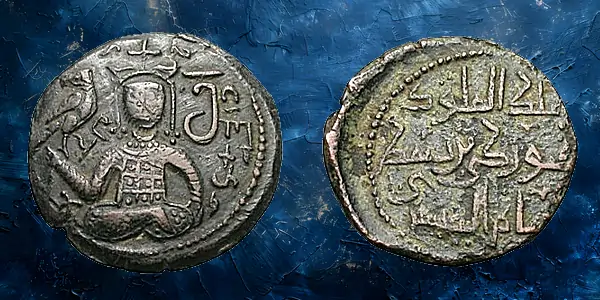
Giorgi III introduced coin designs influenced by neighboring Islamic states.
One copper fals closely resembles the Turkoman figurative bronze coinage circulating in the region [7].
The obverse shows the king wearing a cross-topped crown and sitting cross-legged. He holds a falcon on his extended arm, usually on the right.
The reverse features an Arabic inscription declaring:
“King of kings, Giorgi, son of Dimitri, sword of the Messiah.” [8]
This unusual combination of Christian symbolism and Islamic artistic style illustrates the complex cultural environment of medieval Georgia.
Queen Tamar and the Georgian Golden Age
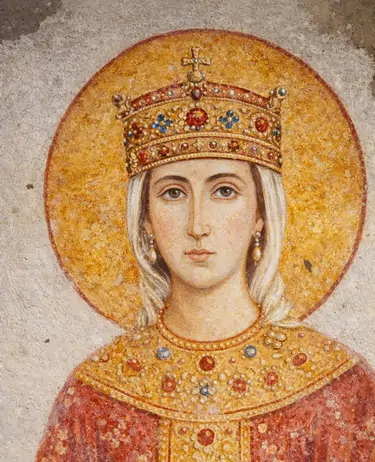
Few rulers occupy a greater place in Georgian history than Queen Tamar the Great.
Born around 1160, Tamar was the daughter of King Giorgi III and the great-granddaughter of David the Builder. Her father named her co-ruler when she reached age 18, and she became sole monarch upon his death in 1184.
Tamar presided over a period of political expansion, cultural achievement, and economic prosperity.
The Georgian Orthodox Church later canonized Tamar as a saint, and she remains a powerful symbol of Georgian identity.
Tamar’s Copper Coinage
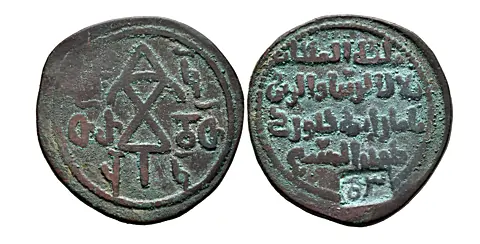
Despite the glory of her reign, Tamar’s coinage reflects a shortage of silver. As a result, the monetary system relied heavily on copper fractional coins.
These coins use the Koronikon calendar, which begins in 780 CE.
The obverse shows a Bagratid dynastic emblem along with the initials of Tamar and her second husband David Soslan, an Ossetian prince.
The Arabic reverse inscription reads:
“Queen of queens / Glory of the world and faith / Tamar, daughter of Giorgi / Champion of the Messiah.” [9]
Many coins were later countermarked during circulation.
Tamar and David Soslan had two children with Giorgi IV Lasha to be the future king.
Queen Rusudan
The exact year of Tamar’s death remains uncertain. Many scholars place it in 1213, although some sources suggest 1207 or 1210. Tradition states that she was buried at Gelati Monastery near Kutaisi, but the exact location of her grave remains unknown.
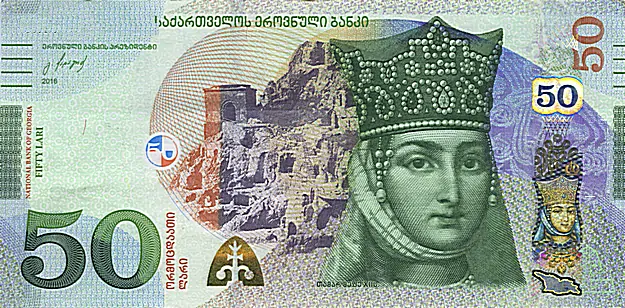
Today, Tamar’s portrait appears on the modern Georgian 50-lari banknote.
Giorgi IV Lasha and the Mongol Threat

Mint: Tiflis
Giorgi IV Lasha, born in 1192, became co-ruler with his mother in 1207 and later ruled alone.
His nickname “Lasha” means “Illuminator of the World.”
However, his reign ended abruptly. Giorgi died at age 31 from wounds suffered in battle against the invading Mongols.
He never married but left an illegitimate son known as Davit Ulu.
Irregular Copper Coins of Giorgi IV
Giorgi IV issued distinctive irregular copper coins struck on crude and misshapen blanks.
These coins often display incomplete designs. Scholars believe they may have circulated by weight rather than by strict denomination. Coins bearing two strikes may represent a double value.
The obverse inscription reads:
“Giorgi son of Tamar.”
The Arabic reverse inscription includes the phrase:
“Sword of the Messiah.”
Many specimens carry countermarks of Queen Rusudan, his successor.
Modern forgeries of these coins remain common [10].
Queen Rusudan and the Mongol Conquest

Queen Rusudan, born in 1194, ruled Georgia from 1223 to 1245.
Her reign faced enormous challenges. In 1225, the Persian Khwarazmian Empire invaded Georgia and captured Tbilisi after major battles.
Then, in 1236, the Mongol Empire invaded.
Georgia soon became a tributary state of the Mongols. Rusudan had to pay an annual tribute of 50,000 gold pieces, likely Persian dinars, and supply armored Georgian cavalry to serve in Mongol armies.
Rusudan Silver Drams
Alongside abundant copper coinage, Rusudan issued rare silver drams.
The obverse shows Christ in Byzantine iconographic style.
The reverse displays the abbreviation RSN for Rusudan in bold Georgian letters. An Arabic inscription surrounds the name:
“Queen of queens, glory of the world and faith, Rusudan, daughter of Tamar, champion of the Messiah.”
An example realized $950 at auction in 2025 [11].
Töregene Khatun and Mongol Authority in Georgia
Estimate: $800-1,000
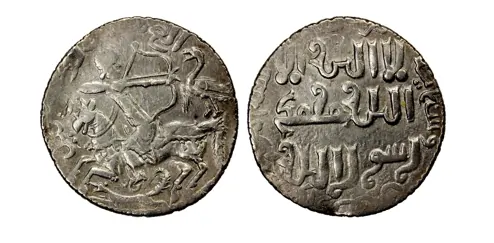
In 1241, the Mongol Empire reached the height of its power when Great Khan Ögedei, the third son of Genghis Khan, died unexpectedly.
His widow Töregene Khatun became regent for their son Güyük Khan.
Silver dirhams issued in Georgia during this period carry her authority.
The obverse shows a mounted archer turning to shoot at a bird.
The Mongol reverse inscription in Arabic script reads:
“Ulugh Mughul Ulush Bik”
(Chief of the Great Mongol Nation).
These coins use the Islamic calendar, which begins in 622 CE.
An example sold for $5,000 at auction in 2023 [12].
David VI Narin and Mongol-Era Georgian Coinage

On August 24, 1246, Güyük Khan was formally enthroned near the Mongol capital of Karakorum. The ceremony drew envoys from the Papacy, neighboring kingdoms, and many Mongol vassals.
Among them were Georgian co-rulers:
- David VI Narin
- David VII Ulu
David VI Narin, the son of Queen Rusudan, was born in 1225. He spent several years at the Mongol court before becoming co-ruler of Georgia in 1246.
In 1259, the Georgian kingdom split. David VI ruled Western Georgia until his death in 1293.
David VI Narin Silver Dirhams
David’s silver dirhams from the mint of Tiflis sometimes appear overstruck on earlier dirhams of Töregene Khatun or the Seljuqs.
The obverse depicts the king on horseback with his name and date in Georgian script.
The Arabic reverse legend states:
“By the power of God, dominion of Güyük Khan, the slave, King David.” [13]
An example realized $2,400 at auction in 2024 [13].
Collecting Medieval Georgian Coins
Collectors rarely encounter medieval Georgian coins in major international auctions.
Most important English-language reference remains:
Kirk Bennett, A Catalog of Georgian Coins (2004).
Much of the specialized literature appears in Russian or Georgian, which can limit accessibility for collectors.
Modern forgeries present a serious concern. According to numismatist Kirk Bennett, many Byzantine-style Georgian coins sold in Western auctions between 2005 and 2015 are modern reproductions [14].
Collectors should therefore exercise caution and verify provenance carefully when purchasing these coins.
References
- Bennett, Kirk. A Catalog of Georgian Coins. Santa Rosa, CA (2004)
- Bennett, Kirk. The Tiflis Dirhems of Mongke Khan. New York (2020)
- Georganteli, Eurydice and Barrie Cook. Encounters: Travel and Money in the Byzantine World. London (2006)
- Lang, David M. Studies in the Numismatic History of Georgia and Transcaucasia. American Numismatic Society, Numismatic Notes and Monographs no. 130. New York (1955)
- Pachomov E. Moneti Gruzii. St. Petersburg 1910 (1970 reprint with commentary by D. G. Kapanadze, Tbilisi)
- Prosser, Ronald. “A Suggested Reattribution of a 13th Century Georgian AE Coin.” Celator 19:1 (January 2005)
Citations
[1] White people are sometimes called “Caucasian” due to an 18th-century racial theory of German anatomist Johann Friedrich Blumenbach.
[2] https://en.wikipedia.org/wiki/Georgian_Golden_Age
[3] CNG Triton XII, January 6, 2009, Lot 946, realized $4,500
[4] CNG Triton XIII, January 4, 2010, Lot 461, realized $6,000
[5] CNG Triton XII, January 6, 2009, Lot 947, realized $2,600
[6] https://www.zeno.ru/showgallery.php?cat=15397
[7] Spengler, William and Wayne Sayles. Turkoman Figural Bronze Coins and Their Iconography, Volume 1 (The Artuquids). 1992.
[8] Gemini Auction II, January 11, 2006, Lot 566, realized $1,000
[9] Leu Numismatik Web Auction 35, July 9, 2025, Lot 5601, realized $150
[10] Stephen Album Auction 52, May 15, 2025, Lot 2121, Unsold
[11] CNG E-Auction 595, September 10, 2025, Lot 741, realized $950
[12] Stephen Album Auction 45, January 26, 2023, Lot 798, realized $5,000
[13] Stephen Album Auction 50, September 19, 2024, Lot 421, realized $2,400
[14] Personal communication, Kirk Bennett
* * *
Edited and Formatted by CoinWeek
Want more stories like this? Sign up for the CoinWeek newsletter






Such wonderful history!
Learned a good bit about a part of the world I had known little about. The only coins from Georgia that I have in my collection are modern, post-Soviet Union issues.