

2026 Semiquincentennial Quarter Rolls and Bags Feature the Mayflower Compact
In recognition of the 2026 Semiquincentennial, which marks 250 years of the United States of America, the United States Mint will issue five new circulating quarters that celebrate the Nation’s history and founding principles.
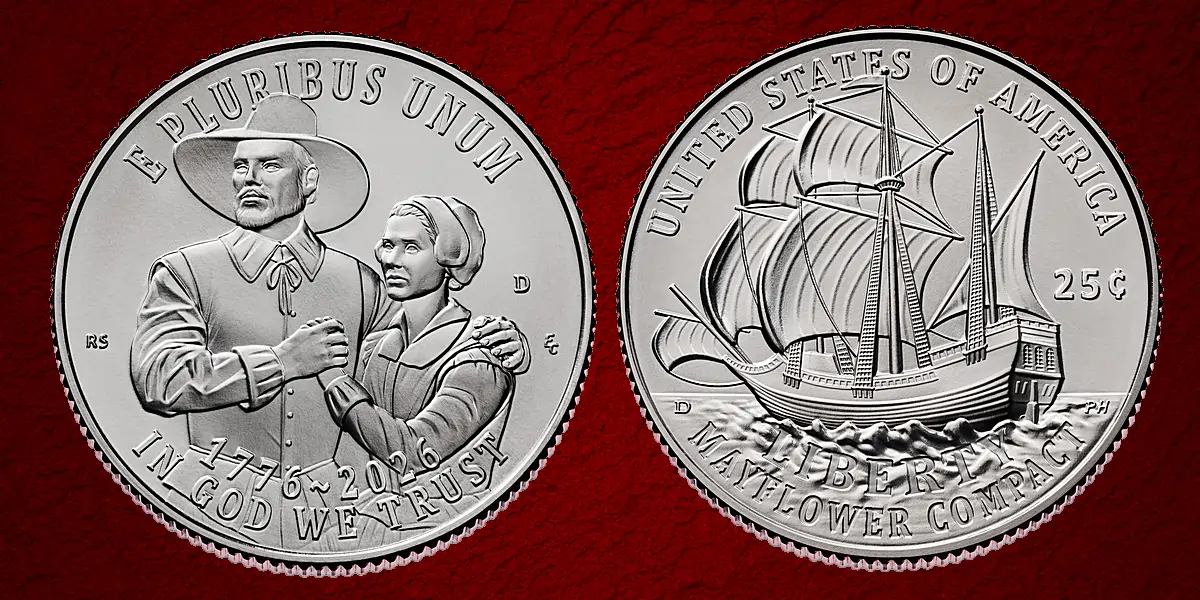
Among these releases, the 2026 Mayflower Compact quarter highlights the early colonial experience at Plymouth and the document that helped shape American self-government.
Limited-Year Semiquincentennial Coinage Program
For one year only, the United States Mint will mark the Semiquincentennial through special coins and medals that introduce design changes to most circulating denominations. These issues commemorate American Liberty by reflecting the Nation’s founding ideals and honoring key moments in United States history.
Within this program, the Mayflower Compact quarter serves as one of five circulating quarter designs planned for 2026.
Mayflower Compact Quarter Available February 5
Collectors may acquire the 2026 Mayflower Compact quarter beginning February 5. The Mint offers these circulating-quality coins in a two-roll set, as well as in 100-coin bags.
Through these formats, the Mint allows collectors and the public to obtain the coins directly upon release.
Obverse Design Depicts Pilgrims and the New World
The obverse of the 2026 Mayflower Compact quarter features two Pilgrims embracing as they behold the New World. This design reflects the moment before the establishment of the Plymouth Colony.
The Pilgrims did not arrive at their intended destination. As a result, they did not possess a charter to establish a colony at Plymouth. Instead, the Mayflower Compact, signed on November 21, 1620, established the colony as a mutual enterprise. Its force of law depended on the consent of the colonists themselves, who sought to promote the common good.
The Mayflower Compact is considered a precursor to both the Declaration of Independence and the United States Constitution. Obverse inscriptions include “E PLURIBUS UNUM,” “1776 ~ 2026,” and “IN GOD WE TRUST.”
Reverse Design Shows the Mayflower Under Full Sail
In contrast, the reverse design presents the Mayflower with full sails as it moves west through rough seas. The image represents the Pilgrims’ journey in search of religious freedom in the New World.
The Pilgrims eventually landed at Cape Cod and settled in what later became Plymouth, Massachusetts. Reverse inscriptions read “UNITED STATES OF AMERICA,” “LIBERTY,” “MAYFLOWER COMPACT,” and “25¢.”
Specifications
The following specifications apply to the 2026 Mayflower Compact quarter:
- Denomination: Quarter
- Composition: 8.33% nickel, balance copper
- Weight: 5.670 grams
- Diameter: 0.955 inch (24.26 mm)
- Edge: Reeded
- Mint and Mint Mark: Philadelphia (P); Denver (D)
- Privy Mark: None




I am writing regarding the description used for the reverse design of the 2026 Semiquincentennial Mayflower Compact quarter, which states that the image “represents the Pilgrims’ journey in search of religious freedom in the New World.”
As a descendant of Mayflower passengers whose families were not part of the Separatist congregation…and who were among those who financially supported the voyage…I would like to respectfully note that this phrasing presents an incomplete and misleading historical narrative.
The Mayflower did not carry a single, uniform group motivated solely by religion. It transported a mixed company that included religious Separatists, merchants, skilled tradespeople, laborers, families, indentured servants, and financial backers. Many were motivated by economic survival, land opportunity, colonial enterprise, and contractual obligations, not by religious freedom alone.
Framing the entire voyage as a religious mission unintentionally erases the experiences and contributions of a large portion of the passengers and sponsors who made the journey possible. Their stories are also part of the nation’s founding legacy.
A more historically accurate and inclusive description might read:
“The image represents the Mayflower’s historic 1620 westward crossing, carrying a diverse group of settlers — including religious Separatists, tradespeople, families, and financial backers — whose motivations ranged from faith to economic opportunity and colonial enterprise.”
Thank you for your time and for your continued work in presenting American history to the public. I appreciate your consideration of this important clarification.
You are correct. We have added some additional copy to the post that states that only about half of the passengers were religious seperatists, the others, as you said had different motivations which we outline. Thanks for your input.