


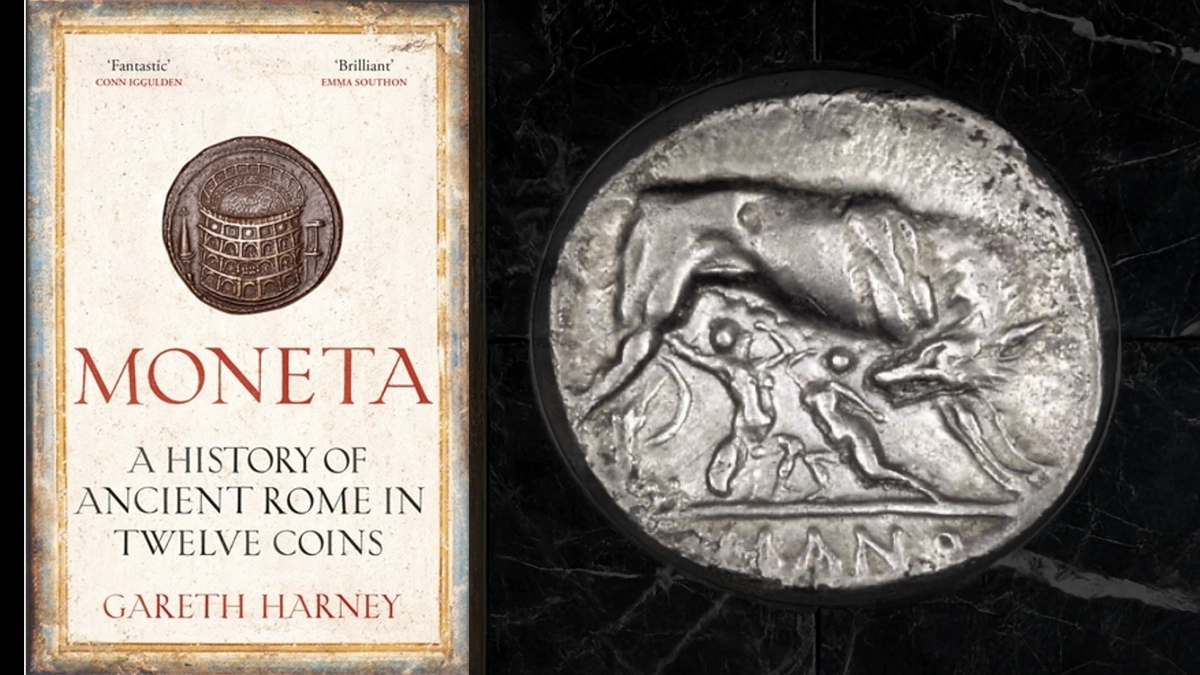
First Read, a continuing series of essays about classic and contemporary works of numismatic literature …
Moneta: A History of Ancient Rome in Twelve Coins by Gareth Harney. London, Penguin (2024) paperback 365 pages. $33.65 ISBN : 978-1-847927514
“This is two thousand years old,” my father reminded me as he placed the small silver disc into the palm of my hand. It was still gleaming, cool to the touch, no bigger than a penny. My young mind could not possibly — and will always struggle to — comprehend such an expanse of time.” (page 1)
So begins this superbly illustrated book, which is, in my opinion, the best publication on ancient Roman numismatics from the viewpoint of a collector to appear in the last few years. The British author doesn’t assume the reader knows Latin or has studied Roman history. He is a talented storyteller and a gifted explainer.
Each of the book’s twelve chapters focuses on a specific coin type that highlights a story from Rome’s long history, but over thirty different coins are illustrated, some with magnified details. Some of these coins are common and relatively affordable, while others are great rarities that go for fabulous prices. There is also a section of color plates with images of some of the coins and related works of art. A clearly drawn map locates every place mentioned in the text.
Rome’s story begins with the legend of Romulus and Remus, the infant twins who were abandoned in the wilderness and nursed by a she-wolf. The “wolf and twins” appear on some of the earliest Roman silver coins (c. 269–266 BCE) and would often reappear on the coinage in later years.
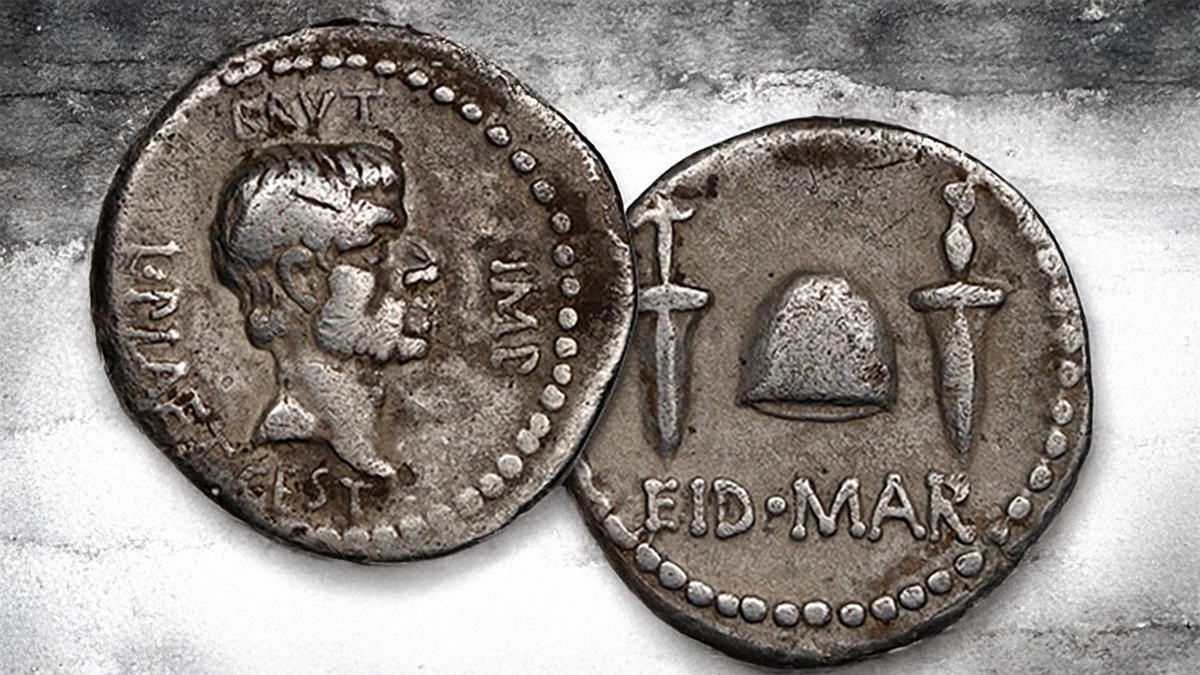
The most famous Roman coin by far is the “Ides of March” silver denarius of Brutus that celebrates the assassination of Julius Caesar on March 15, 44 BCE. Only about a hundred genuine examples are known, and it is a major numismatic event when one comes on the market. An entire chapter, “Ides,” puts this remarkable coin in context.
Another superstar coin is the bronze Colosseum sestertius of Titus, issued to commemorate the opening of Rome’s great stadium in 81 CE. Just eleven examples of this richly detailed type are known; the finest one known brought $464,430 in a 2020 Swiss auction. The chapter on this coin, “Arena,” dramatically describes the life and death of Roman gladiators and the thousands of wild animals that were slaughtered in the arena to entertain the crowd.
A chapter titled “Zenith” profiles Trajan (ruled 98–117 CE), the emperor whose conquests brought the empire to its greatest territorial extent. His capture of 225 tons of gold and 450 tons of silver in Dacia (modern Romania) was enough to strike thirty-one million gold aurei and 160 million silver denarii.
The chapter “Philosopher” focuses on the coinage of Marcus Aurelius (ruled 161–180), whose personal notebook of thoughtful “Meditations” is still a best-seller. A dramatic photograph of two coins side-by-side illustrates the close father-son resemblance of the wise Marcus and his depraved son, Commodus (played by Joaquin Phoenix in the film Gladiator (2000)).
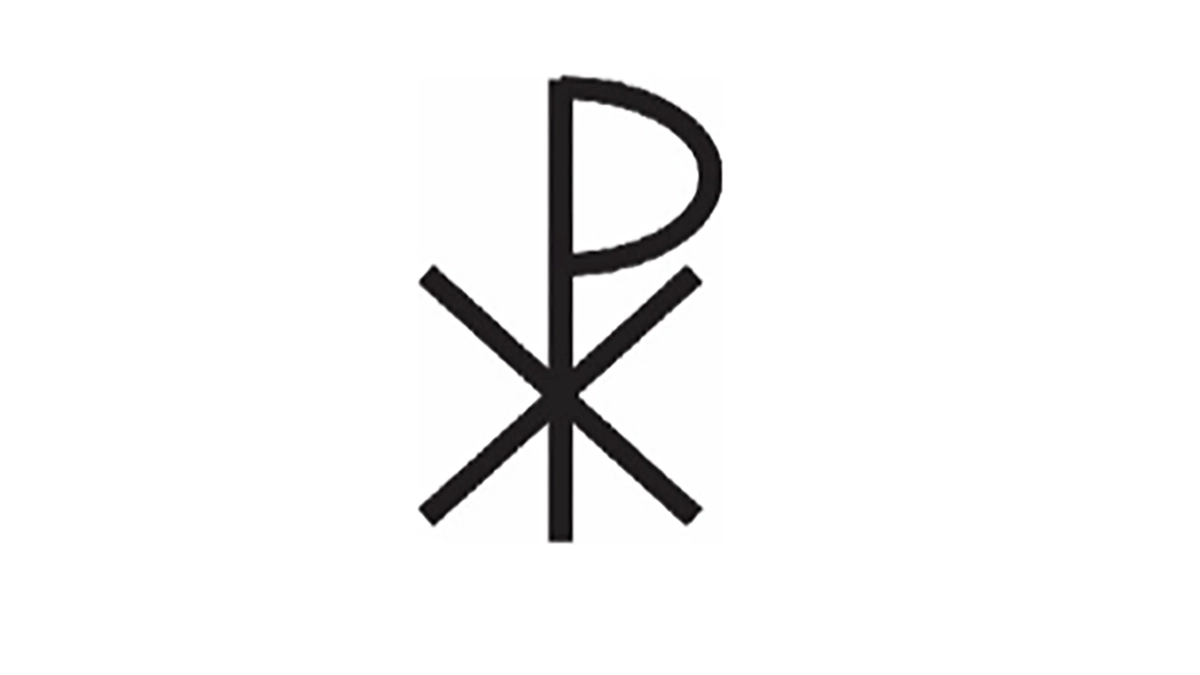
The chapter “Cross” recounts the life of Constantine I (lived 272–337), remembered as the “first Christian emperor,” who was baptized on his deathbed. The symbol of the cross, which Constantine’s pagan subjects would have understood as a horrific means of execution, never appears on his coinage. Instead, he cautiously used the “christogram” or monogram of Christ, which combines the Greek letters chi (X) and rho (P).
The last chapter, “Collapse,” opens with an image of the very rare silver “half-siliqua” of Odoacer, the only surviving portrait of the barbarian warlord who deposed young Romulus Augustus, the last Western emperor, on September 4, 476, a date traditionally regarded as the “Fall of Rome.” Proclaiming himself “king of Italy,” Odoacer was, in turn, assassinated by the Ostrogothic warlord Theodoric “the Great” (March 15, 493). The last coin illustrated in the book, a bronze of Theodoric issued at Rome, depicts the emblematic wolf and twins.
Any collector with an interest in ancient Roman coins will learn many things and find much to enjoy in Moneta. The author’s own extensive collection can be viewed on his website at https://www.harneycoins.com/.





Wonderful article, especially for a collector new to this area of interest.
What an interesting article! I really know nothing at all about ancient coins and I just think they are so cool and really fascinating! It’s amazing to me the detail of these coins from SO long ago!
Very good article. Love ancient coins.
this was a great article, ancient coins are ancient history and that is a field which fascinates me
Very interesting article. I’ve been collecting coins for many many years, but I’ve never owned these type of coins. I find their designs very interesting and what they represent.
Wow history in small sculptures !
I’ll have to get a copy of this book. I have 4 ancient Roman coins and know virtually nothing about them.
The book sounds interesting. I don’t think I’d get the book but reading the articles is fascinating. It is also surprising that these coins weren’t melted down at some point.
i enjoyed this article.
Love a digestible history lesson. Nice work.
Great article. I love ancient coins.
Always fascinated by ancient coins!
Does it touch on their problems with inflation?
I’m adding this book to my ever-expanding to-be-read pile!
Very fun coins!
Currently binge watching series SPARTACUS that frequently denarii is spoken. Timely article.
Fascinating article about ancient Roman history. I liked the Eid-Mar insignia for Ides of March and the chi-rho for Christ.
Currently working on a collection of Constantinian era coins. Fun and affordable to achieve.