


By Roger W. Burdette, special to CoinWeek …..
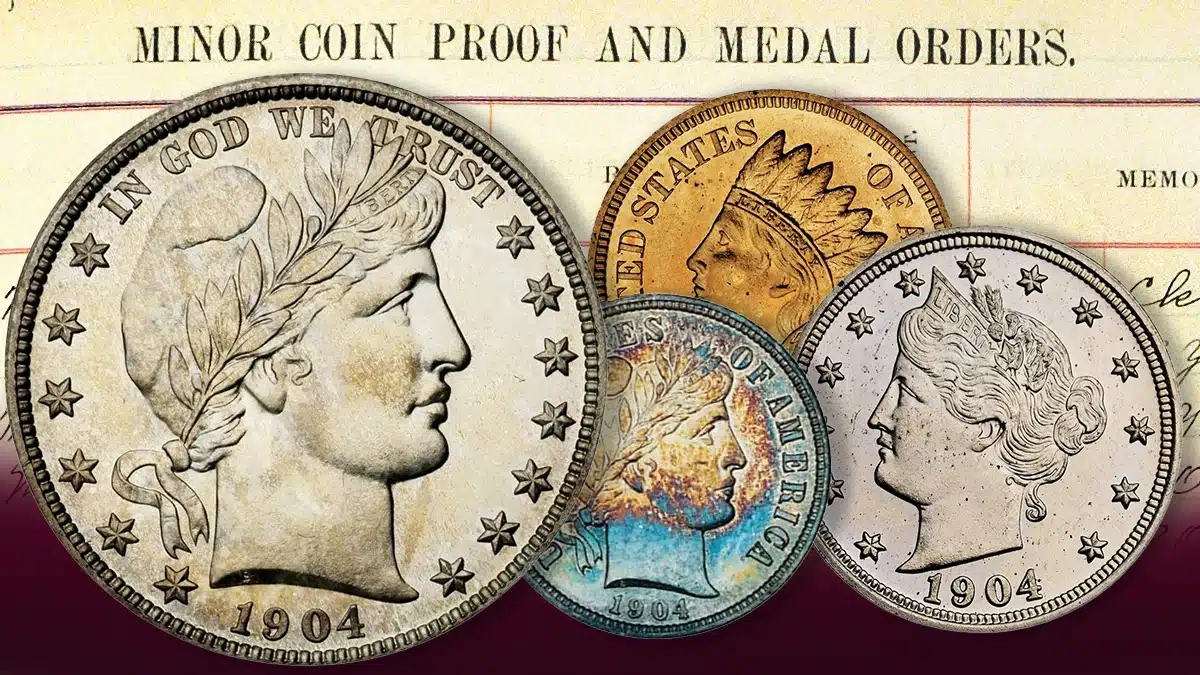
The Philadelphia Mint began selling sets of special coins to collectors in 1858. This new policy did not arise from a bureaucratic whim; it responded to growing demand from coin collectors. When the Mint replaced the old large copper cent with a smaller copper-nickel alloy cent in 1857, large numbers of new collectors entered the hobby.
Early Proof Coin Production and Mint Capabilities
At the time, officials at the United States Mint recognized an opportunity to increase medal and coin sales by producing special collectors’ versions of circulating coinage and selling them at a small premium over face value.
For several decades, Mint workers had already struck and sold special “Master,” “Specimen,” or “Proof” coins informally to collectors, so the Mint already possessed the necessary expertise to produce collectors’ specimen coins.
Proof Coin Sales Expand Nationwide
Likewise, the presses and other equipment in the Medal Department could produce collectors’ coins whenever they were not striking medals.
The Philadelphia Mint actively promoted coin collecting by selling annual sets of Proof coins and encouraging public tours of the Mint building.
By the 1870s, Philadelphia struck and sold thousands of Proof coins directly to collectors across the country each year. During that era and continuing to the present, collections containing great rarities or owned by wealthy and prominent individuals attracted public attention.
Yet these “significant collections” were far fewer in number and scope than those assembled by ordinary middle-class hobbyists. In effect, most collectible coins today owe their survival to the John and Jane Does of earlier generations.
The Role of Ordinary Collectors in Numismatic History
Few Mint records document collectors’ purchases. After shipping orders, Mint staff usually discarded letters requesting Proof coins, and the Mint maintained mailing lists of collectors only sporadically.
One surviving source is an index of medal and Proof coin orders from 1895 to 1906[1]. This thick volume, likely one of many similar books that once existed, lists thousands of collectors and institutions, along with their city and state, the amounts they paid, and the Mint employees who fulfilled the orders.
Banks and businesses placed many orders in dollar amounts that suggest purchases of silver and gold medals. However, many other entries clearly represent individual collectors, most of whom remain unknown today.
A Surviving Ledger of Proof Coin Orders
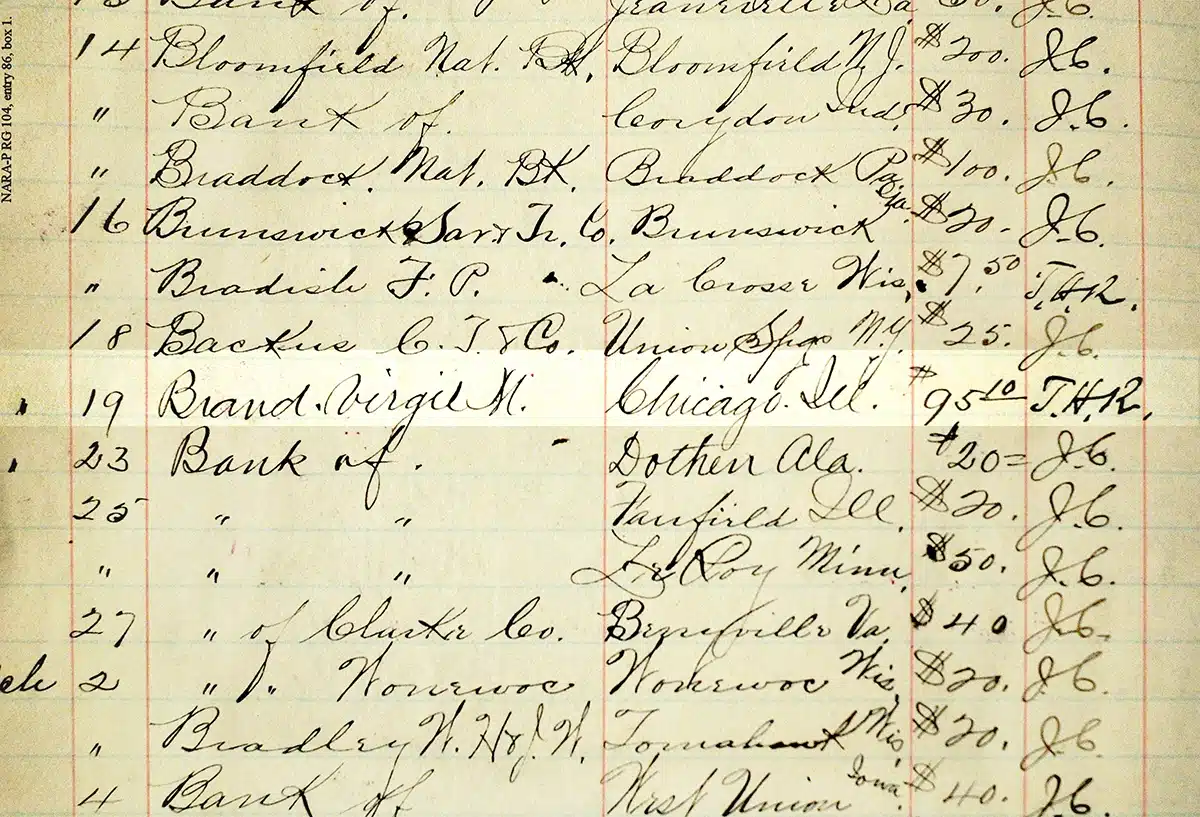
By knowing the cost of various Mint Proof sets, researchers can estimate the contents of some orders. For example, on February 20, L.R. Mixer of Brattleboro, Vermont, sent 8¢ in cash.
Because that amount matched the cost of a minor Proof set consisting of a cent and a nickel, Mr. Mixer was evidently adding to his coin collection during the New England winter. A minor and silver set, which included the 1903 dollar, cost $2.25 plus postage.
A complete set of all 1903 Proof coins cost $40.75, while a glittering gold Proof set alone cost $38.50. Most collectors ordered medals, which generated more revenue for the Mint than coins.
Large Collectors and Small Orders Treated Alike
Collectors could also order individual Proof coins, which explains some of the odd amounts recorded in the journal. Mint staff often estimated postage and took great care to refund any overpayment.
Mint employees handled orders from famous collectors the same way they handled a modest 8¢ order. The detail below shows a March 1904 order placed by Chicago tycoon Virgil Brand.
In exchange for his $94.00 postal money order, Brand likely received two gold sets along with multiple silver and minor sets. At times, he ordered minor sets by the hundred.
The journal also lists collector Alexander Caldwell, although his $38.50 order appears modest when compared to Brand’s.
One of the few documented interactions between the Mint and a small coin collector involved a Connecticut resident named Giles Anderson.
Giles Anderson and a Collector’s Complaint
In 1897, Anderson wrote his first letter concerning Proof coins to address a missing 1896 order. Mint officials appear to have resolved the matter. The record then remains silent until 1909, when Anderson’s complaint about Proof Lincoln cents emerges. Correspondence long forgotten in the Mint archives surfaces.
On December 6, 1909, Treasury Secretary Franklin MacVeagh forwarded a letter and enclosures to United States Mint Director Piatt Andrew:
A Letter from the White House to the Mint Director
Dear Mr. Andrew:
Here is a letter which came over from the White House, and I wish you would give it your personal attention. This is a matter that is Greek to me.
The charge that there is something wrong in the handling of these numismatic matters in the Mint is something that needs investigation.
Evidently this numismatist, Mr. Anderson, does not propose to let anybody or anything – not even the President nor any of his occupations – stand in the way of his coin fads. He is an American citizen, however, and his rights must be regarded.
Very sincerely yours,[2]
Giles R. Anderson, a coin collector from Waterbury, Connecticut, had written President William Taft in August 1909. He complained that he had ordered two sets of the minor Proof coins (including the VDB Lincoln cent) and not received his order. Nor did he get an acknowledgement from the Treasury Department.
Anderson’s Frustration with Proof Lincoln Cents
On December 1, he wrote a follow-up letter to Fred W. Carpenter, personal secretary to the president. The letter was passed to Secretary MacVeagh, who sent it to Mint Director Andrew to handle.
Last August I wrote the President and received your reply of August 20th, stating that my remittance for the Proof coins requested had been sent to the Secretary of the Treasury, for his consideration, but up to this date, I have heard nothing from the same at all.
It is not the amount of twenty-five cents, but the principle involved in my not having any reply at all, when I make a remittance for a definite object, that I complain about.
I desired to get one of the Proofs of the first issue of the Lincoln cents. The cost of the minor Proof set of one and five cent pieces is 8 cts. And I sent enough for two sets and the cost of registering the return package and one cent change.
Previous Corresponance
As stated in my previous letter, I wrote to the Superintendent of the U. S. Mint at Philadelphia, when I heard that the new Lincoln cents were in the engravers hands and asked when Proofs could be obtained and received no reply, then finally saw that they were issued and sending for Proofs, find that they are at once recalled and none can be obtained.
These varieties are of interest to anyone who desires a complete collection of our country’s coinage and I have the Proofs from the date of my birth, to this present year and have regularly purchased the same from the Mint.
Formerly the Mint would inform those who regularly purchased, if they did not get their order before the end of the year, so that the apparent oversight might be called to their attention, before it was too late to get them….
….but during the past few years, in writing for information regarding any proposed new coinage and when Proofs could be obtained, there was either no reply, or a very misleading one and then all of a sudden the news through the papers, come that the new coin is issued and for some reason, being imperfect, is recalled and a new one is out and a FAVORED FEW ONLY, get the first Proofs issued.
Concerns Over Fairness and Access to New Coin Issues
This is not a S Q U A R E D E A L and as a citizen I have just as much right to the knowledge of when I can get Proofs, so that I can have a complete set, as speculators have, who walk in and buy them up and charge me higher rates for them.
I am well aware Sir, that this subject may seem a petty one when we compare the value of it to the country, to the investigation of the Sugar Trust etc. but it does seem to me, that when one has had his name on file, at the United States Mint in Philadelphia, as many years as I have, as a purchaser of the Proof sets, that in the event of new coins being issued, I should have the chance to get them.
The $20 gold piece
An illustration of the above was in the issuing of the $20 gold piece.
At the very first when the first specimen coins were submitted to Bankers and others, there was immediately raised and [sic] objection to them, which objection was stated publicly as a very decided one, viz., that the knee of the Liberty projected so much that the pieces could not be stacked, as money is in a Bank and that they would therefore be very objectionable.
Notwithstanding this fact, well known in advance of their issue, a small lot of them were issued, delivered to the favored few and immediately a “great discovery is made” …..
Bankers do not like the new coins, call them in and change Liberty’s knee. This is done and at once the first issue are [sic] selling at prices ranging from $25.00 to $35 for a twenty dollar gold piece.
No Reply ?
In this case, having written the Mint B E F O R E they were first issued, asking when they could be had and received no reply for some time. I then had occasion to order some coins and asked the question again and with that package, written on an ordinary piece of scrap paper (not a Mint letter head) was the information, that the new coins would not be issued “this year” and it was only a short time after, before they were issued and recalled.
I know positively that in the time that was written to me, that the dies were in preparation, for their issue.
….You can take this matter up and see that I am forwarded for my remittance Proofs of the first two issue of Lincoln cents which I desire and furthermore that such orders be given, that the Mint authorities would give notice by letter to all collectors who are getting Proofs each year, of any new issues, so they could keep their sets complete without paying tribute to any speculators.
Yours respectfully,
P.S. Kindly take this matter up before the time when the annual destruction of dies occurs, so that I may not be informed that it is too late[3].
Anderson had a number of “facts” regarding the Saint-Gaudens coinage incorrect, but his overall opinion was consistent with other disappointed collectors who failed to locate one of the high relief MCMVII double eagles, or who did not receive a 1909 VDB Proof cent with their order.
Matters were further confused by inaccurate newspaper reports and wildly speculative estimates of the value of some of some coin varieties.
The Mint Director Responds
Director Andrew checked with Preston and others at Mint headquarters, and with Superintendent Landis in Philadelphia. He then prepared a memorandum dated December 7 for Secretary MacVeagh:
I have made some inquiries with regard to the question of Proof coins, referred to in the letter from Giles R. Anderson which you sent to me to-day. “Proof coins” are coins struck by hand by means of a hydraulic press upon discs which have been specially polished.
The Mint is not obligated by law to sell such coins but makes a practice of doing so at a regular schedule of prices and the endeavor is to provide Proof coins of the current year for all those who ask for them. The Mint, however, sells no such coins of other than the current date.
Quite naturally, when a new coin is issued for only a few days and the design is suddenly changed, as was the case with the St. Gauden’s [sic] coins and as was the case with the Lincoln cents bearing the initials “VDB”, the Proof coins of the early issue very soon command an extraordinary price.
Making Demands
It does not seem to me, however, that we are in any way obligated to provide collectors or others with Proof sets of designs whose coinage has been abandoned. Mr. Anderson and quite a number of other collectors have besieged the Department with demands for Proof sets of the Indian Head type bearing the numeral “1909”, of which a number were issued early in the year.
As you know, the coinage of the Lincoln cent with VDB was stopped five days after the first issue and it appears that only one lot of Proofs of that coin were made. Only a few of those who ordered Proof coins of the Lincoln cents secured Proofs from those early dies and the other would-be buyers are naturally disappointed.
These Proof coins are only struck at the Philadelphia Mint and Mr. Landis says that orders are always filled there as received.
I shall look into the matter when in Philadelphia at the end of the week, but one can easily see how utterly impossible it would be to meet the demand for such hand-made coins in the case of new coin models which have been abandoned soon after they began to be issued[4].
The Official Reply to Anderson
Two days later Mr. Anderson received a courteous “brush-off” from Director Andrew[5]:
Your letter of the 1st instant addressed to Mr. Fred W. Carpenter, Secretary to the President, has been referred to this Bureau by the Secretary of the Treasury.
In reply you are respectfully informed that your former letter was referred to this Bureau by the Superintendent of the Mint at Philadelphia and it was supposed that officer would reply to you.
Upon examination it appears that he returned your letter with the statement that there were no Proof Lincoln cent with the initials “V.D.B.” on hand. The Superintendent states that there was only one lot of Proof Lincoln cents with the initials made, as the coinage of these pieces was stopped five days after the first issue.
He also states that orders were filled as received and the stock was soon exhausted. Having been directed to discontinue the coinage of the Lincoln one-cent pieces bearing the initials “V. D. B.” there was no alternative but to stop coining both the ordinary and the Proof pieces.
It is not considered a part of the duty of the Superintendent of the Mint to notify coin collectors when Proof coins can be had.
I regret that you did not file your application in time with the Superintendent of the Mint at Philadelphia to obtain Proofs of the Lincoln one-cent piece with initials.
In the examination of the letter of the Superintendent of the Mint at Philadelphia returning your former letter to the Bureau the 25 cents forwarded by you was found enclosed and is returned herewith[6].
Aftermath of the 1909 Proof Coin Dispute
Nothing more appears in the Mint’s archives regarding Mr. Anderson’s search for 1909 Proofs. It is likely he had to buy the coins he desired from a dealer.
Fortunately, the Mint Bureau’s uncooperative attitude did not long dissuade Mr. Anderson from his “coin fads”.
In 1921, we find him writing to the Mint Director in hopes of obtaining some of the new Peace dollars for his collection[7].
Anderson failed in his immediate quest for a 1909 VDB Proof. But he continued his hobby, just as did thousands of other small coin collectors.
Each year they bought Proof sets and individual coins. They carefully admiring the coins and put them in cabinets or custom made albums.
Some vanished by chance at the local penny candy emporium; others disappeared during the Great Depression out of necessity.
The Enduring Legacy of the ‘Little Guy’ Collector
But many of these coiner’s gems, accompanied by pieces saved from circulation or traded with hobby friends, survived. They will be passed on to future generations of collectors.
The coins we now admire were more likely once owned by the “little guy” than by some “big name” collector.
* * *
Citations
- [1] NARA RG104 Entry 86 Box 1. “Minor Coin Proof and Medal Orders.”
- [2] NARA-CP, RG104 Entry 229, box 284. Letter dated December 6, 1909 to Andrew from MacVeagh.
- [3] NARA-CP, RG104, Entry 229, box 284. Letter dated December 1, 1909 to Fred W. Carpenter from Giles R.
Anderson. - [4] NARA-CP, RG104 Entry 229, box 284. Memorandum dated December 7, 1909 to MacVeagh from Andrew.
- [5] RG104, Entry 235, vol. 380, Letter dated December 9, 1909 to Anderson from Andrew.
- [6] A batch of 500 Proof 1909 Lincoln cents was struck on December 3, and another 298 on the 23rd. It’s strange that a coin or two could not have been located for Mr. Anderson.
- [7] RG-104, Entry 235, vol 441. Letter dated December 27, 1921 from O’Reilly to Anderson.
* * *





It is an enigma how the 1964 Kennedy Accented hair proof half dollar variety is not considered more of a rarity than it is..It’s estimated that only up to 5% of the entire mintage of 1964 proofs which is between 50,000 and 100,000 coins before it was abruptly pulled and a more appealing design to his widow, Jacqueline Kennedy, was minted since from popular information on the subject, she did not approve of the heavily accented hair as it was initially produced. So with a mintage of less than the 1916D mercury dine, 264,000, there is a serious discrepancy on the value of this coin. Once collectors wake up to how rare it really is and decide to put more focus on the variety, simce they are still very affordable right now, they will become a coin that we will look back and realize you could have owned but wlevwntually became out of reach once they are snapped up.and held without their current shocking availability
I have a lot of coins I’m trying to sale like pennies,nickels,dimes, and quarters all kinds and dollar bills with a star on it how can I sale them
I have very old coins.i want to sale them where can I go .
What about a Silver Dollar dated in the early 1900’s?
How much is a 1950 dime worth ??
Looking for information on the 1804 Dollar silver
Looking for all. I like being the little guy.
It’s so interesting to read something like that more than a century later.
INTERESTING ARTICLE
What an interesting history!
I love learning about coin history.
Great article–makes me want to email the Mint director about a few things
Very interesting read thanks!
Great article! As a small collector, I’ll do my part and keep stacking bit by bit.
Fascinating article. I wish I had a collection of the older coins.
I’m new to coin collecting and very much like the perspective this articles goes into.
Great article! I found myself rooting for Mr. Anderson the moment I read his letter, even though he did not have all the facts correct
Shout out for the little guy!
Very interesting article.
What a great bit of history. Imagine trying to write to the secretary of the treasury and getting an answer! You would be lucky to get an automated email in reply!
I always love learning something new. It makes me wonder what interesting things people will be reading about us in the future
My small collection will go to my kids whether they want it or not. ;)
I knew about the sharp rise in collecting, once the large cents disappeared from circulation. I like reading about Mint history, too. My first book on the subject was by David W. Lange. It’s still a good read.
So, problems in filling orders at the Mint was also a problem more than 100 years ago.