


By Mike Markowitz
Athens controlled one of the richest silver mines in the ancient world. Wealth extracted by slave labor elevated the city into a cultural, economic, and political powerhouse. Athens maintained that position until Rome eclipsed it in the second century BCE. On its widely circulated coinage, the city placed the image of its patron goddess, Athena, and her sacred bird, the owl.
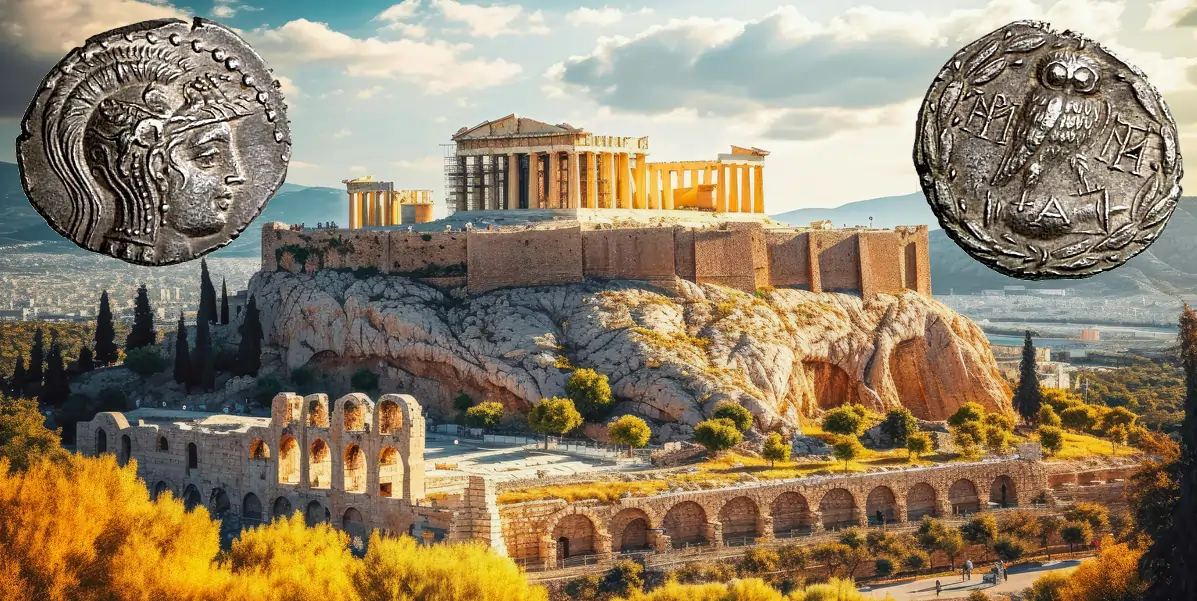
Nearly every collector of ancient coins wants to own an Athenian owl tetradrachm. On Harlan Berk’s list of the 100 Greatest Ancient Coins, the Athenian owl ranks number ten (Berk, 2023). Millions of classic owl tetradrachms, weighing about 17.2 grams of nearly pure silver, were struck between roughly 485 and 404 BCE.
The Classic Owl Tetradrachms

On the classic owl, Athena wears a crested helmet, and a faint smile appears on her lips. The flans were often too small for the dies. As a result, coins that display a complete helmet crest remain especially desirable.
The reverse shows a sprig of olive leaves in the upper left, a small crescent moon, and three bold Greek letters flanking the owl: AΘE, an abbreviation of the city’s name. Today, Very Fine examples sell for around $600, while Extremely Fine specimens bring approximately $1,500. Exceptional near–Mint State coins regularly achieve prices of $7,500 or more.
The Introduction of the New Style Coinage

Beginning around 165 BCE, Athenian coinage underwent a radical transformation. The tetradrachm became slightly lighter, averaging about 16.7 grams, and was struck on a larger, thinner flan.
Athena’s portrait appears more naturalistic and closely follows the monumental statue of the goddess that once stood in the Parthenon. On the reverse, the owl stands on an overturned amphora, a ceramic vessel used to store olive oil. A wreath of olive leaves surrounds the design. In addition to the abbreviated city name, a monogram appears in the field. This mark likely identifies the official responsible for the coinage. These early New Style issues remain very rare.
Expanding Symbols and Administrative Detail

A few years later, around 162 BCE, engravers added a dotted border to the obverse.

By approximately 150 BCE, the reverses became increasingly crowded. Coins now list up to three officials, with names fully or partially spelled out, alongside an expanding array of symbols and control letters.
On a typical example, a small image of the sun god Helios driving his chariot appears in the field to the right of the owl. A lengthy inscription fills much of the remaining space:
A-ΘΕ / ΔΙΟ-ΝΥΣ / ΔΙΟ / ΝΥΣI / AΣ / KΛA
The amphora bears the letter M, indicating the twelfth month of the Attic lunar calendar [1]. Letters from alpha through nu appear in this position, reflecting the need to add an intercalary month at irregular intervals. Because the Athenian year began in midsummer, modern dating of these coins spans two overlapping BCE years.
At the bottom of the reverse, a two-letter code, ME, appears. About twenty-nine such letter codes are known [2]. These likely represent mining contractors who supplied the silver.
Ivory, Elephants, and Symbolism
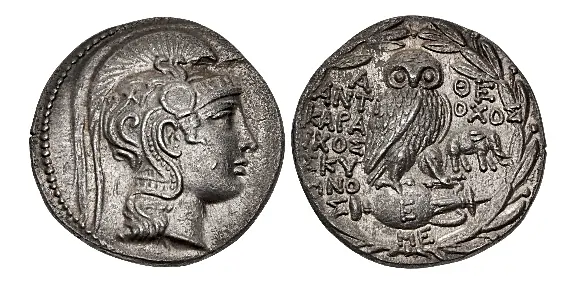
Elephant ivory ranked among the most prized luxury materials in the ancient Greek world. The statue of Athena Parthenos featured carved and polished ivory panels for the goddess’s skin [3].
This symbolism appears directly on New Style coinage. A tetradrachm dated to 131/0 BCE (Thompson 397k) features a small Indian elephant in the lower right field of the reverse [4].
Mithradates, Aristion, and the Roman Siege

One of the most historically significant New Style tetradrachms dates to 87/6 BCE (Thompson 1145). The coin bears the name of King Mithradates VI of Pontus, written as BAΣI-ΛE / MI-ΘPA / ΔA / THΣ, along with his dynastic emblem: a starburst flanked by two crescents [5] [6] [7]
The coin also names Aristion (APIΣ / TIΩN), an Athenian politician described in ancient sources as a tyrant [8]. Aristion briefly seized power in Athens and supported Mithradates during his disastrous war against the Roman Republic.
When the Roman general Lucius Cornelius Sulla besieged and captured Athens, Roman forces executed Aristion.
The Final Issues under Roman Control
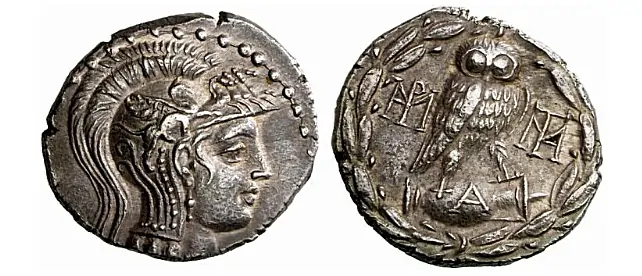
The last New Style tetradrachms were struck under Roman occupation. These coins display crude engraving and feature two Greek monograms. The monogram on the left likely represents a Roman personal name, “of Marcus” (MARKOY). The monogram on the right reads TAMIOY, meaning treasurer or paymaster.
These inscriptions refer to Marcus Lucullus, who served as quaestor under Sulla. Dated to 86–84 BCE, an example (Thompson 1293a) realized CHF 7,000 ($6,063) at a Swiss auction in 2008 [9].
Collecting the New Style Owls
A search of the CoinArchives database, which catalogs more than 2.6 million auction records, returns over 3,000 results for “New Style” and “Athens.” Recent prices range from about $350 to more than $16,000 for exceptional rarities.
Solid Very Fine examples typically sell for around $1,000. Assembling a complete set of known New Style tetradrachm types would challenge even the wealthiest and most patient collector.
Collectors reference these coins by their Thompson numbers. The essential reference remains Margaret Thompson’s The New Style Silver Coinage of Athens (1961). The work spans 757 pages, with a separate 235-page volume of plates. Although long out of print, copies in good condition can sell for as much as $300. The full text remains available online through the American Numismatic Society [10].
As Thompson observed, this coinage speaks clearly, and sometimes tentatively, about a pivotal century in Athenian history. That era opened with the promise of freedom proclaimed by Roman general T. Quinctius Flaminius in 196 BCE and closed amid political dissension and looming catastrophe. By 146 BCE, Greece had become a Roman province [11].
New Video Content
Citations
- [1] https://en.wikipedia.org/wiki/Attic_calendar
- [2] Thompson (1961) page 613
- [3] https://en.wikipedia.org/wiki/Athena_Parthenos
- [4] CNG Auction 121, October 6, 2022, Lot 263, realized $1,900 (estimate $1,500)
- [5] CNG Auction 87, May 18, 2011, Lot 466, realized $10,000 (estimate $1,000)
- [6] https://en.wikipedia.org/wiki/Mithridates_VI_Eupator
- [7] https://coinweek.com/star-crescent-ancient-coins/
- [8] https://en.wikipedia.org/wiki/Aristion
- [9] NAC Auction 48,October 21, 2008, Lot 79, realized CHF 7,000 ($6,063) estimate CHF 4,500
- [10] http://numismatics.org/digitallibrary/ark:/53695/nnan131509
- [11] Thompson (1961) page 727. Roman general T. Quinctius Flaminius after defeating
Macedonian king Philip V, proclaimed the “freedom of Greece” in 196 BCE. In146 BCE Greece became a Roman province.
References
- https://en.wikipedia.org/wiki/Attic_calendar
- Thompson, Margaret. The New Style Silver Coinage of Athens. New York, 1961, p. 613.
- https://en.wikipedia.org/wiki/Athena_Parthenos
- CNG Auction 121, October 6, 2022, Lot 263, realized $1,900.
- CNG Auction 87, May 18, 2011, Lot 466, realized $10,000.
- https://en.wikipedia.org/wiki/Mithridates_VI_Eupator
- https://en.wikipedia.org/wiki/Aristion
- NAC Auction 48, October 21, 2008, Lot 79, realized CHF 7,000.
- http://numismatics.org/digitallibrary/ark:/53695/nnan131509
- Thompson, Margaret. The New Style Silver Coinage of Athens. New York, 1961, p. 727.






The consistency yet variations are really interesting. Great article explaining the impact history had on these coins.
Hoo. Hoo. Love the owls.