


By Tyler Rossi for CoinWeek ….. Updated and Reformatted Feb 2026
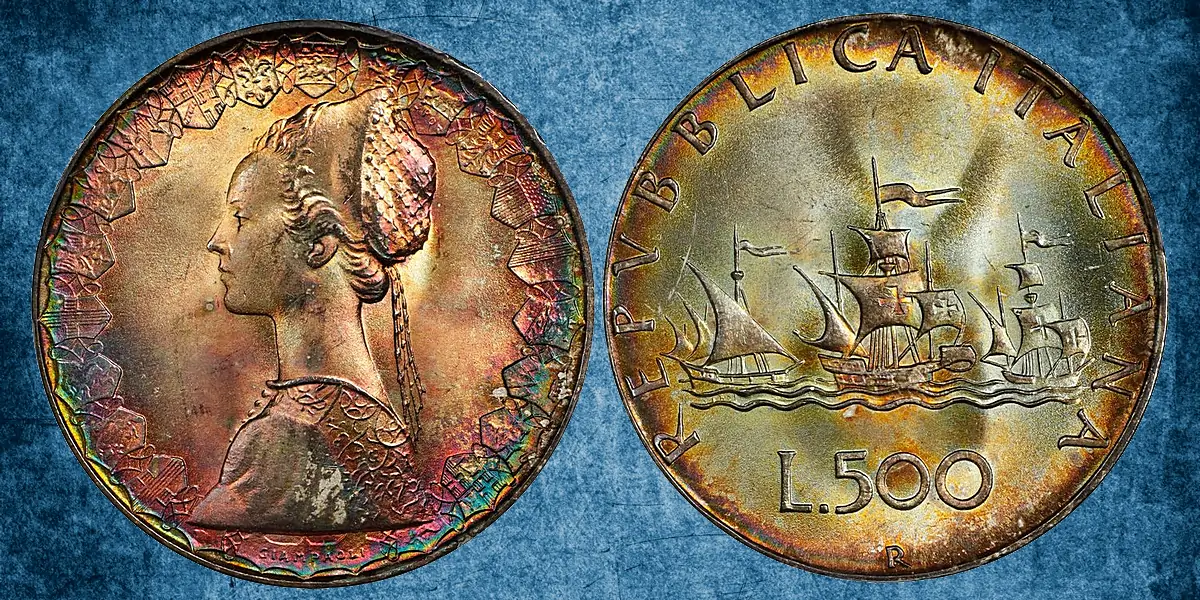
Italy’s 500 Lire “Caravelle” Silver Coin: History, Design, and Value
A Modern Classic of Post-War Europe
In 1958, the Italian Mint in Rome introduced a new silver 500 lire coin. Collectors soon gave it a nickname: the Caravelle.
The Mint struck just under 100 million circulation pieces from 1958 through 1967. Then, beginning in 1968, it continued the same design in Brilliant Uncirculated (BU) and Proof formats for official Mint sets. Those special issues continued intermittently until 2001.
Today, many numismatists consider the 500 lire Caravelle one of the most beautiful post–World War II European coins.
Italy’s Economic Miracle and the Need for a 500 Lire Coin
The coin emerged during a time of dramatic change.
On March 25, 1957, Italy signed the Treaties of Rome, which created the European Economic Community and the European Atomic Energy Community. As a result, Italy integrated more deeply with the German, French, and British economies.
At the same time, the nation shifted from an agriculture-based system to one centered on manufacturing and design. Historians now call this period the Italian Economic Miracle.

During these years:
- Italy’s Gross Domestic Product surged.
- Unemployment fell from postwar highs to below 3% by 1962.
- Per capita income rose sharply.
- Italian consumers gained real spending power.
Against this backdrop, Treasury Minister Senator Giuseppe Medici ordered the creation of a new 500 lire silver coin. The denomination reflected Italy’s rising prosperity.
Exchange Rates, Silver Content, and Intrinsic Value
The 500 lire coin carried serious purchasing power at the time of issue.
In 1958, 1 U.S. dollar equaled 624.74 lire. The exchange rate remained relatively stable until 1968.
By comparison:
- 1972: 583.22 lire per dollar
- 1980: 856.45 lire per dollar
- 1981: over 1,100 lire per dollar
- 2001 (final year of issue): nearly 2,100 lire per dollar
The coin contains 0.2953 troy ounces of silver.
In 2001:
- Silver averaged $4.37 per ounce ($7.32 adjusted for inflation).
- The silver content equaled about $1.29 ($2.16 adjusted for inflation).
- That amount represented roughly 5.4 times the face value at prevailing exchange rates.
- Therefore, by 2001, the coin’s intrinsic silver value far exceeded its 500 lire denomination.
However, in 1958, the story looked different. At issue, 500 lire equaled about 80 U.S. cents, or roughly $8.20 adjusted for inflation. That figure made the coin substantial for circulation use.
A “Shield” for the Lira
Before the coin entered circulation on August 28, 1958, La Settimana Incom released a promotional newsreel on May 1, 1958.
The film described the new 500 lire coin as a “secure shield to defend the stability of the lira.” The message reflected national pride and economic optimism.
The Obverse: A Renaissance Allegory of Italy
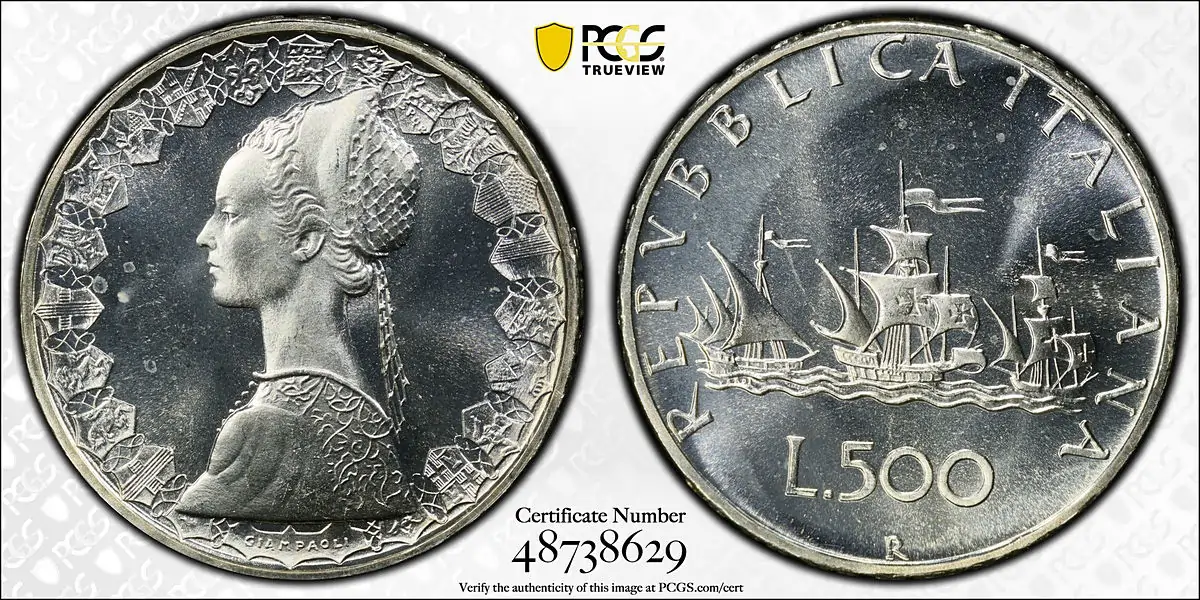
Chief engraver Pietro Giampaoli designed the obverse. The newsreel called it a “Renaissance female figure.” Yet the creative process ran much deeper.
Giampaoli completed five distinct design phases:
- A left-facing female head wearing a Phrygian cap, with wheat behind her ear and the legend REPVBBLICA ITALIANA.
- A more mature head without the cap, hair tied in a bun.
- A Renaissance-style bust wearing period clothing and hat.
- The same head paired with a chain of 19 coats of arms instead of a legend.
- The final type combining the Renaissance bust and the chain of regional shields.
The 19 coats of arms represent:
Genova, Torino, Aosta, Milano, Trento, Venice, Trieste and Udine, Bologna, Florence, Ancona, Perugia, Rome, L’Aquila, Naples, Bari, Potenza, Catanzaro, Sicily, and Cagliari.
Notably, the last two shields sit partially hidden behind the bust.
Was the Model Giampaoli’s Wife?
A persistent rumor claims that Giampaoli based the profile on his wife, Letizia Savonitto. However, scholars believe he drew broader inspiration from Renaissance art.
Specifically, the bust resembles a medal created by Pisanello (Antonio Pisano) depicting Cecilia Gonzaga, daughter of Gianfrancesco Gonzaga, Marquess of Mantua.
Pisanello likely received the commission in 1445. His workshop cast the surviving example posthumously in 1447. Cecilia studied under Vittorino da Feltre and later refused marriage to Oddantonio da Montefeltro. Instead, she became a Clarissa nun in 1445.
Interestingly, Pisanello portrayed her in secular dress. Giampaoli appears to have echoed that Renaissance aesthetic in the 500 lire design.
The Reverse: From Indecision to Icon
Giampaoli also began work on the reverse. However, he struggled to settle on a theme. He produced six entirely different concepts:
- Saint George after Donatello
- David with the head of Goliath after Verrocchio
- A farmer plowing with oxen
- A carnation
- A fleur-de-lis
- A rose
He also experimented with denominations: 1 fiorino, 2 fiorini, and finally 500 lire.
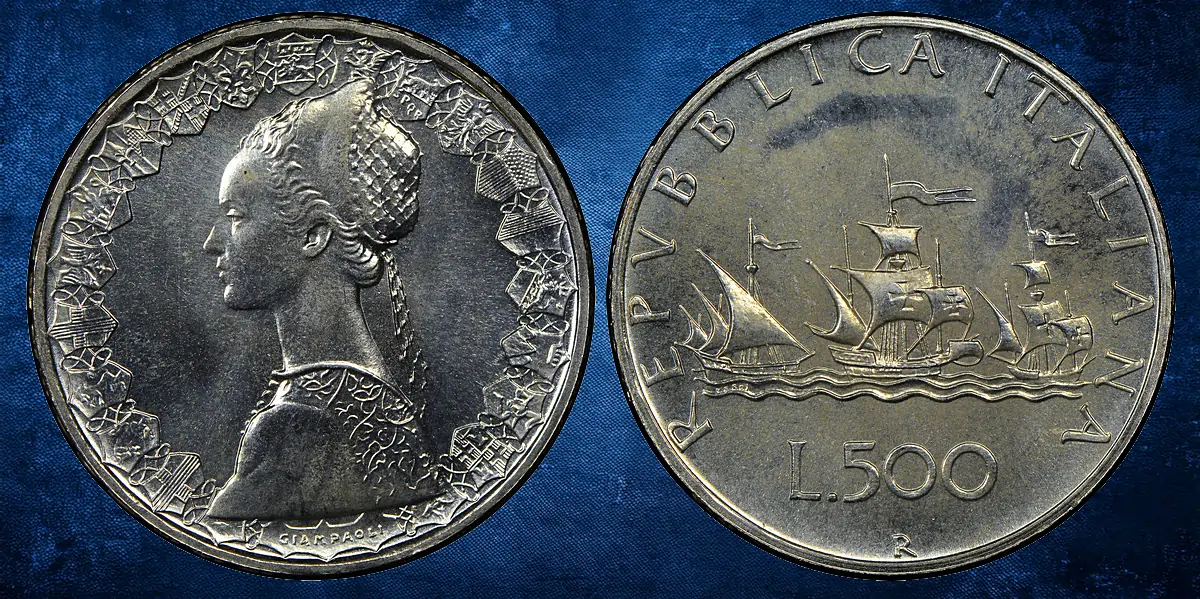
Eventually, the Mint reassigned the project to Guido Veroi. Veroi quickly drafted the now-famous design of Christopher Columbus’s three ships—the Niña, Pinta, and Santa María—sailing rightward across stylized waves.
The legend REPVBBLICA ITALIANA encircles the design. The denomination and mint mark appear below the ships. Early patterns also include the word prova (“trial”) near the lower left edge.
The “Wrong-Way Flags” Prova Controversy
The Rome Mint struck 1,004 prova test pieces for parliamentary distribution.
![Flags flying to the Left in the Trial strikes [Prova]](webp/prova.webp)
Some observers debated the issue. Ships can sail against the wind. In that case, flags may trail differently than expected.
However, Veroi rejected the claim of error. As a civil engineer with marine engineering expertise, he defended his design.
Despite his stance, the Mint reversed the flag direction for circulation strikes. Consequently, the original prova pieces became rare.
Today:
- High-grade circulation examples often sell for $10 to $15.
- Mid- to high-grade prova pieces bring $4,000 to $5,000.
- Exceptional examples exceed $10,000 at auction.
Edge Lettering and Date
- Collectors find the date on the edge.
- The complete edge legend reads:
- **REPVBBLICA ITALIANA 1960 ***
The edge inscription adds another layer of security and design sophistication.
Mintage and Collectibility
The Mint produced 97,840,000 circulation-finish coins between 1958 and 1967. As a result, collectors can obtain circulated examples with ease.
However, few people saved them at the time of issue. Therefore, Gem Uncirculated examples remain relatively scarce.
In contrast, BU and Proof coins from:
- 1968–1970
- 1980–2001
These coins entered the market only through official Mint sets. Because collectors preserved these sets carefully, high-grade examples remain widely available.
For example, an early 1968 Mint set often trades around $50, depending on condition and market demand.
Why the 500 Lire Caravelle Still Matters
The 500 lire Caravelle represents more than silver and artistry.
It reflects:
- Italy’s postwar recovery
- The rise of European economic integration
- Renaissance artistic heritage
- Technical innovation in modern minting
Above all, it captures a moment when Italy projected strength and optimism to the world.
For collectors of world silver coinage, the Caravelle remains a cornerstone of any postwar European collection.
Happy collecting.
Sources
- La Settimana Incom, 1958 Newsreel
- Historical USD/Lira exchange rate data (University of British Columbia)
- Umberto Moruzzi, “Il segreto della 500 lire”
- Italian Renaissance Medals Project
- The E-Sylum (Numismatic Bibliomania Society)
- Valutazione-Oro.com
- Obituary of Guido Veroi (1926–2014)







This is a very informative and excellent article on one of my favorite coins.
Loque no entiendo quien pone el precio..entiendo que digan que son raras ok perfecto.pero hay millones de humanos raros y no valen nada .como valoran la vida entonces ..hoo seme olvida el humano muere x eso no tiene valor verdad
Beautiful coin and great article!
Beautiful design.