


By CoinWeek Notes …..Updated Feb 2026
Collectors recognize two half dollar series as “Bust Halves”: the earlier Draped Bust type, which ended in 1807, and the Capped Bust type, which ran from 1807 through 1839. The Mint produced Capped Bust Half Dollars with a lettered edge through 1836, then adopted the familiar reeded edge later that year.
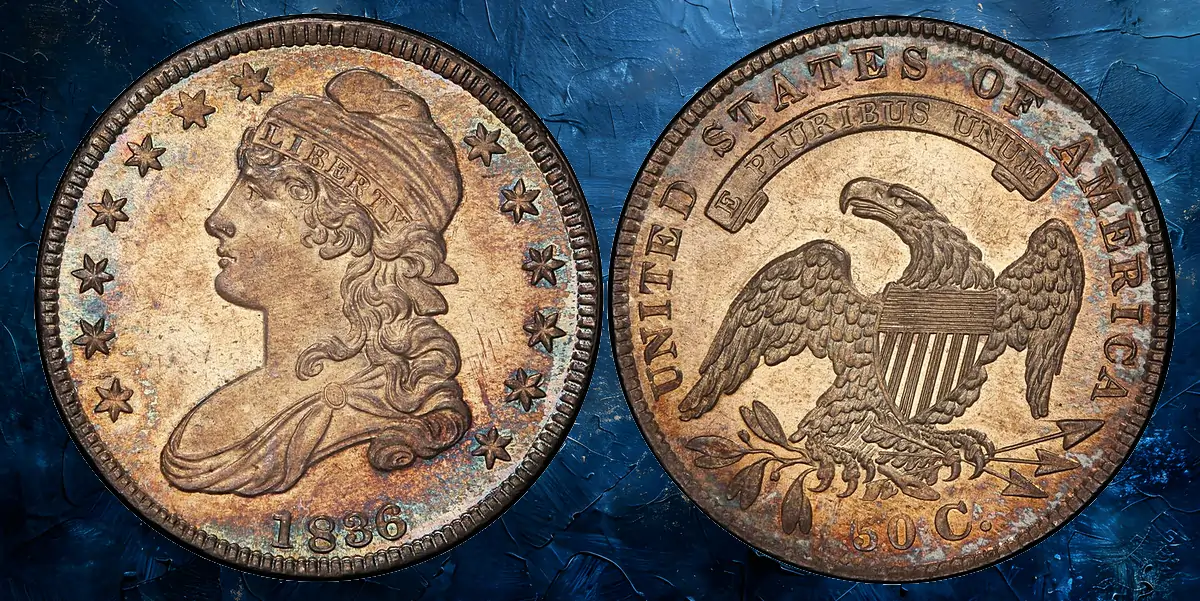
Although engravers introduced subtle design changes after 1809 and at other points in the series, many numismatists use the 1836 edge change to divide the coins into two distinct types.
In the early 1800s, half dollars served as the workhorse of circulating silver coinage. The Mint struck no silver dollars from 1804 through 1835 and did not produce them in significant numbers until 1840. Workers used screw presses and hand-punched elements on the dies, creating a series with numerous varieties that attract strong collector interest.
German-born engraver John Reich created the design. He immigrated to the United States as an indentured servant to escape the Napoleonic Wars. United States Mint Director Robert Patterson hired Reich to improve the nation’s coinage. Some writers claim that Reich modeled Liberty’s portrait on his mistress, but no evidence supports that story.
Production fell below one million coins in only three years of the Capped Bust series. The Mint struck no half dollars in 1816 because a major fire forced officials to suspend all silver coinage. Collectors know of no Proofs dated before 1820, although rumors suggest that the Mint produced sample pieces as early as 1817.

How Much Are Capped Bust Half Dollars with a Lettered Edge Worth?
For nearly every date—though not every variety—CAC, NGC, and PCGS list several hundred coins in their combined population reports. Grading services certify examples from Very Fine to Superb Gem, but most fall between Extremely Fine and near-Mint State. Collectors can find significant numbers in Mint State up through near-Gem, while Gem and finer coins remain scarce to rare. Prices stay moderate through Choice AU, then rise steeply at the Gem level and above.
Collectors recognize Proofs dated from 1820 through 1836, and some speculate about pieces from 1817 through 1819, though no one has confirmed them. All Proofs remain rare and expensive; in most years, the Mint struck fewer than 15 pieces.
Extended Coverage on CoinWeek

Legend Rare Coin Auctions sold the Konstantine’s Capped Half Dollar Registry Set on September 26, 2018, and CoinWeek previewed some of the most spectacular highlights.

A few years ago, noted numismatist Gerry Fortin sold an exceptionally toned 1823 Capped Bust Half Dollar in Extra Fine condition for the impressive sum of $2,100. This article looks at why the coin achieved such a high price.
Rare U.S. coin expert and veteran dealer Jeff Garrett offers some tips on collecting the Lettered Edge type.

- The Once Unknown, Now Famous 1817/4 Half Dollar
- A Sag Harbor Physician’s Hoard of Capped Bust Half Dollars
Q. David Bowers writes about the popular bur rare 1817/4 overdate variety and a curious influx of Capped Bust Half Dollars into circulation long after the series had ended.
And finally, coin expert and CoinWeek contributor Greg Reynolds analyses the Pogue specimen ‘Broken 3’ 1823 Capped Bust Half Dollar.
Counterfeit Detection

- An 1824 Capped Bust Half Dollar
- An 1833 NOT PCGS Half Dollar Counterfeit
- An 1807 Half Dollar and Friends
CoinWeek author Jack Young addresses a few Lettered Edge Capped Bust Half Dollars in his Fun With Fakes series on counterfeit coins he and the “Dark Side” group have discovered online.
Because the Mint used only one pair of dies to strike all half dollars in 1815, the 1815/2 overdate stands as a famously rare Capped Bust Half Dollar variety. NGC reports that someone altered an original 1815-dated coin, a common and opportunistic form of counterfeiting.
Design Overview

To begin with, Reich’s Liberty portrait dominates the obverse. Liberty faces left and wears a mobcap. Webster’s Dictionary defines this cap as “a woman’s fancy indoor cap made with a high full crown and often tied under the chin.” In this case, the engraver shows the high crown folded forward. However, he does not include a tie.
Across the base of the cap appears the word LIBERTY. Meanwhile, curls cascade down Liberty’s back and shoulder. Below the portrait, a draped robe crosses the bust. A clasp secures the garment at the shoulder. Surrounding the figure, thirteen six-pointed stars form a circle within a denticulated rim. Seven stars appear on the left, and six appear on the right. Finally, the date sits at the bottom of the coin.
Reverse Design Details
In contrast, the reverse features a powerful eagle at center. The eagle turns its head to its right, which is the viewer’s left. At the same time, it spreads its wings as if ready to fly. A shield covers the eagle’s breast.
Moreover, the eagle holds three arrows in its left, or sinister, claw. In its right, or dexter, claw, it carries an olive branch. Around the upper portion, the legend UNITED STATES OF AMERICA curves inside a denticulated rim. By comparison, the denomination 50 C. appears at the bottom.
Above the eagle, a banner stretches across the field. Although the ribbon lies mostly flat, its ends fold inward. The motto E PLURIBUS UNUM appears on the banner. Importantly, the coin shows no mintmark. Instead, the Mint struck all examples at Philadelphia.
Edge Inscriptions
Along the edge, the inscription reads FIFTY CENTS OR HALF A DOLLAR. Between 1814 and 1831, engravers added a star between DOLLAR and FIFTY. Later, from 1832 through 1836, they placed vertical lines between the words. As a result, collectors can use these details to help identify specific issues.

Varieties and Overton Numbers
In addition, collectors attribute Lettered Edge Capped Bust Half Dollars by Overton numbers. Researchers have identified more than 789 different dies. Consequently, the series offers a wide range of collectible varieties.
Among the most valuable are the 1812/1 Large 8 and the 1815/2 overdate. Likewise, the 1817/4 overdate commands strong premiums. The 1830 Large Letters variety also attracts attention. Notably, the 1815/2 represents the only 1815-dated coin in the series. Furthermore, fewer than 10 examples of the 1817/4 survive.
Beyond these, specialists have cataloged many other overdates and engraving errors. They have also recorded differences in letter and numeral size. In some cases, census reports list fewer than five known examples. Therefore, advanced collectors often compete fiercely for these rarities.
Coin Specifications
Capped Bust Half Dollar, Lettered Edge
- Years of Issue: 1807–1836
- Mintage (Circulation): High: 6,545,000 (1836); Low: 47,150 (1815; all are the 1815/2 overdate)
- Proof Mintage: High: 15 (1836, estimated); Low: 5 (1820–1824, estimated; none confirmed prior to 1820)
- Alloy: .900 silver, .100 copper
- Weight: ±13.48 g
- Diameter: ±32.50 mm
- Edge: Lettered
- Designer: John Reich
Additional References
- Bowers, Q. David. The Experts Guide to Collecting and Investing in Rare Coins. Whitman Publishing.
- A Guide Book of United States Type Coins. Whitman Publishing.
- Breen, Walter. Walter Breen’s Encyclopedia of U.S. Coins. Doubleday.
- Guth, Ron, and Jeff Garrett. United States Coinage: A Study by Type. Whitman Publishing.
- Overton, Al. United States Early Half Dollar Varieties, 1794-1836. Donald L. Parsley.
- Taxay, Don. The U.S. Mint and Coinage. Arco Publishing.
- Yeoman, R.S., and Jeff Garrett (editor). The Official Red Book: A Guide Book of United States Coins. Whitman Publishing.
* * *






Excellent Article! Great info!