By Mike Markowitz for CoinWeek …..

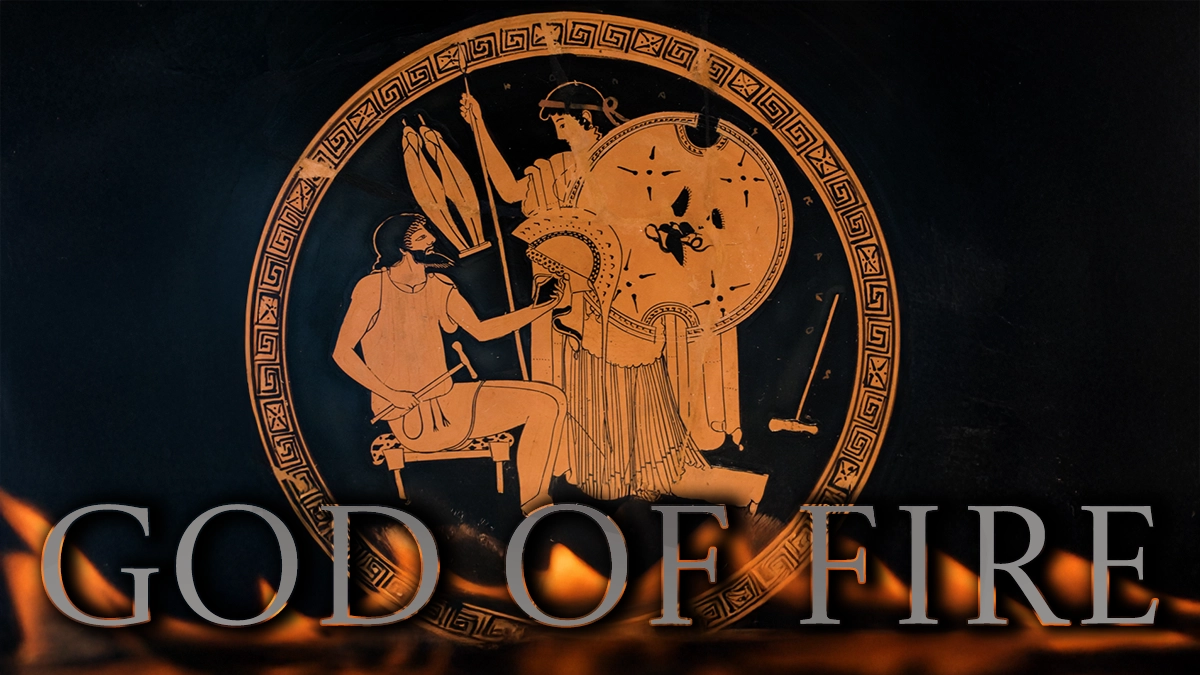
TO THE ANCIENT Greeks, he was Hephaistos[1]. To the Romans, he was Vulcan. To the Etruscans, he was Sethlans. Many ancient cultures imagined a god of fire who presided over volcanoes and was a metalsmith who crafted magical armor and weapons. Of the 12 “Olympian” gods of the Greco-Roman pantheon, he appears on the fewest coins — a special challenge for collectors eager to assemble a “complete” type set of deities.
Like most things in Classical Numismatics, that list is… complicated. The Greek gods who dwelt on Mount Olympus[2] were Zeus, Poseidon, Hera, Demeter, Aphrodite, Athena, Artemis, Apollo, Ares, Hephaestus, Hermes, and either Hestia or Dionysus. The list for the ancient Romans is Jupiter, Neptune, Juno, Ceres, Venus, Minerva, Diana, Apollo, Mars, Vulcan, Mercury, and Vesta or Bacchus. The eminent Belgian numismatist François de Callataÿ tabulated the frequency of Greek gods and heroes on coins in a major collection (de Callataÿ, 118). Zeus topped the list with 14,019 appearances, Athena with 7,503, and Apollo with 3,634. Poor Hephaestus appeared on 20.
In classical mythology, Hephaestus is a relatively minor figure. An early reference from the sixth or seventh century BCE is one of the anonymous “Homeric Hymns:”:
“Sing, clear-voiced Muses, of Hephaestus famed for inventions. With bright-eyed Athene he taught men glorious gifts throughout the world, — men who before used to dwell in caves in the mountains like wild beasts. But now that they have learned crafts through Hephaestus the famed worker, easily they live a peaceful life in their own houses the whole year round. Be gracious, Hephaestus, and grant me success and prosperity! (Hesiod, 20)”
Hephaestus was a son of Zeus and Hera, though one source says he was born miraculously from Hera alone. Unlike the other gods, who were perfect in beauty, he was ugly and therefore hurled from Olympus, breaking a leg when he fell onto the Aegean island of Lemnos. Rescued and nurtured by Thetis[3] (the semi-divine mother of Achilles), the lame god eventually returned to Olympus to serve as craftsman and blacksmith.
Hephaestus on the Coins of Lipara
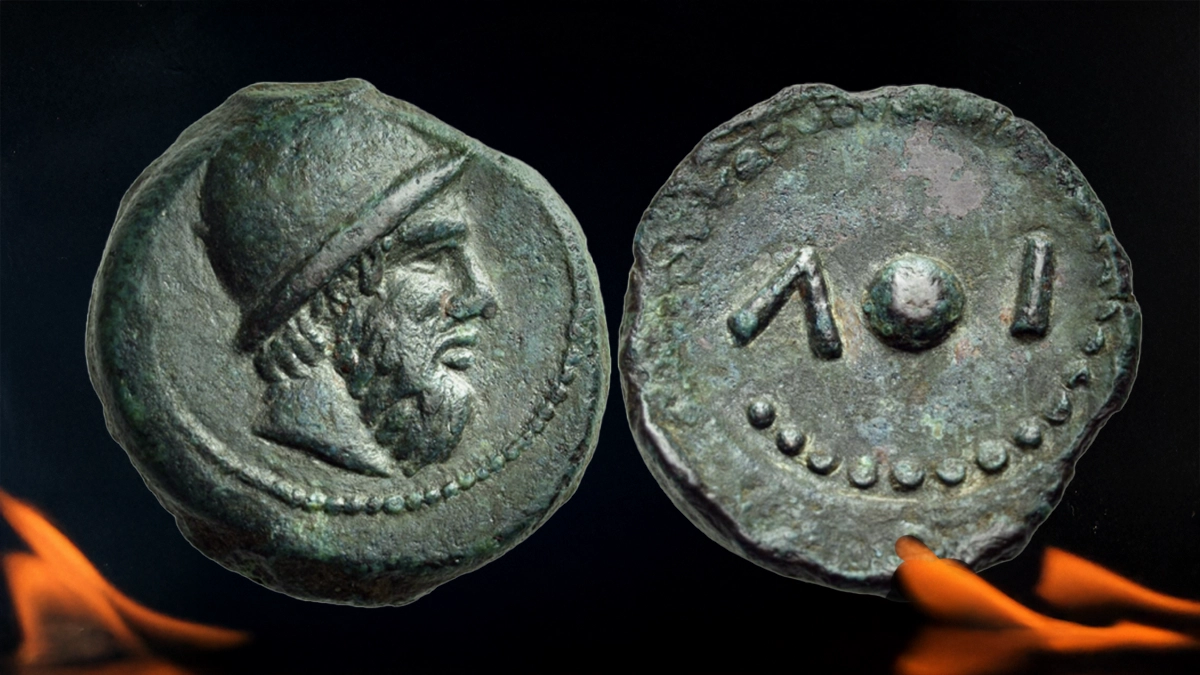
The seven volcanic Aeolian islands off the northern coast of Sicily were settled by Greek colonists as early as 600 BCE. Lipara, the largest island, issued bronze coins bearing what may be the earliest numismatic appearance of Hephaestus dated to c. 440 – 420 BCE.[4] He wears the pilos (Latin: pileus), a conical leather cap worn by smiths to keep sparks from the forge from setting their hair on fire.
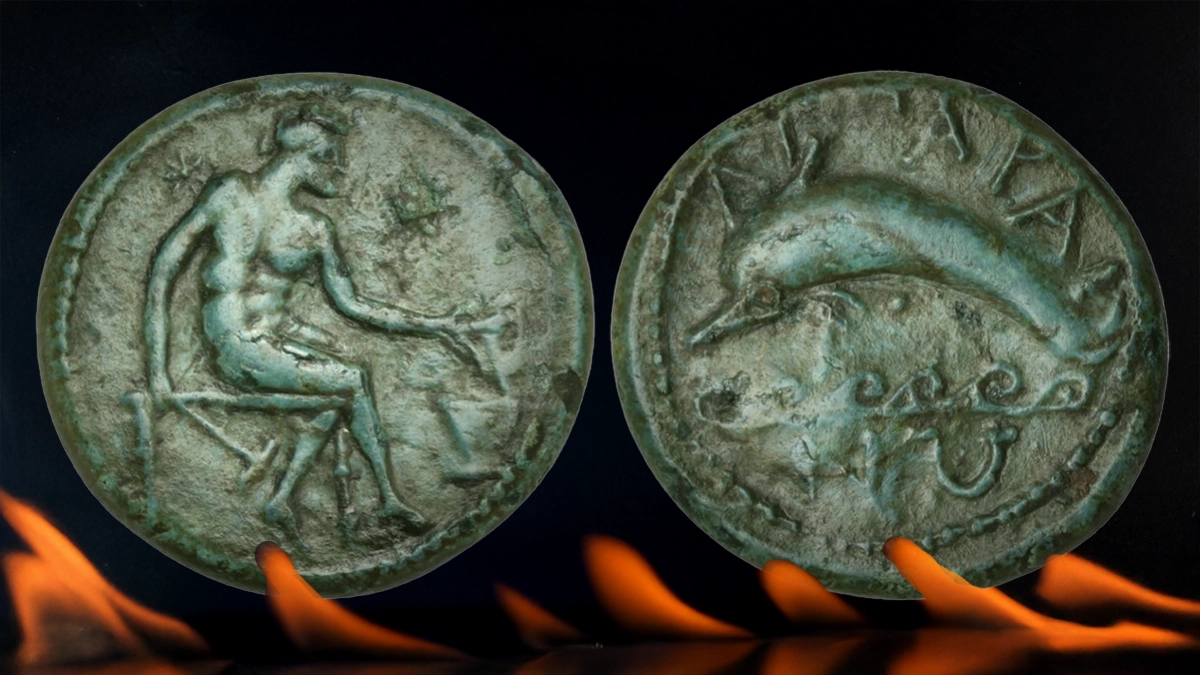
On a bronze coin of Lipara dated to c. 350 – 300 BCE, we see Hephaestus seated at his anvil, holding his hammer and an unfinished drinking vessel.[5]
Mytistraton
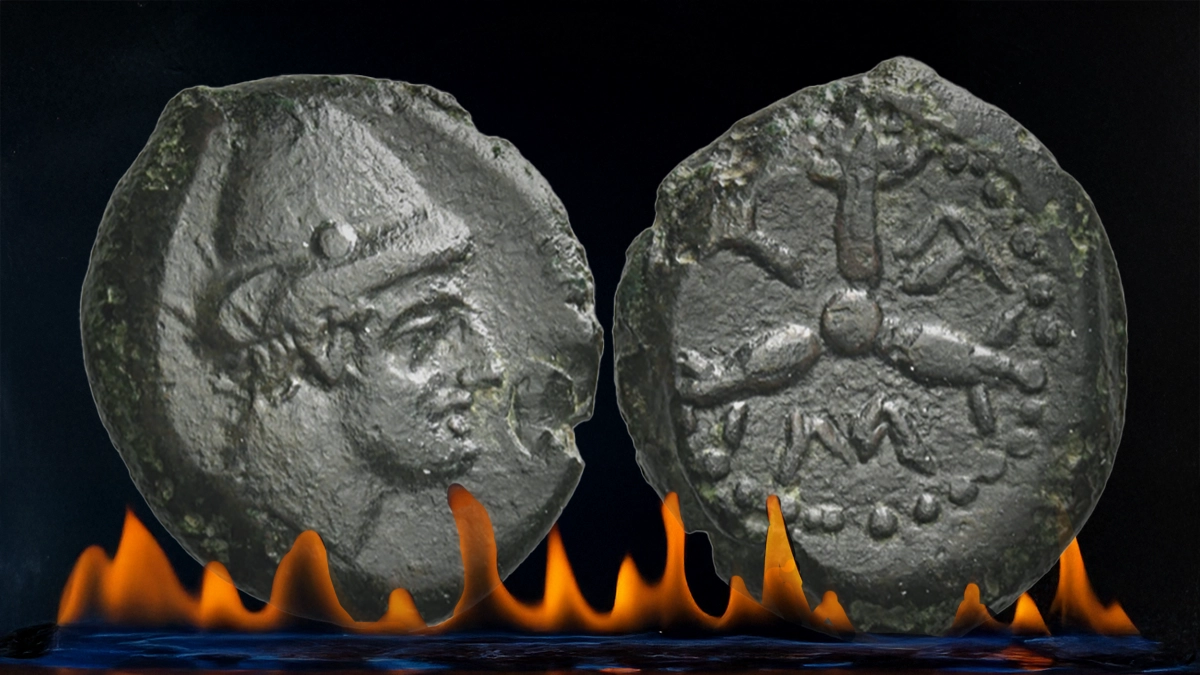
The little town of Mytistraton (or Mytistratus; today Marianopoli) in the interior of Sicily was fortified by the Carthaginians in the First Punic War, and besieged by the Romans. Lying in the shadow of the great volcano Mount Etna, it featured the image of the volcanic god Hephaestus on its rare coinage, overstruck on bronze coins of Syracuse.[6]
Aesernia
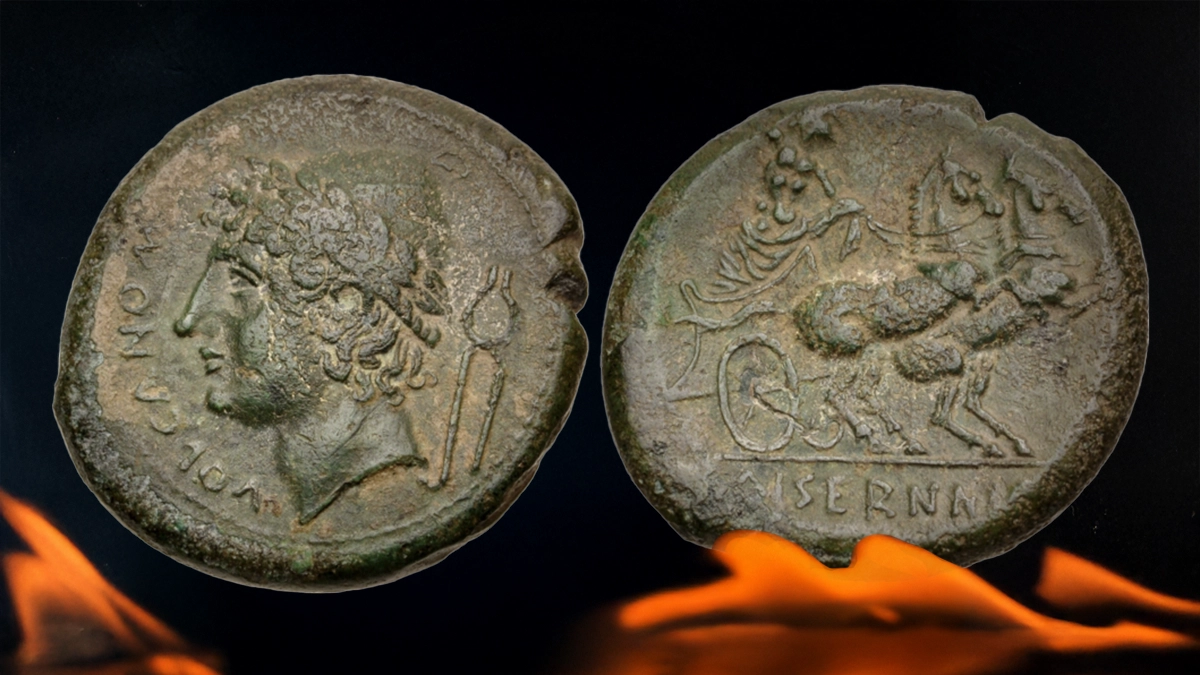
Samnites were a people of south-central Italy conquered by the Romans in a long series of wars from 343 to 290 BCE.[7] Established as a Roman colony in 264 BCE, the Samnite town of Aesernia issued coins bearing the youthful head of Vulcan with one of his attributes, the tongs, used to handle hot metal.[8]
Populonia
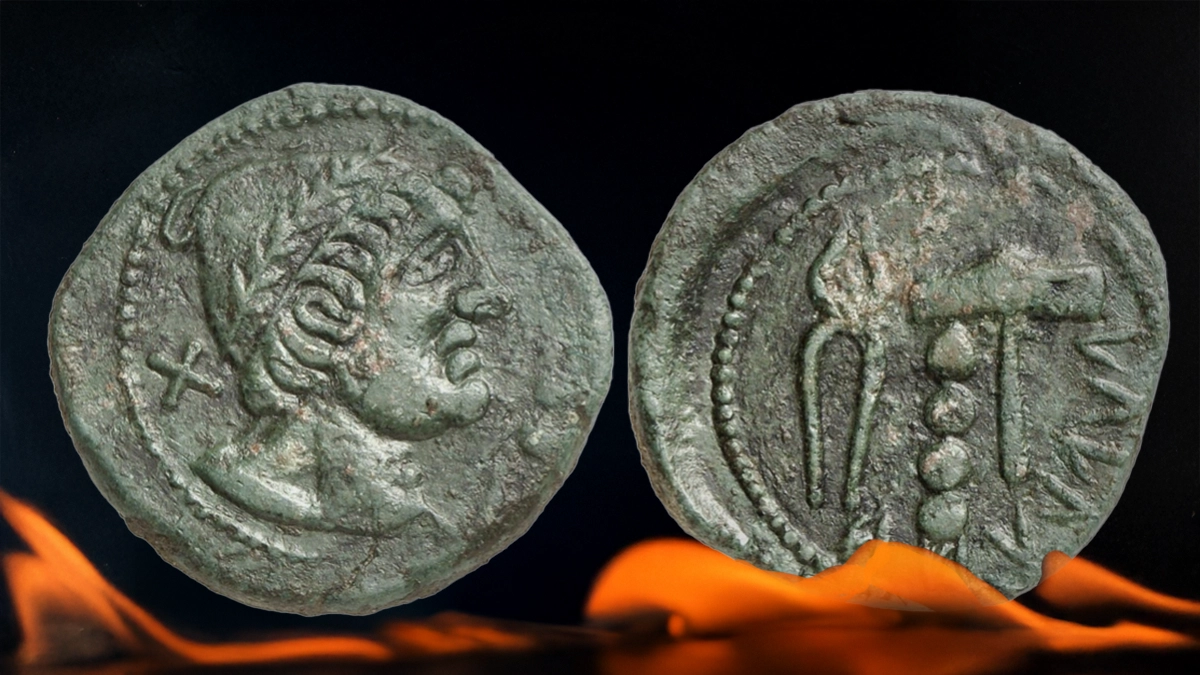
Ancient Etruscans (who called themselves “Rasna”) were an enigmatic people who inhabited the Italian region of Tuscany. They were gradually assimilated by the Romans, who adopted some of their customs. The Etruscan city of Populonia (“Fufluna” in Etruscan) was a thriving center of metal working, smelting copper mined in nearby hills, and iron ore from the island of Elba. Populonia issued more coins than any other Etruscan city. Dated to c. 215 BCE, a bronze triens honors Sethlans, the Etruscan version of Vulcan, with his characteristic cap, hammer, and tongs.[9 The CoinArchives Pro database lists 42 examples of this type.
Malaka
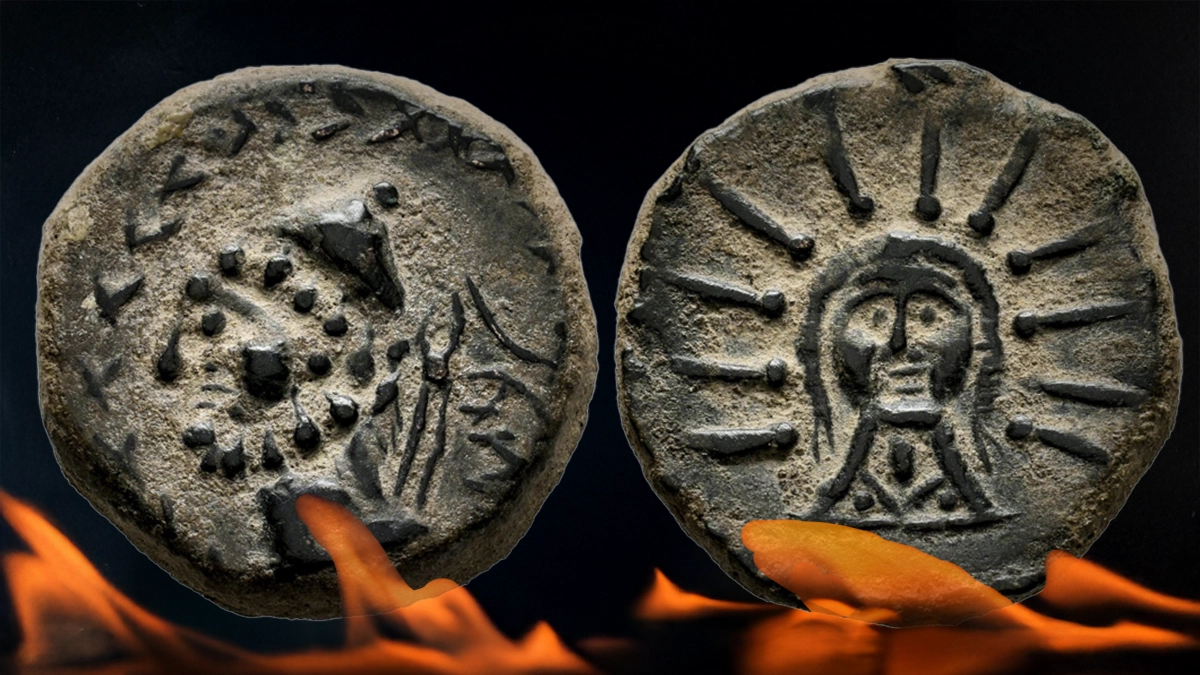
One of the oldest cities in the world, Malaka[10] (today Malaga, Spain) was founded by Phoenician traders around 770 BCE. Part of the Carthaginian Empire, it was captured by the Romans in 218 BCE. For almost two centuries under Roman rule, the city issued bronze small change for local use that continued to bear inscriptions in the Punic script, usually some variant of the city name MLK’. The coins bear the profile head of Vulcan with his tongs on the obverse and a star, a temple, or the facing head of Helios, the sun god, on the reverse.[11]
Hephaistia
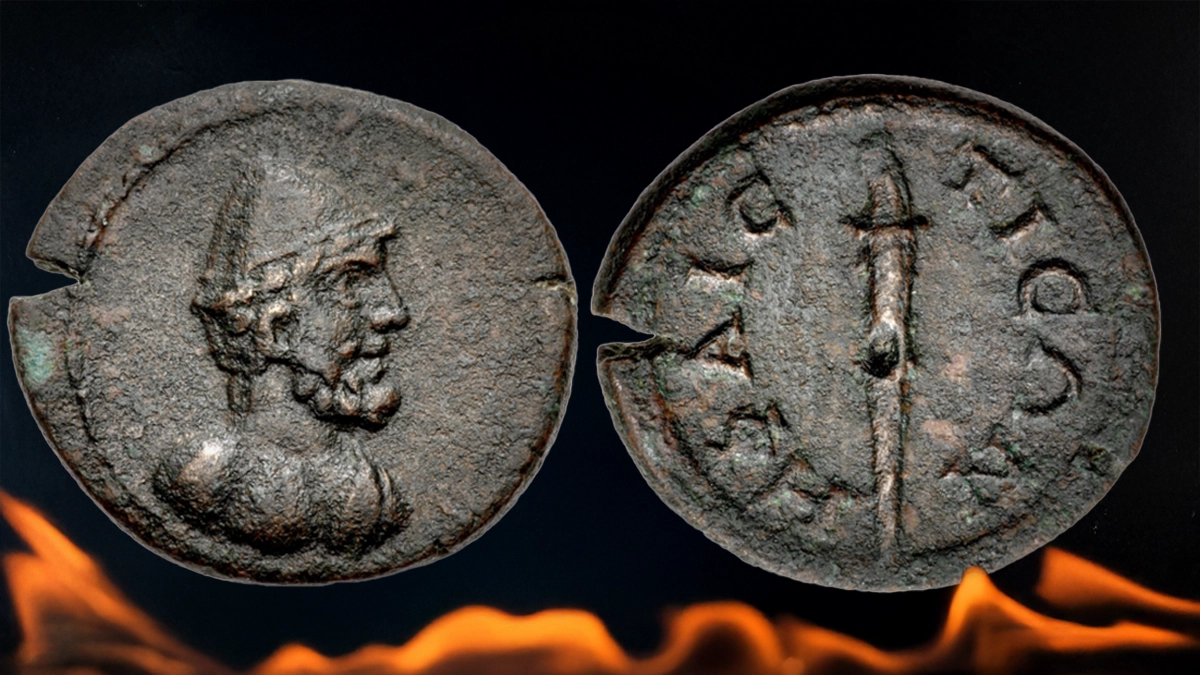
On the northern coast of the island of Lemnos and bearing the god’s name, the town of Hephaistia[12] was a center of his cult. A rare small bronze dated to c. 100 CE, when the island was under Roman rule, bears the head of the god, with his characteristic conical cap. On the reverse, the city’s name is inscribed around a torch – an appropriate symbol for a god of fire.[13]
L. Caesius
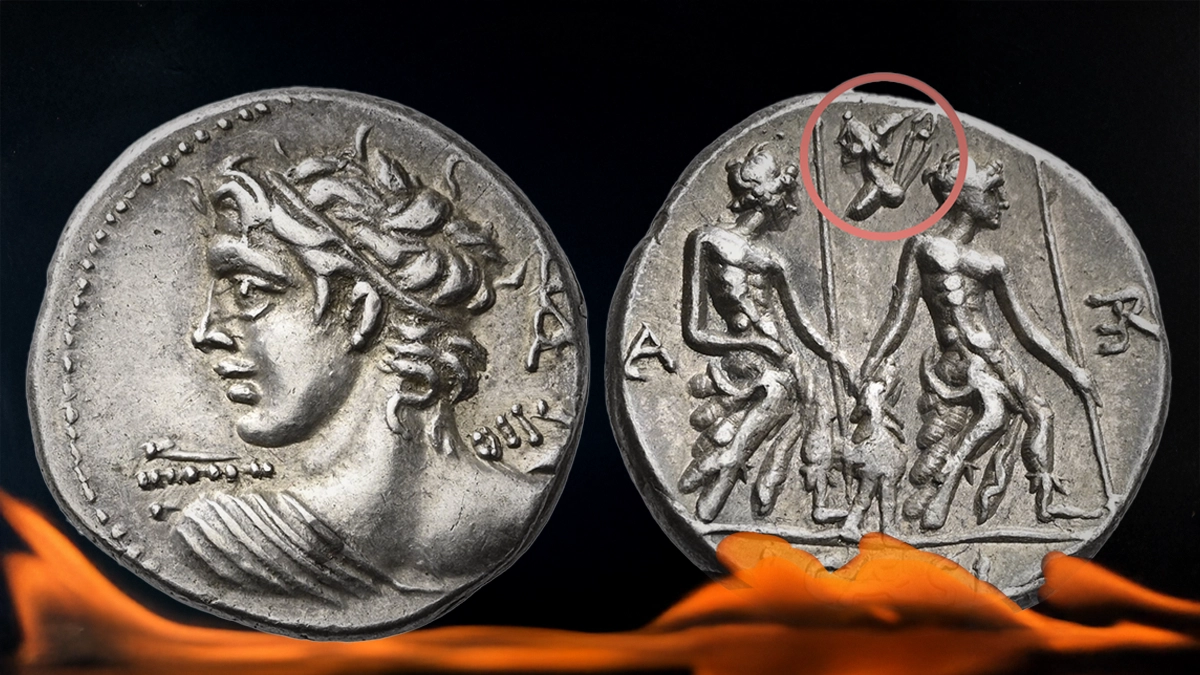
Lucius Caesius served as a mint official in 112/111 BCE. He issued silver denarii bearing a tiny head of Vulcan with his tongs on the reverse. Perhaps a tribute to the mint workers who produced the coins, this detail is visible only on the most well-preserved examples of the type.[14]
L. Cotta
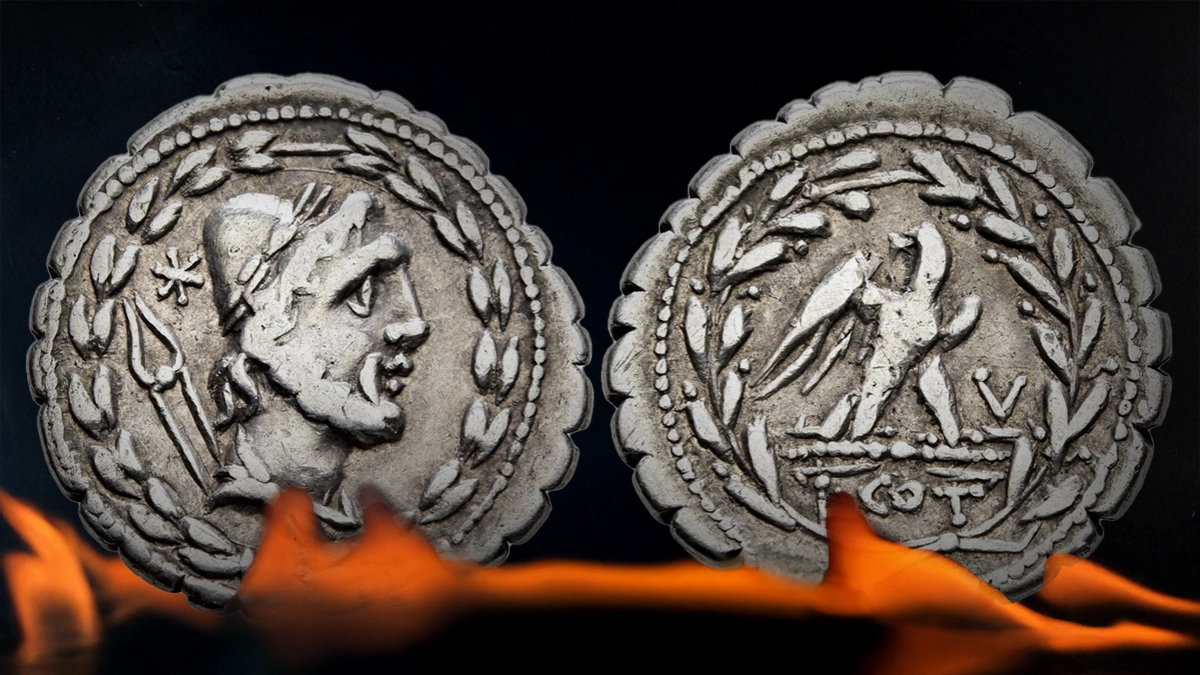
Lucius Aurelius Cotta came from an elite senatorial family, the gens Aurelia. As one of the annual magistrates who supervised the mint (triumviri monetales) in 105 BCE, he issued silver denarii bearing the head of Vulcan with his cap and tongs within a wreath.[15] Vulcan must have had some special meaning for him. In 119 BCE, he was elected as consul, the highest office in the Roman Republic. His son, of the same name, became consul in 65 BCE, and his daughter, Aurelia Cotta, was the mother of Julius Caesar.
Severus
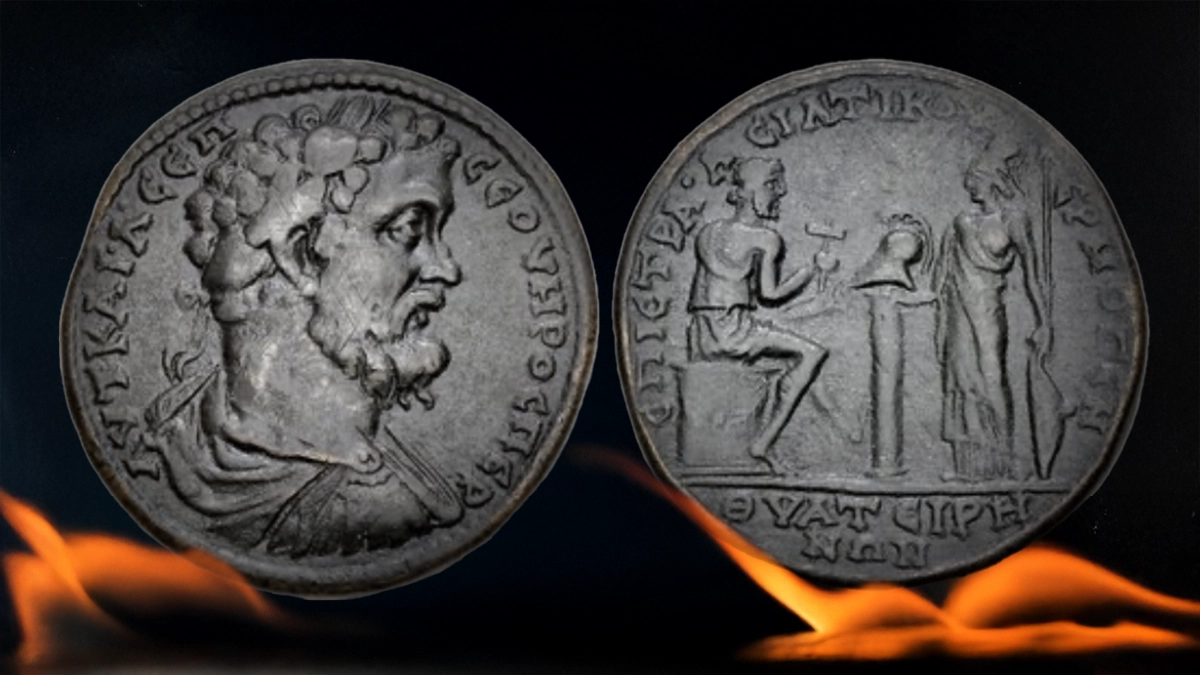
One of the best-known stories about Hephaestus is his creation of a shield and armor for the hero Achilles, recounted in book 18 of Homer’s Iliad. Achilles had lost his armor when Patroclus, his best friend forever, borrowed it and went off to fight and get killed by the Trojan hero Hector. Thetis, divine mother of Achilles, begged Hephaestus to craft new gear for her son. Roman provincial coins (sometimes called “Greek imperials”) issued by Greek-speaking cities of the Empire are often illustrated by mythological stories with a local connection. During the reign of Emperor Septimius Severus, the city of Thyateira in Lydia issued a large bronze medallion[16] with a reverse depicting Hephaestus putting finishing touches on a helmet with his hammer, while the goddess Athena looks on approvingly.[17]
Valerian
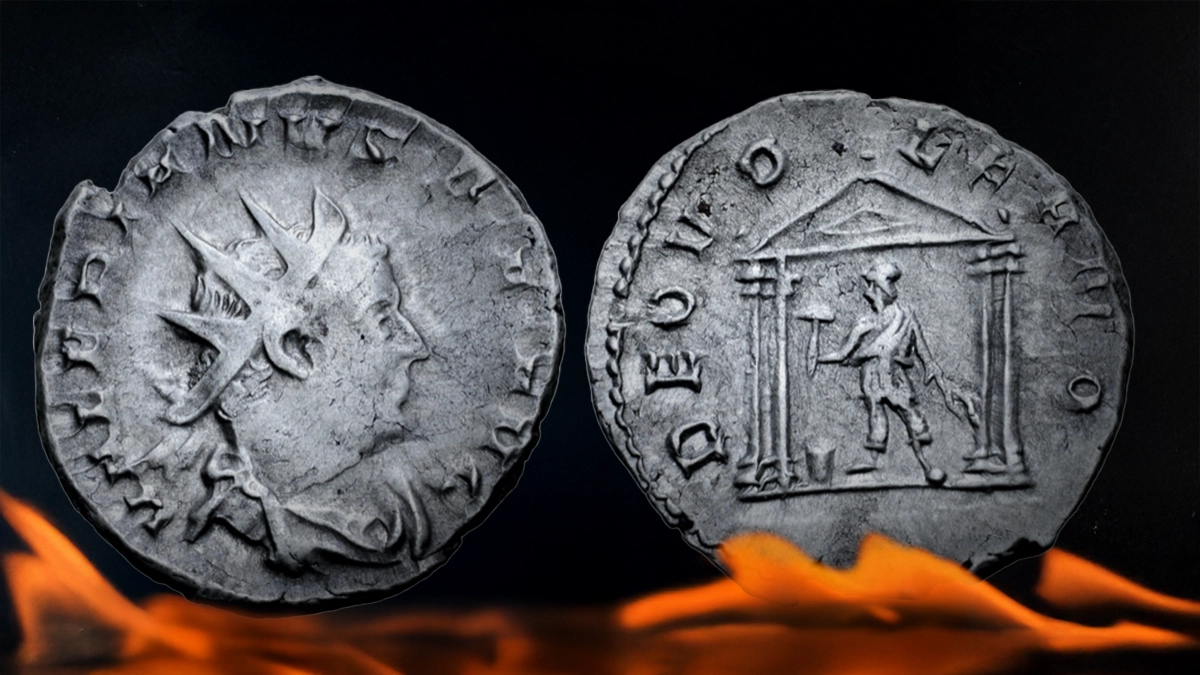
Born to an elite senatorial family about 199 CE, Publius Licinius Valerianus rose to command an army that proclaimed him Emperor after Trebonianus Gallus was assassinated by his troops in 253. During his seven-year reign, he issued a variety of coins of remarkably poor workmanship honoring Roman gods. A silvered bronze antoninianus from the mint of Colonia Agrippinensis (today Köln, Germany) depicts Vulcan standing in a temple, holding his hammer and tongs.[18] The Latin inscription DEO VOLCANO simply states “to the god Vulcan”. At just $45, this common type was the most affordable coin I found for this god.
Claudius II Gothicus
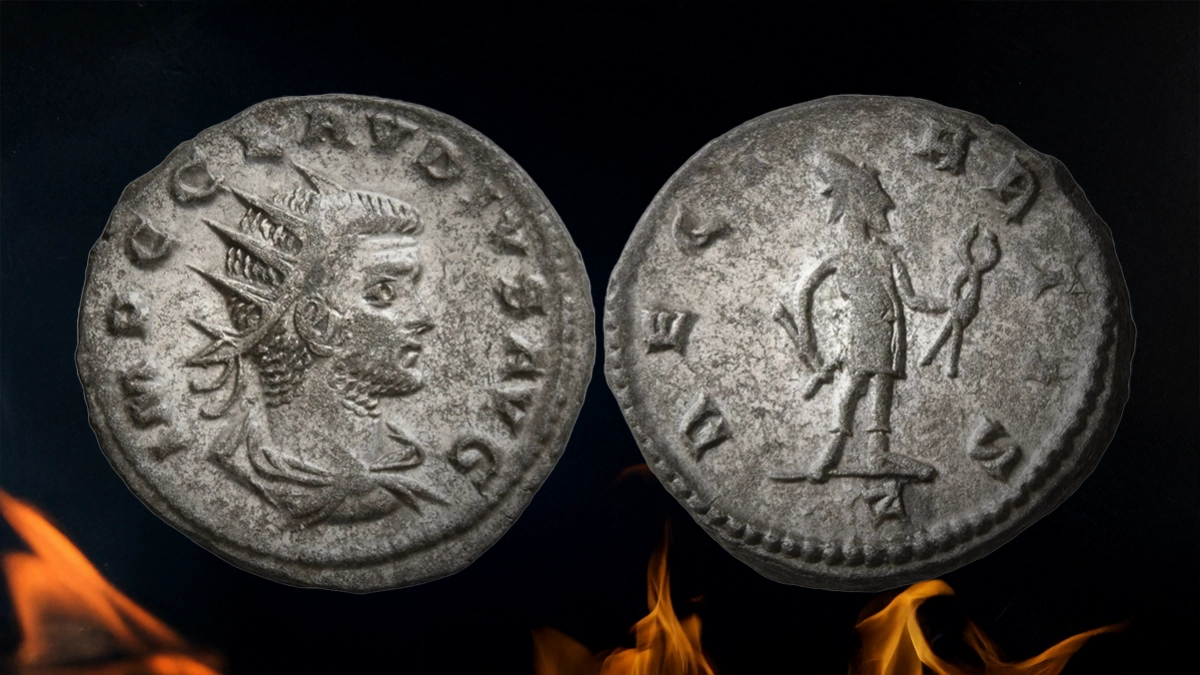
Born in 214 somewhere in the Balkans, Marcus Aurelius Claudius rose through the ranks of the Roman Army thanks to his physical strength. A legend says that he once knocked out a horse’s teeth with one punch. After the death of Emperor Gallienus in 268, Claudius was proclaimed Emperor by his troops. At the great Battle of Naissus in 268 or 269, he defeated a massive barbarian invasion, earning the title “Gothicus Maximus”.
Early in 270, he died in the devastating Plague of Cyprian[19] (possibly smallpox). During the Crisis of the Third Century, the main Roman coin in circulation was the debased, crudely struck antoninianus[18], a coin of leaded copper alloy with a thin surface coating of silver. For this short reign, some 73 different types are known, including one depicting Vulcan with his hammer and tongs, and the unusual inscription REGI ARTIS (“To the King of Arts”).[20]
Huvishka
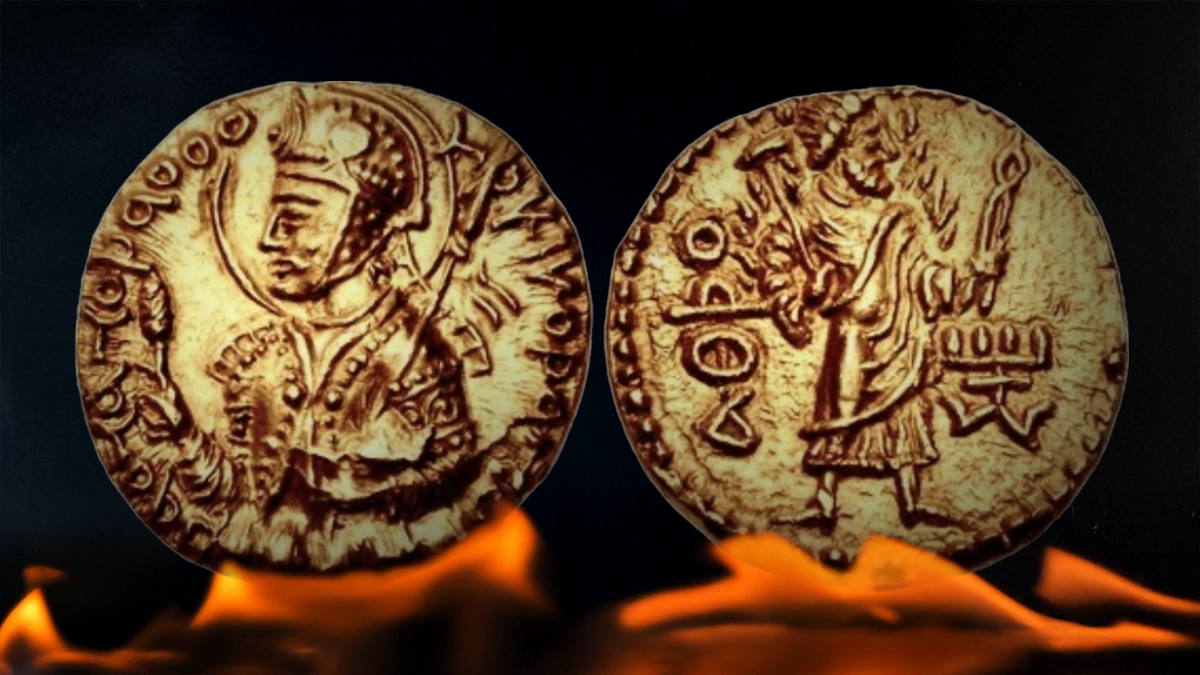
The Kushan Empire ruled much of central Asia and northern India for over three centuries (c. 30 – 375 CE). The Empire controlled the Silk Road and prospered from international trade. Huvishka (c. 151 – 190 CE, roughly contemporary with Marcus Aurelius) issued an extensive gold coinage. A wide variety of Hindu, Persian, and Greco-Roman divinities were honored on his coins. A gold dinar from a mint in Baktria depicts the standing figure of Athsho, a local god identified with Hephaestus. Flames surround his head and shoulders, and he grasps the hammer and tongs.[21]
Hephaestus on the Coins of Germanic Tribes
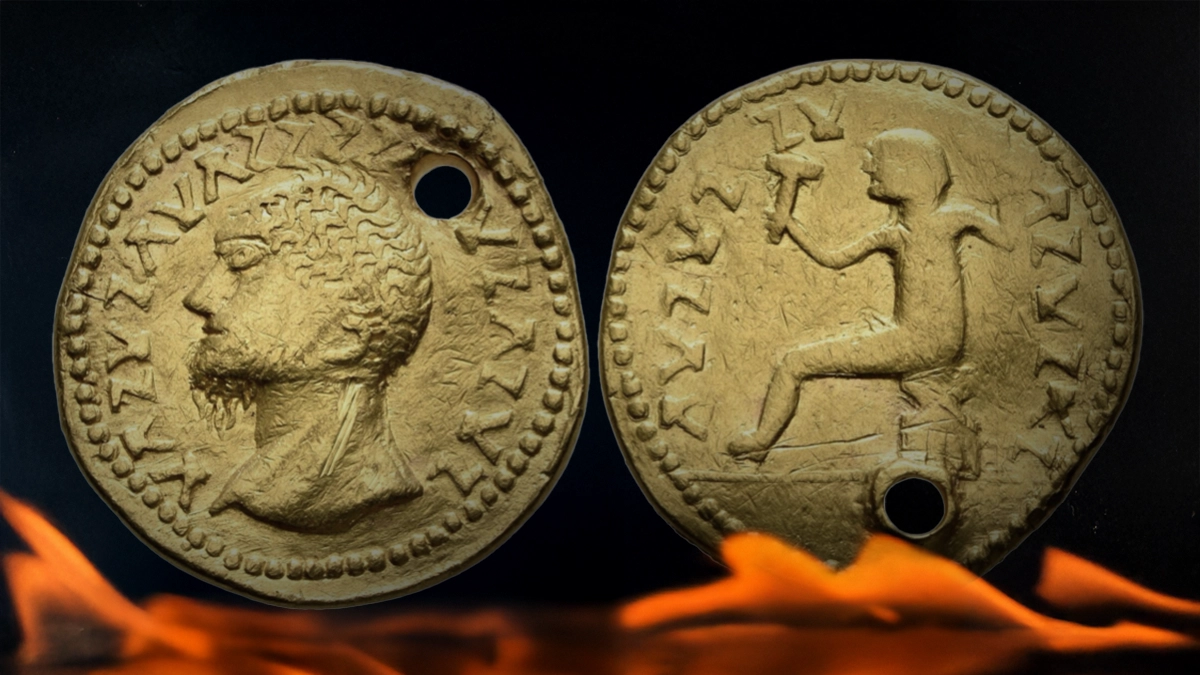
Perhaps the last appearance of a metalsmith god on an ancient coin is a barbaric gold piece imitating a Roman aureus attributed to an “uncertain Germanic tribe” and dated to the late third or early fourth centuries.[22] The coin is pierced for wear as an amulet and inscribed with meaningless strokes (a “pseudo-inscription”) by an engraver who was probably illiterate. A seated figure on the reverse raises a hammer. The cataloguer speculates that this might be Thor, the Germanic thunder god. He could also be Eitri[23], the mythical smith who forged Mjölnir, Thor’s hammer, and Draupnir, Odin’s magical golden ring.
* * *
Notes
[1] Usually rendered as the Latin spelling “Hephaestus”.
[2] https://en.wikipedia.org/wiki/Mount_Olympus
[3] https://en.wikipedia.org/wiki/Thetis
[4] Nomos Auction 30, November 6, 2023, Lot 1122. Realized CHF 1,800 (about $2,007 USD; estimate: CHF 1,000).
[5] Bertolami Auction 67, July 11, 2019, Lot 102. Realized £1,600 (about $2,009 USD; estimate £500).
[6] NAC Auction 123, May 9, 2021, Lot 134. Realized CHF 900 (about $991 USD; estimate CHF 250).
[7] https://en.wikipedia.org/wiki/Samnite_Wars
[8] CNG E-auction 502, October 20, 2021, Lot 7. Realized $700 USD (estimate $200).
[9] Gorny & Mosch, Auction 232, October 5, 2015. Realized €2,600 (about $2,915 USD; estimate €3,000).
[10] https://en.wikipedia.org/wiki/History_of_Málaga
[11] Tauler & Fau Auction 145, June 25, 2024, Lot 28. Realized €1,300 (about $1,391 USD; estimate €800).
[12] https://en.wikipedia.org/wiki/Hephaestia
[13] CNG Auction 115, September 16, 2020, Lot 424. Realized $1,600 USD (estimate $300).
[14] NAC Auction 143, May 7, 2024, Lot 113. Realized CHF 2,250 (about $2,487 USD; estimate CHF 1,000).
[15] Leu Web Auction 26, July 8, 2023, Lot 3514. Realized CHF 170 (about $191 USD; estimate CHF 50).
[16] The author is grateful to Tom Mullally, numismatist at CNG, for alerting him to this coin.
[17] CNG Auction 90, May 23, 2012, Lot 1011. Realized $4,500 USD (estimate $2,000).
[18] Roma E-sale 64, November 28, 2019, Lot 825. Realized £35 (about $45 USD; estimate £30).
[19] https://en.wikipedia.org/wiki/Plague_of_Cyprian
[20] Leu Web Auction 10, December 7, 2019, Lot 1466. Realized CHF 360 (about $364 USD; estimate CHF 50).
[21] CNG Auction 105, May 10, 2017, Lot 545. Realized $8,000 USD (estimate $4,000).
[22] Leu Auction 13, May 27, 2023, Lot 419. Realized CHF 2,200 (about $2,428 USD; estimate CHF 500).
[23] https://en.wikipedia.org/wiki/Eitri
References for God of Fire: Hephaestus and Vulcan on Ancient Coins
Adkins, Lesley and Roy Adkins. Dictionary of Roman Religion. New York (1996)
Bonfante, Giuliano, and Larissa Bonfante. The Etruscan Language: An Introduction (2nd Edition). Manchester (2002)
de Callataÿ, F. “Greek coin types in context: a short state of the art”, Pharos 22 (2016)
Hamilton, Edith. Mythology: Timeless Tales of Gods and Heroes. New York (1942)
Hesiod. Homeric Hymns, Epic Cycle, Homerica (H.G. Evelyn-White, translator). Cambridge, MA (1914)
Homer. Iliad (Richmond Lattimore, transl.). Chicago (1951)
Melville Jones, John. A Dictionary of Ancient Greek Coins. London (1986)
Sear, David. Roman Coins and Their Values, Volume III. London (2005)
* * *