


By Steve Benner for CoinWeek
Medusa is one of the most recognizable figures in Greek mythology. Even people with little interest in classical history know her name.
That familiarity comes primarily from popular culture. Films like Clash of the Titans (1981 and 2010), The Gorgon (1964), and Medusa: Beauty Is the Beast (2020) kept her story alive for modern audiences.
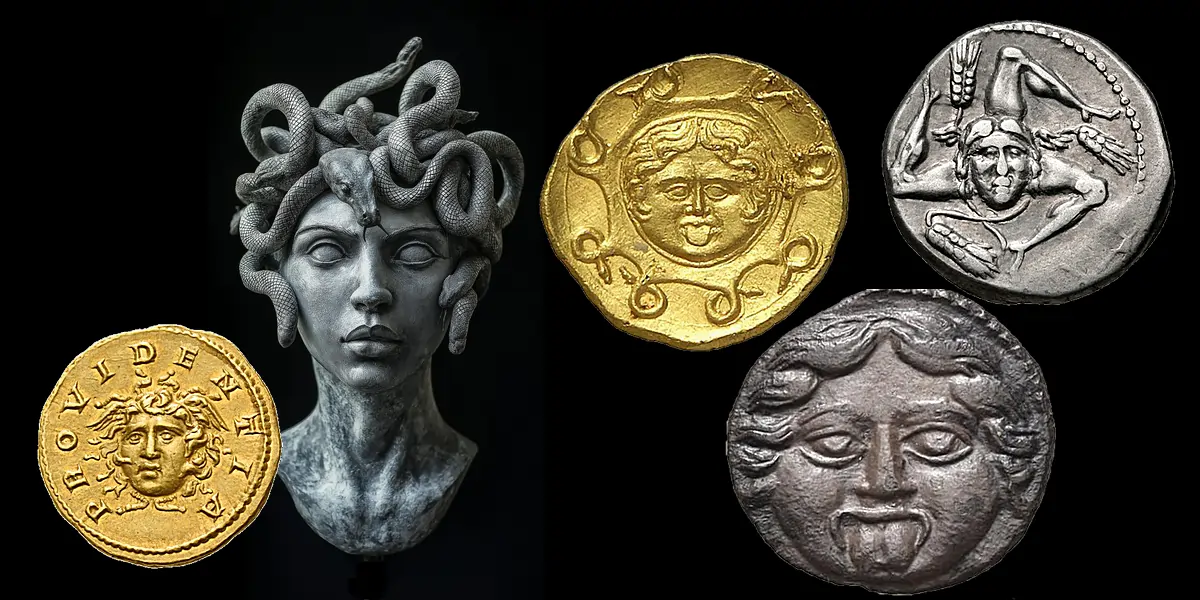
Many also recognize Medusa as a symbol of power and allure. Her image famously appears in modern fashion branding, while her ancient counterpart stared out from coins across the Mediterranean world.
Yet few realize how deeply Medusa permeated ancient coinage, or how complex her story truly was.
Medusa Before the Monster
Before she became a monster, Medusa was a mortal woman. According to a later myth, she served as a virgin priestess in the temple of Athena. She was especially admired for her hair, which ancient writers described as radiant and beautiful.
That beauty caught the attention of Poseidon (Neptune). He pursued her violently and assaulted her within Athena’s sacred temple. Medusa pleaded for protection, but none came.
Athena’s response defined Medusa’s fate.
Rather than punish Poseidon, the goddess transformed Medusa. Her hair became venomous snakes. Her gaze turned men to stone. Athena also granted her a strange immortality, despite Medusa’s mortal birth.
Some sources add further details. Medusa may have had scales. She may have worn small wings on her head. These elements appear inconsistently, but they surface often enough to matter.
Exiled and feared, Medusa retreated to a cave along the coast of Asia Minor, possibly near ancient Cisthene in Aeolis. There she lived alone, surrounded by the stone remains of those who tried to kill her.
Ovid and the Tragic Medusa
The best-known version of Medusa’s story comes from Ovid, writing during the reign of Augustus. Ovid often treated the gods with skepticism, yet his account drew from older traditions.
Importantly, Ovid emphasized Medusa’s humanity.
That interpretation mattered. It reframed Medusa as a tragic figure rather than a simple monster. This shift would later influence Greek artists, and, significantly, Greek coin engravers.
From Minoan Roots to Classical Beauty
Medusa’s origins reach back to Minoan times. She was one of three Gorgon sisters: Stheno, Euryale, and Medusa. Only Medusa was mortal. All three were daughters of the sea deities Phorcys and Keto.
Early artistic depictions were terrifying. Vase painters and sculptors showed Medusa with bulging eyes, tusks, and a grotesque face. She embodied chaos and danger.
That image changed during the Classical period.
By the fifth century BC, writers like Pindar and artists like Polygnotus described Medusa as beautiful. Greek art softened her features. Coins soon followed.
Perseus and the Severed Head
Medusa’s death remained consistent across traditions.
King Polydectes sent Perseus to kill her. The gods intervened. They armed Perseus with winged sandals, a curved sword (harpa), a reflective shield, and a cloak of invisibility.
Using the shield’s reflection, Perseus avoided her deadly gaze. He struck swiftly and beheaded her.
From Medusa’s severed neck sprang Pegasus and Chrysaor, the result of her earlier union with Poseidon. Perseus later used Medusa’s head as a weapon, turning enemies, including Atlas, to stone.
Eventually, he gave the head to Athena. She mounted it on her shield, the aegis.
That moment sealed Medusa’s transformation, from victim to eternal symbol.
Medusa on Greek Coins
Medusa appeared on Greek coinage with astonishing frequency. Cities across Asia Minor, mainland Greece, Sicily, Thrace, and the Black Sea world struck coins bearing her image.
Her popularity was no accident.
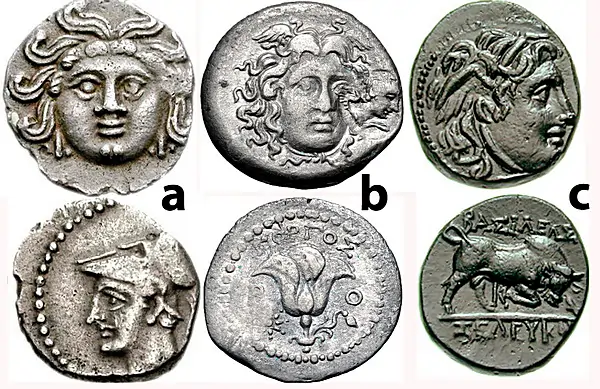
She symbolized protection, power, and divine authority. On coins, she served both religious and political purposes.
Two Primary Coin Types
Greek coins show Medusa in two dominant forms:
- Medusa as a Woman
In these depictions, she appears human. Sometimes she looks severe. More often, she appears calm or even beautiful. Wings occasionally appear on her forehead, a lingering archaic feature. - The Gorgoneion
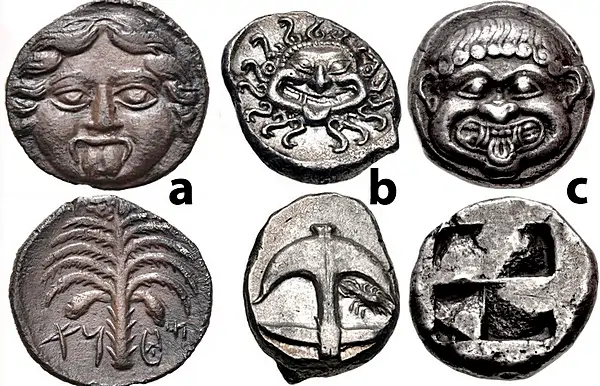
This was Medusa as an apotropaic symbol. The Gorgoneion stared outward, meant to ward off evil. These faces are frontal, intense, and often grotesque.
A consistent feature helps identify them: the protruding tongue. Nearly every confirmed Gorgoneion shows it.
During the Classical period, the humanized Medusa became more common. The monstrous version did not disappear, but it lost dominance.
Medusa as a Secondary Motif
Some coins use Medusa as an attribute rather than a central image. Small Gorgoneia appear on reverses, shields, or field symbols.
Even when reduced in size, her presence carried weight.
Perseus with Medusa’s Head
Several Greek cities also depicted Perseus holding Medusa’s severed head. These scenes are dramatic and unapologetically violent.
They reinforce Medusa’s role as a source of power, even in death.
The Aegis and Divine Protection
The aegis deserves special attention.
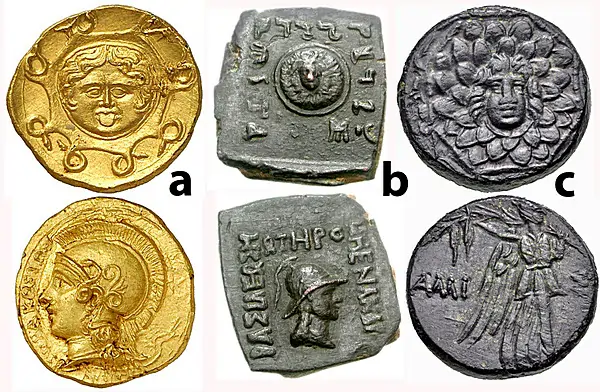
Zeus wore a goatskin adorned with Medusa’s head. Athena carried a shield bearing the same image. The aegis inspired terror and guaranteed victory.
Greek coinage adopted this symbol eagerly. Medusa appears on shields, breastplates, and armor, not just faces.
Her role shifted again. She no longer threatened the viewer. Instead, she protected the bearer.
Medusa in Roman Coinage
The Romans used Medusa far less frequently than the Greeks.
Most examples date to the late Roman Republic. Civil war may explain this timing. Medusa’s image offered protection during chaos.
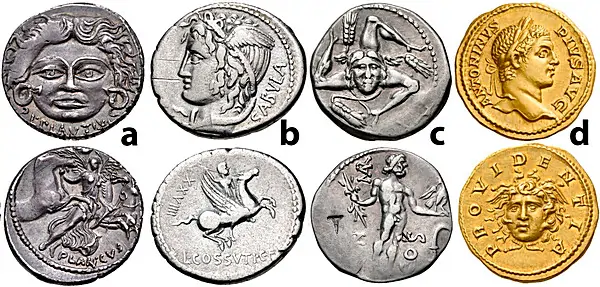
Republican denarii show her both facing forward and in profile. Some versions retain her wings. Others soften her features dramatically.
Imperial Rome rarely used Medusa. When she does appear, it is usually as an ornament on armor.
One notable exception stands out.
Septimius Severus and Caracalla issued aurei featuring Medusa prominently. These coins likely referenced a famous gilt-bronze aegis donated to Athens centuries earlier.
A similar type later appeared under Victorinus. Even so, such issues remain rare.
Provincial mints, however, continued to use Medusa more freely.
Final Thoughts on Medusa’s Legacy
Medusa’s image evolved more than almost any mythological figure in antiquity.
She began as a monster. She became a victim. Eventually, she emerged as a symbol of divine power and protection.
Ancient coins capture that transformation perfectly.
Greek engravers preferred her human face. Roman minters used her sparingly but deliberately. Across centuries, Medusa never lost her ability to command attention.
One final note underscores her enduring appeal:
a Medusa aureus sold for $350,000 in 2020.
For a “maligned maiden,” that is a remarkable legacy.
Reference
- Acsearch.info: an auction database
- Classical Numismatic Group (CNG)
- Head, Barclay V. Historia Numorum: A Manual of Greek Numismatics. Oxford (1887).
- Sear, David. Greek Coins and Their Values, Vol 2: Asia. B.A. Seaby Ltd. (1979).






Very interesting how the different types of her profile from monster, to human, to a goatskin shield. Great article.
The ancients had a way of ingraining their beliefs and history into their coinage to make something legendary. Wish we would do designs like that.
So, so interesting. If only we still had such history behind our modern coins
I didn’t know she was on so many coins.
Surprised that she had this many coins, amazing works
Such a great, informative article. I didn’t know she was depicted on coins.
Very cool coins!