


By Russell A. Augustin, AU Capital Management, LLC
Updated and reformatted March 2026
Electrum Coins : Mytilene’s Archaic Lion and Cockerel Hekte
Mytilene: Power and Wealth in the Northeastern Aegean
The ancient Greek island of Lesbos lies in the northeastern Aegean Sea, just off the coast of modern-day Turkey. Its largest and wealthiest city, Mytilene, rose to prominence early in the Greek world.
The Penthilidae family of Thessaly founded Mytilene in the 11th century BCE. They ruled the city until 580 BCE. At that time, Pittacus led a revolt and ended their control.
Initially, settlers confined Mytilene to a small offshore island. However, engineers later connected it to the main island of Lesbos. This development created two harbors—one north and one south. As a result, Mytilene became a powerful maritime and commercial center.
Moreover, its strategic location placed it between Greek and Persian spheres of influence. That political reality shaped its coinage in profound ways.
Persian Control and the Rise of Electrum Coinage
In 546 BCE, Cyrus the Great defeated Croesus of Lydia. Soon after, Lesbos came under Persian control. Consequently, Mytilene operated within the vast Achaemenid imperial network.
During the late sixth century BCE, Mytilene produced substantial quantities of electrum coinage. In part, the city struck these coins to subsidize the neighboring Persian Empire. At the same time, the mint maintained economic ties across the Ionian region.
Later, during the fifth century BCE, Mytilene continued to issue coins, especially the hekte, or one-sixth stater. These issues extended through the mid-fourth century BCE. They supported the city’s participation in the Delian League, the Athenian-led maritime alliance formed after the Persian Wars.
Therefore, Mytilene’s coinage reflects shifting allegiances. It balanced Greek identity with Persian political realities.
What Is Electrum? The World’s First Coinage Metal
Electrum coins represent the world’s first metal currency. They originated in the 7th century BCE in the ancient kingdom of Lydia, located in western Asia Minor.
Historical Origins in Lydia
The earliest electrum coins appeared under the Lydian kings, including Alyattes and his son Croesus. Later, Croesus introduced a bimetallic system of separate gold and silver coinage. However, before that reform, electrum served as the standard monetary metal.
Natural electrum formed as an alloy of gold and silver. Ancient miners collected it from riverbeds such as the Pactolus River. Typically, natural electrum contained between 70% and 90% gold.
However, many early Lydian coins contained closer to 55% gold. This lower percentage suggests that ancient metallurgists intentionally added silver. They likely sought to standardize the alloy for monetary purposes.
Why Electrum?
Electrum offered practical advantages. It proved harder than pure gold. Therefore, it resisted wear during circulation. In a world of heavy commercial exchange, durability mattered.
Early Lydian coins often featured a roaring lion, emblem of the Mermnad dynasty. On the reverse, they displayed a simple incuse punch. This technique created a recessed design impressed into the metal.
Denominations and Value
The primary unit of value was the stater. A full electrum stater weighed approximately 14.1 grams. That amount roughly equaled one month’s pay for a soldier in antiquity.
Ancient mints also produced fractional denominations. These included:
- The trite (one-third stater)
- The hekte (one-sixth stater)
Smaller fractions down to 1/96 stater
Beyond Lydia, Greek cities such as Cyzicus, Phocaea, and Mytilene struck electrum coins. They used diverse motifs, including seals, tuna fish, mythological figures, and powerful animal imagery.
Mytilene’s Electrum: Composition and Circulation
During the late sixth and early fifth centuries BCE, Mytilene struck electrum that contained approximately 43% gold. The remaining percentage consisted primarily of silver.
This alloy strengthened the coinage. As a result, the pieces endured extended circulation. Indeed, Mytilenean electrum remained in widespread use throughout the Ionian region for nearly two centuries.
Over time, heavy commerce wore many coins smooth. Eventually, authorities melted large numbers down. Consequently, high-grade survivors remain scarce today.
Archaic Miniature Mastery: The Lion and Cockerel Hekte
The small archaic hektes from Mytilene demonstrate miniature engraving at its finest. Despite their size, they display remarkable sculptural depth and artistic control.
Persian Influence and the Roaring Lion
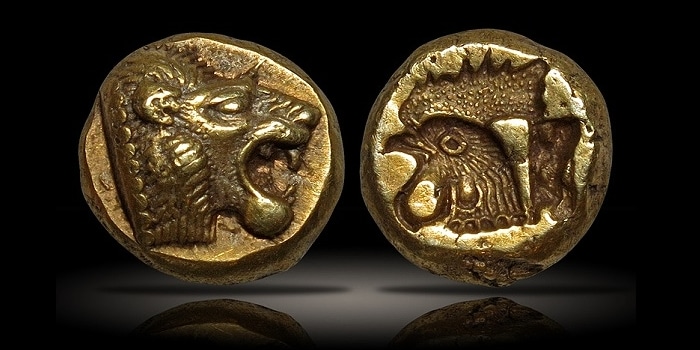
Shortly after Lesbos came under Persian rule, Mytilene introduced a new design. The obverse features a lion’s head facing right, jaws open in a roar.
The lion held powerful symbolic meaning in the ancient Near East. Persian royal iconography frequently employed the lion as a symbol of kingship and strength. Therefore, the motif likely reflected Persian political influence.
At the same time, the design drew inspiration from earlier Lydian coinage. A century before, Lydian staters displayed similar roaring lions on their obverses. Mytilene adopted and refined this established monetary symbol.
Technical Innovation in Die Engraving
Advancements in die engraving allowed Mytilene’s mint to elevate its artistry. Earlier Lydian coins paired a sculptural obverse with a simple incuse punch on the reverse.
However, Mytilene introduced a more elaborate incuse intaglio reverse. Engravers cut a detailed animal head directly into the die. Consequently, the mint struck two distinct animal motifs on a single coin.
This innovation enabled a powerful visual statement. The coin united sacred and political symbols from both Greece and Persia. It mirrored Lesbos’ delicate political balance between the two worlds.
The Incuse Rectangle Tradition
Despite these advances, mint authorities preserved an older design element. They required a miniature incuse rectangle to accompany the reverse type.
On this hekte, an irregular oblong rectangle appears behind the head of a rooster wearing a collar of five pearls. The engraver placed this element behind the incuse cockerel’s head.
Thus, the design carried forward the legacy of the earlier Lydian reverse punch. At the same time, it embraced the new realistic animal depiction.
The Coin: Technical Description
- Lesbos, Mytilene. EL Hekte. Circa 521–478 BCE.
- Lion’s head right with open jaws, truncation with rim of dots / Incuse cockerel’s head left,
- collar of five pearls; behind, irregular oblong object.
- Bodenstedt 7 (a/a); De Luynes 2544.
- 2.55 grams; 10 mm; die axis 1h.
- Grade: Good Extremely Fine.
This exceptional piece from the Colosseo Collection stands as a testament to Mytilene’s artistic achievement and geopolitical significance.
Why This Electrum Hekte Matters
Mytilene’s electrum coinage tells a larger story. It reveals economic pragmatism. It reflects technological innovation. Moreover, it captures the political tension between Greek autonomy and Persian authority.
The lion roars with imperial confidence. Meanwhile, the cockerel stands alert and refined. Together, they represent a city that mastered both commerce and symbolism.
For collectors and scholars alike, these archaic hektes offer more than beauty. They provide a tangible link to the earliest centuries of coinage and to the birth of money itself.






That is an impressively majestic and well engraved rooster on such a small coin. Normally hektes don’t excite me this much but I would love a coin like this.
Stories from the dawn of metal coinage are fascinating.
I have a very large income tax refund coming. I think I will see if my favorite coin shop has an electrum coin.
Awesome Coins
It is amazing that coins of this age exist in such fine condition. Gold, being a soft metal, can easily wear down. The historical significance of the designs showing the power struggle between Greeks and Persians is fascinating.
Thank you. These issues of Mytilene are among my favorites.