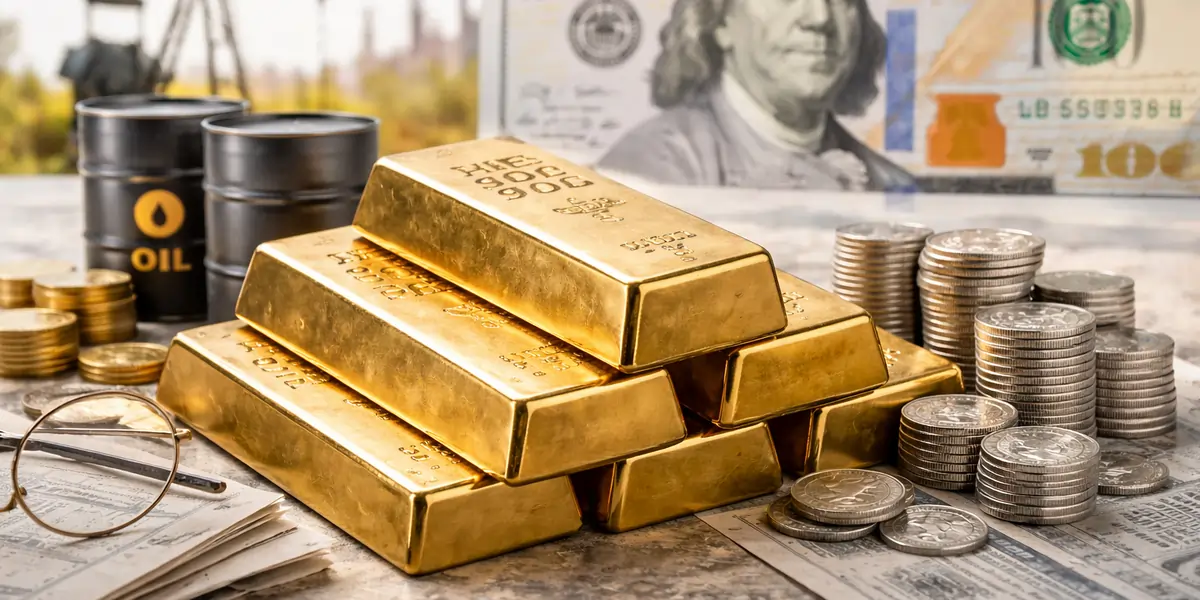
Rising oil prices, stronger dollar and stagflation concerns cool bullion momentum
For five straight weeks, gold marched higher. The rally looked unstoppable.
Then global markets shifted.
A surge in energy prices and renewed geopolitical tensions rattled investors. As a result, gold prices pulled back for the first time in more than a month. The pause comes as traders reassess inflation risks, central-bank policy, and the broader economic outlook.
Yet despite the recent drop, gold remains central to the global financial conversation.
Investors still view bullion as a hedge against currency risk and economic instability. However, the powerful momentum that drove the metal above the $5,000 level has clearly cooled.
Gold Falls as Dollar Surges and Energy Prices Jump
Gold prices moved lower in Monday trading. The decline coincided with a stronger U.S. dollar and rising worries that geopolitical tensions could trigger global stagflation.
By midday Monday, April gold futures were down $65.50 at $5,092.00. Meanwhile, May silver futures gained $0.169 to trade at $84.50, rebounding after earlier pressure.
Outside markets played a major role.
The U.S. Dollar Index climbed to a 3.5-month high, which often pressures precious metals. At the same time, Nymex crude oil surged toward $98 per barrel, after spiking near $120 overnight, its highest level in almost four years.
Treasury yields also remained elevated. The benchmark 10-year U.S. Treasury note hovered near 4.2%.
Together, those forces created a difficult environment for gold prices.
The Energy Shock Driving Market Anxiety
The deeper story centers on energy markets.
Oil prices have jumped more than 20%, while natural gas has surged over 50% in recent weeks. Those moves have reignited fears of a stagflationary shock similar to the one markets faced in 2022.
According to Bob Savage, head market strategist at BNY, investors have reacted by shifting away from bonds and reassessing global risk.
“For the last week, investors shunned bonds amid fears an energy shock could reduce interest-rate cuts in the U.S. and U.K. and raise rate-hike risks in the EU,” Savage said.
The impact spread across asset classes.
Gold dropped about 3% during the week, ending a five-week winning streak. At the same time, the U.S. dollar surged 1.7%, its strongest weekly rise in four years.
Savage also noted that BNY’s iFlow Mood risk sentiment index has cooled significantly. The indicator peaked in the 99th percentile two weeks before the conflict began, but it has since fallen back to 64th percentile, which signals neutral sentiment.
Investors still see gold as an alternative to fiat currencies. However, the urgency to buy bullion has clearly eased.
The Oil-to-Gold Relationship Is Out of Balance
Historically, gold and oil prices move in recognizable patterns.
Energy prices drive inflation expectations. In turn, inflation expectations influence interest rates, currencies, and gold demand.
Right now, that relationship looks stretched.
Savage believes markets may soon push the oil-to-gold ratio back toward historical trends. That adjustment would require either:
- significantly higher oil prices, or
- lower gold prices.
He also warned that many investors still treat the current geopolitical conflict as short-term “noise.” For now, markets remain focused on broader economic trends.
Yet the energy market could still transmit inflation pressure across the global financial system.
“The dollar’s resurgence echoes the 2022 energy crisis playbook,” Savage said. “However, gold’s fading momentum and still-neutral risk sentiment suggest investors are not fully positioned for a prolonged stagflationary impulse.”
Middle East Conflict Raises Long-Term Supply Fears
Geopolitics continues to drive much of the market narrative.
Financial markets initially hoped the latest conflict in the Middle East would remain contained. That optimism is fading.
Investors now see a greater risk of a longer-lasting energy supply shock.
According to Bloomberg reporting, sentiment shifted sharply after President Donald Trump said some parts of Iran had not yet been attacked. He also described $100 oil as “a very small price to pay” for “safety and peace.”
Those remarks forced markets to reconsider the worst-case scenario.
Instead of a short disruption, investors now worry about an extended conflict that could strain global energy supplies through the coming winter.
IMF Warns of Inflation Risks from Higher Energy Prices
Global policymakers share those concerns.
International Monetary Fund Managing Director Kristalina Georgieva recently warned that prolonged Middle East hostilities could reshape the economic outlook.
Energy prices remain the key variable.
According to Georgieva, a 10% rise in energy prices sustained for one year could increase global inflation by about 40 basis points. At the same time, it would slow economic growth.
Such a scenario would complicate monetary policy decisions worldwide. Central banks would face rising inflation even as economic momentum weakens.
That combination defines stagflation, the environment gold historically performs best in.
Yet markets have not fully embraced that possibility.
China Continues Its Gold Buying Streak
Even as investor momentum cools, central banks continue to accumulate gold.
China’s central bank extended its buying streak in February.
Data released over the weekend shows that the People’s Bank of China added 30,000 troy ounces of gold, increasing its holdings to 74.22 million fine troy ounces.
The purchases mark the 16th consecutive month of accumulation since the latest buying cycle began in November 2024.
Central banks have been among the strongest drivers of gold demand in recent years. However, buying slowed slightly at the start of the year.
According to the World Gold Council, global central banks purchased five tons of gold in January, well below the 12-month average of 27 tons.
Some countries have also reduced their holdings.
Poland’s central bank, recently the world’s largest reported buyer, has discussed selling part of its gold reserves to finance defense spending. Meanwhile, both Russia and Venezuela have sold gold in recent months.
Even so, global purchases still exceed sales.
The Bigger Picture for Gold
Gold’s recent decline reflects shifting market sentiment rather than a collapse in demand.
The metal still sits above the psychologically important $5,000 level, supported by geopolitical risk and central-bank buying.
However, the next move may depend less on gold itself and more on the global energy market.
If oil prices continue to rise, inflation expectations could surge again. That scenario would likely revive gold’s momentum.
For now, investors remain cautious.
Markets are watching energy prices, interest rates, and geopolitics closely. The outcome of that three-way tug-of-war will determine whether gold resumes its rally, or faces deeper consolidation in the months ahead.