


Mass murder… domestic terrorism… swastikas… are they really on American medals and tokens?
By CoinWeek …..
In the first and second installments of “Spotlight on So-Called Dollars“, we touched on the relationship between So-Called Dollars and America’s classic commemoratives. In this installment, we look at some of America’s forgotten history. At one time, these people, places, and things were very American, but now only serve to shock and surprise.
Swastikas on So-Called Dollars
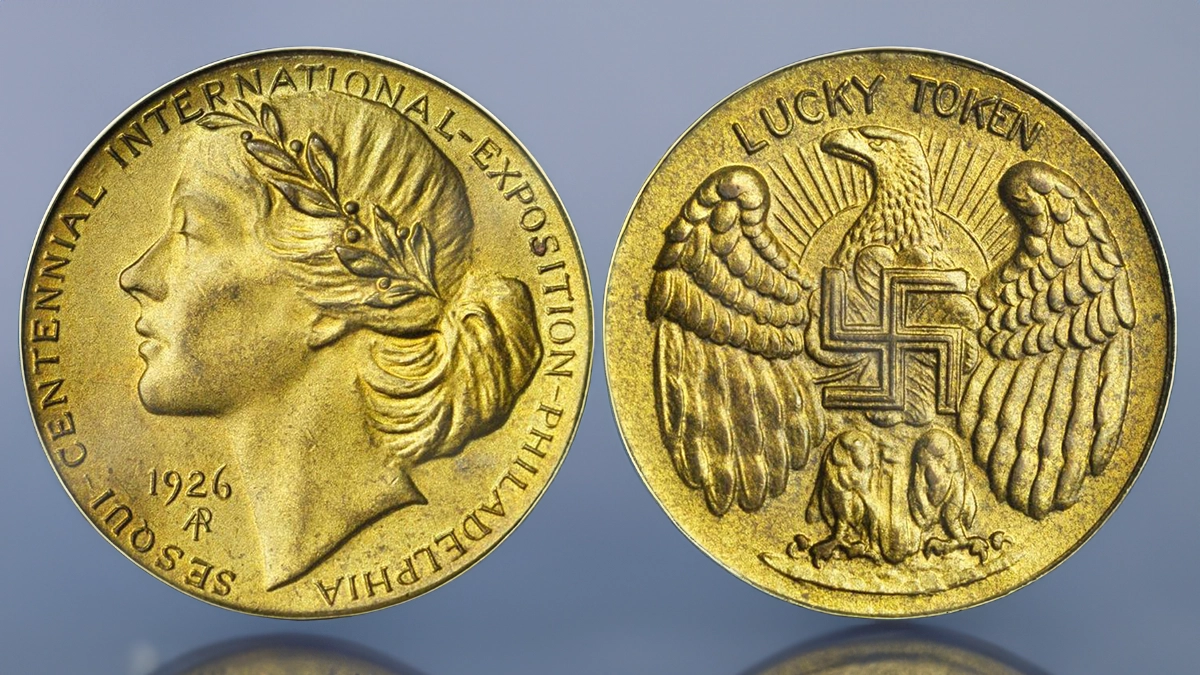
In Asia, the swastika is a symbol of good luck. Before the Nazis, it served a similar purpose in the West. By some estimates, thousands of medals and tokens made before World War II bear the image of the swastika, as well as untold tens of thousands of highway roadsigns (in Arizona), architectural ornaments, greeting cards, corporate signage, and other miscellaneous items.
Still, it’s somewhat jarring to see the Neolithic sun symbol in an “American” context. So-Called Dollar HK-895 below is a restrike of a medal designed by Adam Pietz and manufactured by the United States Mint.
Adam Pietz’s work, described as a Victory medal, is one of the most attractive So-Called Dollar designs of the 20th century. It features a classic female head with the word VICTORY on the obverse and an eagle on the reverse, both in high relief. Superimposed on the eagle’s chest are a four-leaf clover and a swastika, along with the phrase GOOD LUCK AND…. Not many numismatic items feature a wrap-around inscription, so this alone makes the piece singular and distinctive.
Pietz’ talent as a sculptor is apparent. It’s a shame that his only coined federal design would be the 1946 Iowa Half Dollar, which, along with the Booker T. Washington and later Washington Carver Half Dollars, would close out the classic commemorative era.
The Knights of the Ku Klux Klan
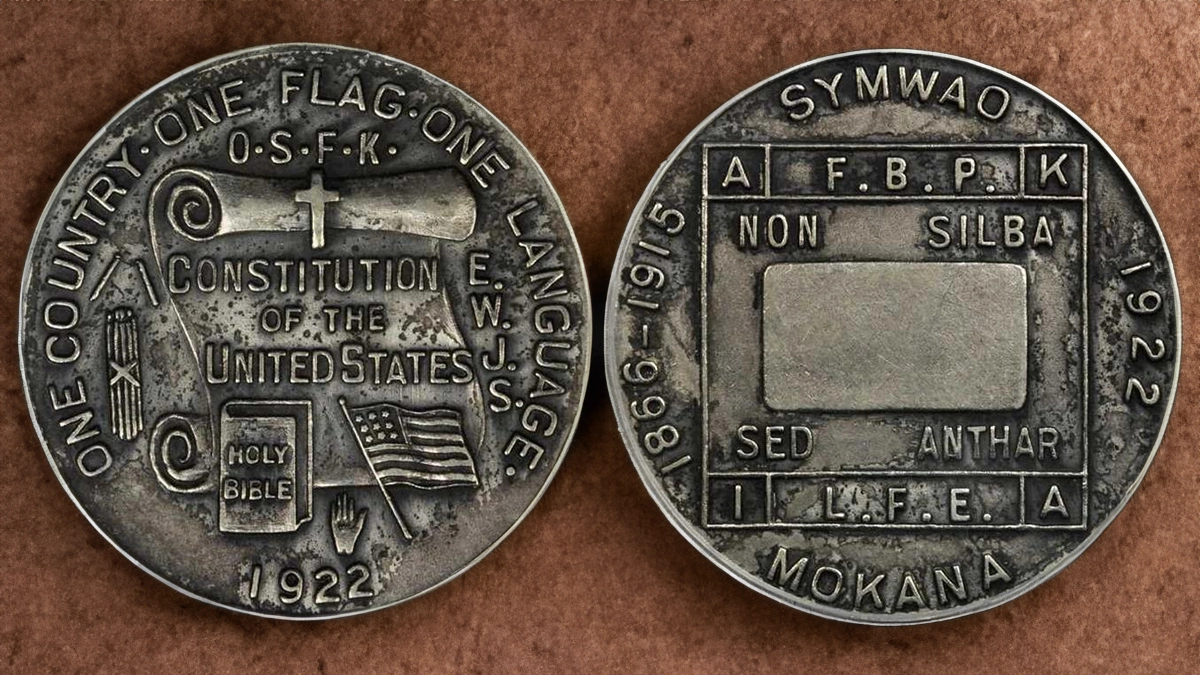
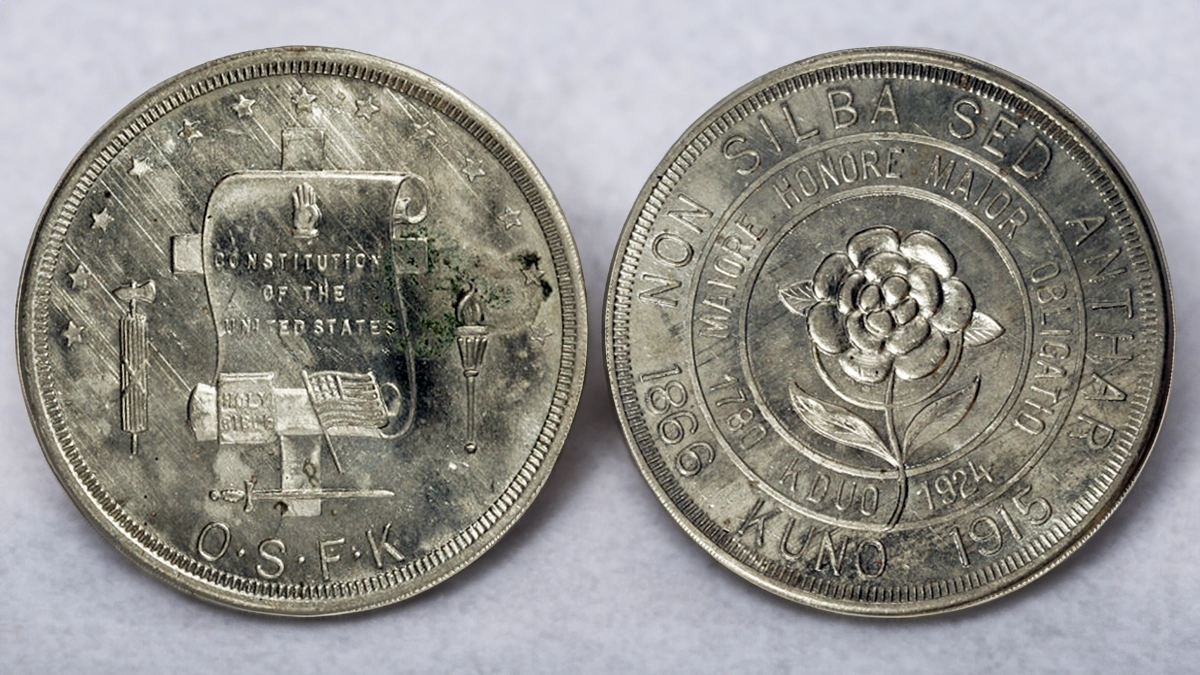
The 1910s and ’20s saw the resurgence of the Ku Klux Klan, bolstered in large part by a three-hour-long motion picture called The Birth of a Nation (1915), itself based on Thomas Dixon’s novel The Clansman (1905). The Klan depicted in D.W. Griffith’s film, however, was far removed from the resuscitated version inspired by the movie. This second Klan was larger and had national political ambitions. During the 1920s, the terrorist organization was at its peak, boasting a membership of over six million Americans. After scandals and government persecution, Klan membership shrank to under 30,000 during the 1930s. By the end of World War II, the white supremacist group’s second incarnation was no more.
The two Klan-related So-Called Dollars listed in Hibler and Kappen’s reference were produced at the height of the second Klan’s influence. Both medals feature the faux-Latin phrase “Non Silba Sed Anthar”, purported to mean “not for one’s self but for others”. The dual date “1866-1915” refers to the founding of the first and second Klans. Various symbols and acronyms clutter both sides of both pieces.
From a value judgment standpoint, there’s something detestable about entering this sector of token and medal collecting. Hibler and Kappan’s inclusion of these two pieces may be impolitic, but they do represent a real if depressing facet of American history.
First Strikes. No, Really… (HK-876 and 876a)
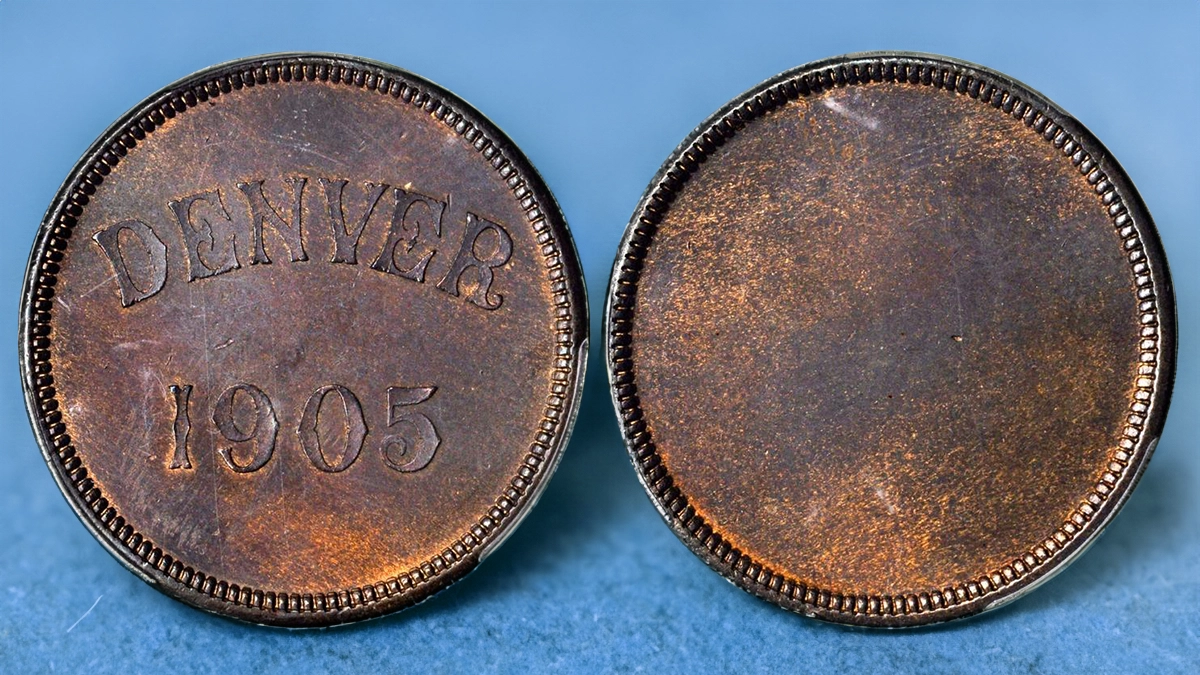
Does the story of the Denver Mint begin here?
While the term “first strike” may mean something a little different these days, these medals are purported to be the actual first pieces struck by the Denver Mint in 1905. Some sources say they were test strikes of new machinery; we wonder if they were struck on equipment used during the St. Louis World’s Fair that was earmarked for Denver. Described by Hibler and Kappen as being roughly the size of a double eagle, these sparse So-Called Dollars are intriguing and scarce collectors’ items, with true crossover appeal for numismatists that care about the production of the Denver Mint.
American Murder and Assassination (HK-765 and 766: Carter H. Harrison Memorial)
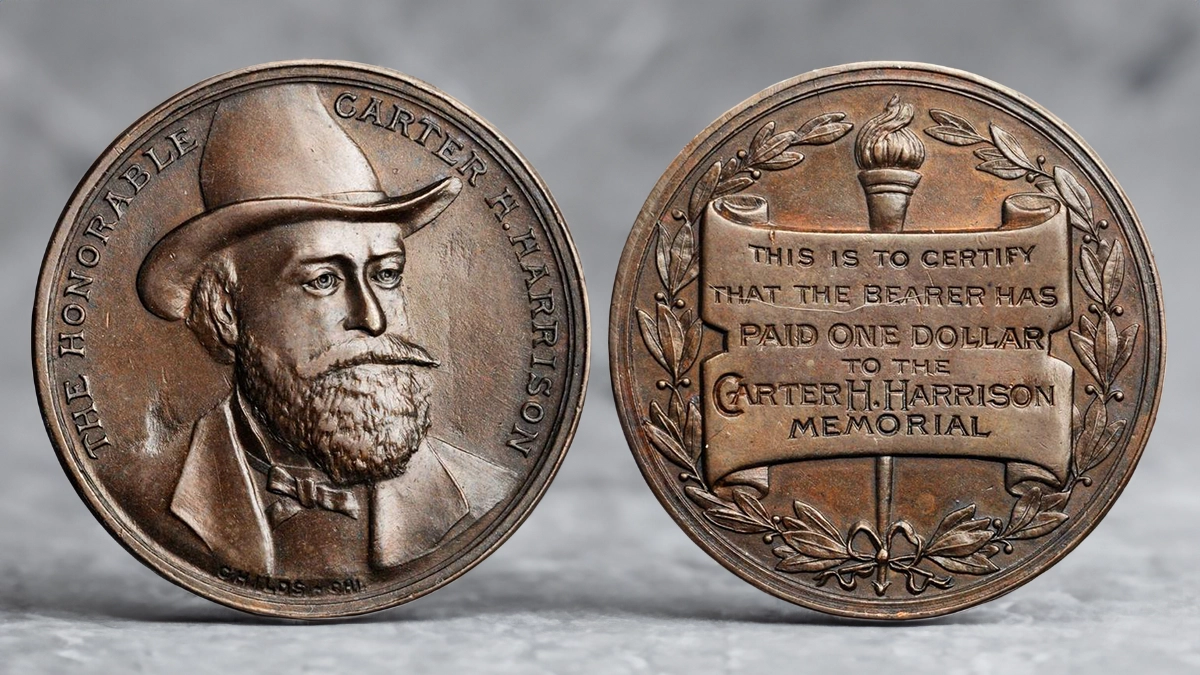
While the Columbian World’s Exposition captivated a generation of Americans and helped launch the country into the 20th century, it also ended in tragedy when Chicago Mayor Carter H. Harrison was gunned down in his home by Patrick Eugene Prendergast. The assassin had suffered from the delusion that Harrison would reward him with a patronage job for his support in the 1893 mayoral election; no such commission was forthcoming.
This So-Called Dollar could easily be coupled thematically with the Columbian World’s Exposition medals described in our first installment. Like other So-Called Dollars–and classic commemoratives, for that matter–this piece was part of a fundraising campaign. It signified that the original buyer donated one dollar towards the construction of the Carter H. Harrison Memorial.
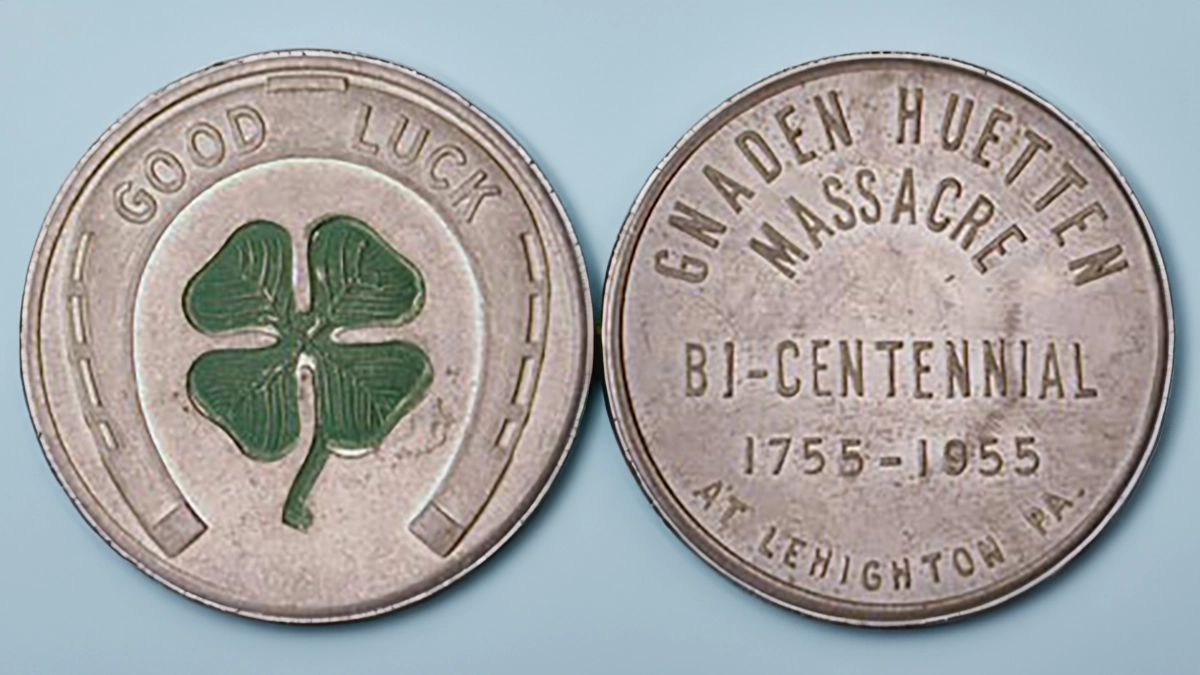
The Gnaden Huetten Massacre So-Called Dollar is strange for a few reasons.
For starters, it celebrates a massacre – quite an odd topic for a bicentennial commemoration.
Secondly, the reverse features a green-colored four-leaf clover and a horseshoe along with the inscription GOOD LUCK. Not only is it a non sequitur but it also seems mockingly disrespectful of the victims of the massacre.
Finally, there were TWO Gnaden Huetten Massacres. The one commemorated here took place on the evening of November 24, 1755, when Native American warriors, incited by the French during the French and Indian War, attacked and burned a village of Moravians. Eleven missionaries were killed, alongside Christian Munsee Lenape Indians. A second, unrelated Gnaden Huetten Massacre occurred in 1782 in Ohio, also involving the same ethnic Moravians and Munsee Lenape Indians. In that attack, 96 people were murdered.
The War Begins (HK-11 and 11e)
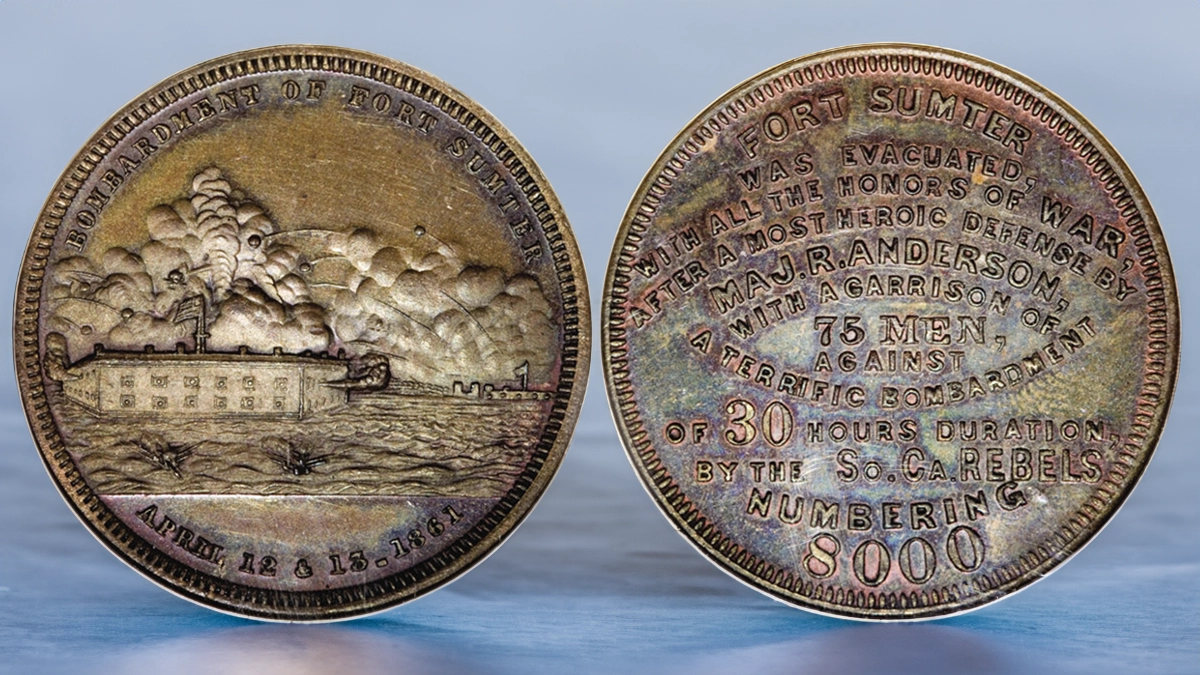
The country begins to tear itself apart.
Two months before Republican Abraham Lincoln was sworn in as the 16th president, students from the Citadel, a military college in South Carolina, fired the first shots of the Civil War at a steamship sent to resupply federally controlled Fort Sumter. A month after Lincoln’s inauguration, Col. James Chesnut, Jr. opened fire on the fort itself, taking it a day later. Charleston’s high society watched the exchange and celebrated the first Confederate victory. Little did they know that they were drinking to their ultimate ruin and the eventual loss of 850,000 American lives.
This privately-issued medal marking the beginning of the war is an important contemporaneous artifact of the North’s psychology entering into the war. The reverse inscription reads as follows:
FORT SUMTER WAS EVACUATED, WITH ALL THE HONORS OF WAR, AFTER A MOST HEROIC DEFENSE BY MAJ R. ANDERSON, WITH A GARRISON OF 75 MEN, AGAINST A TERRIFIC BOMBARDMENT OF 30 HOURS DURATION BY THE SO. CA. REBELS NUMBERING 8000.
From this, one gets a strong sense of the shock and indignation felt by northerners at the onset of war. The piece also serves as a poignant reminder that, once upon a time, America’s fate looked precarious and uncertain.
The Fort Sumter So-Called Dollar comes with two reverse die varieties (the second features a federal eagle and the inscription ONE FLAG AND ONE UNION NOW AND FOREVER) and three metal compositions for each variety. They are all quite scarce, with less than 20 of each known to survive. If we were putting together a Civil War Era set of federal issue coins and tokens, this piece would be high on our “covet” list.
* * *
Written By Charles Morgan and Hubert Walker for CoinWeek






I didn’t know the first shots of the civil war were shot before Lincoln took office.