


In 1897, the British Empire stood at its zenith. That same year, Queen Victoria marked an unprecedented milestone: 60 years on the throne. To honor the moment, the Royal Mint struck one of the most impressive commemorative medals of the Victorian era, the large 56mm Diamond Jubilee silver medal.
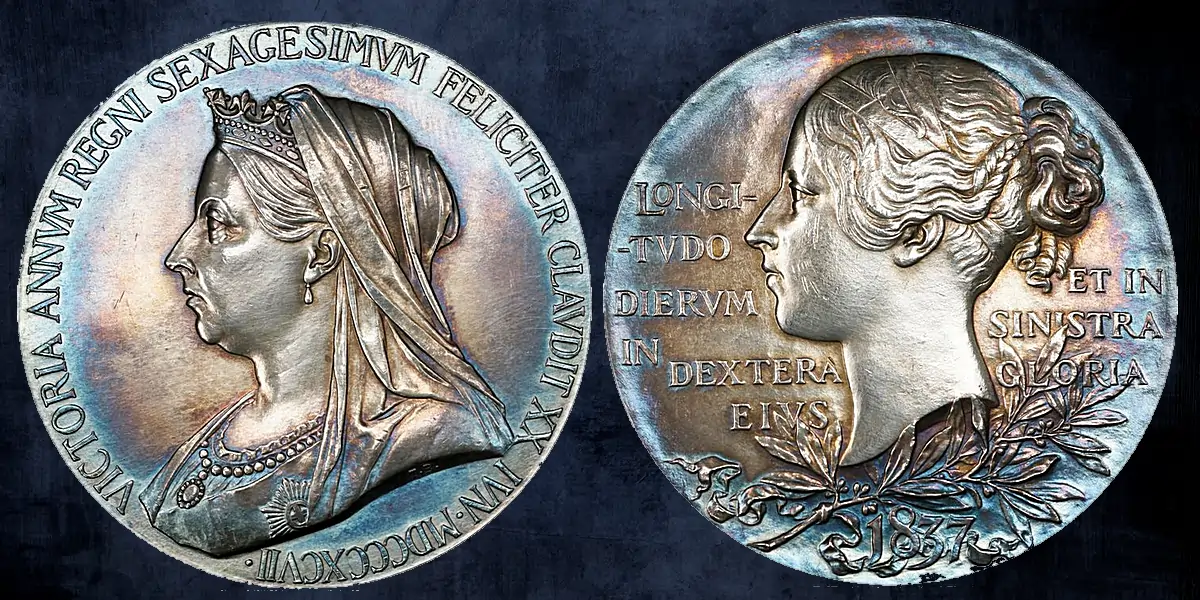
Today, the medal remains a defining relic of imperial Britain. More importantly, it tells a powerful story of monarchy, memory, and national identity.
The First Diamond Jubilee in British History
On June 20, 1897, Queen Victoria became the first British monarch to celebrate a Diamond Jubilee. She ascended the throne in 1837 at age 18. By 1897, she ruled over a vast global empire.
Therefore, the anniversary carried enormous symbolic weight. The government organized grand celebrations across London and throughout the Empire. Colonial Prime Ministers, foreign ambassadors, and military leaders attended. The Royal Mint commissioned official medals to mark the occasion.
The result was a masterpiece in Sterling Silver.
Medal Specifications: The Large 56mm Version
The 56mm medal represents the prestigious “large” format of the issue.
Specifications:
- Diameter: 56mm (approximately 2¼ inches)
- Weight: Approximately 85 grams (2.2 oz.)
- Composition: .925 Sterling Silver
- Designer/Engraver: George William de Saulles, after Sir Thomas Brock
- Mint: London Mint (Official Royal Mint issue)
- References: BHM 3506; Eimer 1817a
Collectors also recognize a smaller 26mm version struck in gold and silver. However, the 56mm medal stands as the presentation format intended for dignitaries and officials.
Obverse: The Veiled “Old Head” of Victoria
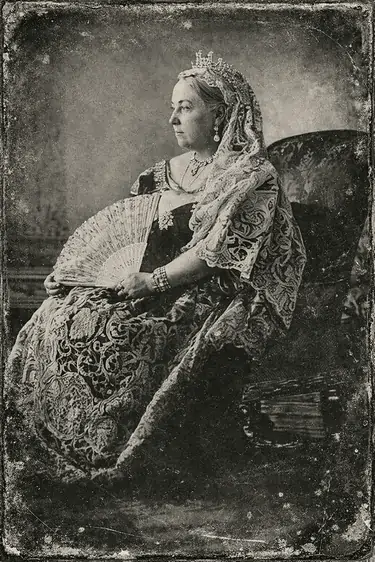
The obverse features the crowned, veiled bust of Queen Victoria facing left. Sir Thomas Brock created the portrait in 1893. George William de Saulles executed the engraving for the Royal Mint.
The Latin legend reads:
“VICTORIA ANNVM REGNI SEXAGESIMVM FELICITER CLAVDIT XX IVN. MDCCCXCVII.”
Translated, it declares:
“Victoria happily closes the sixtieth year of her reign, 20 June 1897.”
The design presents Victoria as the widowed matriarch of a global empire. She appears dignified, solemn, and enduring. In many ways, the portrait embodies stability at the height of British power.
Reverse: Youth and Glory
In contrast, the reverse features a youthful portrait of the Queen facing left. The inscription divides around the image:
“LONGITVDO DIERVM IN DEXTERA EIVS ET IN SINISTRA GLORIA.”
This translates to:
“Length of days is in her right hand, and in her left hand glory.”
Below appears the date 1837, marking her accession year, alongside a laurel branch.
The artistic contrast carries deep meaning. The young monarch of 1837 stands opposite the veiled sovereign of 1897. Together, the portraits frame six decades of transformation, from a youthful queen to the Empress of India.
Presentation and Official Use
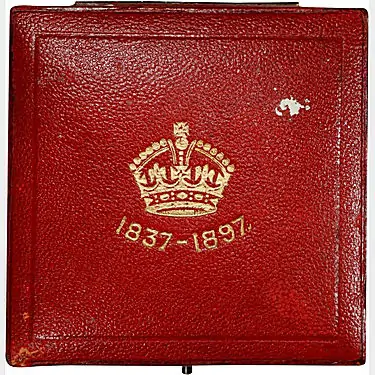 The Royal Mint produced these medals as official awards. Recipients included:
- Members of the Royal Family
- Government officials
- Foreign ambassadors
- Colonial Prime Ministers
Each medal came housed in a red leather presentation case. Furthermore, selected officers and troops from the Royal Navy, Army, and colonial contingents wore the medal on the left breast during Jubilee processions.
This fact elevates the piece beyond a commemorative object. It functioned as a visible badge of participation in a defining imperial ceremony.
The Artists Behind the Medal
George William de Saulles served as engraver for the Royal Mint. He also executed the 1893 coinage portrait of Victoria. Meanwhile, Sir Thomas Brock designed the underlying bust. Brock later achieved renown for his work on the Victoria Memorial outside Buckingham Palace.
Thus, the medal unites two important figures in British numismatic and sculptural history.
Why the 56mm Medal Matters Today
Collectors prize the large silver medal for several reasons.
First, it represents the first Diamond Jubilee in British history. Second, it stands as an official Royal Mint issue, not a private commemorative. Third, its substantial size, 56mm and roughly 85 grams of .925 Sterling Silver, gives it undeniable physical presence.
Moreover, the dual-portrait concept captures a rare narrative arc in medallic art. Few medals illustrate both the beginning and maturity of a reign with such clarity.
In short, this medal does not merely commemorate an event. It captures the passage of time itself.
Auction Information
This 1897 Queen Victoria Diamond Jubilee large silver medal (56mm, ~85g) is offered in the Collectors Choice Auction as Lot 78687 presented by Stack’s Bowers Galleries.
The sale closes on February 26, 2026.
For collectors of British medals, Royal Mint issues, and historic presentation pieces, this offering represents an exceptional opportunity to secure a tangible symbol of imperial Britain at its height.








What a beautiful coin. thanks for the info.
Beautiful
Interesting blend of old and new.
Sixty years on the throne, imagine that!