


Original Article by Aadya Bedi for the (ANS) Reformated by Coinweek……
ANS Acquires an 1880 Contemporary Counterfeit Five-Dollar Note
The American Numismatic Society (ANS) has added an 1880 contemporary counterfeit five-dollar United States Note to its collection. The acquisition is notable. The Society first reviewed this note nearly forty years ago and declined it then.
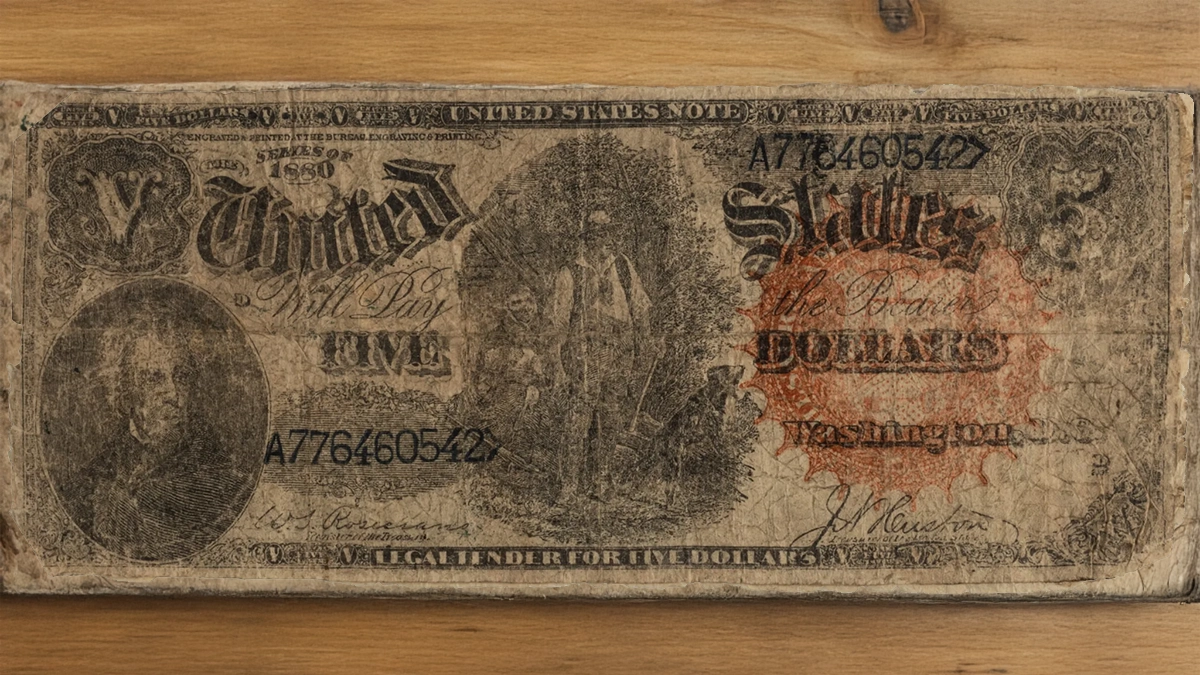
The note, now cataloged as ANS 2024.37.1, entered the collection in 2024 after a new examination revealed it was counterfeit and had an unusually well-documented history.
An Unlikely Artifact in the Trinity Church Archives
The counterfeit note came from the Trinity Church Archives. The archives preserve records documenting the history of Trinity Church and its parishioners. Located at the head of Wall Street, Trinity Church has played an important political and social role in New York City for more than three centuries.
The collection includes baptismal, marriage, confirmation, and burial records dating back to 1749. Alexander Hamilton is among the notable figures buried in the churchyard. Genealogical material makes up most of the archive. For that reason, the presence of a counterfeit five-dollar bill stands out.
A 1986 Inquiry, and a Missed Identification
In February 1986, Trinity parish Archivist and Curator Phyllis Barr contacted the ANS. She wrote to Richard Doty, then Curator of Modern Coins and Paper Money. Barr enclosed a black-and-white Xerox copy of a five-dollar bill she had found in the archives.
Barr described the note as being in “fragile condition.” She added that it appeared to be “splitting in two as if it were in two layers.” She asked whether the note had any monetary value.

Doty replied that the bill was not worth much because of its poor condition. Based on the surviving correspondence, the black-and-white photocopy likely prevented a proper identification. Doty did not recognize the note as a contemporary counterfeit at that time.
Reexamination and Donation in the 2020s
Nearly four decades later, Marissa Maggs, Director of Trinity Church Archives, offered the note and the 1986 correspondence to the ANS as a donation.
Upon examination, Dr. Jesse Kraft, Resolute Americana Assistant Curator of American Numismatics, identified the bill immediately as a circulating counterfeit. The Society added the note to its reference collection of forgeries, fakes, and counterfeits, often referred to as the “black trays.” Items with clear historical context hold particular research value within this collection.
Physical Construction and Visual Clues
Collectors often refer to this type of counterfeit as a “woodchopper.” The engraving quality is poor. The portrait of Andrew Jackson at left appears crude. The central vignette of a pioneer family, man, woman, baby, and dog, is present but barely defined.

Barr’s original description from 1986 proved accurate. The counterfeit consists of two separately engraved sheets adhered together. This construction explains the layered appearance and the tendency to split.
The motive for this method cannot be confirmed. However, the added thickness may have helped imitate the weight and feel of a genuine note.
The obverse design provides the clearest evidence of counterfeiting. Aside from the red seal and blue serial numbers, the note lacks tonal variation. It appears almost entirely black and white. Genuine notes display subtle grayscale effects produced by advanced engraving techniques. The counterfeit does not. This difference reflects the simpler printing methods used by counterfeiters.
Historical Background of the Five-Dollar United States Note
The Bureau of Engraving and Printing first issued United States Notes in 1862. These Legal Tender Notes remained in production until 1971. As a result, they represent the longest-running form of U.S. paper money.
In 1869, the five-dollar denomination adopted a new design. It featured Andrew Jackson’s portrait at left and a pioneer family vignette at center. The series changed again in 1875. That redesign introduced the reverse seen on the ANS counterfeit example.
A Warning Against the Crime It Represents
The reverse includes a forceful legal warning. It threatens fines of up to $5,000, imprisonment of up to fifteen years at hard labor, or both for counterfeiting-related offenses.
The warning targeted organized counterfeiters, often called “coneymen.” These groups operated across specific regions of the United States during the nineteenth century.
Enforcement, Circulation, and Final Preservation
The United States established the Secret Service in 1865 to combat counterfeiting. The agency did not assume responsibility for presidential protection until after the assassination of President William McKinley in 1901.
Despite these efforts, this counterfeit five-dollar note circulated successfully for some time. The exact circumstances remain undocumented. It is possible the note entered Trinity Church through a Sunday collection. It may also have arrived as a holiday donation, such as a Christmas or Easter gift. Given the note’s purchasing power at the time, either scenario would have involved a meaningful sum.
What is certain is its long archival life. The note remained at Trinity Church for nearly a century. It now resides permanently in the ANS collection, where scholars can study it as part of the broader history of American paper money and counterfeiting.
* * *
* * *







It seems a church trustee recognized the counterfeit and took it out of circulation.
I agree, it seems like someone knew all along that it was counterfeit which is why it was never spent during its time.
I bet those “black trays” have many stories to tell of human cons.