


United States pattern coins represent ideas that never reached circulation. They show what the U.S. Mint considered, tested, and ultimately rejected. For collectors, that makes them both intellectually compelling and genuinely rare.
Pattern coinage rewards patience and strategy. It does not reward shortcuts. As a result, this field continues to attract advanced collectors who value history, scarcity, and long-term perspective.
The Origins of U.S. Pattern Coinage
The United States Mint struck its first pattern coins in 1792. That year produced six pattern types, representing thirteen distinct varieties. These included the Silver Center Cent, the Birch Cent in two forms, the Half Disme, the Disme, and the Eagle on Globe Quarter Dollar.
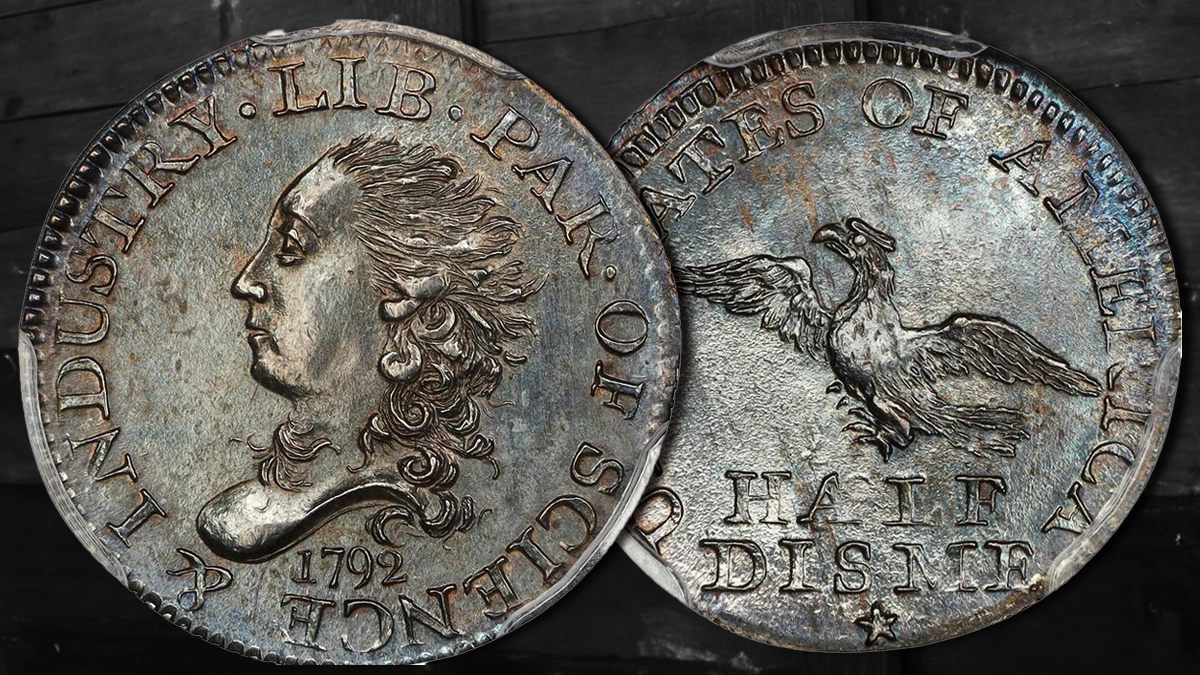
These early pieces remain among the most significant coins in American numismatics. Evidence indicates the 1792 Half Disme likely entered circulation. Even so, standard references continue to classify it as a pattern issue. Approximately 1,500 to 2,000 examples were struck, making it the most available of the 1792-dated patterns.
The remaining issues from that year are all extremely rare and appear on the market only infrequently. Collectors across multiple specialties pursue them due to their strong crossover appeal within Early American coinage.
From that starting point, the Mint continued producing pattern coins almost continuously for more than 225 years.
What Makes a Coin a Pattern
Pattern coins are experimental by definition. The Mint struck them to test new designs, denominations, or metal compositions. In many cases, these coins represent alternatives that never advanced beyond the experimental stage.
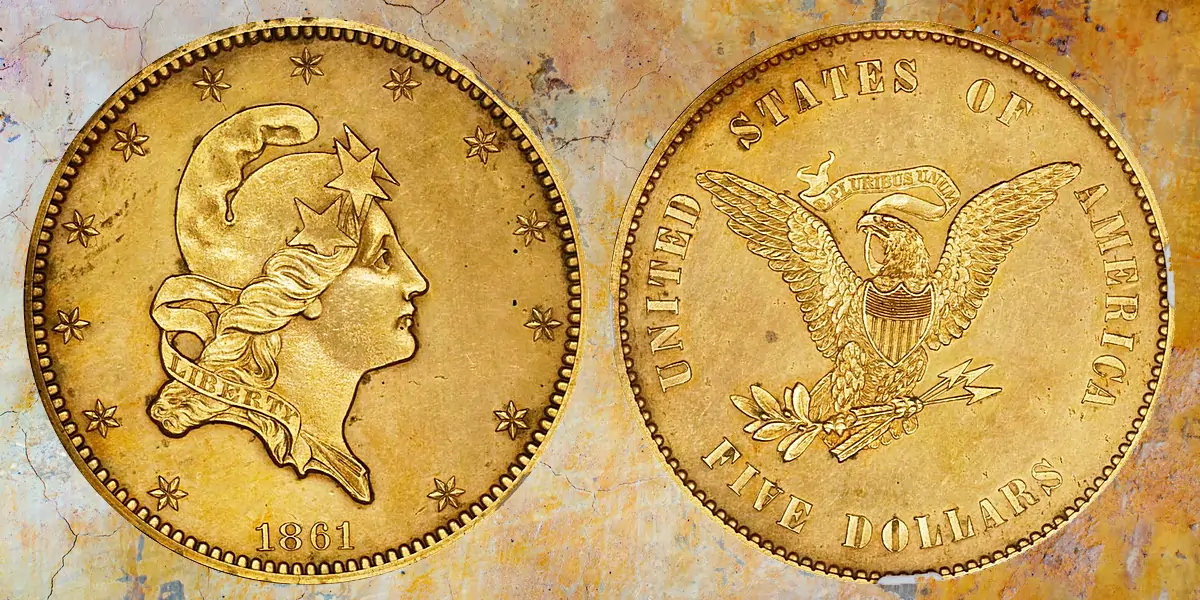
As a group, U.S. patterns reflect both technical experimentation and the artistic sensibilities of their time. They also include some of the rarest and most historically important coins ever produced by the United States.
Collectors should understand one fundamental reality early on. A complete collection of U.S. pattern coins is impossible. Approximately 1,500 distinct patterns exist when major types and varieties are included. Several unique examples remain permanently housed in museum collections.
Iconic Pattern Coins Held by Museums
The Smithsonian Institution preserves several of the most famous U.S. pattern coins in its National Numismatic Collection. These include the 1849 Double Eagle, the first double eagle struck from gold mined in California. Many numismatists regard it as the greatest United States coin ever produced. This assessment reflects long-standing scholarly opinion rather than any official designation.

The Smithsonian also holds both varieties of the 1877 Fifty Dollar Gold pattern. The U.S. Mint reacquired these coins in the early twentieth century through a trade involving a trunk filled with pattern coins. No surviving records document the trunk’s contents. Scholars have suggested it may have included a substantial portion of the patterns now available to collectors, though this remains an informed assumption.
Another notable museum piece is the 1906 Barber Double Eagle. This coin represents Chief Engraver Charles Barber’s response to the complex double eagle design proposed by Augustus Saint-Gaudens.
Strategy One: Start with a Single Standout Coin
Many collectors begin their pattern journey with one exceptional example. This approach emphasizes quality over quantity and allows collectors to study the series without overextending.

Certain designs have remained consistently popular. These include the 1872 “Amazonian” coinage, produced from quarter dollar through double eagle, the 1879 “School Girl” Silver Dollar, the 1876 “Sailor Head” Dollar, and the 1882 “Earring Silver” Dollar.
Even a single pattern coin adds depth and historical perspective to a collection.
Strategy Two: Add Patterns to an Existing Series
Nearly every classic U.S. coin series was preceded by experimental issues, often called transitional patterns. Collectors of Indian Head Cents, for example, frequently pursue 1858 pattern cents. These coins are far rarer than the regular issues that followed, yet prices often remain relatively approachable.
Auction results continue to reinforce the importance of these transitional pieces.
Strategy Three: Collect by Design
Some pattern designs appeared across multiple years and in many varieties. The “Standard Silver” issues of the 1860s and 1870s represent one of the best-known examples.

Collectors who pursue a design-based strategy should expect a long-term challenge. Completing even a partial set requires patience and sustained effort.
Strategy Four: Focus on a Single Denomination
Denomination-based collecting provides structure without overwhelming scope. Two-cent and three-cent pattern coins remain especially popular for this reason. Another approach involves acquiring one significant pattern from each denomination, ranging from half cents through double eagles.
Strategy Five: Explore Metal Experiments
The Mint struck pattern coins in a wide range of metals. These include copper, nickel, silver, aluminum, white metal, and gold. Gold patterns are extremely rare.

Aluminum patterns, particularly those struck in 1868 and 1869, appear in greater numbers and span many denominations, making them accessible entry points for collectors.
Strategy Six: Add Die Trials
Die trials pair familiar designs with unexpected metals. They allow collectors to explore Mint experimentation without competing for the most famous pattern issues. Hundreds exist, offering flexibility and variety within the series.
Strategy Seven: Collect by Historical Era
Patterns struck during the Civil War period attract sustained collector interest. These coins are uniformly rare and historically significant. Many date from the period when the Mint experimented with adding the “In God We Trust” motto to U.S. coinage.
Strategy Eight: Focus on Mainstream Pattern Issues
Some pattern coins have long occupied a place in mainstream collecting. These include the 1856 Flying Eagle Cent, Gobrecht Silver Dollars, and Four Dollar Stellas. Standard references list these coins, and collector demand has remained strong for generations.

Why Pattern Coins Represent True Rarity
U.S. pattern coinage meets every accepted definition of true rarity. Large hoards do not exist. Supply remains fixed. Condition does not determine desirability. Set registry competition does not distort demand.
Collectors and dealers alike consistently note the excitement of encountering a pattern coin, regardless of grade.
Transparency and Value in Today’s Market
Modern collectors benefit from unprecedented access to information. Population reports and auction records now appear readily online. As a result, research and valuation have become significantly more accessible.
Many pattern coins trade at prices comparable to regular-issue Proof coins from the same year. In most cases, the pattern coins are far rarer. From a relative-value standpoint, they continue to merit close attention.
Collectors seeking a meaningful challenge should examine U.S. pattern coinage carefully. Sound advice and patience remain essential. The rewards justify the effort.







Great info thanks
Those are some very pretty coin patterns.
So many coins to collect, so little time (and money).
Thank you for the wonderful history lesson!
I have always had a thing for 1800s coins; I prefer their historical value.
Too bad the we don’t make quality coinage like we used to. The mint just puts out a bunch of crap now. Mostly political.
I have to agree. Zero imagination!!
Such amazing coins.
Great article, too bad some of those designs weren’t used and not having the same obverse design on three silver denominations.
That’s a lot of strategies to study. That excellent hints and tips thank you!
So many strategies to learn. I Have so much more to studying to do!
Interesting. Curious how these experimental couns ever escape the mint. I eould have assumed that they should always remain tge property of the mint.
The older designs were something to behold. Beautiful coins
Hard to believe all these patterns have survived
Hard to believe that all these patterns survived
Was not aware of this type of coin
Some really cool coins
I love these in all their uniqueness!
Thanks for the informative article! i have my eyes on the 1877 Fifty Dollar Gold pattern.
Those coins are all so rare and beautiful.
Very interesting ‘what if’ cases. The history of the birth of a coin its one of the elements making this hobby fascinating. Beautiful examples all!
All are beautiful!
Wow what a coin. I need one.
Truly coinage of the time,amazing tone.
Well designed and beautiful, as coins go, superb astetic?
Anyone who has or owns, just one coin, would be well
Beyond life time goal?
Beautiful coins!
Coins I’ll never see or own in my lifetime.
What amazing coins! Thanks for the article!!
I’ve always loved Patterns. I think the US Mint should get rid of the Walker design (really stale) for the silver eagle and replace it with the “Amazonian” design! When I become the ruler of this planet – that’s what I will do!!
Great info, If I were a rich man I could afford some of these coins, But I would still have to find them.
Such beautiful and iconic designs that we unfortunately don’t get to see anymore in the modern age of US coins. Love the elegant and classic designs
What each of these coins have in common is the way their designed. Unfortunately in the modern age of US coins these elegant and majestic designs are long gone.
Beautiful coins! Thanks for sharing!
Very interesting article
Learned something new – pattern coins – thanks
Learned something new – makes coin collecting fascinating
Those are some beautiful examples!
Great article! I really enjoyed learning something new.
Great looking coins
Miss Liberty’s freedom cap on the 1861 half eagle pattern is of a style never adopted by the Mint. The stars on her forehead and liberty ribbon streaming downward toward her shoulder are both aesthetically pleasing and distinctive. With such a beautiful design, I wonder why the Mint stuck so long with the rather plain Coronet design on American gold coinage.
I want one. Good luck on the coin giveaway!
A lot of helpful information! Thanks
Beautiful coins that anyone would appreciate in their collection
Great article — I’ve always been attracted to “what-ifs” and the history of U.S., as well as world pattern coins.
Very intricate design
Great info. I have nev er heard of pattern coins before.
Love the pre-civil war eagles on so many of the coins. They tried to make them varied and interesting.
Excellent article! tons of great information.
I really like Miss Liberty’s freedom cap on the 1861 half eagle.
I have to be truthful about this article. I really like what was presented about the pattern coins, but I don’t think I will ever have one in my collection. I would like to though. They are beautiful coins that I believe will remain just out of my reach.
Thanks.
This is my first week on this site and I find it very interesting. I found quite a bit of information. I’m new to collecting coins. Mostly Morgan and Dove dollars, Franklin and Kennedy Half dollars. i don’t think I have much to offer in the way of advice but I’m looking forward to learning much in the future. Thank You for providing so much information . Looking forward to next week.
Sincerely,
These coins are so cool looking Thanks